Ranger Was Found Alone in a House That No Longer Felt Like a Home
Ranger, a 6-year-old Shepherd mix, came into the shelter after animal control was called to a vacant house where neighbors had repeatedly seen a dog moving inside.
The family who had previously lived there had already moved away.
By the time officers entered the property, the house was largely empty.
There was no normal household activity.
No furniture arrangement that suggested anyone was still living there.
No person came to the door.
Ranger was inside.
We could confirm that he had been living there alone when animal control found him. We could also confirm that the former occupants had moved.
What we could not responsibly say was exactly how the situation had unfolded.
We did not know whether someone had planned to return for him.
We did not know how long he had been without regular human contact.
We did not know every detail of what care he had received before the move.
Those unknowns mattered.
It would have been easy to tell a harsher story than the facts supported.
We did not need to.
Ranger's behavior at intake already showed how difficult the transition had been for him.
He Did Not Fight the Officers
When animal control entered, Ranger did not charge or bark continuously.
He retreated.
He moved as far from the doorway as the room allowed and kept his body low.
His ears stayed back.
His weight shifted away from people.
When an officer turned sideways and tossed several small pieces of food onto the floor, Ranger watched but did not immediately approach.
Nobody advanced straight toward him.
Nobody tried to corner him quickly.
The officers allowed him time.
Eventually, Ranger sniffed one of the treats.
Then another.
A slip lead was introduced slowly.
The capture was uneventful in the sense that nobody was bitten and no forceful restraint was required.
Emotionally, however, Ranger arrived at the shelter carrying a very obvious problem.
He wanted distance.
The First Veterinary Examination Had to Respect That Fear
Ranger received a complete intake examination, but the team modified the process around his stress level.
A fearful dog does not become more cooperative simply because people insist on finishing every procedure immediately.
Caregivers used quiet voices.
They avoided crowding him.
Food was offered.
Handling was broken into manageable steps.
When a procedure required more contact than Ranger could tolerate comfortably, staff prioritized safety and low-stress restraint rather than physically overpowering him.
His examination did not reveal a medical crisis.
He was somewhat underconditioned, but not severely emaciated.
His hydration was acceptable.
His heart and lungs sounded normal.
His abdomen was soft.
There was no obvious acute orthopedic injury.
His skin and coat needed routine care, but there were no major wounds.
Baseline bloodwork was appropriate because his recent history was incomplete.
The results did not show a significant systemic problem.
Medically, Ranger was stable.
Behaviorally, he was not ready to act like a typical adoptable dog.
The Back Corner Became His Default Position
Ranger was moved into a quiet kennel with a covered resting area.
The first time a caregiver opened the door, he stepped backward.
The second time, he did the same thing.
By the end of the first day, staff understood his pattern.
When a person approached, Ranger moved to the back.
If the person came closer, he pressed himself against the corner.
He did not lunge.
He did not snap.
He did not make dramatic attempts to escape.
He simply tried to create as much distance as possible.
That behavior continued for days.
Then weeks.
Ranger would eat once the hallway became quieter.
He would drink.
He would go outside with familiar staff using careful routines.
But the appearance of an unfamiliar person near the kennel still sent him backward.
We Did Not Pull Him Forward to Make Him Social
There is a strong temptation in shelter settings to "show" a shy dog to visitors.
Bring him to the front.
Put a leash on him.
Ask strangers to offer treats.
Encourage touching.
For Ranger, that would have been the wrong approach.
His fear was not going to improve through repeated flooding.
Instead, staff worked on predictability.
The same caregivers visited him when possible.
They entered sideways rather than facing him directly.
They sat down.
They tossed treats rather than reaching for his face.
They allowed him to decide whether to move closer.
If he stayed in the back corner, the session could still be successful.
Success might simply mean that Ranger ate while a person sat six feet away.
His First Progress Was Almost Invisible
During the first week, Ranger would not eat with an unfamiliar person standing near the kennel.
Then one afternoon, he took a treat after a familiar caregiver sat outside the door.
A few days later, he took another while the kennel remained open.
He still stayed at the back.
But his body was less rigid.
Later, he began shifting his weight forward before retreating.
Then he started sniffing the air when someone approached instead of immediately turning his head away.
Small changes.
None made a dramatic video.
All mattered.
Outside, He Was Slightly Different
Ranger's behavior in the exercise yard gave staff useful information.
In the kennel, he appeared trapped by the closeness of people.
Outside, with more space, he was cautious but less shut down.
He stayed near the perimeter.
He sniffed.
He avoided direct approaches.
But he could walk.
He could investigate.
If a familiar caregiver sat quietly, Ranger sometimes moved several feet closer.
That told us the kennel itself was part of the challenge.
A small enclosed space can make fearful dogs feel that they have fewer options.
Ranger needed environments where he could retreat safely and then choose to return.
He Began Recognizing Specific People
By the second week, Ranger had a short list of caregivers he clearly knew.
He did not greet them enthusiastically.
That was not the goal.
But he stopped flattening himself every time they appeared.
One caregiver could enter, place food down, and remain nearby while Ranger ate.
Another could clip on his leash with only mild hesitation.
Ranger began walking toward the kennel door when he recognized the sound of his regular morning routine.
With strangers, however, the old pattern remained.
Back corner.
Low posture.
Avoidance.
That meant adoption would require someone willing to meet him differently.
We Were Careful About How He Was Presented to Visitors
Ranger's kennel card did not describe him as "unfriendly."
That would have been misleading.
It also did not call him a "sweet boy who just needs love."
That would have simplified the work ahead.
Instead, staff explained that he was fearful around unfamiliar people and needed a low-pressure introduction.
Visitors were asked not to put their hands through the kennel immediately.
They were asked not to stare at him.
They were asked to let him approach if he chose.
Many people understood.
Some still moved on quickly.
That was okay.
Ranger did not need every visitor to choose him.
He needed the right one.
Weeks Passed Without a Dramatic Breakthrough
Other dogs came to the front of their kennels.
Some barked.
Some wagged.
Some pressed their bodies against the door for attention.
Ranger stayed in the back.
His behavior improved with staff, but strangers rarely saw that side of him.
Adoption traffic tends to reward visibility.
Dogs who come forward are easier to notice.
Ranger's fear made him almost disappear in plain sight.
People would glance into his kennel, see a dog against the back wall, and keep walking.
We did not blame them.
Most visitors do not arrive expecting to spend an hour waiting for one dog to decide whether to move.
Then one afternoon, a mother and her young son came through the adoption area.
The Boy Did Not Walk Toward the Loudest Kennels
They moved slowly through the row.
Several dogs barked excitedly.
One jumped at the kennel door.
Another carried a toy.
The boy watched them.
Then he stopped in front of Ranger.
Ranger did what he usually did.
He moved backward.
His body settled into the far corner.
The mother looked at the kennel card.
A staff member began explaining that Ranger was very shy and that he usually needed time.
The boy did not ask Ranger to come closer.
He did not call his name repeatedly.
He did not tap the glass.
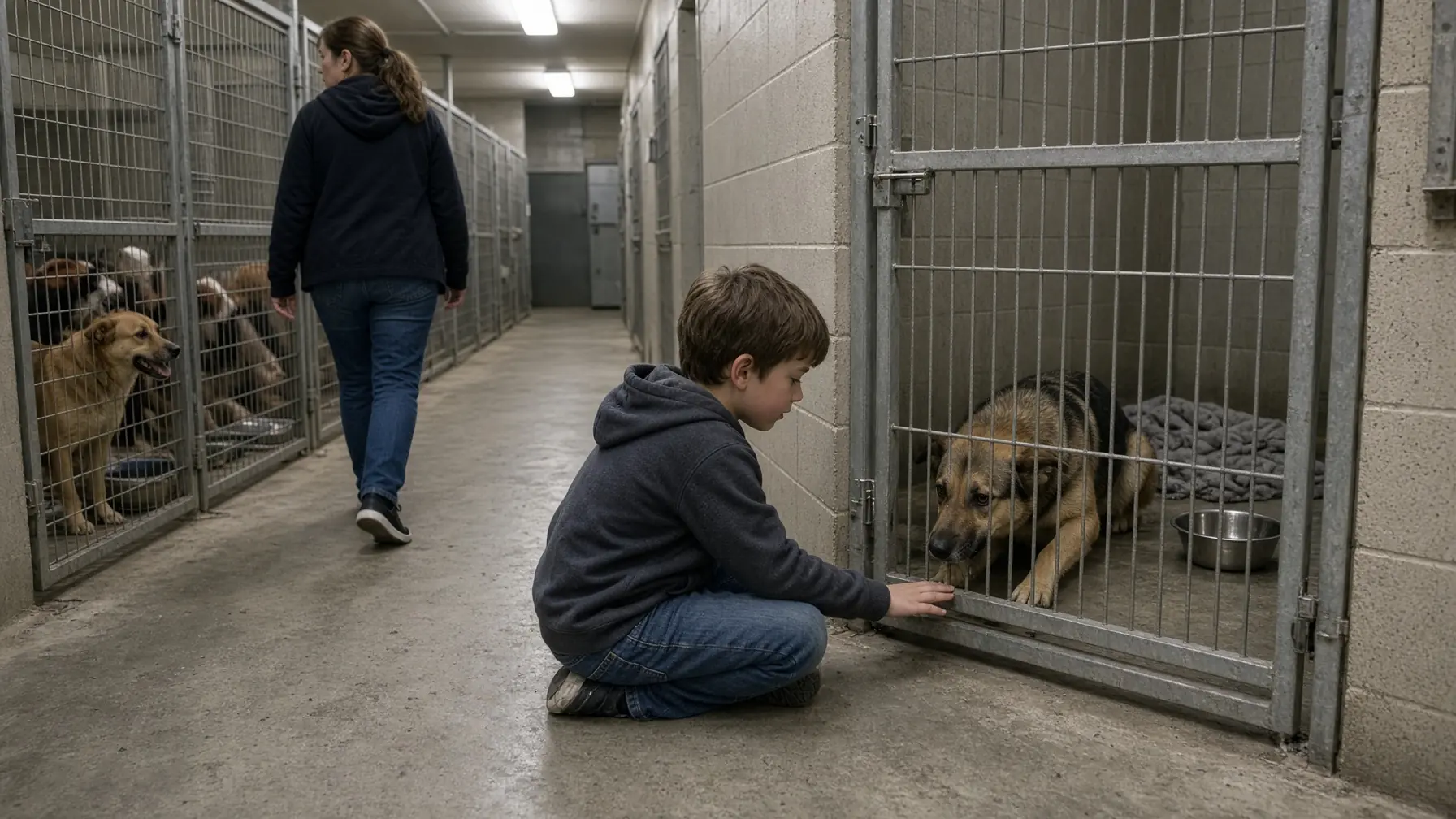
He sat down.
At First, Nothing Happened
The boy sat several feet from the kennel door.
His mother remained nearby.
A staff member explained that Ranger might not approach.
The boy stayed where he was.
Ranger watched.
Minutes passed.
Other dogs barked in the hallway.
People walked by.
Ranger remained in the corner.
The boy did not stand up.
He did not try to lure him with exaggerated gestures.
Eventually, a staff member gave him a few small treats.
The boy slid one through the lower opening and left his hand outside.
Ranger looked at it.
No movement.
Another minute passed.
Then Ranger stretched his neck forward.
The First Step Was So Small Almost Nobody Noticed
Ranger did not walk confidently to the door.
He shifted one front paw.
Then another.
He lowered his body.
He moved forward only a few inches.
Then stopped.
The boy stayed still.
Ranger retreated slightly.
The boy waited.
A few minutes later, Ranger tried again.
This time he moved farther.
His belly remained low to the kennel floor.
His ears were back.
His body language still showed fear.
But he was moving by choice.
Nobody reached toward him.
Ranger Reached the Front Without Being Called
Eventually, Ranger crossed most of the kennel.
He paused within a foot of the door.
The boy's fingers rested quietly through the lower gap.
Ranger sniffed.
He leaned forward.
His nose touched the tips of the boy's fingers.
That was all.
No instant cuddle.
No tail-thumping celebration.
No dramatic transformation.
Ranger touched his nose to a child's hand and then pulled back.
For a dog who had spent weeks pressing himself into the back corner when unfamiliar people approached, that was enough.
The Boy Did Not Try to Pet Him
This part mattered.
The natural reaction after a fearful dog finally approaches is to reach farther.
The boy did not.
He kept his hand where it was.
Ranger came forward again.
This time he sniffed longer.
His body remained low, but he did not immediately retreat.
A staff member quietly explained that Ranger was making a very big choice.
The boy nodded.
Then he waited again.
His Mother Asked the Right Questions
The family did not immediately say they wanted to take Ranger home that day.
That would not have been responsible.
Instead, the mother asked about his behavior.
How did he do outside the kennel?
How long had he been there?
Was he comfortable with children?
Did he have a bite history?
How did he respond to men?
What happened when he was left alone?
What kind of home would help him?
Those questions mattered more than enthusiasm.
Ranger had not shown aggression toward children, but one calm interaction did not prove that every child or every situation would be appropriate.
The family would need additional meetings.
Any child in the home would need to understand boundaries.
Ranger needed space.
A Second Visit Looked Different
The family returned.
This time, Ranger recognized something.
Perhaps the boy's voice.
Perhaps his smell.
Perhaps the overall routine.
We cannot know.
But Ranger did not immediately press himself fully into the back corner.
He retreated several steps.
Then stopped.
The boy sat down again.
This time, Ranger approached sooner.
He did not crawl all the way.
He walked part of the distance with his body low.
When he reached the kennel door, he sniffed the boy's fingers.
Then he stayed.
The First Meeting Outside the Kennel Was Carefully Managed
Staff eventually arranged a controlled meeting in a quiet interaction room.
Ranger entered on leash with a familiar caregiver.
The boy and his mother were already seated.
Nobody stood over him.
Nobody called him repeatedly.
Ranger walked the perimeter first.
He sniffed the corners.
He checked the door.
Then he noticed the boy.
His body slowed.
The boy placed a treat on the floor rather than holding it directly in front of Ranger's face.
Ranger approached.
He ate.
Then stepped away.
The entire session continued like that.
Approach.
Retreat.
Sniff.
Pause.
No one forced contact.
Ranger Chose to Lie Down Near Them
Near the end of the visit, Ranger moved to one side of the room.
He circled once.
Then lay down.
He was not touching anyone.
He was several feet away.
But he had chosen to remain in the open rather than hiding behind the chair or pressing against the wall.
That was another useful sign.
The family understood that this was the dog they were considering.
Not a future version of him who would necessarily become outgoing.
Ranger might always prefer quiet introductions.
He might always need strangers to give him time.
Adoption had to be based on the dog he was, not the dog people hoped he would become.
Medical Care Continued While Behavior Improved
Ranger's medical needs were relatively straightforward compared with his behavioral recovery.
His weight improved gradually with regular meals.
Routine preventive care was updated.
Dental evaluation showed mild disease appropriate for future monitoring, but there was no urgent oral problem.
His follow-up physical examination remained reassuring.
The more important changes appeared in posture and routine.
He slept on his side more often.
He began spending less time in the farthest corner.
He greeted familiar caregivers by moving toward them instead of away.
He started taking treats from several staff members.
Still cautious.
Still Ranger.
Just less afraid.
The Family Was Asked to Visit Again
One good meeting is not enough for a fearful dog.
The family came back multiple times.
The boy never rushed the process.
Sometimes Ranger approached quickly.
Sometimes he did not.
One visit was harder because the shelter was unusually loud.
Ranger stayed near the wall for much of the session.
The family did not treat that as a setback that had to be fixed immediately.
They sat.
They talked quietly.
They left without forcing a better ending.
That response gave staff confidence in them.
A Home Visit Focused on Environment, Not Perfection
Before placement, the rescue reviewed the home setup.
Ranger would need a quiet transition space.
He should not be given unrestricted access to the entire house immediately.
Visitors would need rules.
The boy understood that Ranger's crate or bed would be off-limits when he chose to retreat.
No hugging.
No climbing on him.
No taking food or toys away by hand.
No reaching into his resting area.
The family also understood that Ranger needed adult supervision around children, even though the boy had interacted with him appropriately.
Respectful behavior lowers risk.
It does not eliminate the need for responsible management.
Foster-to-Adopt Was the Safer Choice
Rather than finalizing the adoption immediately, Ranger entered a foster-to-adopt period with the family.
That allowed everyone to evaluate the match in a real home.
His first day was quiet.
Ranger entered the prepared room.
He sniffed.
He found the bed.
He found the water.
Then he chose the corner farthest from the doorway.
Nobody tried to pull him out.
The boy sat outside the room for a while and read quietly.
Ranger watched.
That was enough.
The First Night Was Not Easy
Ranger did not immediately relax just because he was out of the shelter.
New homes contain unfamiliar sounds.
Plumbing.
Appliances.
Footsteps.
Doors.
Cars outside.
Ranger woke often.
He changed positions.
At one point, he stood and stared toward the hallway for several minutes.
The family did not bring him into the boy's bed or try to soothe him through constant touching.
They kept the environment calm.
By morning, Ranger had slept several short stretches.
The transition had begun.
Breakfast Showed the First Sign That the Routine Could Work
Ranger's food was placed in the same location it had been the night before.
He waited until the family stepped away.
Then he ate.
The next morning, he began eating while the mother remained in the room.
A few days later, he ate while the boy sat quietly several feet away.
That was how trust developed.
Not through one heroic moment.
Through repetition.
He Began Following the Boy Without Being Asked
The boy continued doing something remarkably helpful.
He ignored Ranger when Ranger wanted to be ignored.
He did not make every room entry into an interaction.
That gave Ranger freedom to observe without pressure.
Within the first week, Ranger began following him at a distance.
The boy would walk from the living room to the kitchen.
Several seconds later, Ranger appeared in the doorway.
If the boy turned toward him too quickly, Ranger sometimes backed up.
So the boy learned to keep moving naturally.
Soon, Ranger followed more often.
Ranger Chose the Couch Area Before He Chose the Couch
For several days, Ranger would not lie close to the family.
His bed remained in a quiet corner.
Then he began sleeping on the rug several feet from the couch.
Later, he chose the space beside the couch.
One evening, the boy sat watching television.
Ranger walked over.
He sniffed the boy's hand.
Then he lay down on the floor beside his feet.
The boy did not reach for him.
Ranger stayed for nearly an hour.
Touch Came After Proximity
Ranger's first voluntary physical contact at home was small.
He approached the boy while the boy was sitting on the floor.
He sniffed his shoulder.
Then he stepped sideways until part of his body touched the boy's knee.
The boy remained still.
Ranger stayed.
Only after Ranger lingered did the boy gently scratch the side of his chest.
Ranger did not move away.
That interaction was more meaningful than forcing affection earlier would have been.
Ranger had control.
Strangers Were Still Hard
A week into the foster period, a relative visited.
Ranger immediately returned to old behavior.
He moved to the back of his safe room.
His body lowered.
The family followed the plan.
The visitor did not enter his space.
No introduction was forced.
Ranger remained away for most of the visit.
That did not mean the placement was failing.
It meant Ranger was still a fearful dog.
The family accepted that.
His World Expanded Room by Room
Once Ranger was comfortable in his transition space, access to the house expanded gradually.
He learned the living room.
Then the kitchen.
Then the hallway.
The family used baby gates where needed rather than overwhelming him with too much space at once.
Ranger began developing favorite spots.
A rug near the sliding door.
The corner beside the couch.
A patch of morning sunlight.
His original safe room remained available.
He still used it.
But it stopped being the only place where he could settle.
The Boy Became Predictable
Children can be difficult for fearful dogs because they move quickly and make sudden sounds.
This boy learned to be predictable.
He did not run toward Ranger.
He did not grab.
He did not corner him during play.
If Ranger walked away, the interaction ended.
Those rules benefited both of them.
Over time, Ranger began approaching even when the boy was moving normally around the house.
The dog was adapting to the child's real presence, not just staged quiet sessions.
Training Focused on Confidence, Not Obedience Theater
The family worked with reward-based guidance.
Ranger learned simple cues.
Come.
Touch.
Place.
Wait.
But the purpose was not to make him perform.
The exercises gave him predictable ways to interact.
A hand target allowed Ranger to approach voluntarily.
A mat cue gave him a safe place to settle.
Recall games inside the house helped him practice moving toward people without pressure.
Sessions stayed short.
Ranger responded well.
He Began Greeting the Mother at the Door
Several weeks into the foster period, the mother came home and opened the front door.
Ranger was in the living room.
Previously, he would have moved away.
This time, he stood.
His body remained relaxed.
He took several steps toward her.
Then he stopped.
She crouched sideways.
Ranger finished the distance.
That was the first time he had voluntarily greeted someone arriving home.
The Back Corner Was Still Available
The family deliberately did not remove Ranger's retreat space just because he was improving.
Fearful dogs benefit from knowing they can leave.
His bed remained in a protected corner.
When visitors came, Ranger sometimes used it.
During thunderstorms, he used it.
After busy days, he occasionally chose it.
Recovery did not mean eliminating the corner.
It meant the corner was no longer his only option.
The Adoption Was Finalized Gradually
By the end of the foster-to-adopt period, Ranger was functioning comfortably in the household.
He ate normally.
He slept.
He played in short bursts.
He enjoyed walks in quieter areas.
He sought contact from family members.
He could tolerate predictable periods alone.
He remained cautious with strangers.
Everyone understood that this might always be part of him.
The family chose to finalize the adoption.
There was no dramatic last test.
No moment when Ranger suddenly became fearless.
He simply had enough weeks of successful daily life to show that the match worked.
Shelter Staff Saw Him Again at a Follow-Up
Ranger returned later for a routine follow-up visit.
The shelter environment still made him cautious.
He entered with his body lower than it was at home.
He looked toward familiar hallway sounds.
Then the boy sat down.
Ranger moved toward him.
Not crawling.
Walking.
He stood beside the boy's chair while staff reviewed his progress.
That contrast was difficult to miss.
This was the same dog who once pressed himself into the kennel's back wall when strangers appeared.
The Boy Never "Fixed" Ranger
That is an important distinction.
Ranger's recovery did not happen because one child possessed a special ability to cure fear.
Animal control handled him carefully.
Veterinary staff ruled out medical contributors.
Shelter caregivers spent weeks building predictable routines.
Behavior staff avoided flooding.
The family visited repeatedly.
The home transition was managed gradually.
Ranger himself did the work of learning that new interactions could be safe.
The boy's contribution was simpler.
He was willing to wait.
The Moment at the Kennel Door Still Defines Their Beginning
Staff remember the scene because almost nothing happened.
A crowded shelter hallway.
Dogs barking from neighboring kennels.
A Shepherd mix pressed against the back wall.
A child sitting on the floor.
Minutes passing.
Then Ranger moving forward in tiny increments.
He did not charge into the boy's arms.
He did not suddenly wag and become a different dog.
He crawled close enough to put his nose against small fingers resting through the lower opening.
That was the whole moment.
And it was enough to begin something.
Ranger Still Needs Time With New People
Today, Ranger is comfortable in his home.
That does not mean he behaves the same way with everyone.
New visitors are introduced slowly.
Some he approaches after several minutes.
Others take multiple visits.
Occasionally, he chooses not to interact at all.
His family respects that.
He has never been required to become the social dog at the center of every gathering.
He has a quiet room available.
He can leave.
That freedom has made him more willing to return.
He No Longer Spends His Days Against a Wall
Most mornings, Ranger follows the family into the kitchen.
He waits while breakfast is prepared.
He eats.
Later, he may stretch across the living-room rug.
Sometimes he follows the boy from room to room.
Sometimes he remains asleep when the boy gets up.
That independence is important too.
Ranger does not need to stay attached to one person to feel safe.
He has learned the house.
He knows the routines.
He knows where he can rest.
The back corner still exists.
But now it is just one place in a much larger life.
And the child who first met him there still understands the rule that made their relationship possible.
When Ranger comes forward, he is welcome.
When he needs space, he gets it.