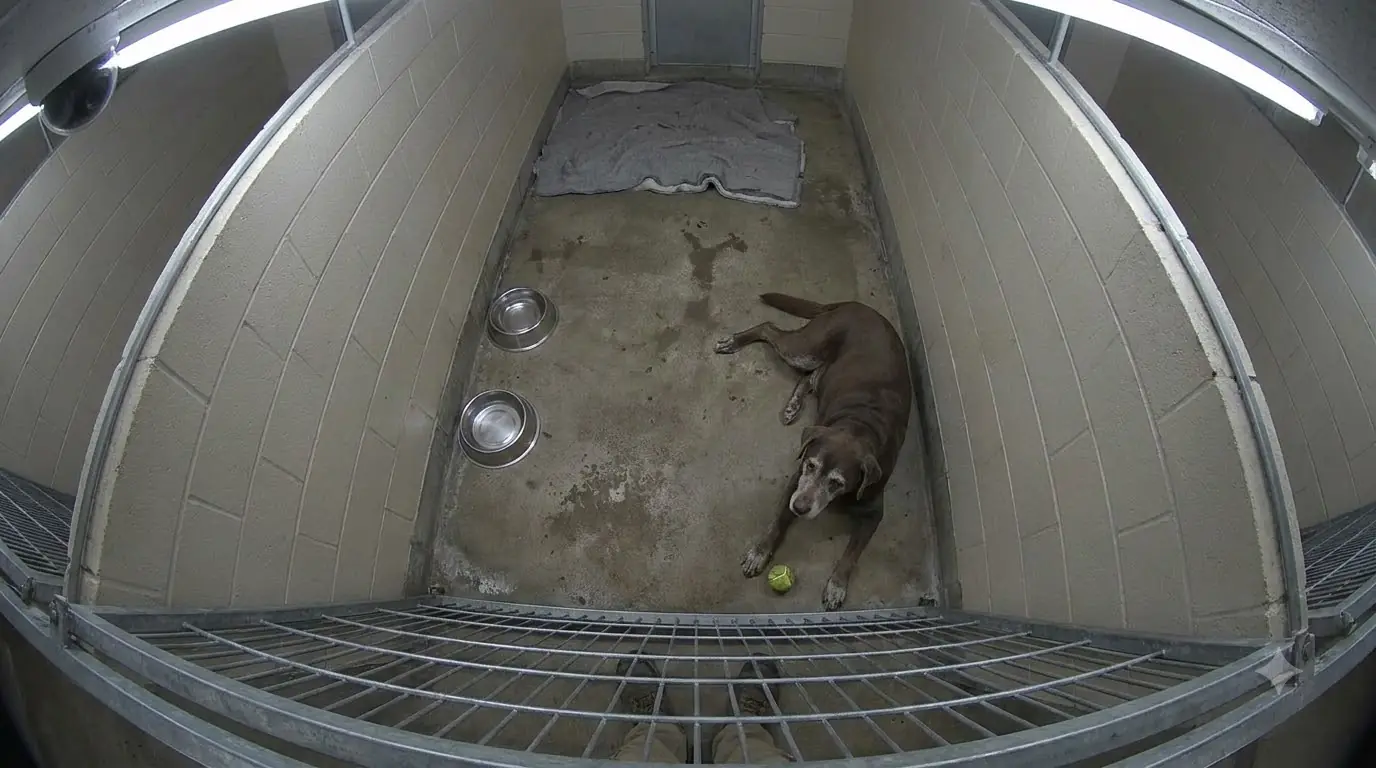
The tennis ball should have been too much work.
By evening, almost everything was.
The seven-year-old Labrador Retriever spent most of her time lying on a thick bed near the front half of her kennel. Chronic illness had slowly taken away the endurance people expected when they saw a Labrador.
She could still stand.
She could still walk.
But neither lasted very long anymore.
A short trip outside could leave her ready to sleep.
Standing at the kennel door for several minutes made her legs begin to tremble.
On harder days, she would rise, take only a few steps, then look for somewhere to lower herself again.
That was why shelter staff had moved her bed closer to the front.
They did not want her crossing the entire kennel every time someone came down the hallway.
Still, there was one trip she kept making herself.
Whenever footsteps slowed outside her gate, the Labrador's eyes opened.
Her head came up.
Then she looked for the old tennis ball.
It was worn nearly smooth in places.
The yellow felt had darkened from use, and one side showed the flattened marks of years of being carried.
The ball usually rested beside her blanket.
She would slowly push herself upright.
Pause until her legs were steady.
Lower her head.
Pick up the ball.
Then walk toward the bars.
One step.
Another.
Sometimes she stopped halfway.
Then continued.
When she reached the gate, she dropped the ball directly in front of her paws.
And stood there.
The person outside might crouch.
Speak softly.
Smile.
The Labrador looked through the bars.
The ball remained between her feet.
Eventually the shaking started.
First one rear leg.
Then both.
If the visitor stayed, she tried to stay too.
Staff usually intervened before her legs failed completely.
They moved closer.
Encouraged her to lower herself.
Sometimes they brought the bed forward.
Sometimes a caregiver entered and sat beside her.
The Labrador would finally lie down.
But she kept the tennis ball close.
And on this particular evening, every repetition carried a weight she could not understand.
Because when the shelter closed for the night, there was still no confirmed adopter.
No rescue commitment.
No medical foster.
Her euthanasia appointment was scheduled for the following morning.
She Did Not Know What “Tomorrow Morning” Meant
That distinction mattered to everyone caring for her.
The Labrador did not understand the schedule attached to her kennel record.
She did not know staff had been making calls.
She did not know her medical information had been sent to rescue groups.
She did not know people were sharing her case and asking whether anyone could take a chronically ill adult dog before morning.
Her ball-carrying behavior was not evidence that she understood she was running out of time.
It was something she had already been doing.
The urgency belonged to humans.
What staff could honestly describe was this:
When someone stopped at her kennel, she repeatedly chose to get up.
She repeatedly picked up the same tennis ball.
She repeatedly brought it to the gate.
And even when her body began shaking from the effort of standing, she tried to remain there.
That was enough.
She Had Once Been a Family Dog
Her shelter intake was a surrender.
She had not been found wandering beside a highway.
She had not been discovered chained to an abandoned house.
There was no need to invent a cruelty story.
Her previous family had reached a point where the cost of managing her chronic illness exceeded what they could continue to afford.
That is a painful reality in animal welfare.
Long-term disease can mean repeated examinations, diagnostic testing, medication, laboratory monitoring, special diets, emergency visits, and changing treatment plans.
The financial burden can become enormous.
The shelter documented the reason for surrender without turning it into an accusation it could not support.
Whatever emotions surrounded the decision, the practical result was clear.
The Labrador still needed medical care.
And now the shelter had become responsible for providing it while also trying to find somewhere she could go.
Her Disease Had Changed Her Endurance More Than Her Personality
That difference became obvious quickly.
She remained socially interested.
She noticed people.
She still liked gentle attention.
She still carried the tennis ball.
But her body could no longer support the amount of activity her behavior sometimes suggested she wanted.
This is an important distinction in chronically ill dogs.
Motivation and physical capacity are not the same thing.
A dog may want to walk farther than the heart, lungs, joints, or muscles can comfortably support.
A dog may want to remain standing because a visitor is present.
That does not mean the humane response is to let her keep standing until she collapses.
Staff had to become the limit her body could not reliably set for itself.
Her Medical Record Followed Her Into Every Placement Conversation
Potential adopters were not told only that she was sweet.
They received the difficult information too.
Her chronic condition required ongoing veterinary management.
Her stamina was limited.
She tired quickly.
Her medications needed to remain consistent.
Depending on the specific disease and its progression, future treatment could become more complicated or expensive.
She might never return to the activity level people associate with a healthy seven-year-old Labrador.
A home needed to accept the dog she was now.
Not the dog someone hoped medication might turn her back into.
That honesty reduced the number of possible placements.
It also protected her.
The Tennis Ball Had Come With Her Into Shelter Care
It was one of the few objects that seemed familiar from the beginning.
Staff had other toys available.
New balls.
Soft toys.
Rubber chews.
The Labrador occasionally investigated them.
But the old tennis ball was different.
That was the one she carried most often.
No one claimed they knew exactly why.
Familiar scent could matter.
Prior play history could matter.
Habit could matter.
The shelter did not need to call it her “last piece of home” to make it meaningful.
It was simply the object she repeatedly chose.
The First Few Days, She Tried to Play Normally
A volunteer rolled the ball.
The Labrador followed.
Picked it up.
Returned.
Then the volunteer rolled it again.
By the second retrieve, the dog slowed noticeably.
The third was stopped before it happened.
That interaction taught staff something important.
Traditional fetch was no longer appropriate.
The interest was still there.
The endurance was not.
So the way people used the toy had to change.
Play Became Almost Stationary
The ball could be rolled only a foot or two.
Sometimes not at all.
A caregiver would place it near her paws.
She might pick it up.
Mouth it.
Carry it several feet.
That was enough.
Enrichment should fit the animal's body.
There is no prize for making a sick Labrador retrieve twenty times just because Labradors are stereotypically supposed to love fetch.
The toy remained.
The physical demand changed.
Then Staff Noticed She Carried It to Visitors
Not every visitor.
Not every time.
But often enough to form a clear pattern.
A person stopped.
The Labrador looked toward the ball.
Stood.
Picked it up.
Came forward.
Dropped it at the gate.
The first time, someone rolled it back into the kennel.
The dog turned to retrieve it.
Staff stopped the game after one return because the movement was already tiring her.
Over time, the ball became less about fetch and more about the act of bringing it forward.
She Rarely Pushed It Through the Bars
That was interesting.
Most of the time, she simply placed it on her side.
Between her front paws.
Then watched the person.
Sometimes the visitor touched the bars near the ball.
Sometimes they spoke to her.
Sometimes they simply stood there.
The Labrador remained as long as her body allowed.
The toy appeared to be part of the greeting.
Exactly what it meant to her could not be known.
The repeated physical sequence could.
Her Legs Started Shaking Earlier as the Weeks Passed
At intake, she could stand longer.
Later, the first tremor came sooner.
The shelter medical team paid attention.
Progressive weakness can result from the underlying disease itself, reduced activity, muscle loss, pain, medication effects, or several factors together.
They reassessed her rather than assuming every change was inevitable.
Was pain controlled?
Was hydration adequate?
Was she eating enough?
Had her disease progressed?
Were there new findings?
Could medication be adjusted?
What could improve comfort?
Those questions mattered more than the ball.
The Bed Moved Toward the Gate
This was one of the simplest and most effective changes.
If she wanted to be near people, the shelter could reduce the distance.
Her thick bed was shifted forward.
Now she could remain supported while seeing hallway activity.
Water stayed close.
The tennis ball stayed near the bed.
A person could crouch at the gate without requiring the Labrador to walk several feet.
It helped.
She Still Stood Up
That was the frustrating part.
A child.
A volunteer.
A familiar technician.
The Labrador would see someone stop and gather her legs underneath herself.
Staff started moving closer immediately when they saw the sequence begin.
If the visitor could come to the dog, there was no reason for the dog to spend her limited energy going to them.
On Better Days, She Beat Them to the Gate
She would already be standing.
Ball in mouth.
Legs relatively steady.
Those moments could make her look healthier than she was.
That is dangerous in chronic disease.
A five-minute snapshot can hide what the other twenty-three hours look like.
The shelter made sure potential adopters understood the whole day.
She might appear bright during a meeting.
Then sleep for hours afterward.
That recovery time was part of her medical reality.
Some Visitors Thought Her Ball Meant She Wanted to Play
Staff had to explain.