Maple has a pattern.
When someone she doesn't know approaches too quickly, she moves away.
At adoption events, that often means retreating behind her bed while other dogs come forward. In a meet-and-greet room, it can mean choosing the farthest available corner. In her kennel, she may remain several feet back instead of walking toward a visitor.
For someone meeting several dogs in one afternoon, the first impression can be simple.
Maple doesn't seem interested.
But that isn't really what is happening.
Maple needs time.
Not hours. Not some dramatic weeks-long process before anyone can see her personality.
Sometimes she simply needs a few quiet minutes in which nobody asks anything of her.
This weekend, during her fourth introduction, someone finally gave her exactly that.
But understanding why that moment mattered requires understanding how Maple has spent the past several months.
How Maple Came Into Our Care
Maple came into our care through a transfer from another shelter that was working to create space for incoming animals.
She was approximately 4 years old and identified as an Australian Shepherd mix based on the information transferred with her and her physical characteristics.
We don't have a complete history of Maple's life before she entered the shelter system.
We don't know exactly where she lived, what her daily routine looked like, or what experiences shaped the way she responds to unfamiliar people.
Because we don't know, we don't fill those gaps with assumptions.
Maple's tendency to retreat from strangers does not prove that she was mistreated.
Some dogs are naturally cautious. Some have had limited social exposure. Some find shelter environments overwhelming. Genetics, previous experiences, personality, and the stress of a major environmental change can all influence how a dog responds.
What we know about Maple comes primarily from what she has shown us here.
And Maple has been remarkably consistent.
With unfamiliar people, she is cautious.
With familiar people, she is a very different dog.
Maple's First Days
During her initial adjustment, Maple spent a significant amount of time observing.
She wasn't constantly pacing her kennel or throwing herself against the door.
She wasn't trying to get attention from everyone who passed.
Instead, she often positioned herself where she could watch without being approached directly.
She ate.
She drank normally.
She went outside with staff.
She accepted routine care.
But she was hesitant when unfamiliar people entered her space.
If someone walked directly toward her, Maple often increased the distance between them.
If the person continued advancing, she might retreat farther.
That gave our team useful information early.
Trying harder to approach Maple was not necessarily helping Maple.
Giving her room was.
Staff began allowing her to make more choices during interactions.
Instead of repeatedly reaching toward her, they gave her opportunities to approach.
Instead of standing over her, they sat nearby.
Instead of expecting immediate physical affection, they let Maple investigate.
The difference was noticeable.
Maple was still cautious.
But curiosity started appearing alongside the caution.
The First Few Minutes Matter
Maple's introductions tend to happen in stages.
First, she watches.
She studies where a person is sitting, how they move, whether they are looking directly at her, and how much space exists between them.
Then, sometimes, she sniffs.
She may stretch her neck forward without moving her feet.
She may take one step and stop.
If everything remains quiet, she may take another.
Eventually, with people she becomes comfortable around, Maple can settle surprisingly close.
One of her most recognizable behaviors is resting her chin near someone.
She does not necessarily climb into a lap.
She doesn't suddenly become a dog demanding nonstop petting.
She simply moves close enough to lie down, lowers her head, and stays.
For staff members who know her, that behavior has become familiar.
For most visitors, it remains invisible.
They don't stay long enough to reach that part.
Why Maple Keeps Getting Passed Over
Adoption environments are unusually difficult places for dogs like Maple to make a first impression.
Many dogs actively participate in getting themselves noticed.
They come to the front.
They wag.
They bounce.
They paw at gates.
They follow visitors from one side of an enclosure to another.
At adoption events, those behaviors naturally attract attention.
Maple usually does the opposite.
The more unfamiliar people move around her, the more likely she is to seek distance.
At an event, she may curl behind her bed.
If someone approaches and reaches toward her, she may move farther back.
Meanwhile, a dog a few feet away may be standing at the front of an enclosure, tail moving rapidly, ready to interact immediately.
It is understandable why someone hoping to make a connection might gravitate toward the dog already trying to meet them.
We cannot know what every person who passes Maple is thinking.
Some may be looking for a more outgoing personality.
Some may need a dog comfortable with frequent visitors or a busy household.
Some may simply connect with another animal.
And for some people, Maple genuinely isn't the right match.
But the observable pattern is clear.
Maple's hesitation happens during exactly the period when potential adopters are forming their first impression.
By the time Maple begins deciding that a stranger might be safe to investigate, the stranger is often already gone.
Adoption Events Are Especially Difficult
The shelter has learned that Maple's kennel behavior does not fully represent her, but adoption events create an even greater challenge.
There are unfamiliar voices.
Dogs are moving around.
People stop and start constantly.
Chairs scrape.
Doors open.
Someone may walk past carrying a child.
Another person may approach with a dog.
People naturally want to look closely at animals they are considering adopting.
For Maple, all of that can be a lot to process.
Her response is usually to make herself less available.
At one recent event, Maple positioned herself behind her bed while more outgoing dogs nearby pressed toward the front.
People stopped for them.
Maple watched.
Some glanced toward her.
A few asked questions.
But Maple did not come forward on cue.
She stayed where she felt safer.
That is one of the hardest things about placing a shy dog.
The animal is being asked to demonstrate trust during one of the least comfortable situations in which to build it.
What Visitors Don't See
Take Maple away from that environment and lower the pressure, and the picture begins changing.
She still doesn't rush.
That part is important.
Maple doesn't become a completely different dog simply because she enters a quieter room.
She remains Maple.
She watches first.
But now she has enough space to make decisions.
If a person sits quietly instead of approaching, Maple may begin investigating.
Her nose starts working.
Her posture softens.
She may change positions.
Sometimes she moves closer and then backs away again.
That is fine.
Nobody needs to turn every forward step into an opportunity to touch her.
In fact, one of the most useful things a new person can do is allow Maple's first approach to be just that: an approach.
She can sniff a shoe and leave.
She can walk behind someone and investigate.
She can stand nearby without a hand immediately reaching toward her head.
Once Maple realizes that coming closer does not automatically result in pressure, she often becomes more willing to do it again.
Eventually, she settles.
That is where visitors begin seeing the dog staff members know.
Maple With Familiar People
With people she trusts, Maple is quieter than many Australian Shepherd mixes, but she is not withdrawn.
She enjoys walks and likes having time to investigate her surroundings.
She responds well to predictable routines.
She pays close attention to familiar caregivers and often chooses to remain near them once she is comfortable.
Inside a quiet room, she can settle beside someone without needing constant interaction.
Sometimes she rests her chin near a person's leg.
Sometimes she stretches out nearby.
She may accept gentle petting once she has initiated enough contact to show she is comfortable.
Her affection tends to feel deliberate.
Maple isn't distributing it to every person who walks into the building.
She builds toward it.
That makes her difficult to showcase during a five-minute introduction.
It may make her wonderful for someone who appreciates a relationship that develops gradually.
Maple's Veterinary Care
Maple received routine veterinary evaluation as part of her care.
Her physical health has not been the primary obstacle to adoption.
At approximately 4 years old, she is an adult dog rather than a senior, and she has been kept current on appropriate preventive care while in the shelter's program.
Her veterinary team monitors the same fundamentals we consider for other dogs in our care: body condition, appetite, skin and coat, ears, eyes, teeth, mobility, heart and lung function, parasite prevention, and any changes that could indicate a health concern.
There is no need to invent a medical crisis around Maple.
Her challenge is behavioral and environmental.
She needs introductions structured in a way that allows her to feel safe enough to participate.
That is an adoption consideration, but it is not the same thing as saying Maple is incapable of forming relationships.
We see evidence to the contrary every day.
Months of the Same Pattern
Shelter life develops rhythms.
Maple knows many of them now.
She recognizes the sounds associated with meals.
She recognizes familiar staff.
She knows when she is likely to go outside.
She knows which doors lead toward quieter areas.
And she notices when unfamiliar people arrive.
Some days are relatively calm.
Other days bring more visitors.
When the adoption floor gets busy, Maple's behavior can become more reserved.
She may stay farther back.
Then the building becomes quiet again.
A familiar caregiver approaches.
Maple's response changes.
She comes closer.
That contrast has been one of the clearest pieces of information guiding her adoption plan.
Maple does not need someone to force her through her fear.
She needs conditions that allow her confidence to emerge.
Helping Maple Be Seen Differently
Once it became obvious that the standard adoption-floor experience was working against Maple, staff began adjusting how she was presented.
Her adoption profile was updated to explain her behavior clearly.
That matters because calling Maple simply "shy" does not give potential adopters enough useful information.
We want people to understand what shy means for this particular dog.
It means she may back away during the first meeting.
It means she may not seek physical contact immediately.
It means a busy adoption event may show the least confident version of her.
It also means that, given quiet and time, she begins approaching voluntarily.
Photos taken when Maple is relaxed help show another side of her.
Videos can capture her moving around comfortably with familiar people.
And when someone expresses serious interest, we prefer to arrange introductions in calmer spaces whenever possible.
The goal isn't to hide Maple's hesitation.
The goal is to give potential adopters an accurate picture of both sides of it.
Why We Don't Push Her Forward
There is a temptation with shy animals to believe that more exposure automatically creates confidence.
That is not always true.
Simply placing Maple in increasingly overwhelming situations and waiting for her to "get used to it" could make introductions harder rather than easier.
Instead, our team focuses on manageable experiences.
Choice matters.
Distance matters.
Body language matters.
If Maple retreats, that tells us something.
If she chooses to approach again, that tells us something too.
The objective is not to eliminate every cautious behavior before she can be adopted.
A shelter is not always the best environment for achieving that anyway.
The objective is to understand Maple well enough to match her with someone capable of continuing that work responsibly at home.
Meet-and-Greets Can Be Hard to Watch
Maple's introductions sometimes follow a frustratingly predictable pattern.
A visitor enters.
Maple notices.
The visitor naturally wants to interact.
Maple backs away.
There is an awkward moment.
Sometimes the person waits.
Sometimes they decide another dog is more appropriate for what they need.
That decision can be reasonable.
Someone with a busy household full of frequent visitors may genuinely need a dog who adapts to strangers more quickly.
A family wanting a dog immediately comfortable around a large social circle may decide Maple isn't the right choice.
Those are not failures.
Good adoption matching involves acknowledging what an animal actually needs.
But there have also been meetings where we wondered what Maple might have shown if the introduction had simply lasted a little longer.
This weekend gave us several examples.
Three Introductions
Maple had three introductions in which her familiar pattern appeared.
She backed away.
She did not immediately engage.
She chose distance.
The circumstances of each meeting were slightly different, but none resulted in a match.
That is part of shelter work.
Not every person who meets an animal will adopt that animal.
Not every promising inquiry becomes an application.
And an adoption should not happen simply because everyone wants a happy ending.
After those meetings, Maple returned to her routine.
She wasn't punished for retreating.
Nobody treated her hesitation as misbehavior.
The information simply reinforced what we already knew.
Maple needed a different kind of introduction.
Then came the fourth visitor.
The Fourth Introduction
The beginning looked familiar.
Maple entered the room and realized an unfamiliar person was there.
She created distance.
Nothing about that surprised us.
The visitor did not follow.
They didn't repeatedly call Maple toward them.
They didn't lean across the room trying to touch her.
And, most importantly, they didn't interpret Maple's retreat as the end of the meeting.
They stayed.
For several minutes, very little happened.
That absence of action was exactly what Maple needed.
She watched.
The visitor remained where they were.
Maple continued watching.
There was no dramatic breakthrough.
No sudden sprint across the room.
No instant transformation.
Just time.
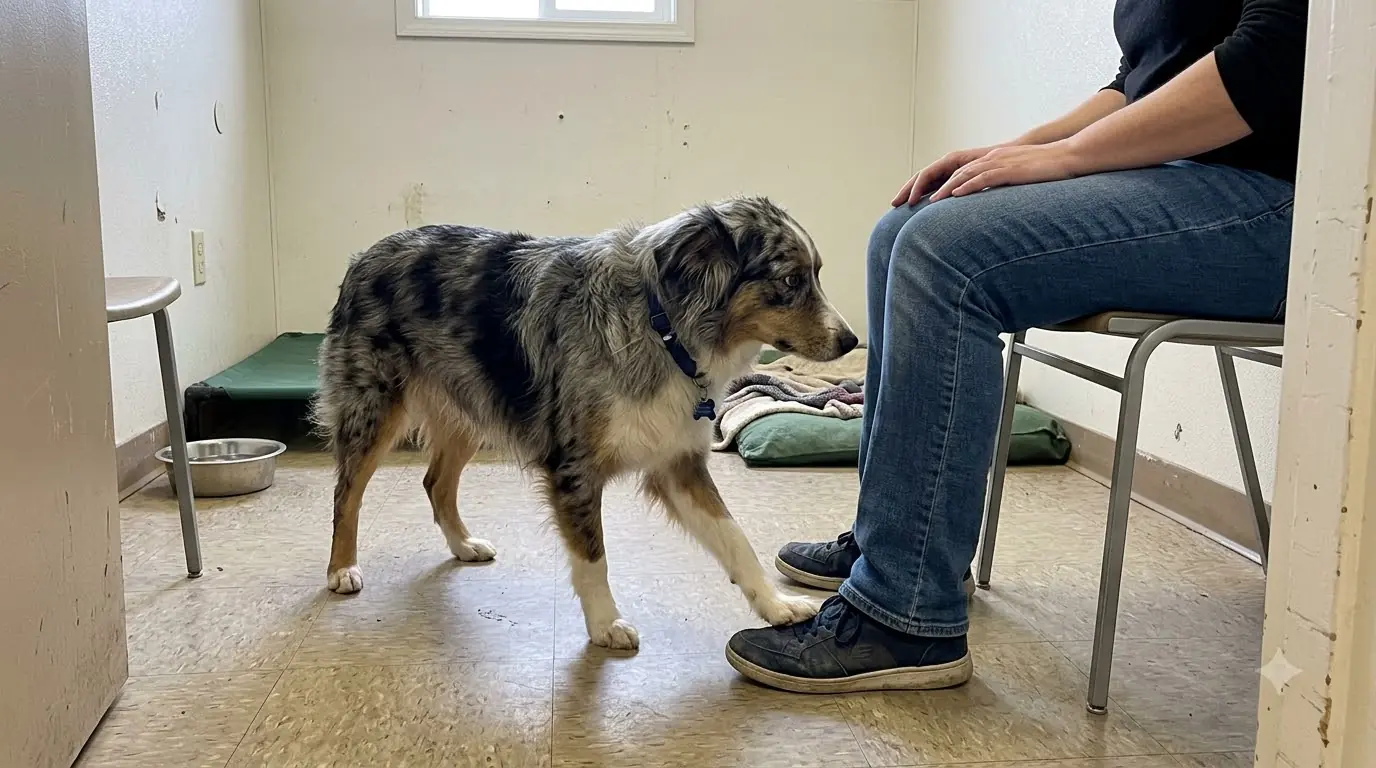
Then Maple stood.
She took a few steps.
She stopped.
Eventually, she crossed the room.
When she reached the visitor, Maple did not climb into their lap.
She didn't demand petting.
She gently placed one paw beside the visitor's shoe.
Nobody moved.
Neither did Maple.
For a dog whose introductions so often end during the retreat, standing voluntarily beside a stranger was significant.
The visitor let the moment remain small.
That may have been the most important part.
What Happened Next
Maple stayed near the visitor longer than she typically does during the opening stage of a first meeting.
After standing beside the shoe, she continued investigating at her own pace.
She sniffed.
She shifted her position.
She remained cautious, but she did not immediately return to the far side of the room.
Eventually, she settled closer.
This was the Maple that staff had hoped someone would wait long enough to see.
Not a suddenly fearless Maple.
Not a completely transformed Maple.
Just a dog making a choice.
That distinction matters.
For shy dogs, progress is often measured in choices rather than dramatic displays.
Choosing not to retreat.
Choosing to investigate.
Choosing to remain.
Choosing to lie down.
Choosing to approach again.
Maple made several of those choices during the meeting.
For the first time that weekend, the introduction moved beyond the moment when she backed away.
It Wasn't an Instant Adoption
We want to be careful about what this meeting means.
A meaningful introduction is not the same thing as a completed adoption.
There are still questions to consider.
A potential adopter needs to understand Maple's behavior outside one successful meeting.
They need to consider their household.
They need to understand that Maple may retreat again when she enters a new environment.
She may hide when visitors come to the home.
She may need time before she feels comfortable in new places.
Progress is rarely a straight line.
A dog who approaches one stranger today may hesitate with another tomorrow.
The important thing is that Maple demonstrated exactly what staff have been trying to explain.
Backing away is the beginning of her process.
It isn't necessarily the end.
What Maple's Future Adopter Needs to Understand
Maple's ideal home begins with patience, but patience alone isn't a complete adoption plan.
She would benefit from a relatively predictable environment where she can learn routines without constant social pressure.
Her adopter should be comfortable allowing her to approach new people at her own pace.
That means guests may need instructions.
Some visitors may need to ignore Maple initially rather than trying to win her over immediately.
She should have access to a comfortable retreat where she can choose distance when the household becomes busy.
Nobody should corner her or force physical interaction.
At the same time, Maple still needs normal life experiences.
She needs walks.
Enrichment.
Training.
Appropriate exercise.
Positive exposure to the world at a level she can handle.
As an Australian Shepherd mix, she benefits from opportunities to use both her body and her brain, though her individual temperament matters more than breed stereotypes.
Her adopter should expect a transition period.
The Maple who eventually rests her chin beside someone may not be the Maple who walks through their front door on the first evening.
That relationship needs room to develop.
A Quieter Home May Fit Her Best
Based on what we have observed, Maple is likely to do best in a home that does not require her to function as the social center of every gathering.
A household with constant unfamiliar visitors could be challenging for her.
A quieter routine would make it easier for Maple to predict what happens next.
If there are other animals in a potential home, compatibility should be assessed through appropriate introductions rather than assumed.
The same is true for children.
Age alone does not determine whether a child and a shy dog are compatible. The household's activity level, the child's ability to respect space, supervision, and Maple's observed comfort all matter.
What we don't want is a home expecting Maple to become an outgoing dog simply because she is loved.
Love matters.
So does management.
So does understanding behavior.
The right person will appreciate Maple as she is while helping her continue gaining confidence.
What Waiting Has Taught Us About Her
Months in a shelter are not what we would choose for Maple.
But those months have allowed staff to understand patterns that might otherwise have been missed.
We know she does better when people reduce pressure.
We know she watches before approaching.
We know curiosity eventually competes with caution.
We know she can form strong relationships with familiar people.
We know she enjoys being near someone after she has decided the situation feels safe.
And we know that her first response to a stranger is not an accurate summary of everything that comes afterward.
That last point is the reason we keep trying different ways to introduce her.
Maple isn't failing meet-and-greets.
Traditional meet-and-greets often fail to give Maple enough time.
Her Current Status
Maple is still in our care while the interest from her most recent introduction is explored carefully.
Nothing is being announced as final.
We don't want to turn one encouraging afternoon into a conclusion that has not happened yet.
The visitor who waited has learned more about Maple's needs, and our team is continuing the conversation to determine whether the home and Maple are genuinely compatible.
If another meeting is appropriate, it will be arranged with the same principle that made the first one successful.
Low pressure.
Time.
Choice.
Whatever the outcome, the fourth meeting gave us something useful.
It confirmed that the strategy works.
When someone doesn't demand that Maple immediately behave like an outgoing dog, she has room to show them who she actually is.
Tomorrow, Maple May Back Away Again
That possibility is important to say out loud.
Tomorrow, an unfamiliar person could approach Maple and she might retreat.
That would not erase what happened this weekend.
Behavior doesn't work that way.
Confidence develops through repeated experiences.
A shy dog may make progress in one setting and struggle in another.
Maple's future family will need to understand that.
There may be days when she surprises them by approaching someone quickly.
There may be days when she decides the safest place is behind a chair.
Success will not mean Maple never feels uncertain again.
Success will mean she has a home where uncertainty is handled appropriately.
The Side Most Visitors Miss
People often notice Maple at exactly the wrong moment.
They see the retreat.
They see her behind the bed.
They see another dog pushing happily toward the front and understandably turn their attention there.
What they usually miss happens several minutes later.
Maple looks again.
Her nose begins working.
She changes position.
She moves a little closer.
If nothing pressures her, she may close the distance herself.
Then eventually, the dog who appeared uninterested may be lying beside the same person she initially avoided.
That is not a trick.
It is not a dramatic personality change.
It is simply what trust looks like for Maple.
Slow.
Quiet.
Voluntary.
For Now, We Keep Giving Her Time
Maple's story does not currently end with someone walking out of the shelter holding her leash.
Maybe that will happen after this promising introduction.
Maybe this particular home will turn out not to be the right one.
If it doesn't work, Maple will continue receiving the same care while we look for another suitable match.
She will still have walks.
She will still have enrichment.
She will still spend time with the people she knows.
And we will keep explaining the most important thing about meeting her:
Don't judge Maple by the moment she moves away.
Wait for what she chooses to do next.
This weekend, three introductions ended without a match.
During the fourth, Maple backed away just as she had before.
But this time, the person stayed.
The room remained quiet.
Several minutes passed.
Maple watched from a distance until she finally stood.
Then she crossed the room by herself.
She stopped beside the visitor and placed one paw next to their shoe.
Nobody reached for her.
Nobody asked for more.
For a while, nobody moved at all.
And Maple, who has spent months watching people leave before she was ready to approach, chose to stay.