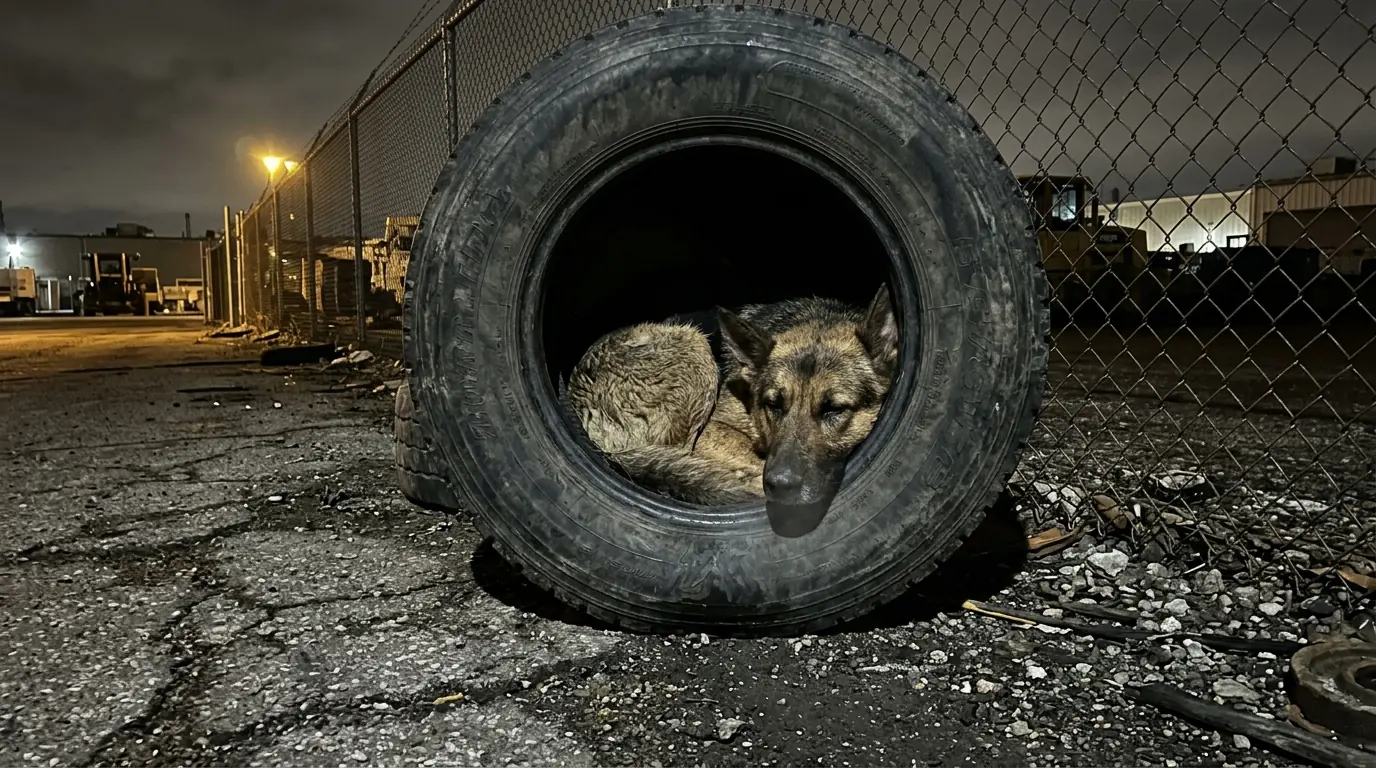
The First Time We Saw Ranger, Only His Muzzle Was Visible
From a distance, the tire looked empty.
It was an old truck tire lying on its side beside a chain-link fence at the edge of an industrial property, half surrounded by gravel, weeds, and debris.
Then something moved inside it.
A narrow muzzle appeared through the center opening.
A pair of dark eyes followed.
The rest of the dog was hidden.
That was how Ranger had been sleeping.
He was a thin Shepherd mix who had been seen wandering around the industrial area for some time. His belly and legs were consistently dirty, the fur along his underside darkened by grease, dust, mud, and whatever else he had been lying in.
During the day, people occasionally saw him moving between buildings, fenced lots, loading areas, and strips of scrubby ground.
At night, he returned to the tire.
He curled his entire body into the hollow center, folding himself into a space that barely looked large enough for him.
Only his nose and part of his face remained outside.
The tire did not provide warmth in any meaningful sense.
It did not give him a dry floor.
It was not a shelter.
But the thick rubber walls blocked some of the wind.
For Ranger, that seemed to be enough reason to keep coming back.
We Did Not Know How Long He Had Been Living There
There was no reliable history attached to Ranger.
No one could tell us exactly when he first appeared.
Some people in the area remembered seeing a thin shepherd-type dog for several weeks.
Others thought it might have been longer.
We could not verify whether Ranger had once belonged to someone nearby, whether he had wandered into the area from somewhere else, or how he had ended up surviving around warehouses and fenced lots.
We did not label him abandoned.
We did not assume cruelty.
We did not invent a story to explain why an adult dog was sleeping inside discarded equipment.
What we could confirm was much simpler.
Ranger was living outdoors.
He was underweight.
His coat was dirty.
His sleeping place offered almost no protection except from wind.
And he was wary enough of people that simply walking toward him caused him to move away.
That was the situation we had to work with.
The Tire Told Us More Than His Daytime Behavior Did
During daylight hours, Ranger could look almost functional.
He walked normally enough from a distance.
He knew how to navigate the property.
He avoided vehicles.
He disappeared behind buildings when people approached.
He seemed to have learned a predictable route through the industrial lots.
But the tire showed what his daily routine actually cost him.
A healthy housed dog has choices about where to sleep.
Ranger appeared to have found one narrow pocket of relative protection and turned it into a nightly refuge.
The tire sat close to the fence, where one side was somewhat shielded.
Inside, the rubber created a small barrier against crosswind.
To use it, Ranger had to curl himself tightly.
His back curved around the interior wall.
His hind legs tucked beneath him.
His chest pressed against the bottom.
His face remained near the opening.
The position was cramped, but when the wind moved across the open lot, it was quieter inside the tire than outside it.
We saw him return to it more than once.
That repetition was what made the image difficult to forget.
Trying to Catch Him Quickly Would Have Made Things Worse
Ranger was not a dog who walked up looking for help.
He kept distance.
If a person approached head-on, he moved away.
If someone followed, he increased that distance.
Trying to chase him around an industrial property would have created serious risks.
There were vehicles.
Open gates.
Fenced sections.
Equipment.
Areas where a frightened dog could become trapped or disappear.
So the approach had to be low pressure.
Food was placed where Ranger already traveled.
People avoided crowding him while he ate.
Observation happened from a distance.
The goal was to make one location predictable enough that Ranger would continue returning instead of feeling forced out of the area.
That took patience.
A stray dog surviving outdoors often has very good reasons for being cautious, even when we do not know what those reasons are.
Trust is not built by proving that a person can get closer.
It is built by giving the dog repeated experiences in which nothing bad happens when people are nearby.
He Came Out of the Tire Before Sunrise
The first successful capture attempt was planned around Ranger’s established pattern.
He tended to use the tire overnight and move away from the fence early in the morning.
That allowed rescuers to anticipate where he would be without cornering him inside the tire itself.
The tire was not treated as a trap.
We did not want Ranger to associate his only shelter with people reaching in after him.
Instead, food placement and a humane containment strategy were used nearby.
When Ranger emerged, he was given time.
He sniffed.
He moved cautiously.
He retreated once.
Then returned.
Eventually, he entered the secured area far enough for the capture to be completed without a chase.
Once contained, Ranger did not immediately relax.
His body stayed low.
His ears moved constantly.
He kept his weight shifted away from unfamiliar hands.
A leash was not simply snapped on while people crowded around him.
Handling remained quiet.
A barrier and controlled setup did most of the work.
That mattered because the next few minutes could easily shape how Ranger responded to people throughout intake.
Up Close, He Was Thinner Than He Had Looked From Across the Lot
Ranger’s coat hid some of his body condition.
From a distance, the Shepherd outline made him look broader than he really was.
Once he arrived at the shelter and could be examined more carefully, the weight loss became obvious.
His ribs were easy to feel.
His waist was pronounced.
Muscle over the hips and thighs was reduced.
The fur along his belly and lower legs was heavily soiled.
There were areas where dirt had worked deep into the coat, especially around the elbows, hocks, and underside.
He smelled strongly of outdoor debris and old grime.
But dirt was not a diagnosis.
His veterinary team needed to know why he was thin and whether there were any medical problems that had been hidden by his survival behavior.
His Examination Started With the Basics
Ranger received a full physical examination.
His hydration was assessed.
His body condition was documented.
His skin and coat were checked for parasites, wounds, irritation, and infection.
His paws were examined carefully because dogs living around industrial sites can develop cuts, abrasions, worn pads, or embedded debris.
His ears and mouth were checked.
His abdomen was palpated.
His heart and lungs were listened to.
Because of his low body condition, baseline bloodwork and fecal screening were appropriate.
Not every thin stray dog has the same medical explanation.
Some are underweight largely because access to consistent food has been poor.
Others have intestinal parasites, chronic gastrointestinal disease, dental pain, metabolic disease, infection, or multiple contributing issues.
Ranger’s testing did not reveal one dramatic hidden illness that explained everything.
His condition appeared most consistent with prolonged inadequate nutrition and exposure, with routine issues that could be addressed through shelter care.
That was reassuring in one sense.
It did not make his recovery immediate.
Feeding Him More Was Not as Simple as Filling a Bowl
Ranger was hungry.
That did not mean he should be given unlimited food all at once.
Dogs that have been underfed for a prolonged period are best managed with controlled nutritional rehabilitation.
His meals were measured.
Portions were divided.
His appetite was monitored.
So were stool quality, hydration, abdominal comfort, and weight change.
The goal was steady improvement, not rapid visible gain.
Putting weight back onto an underconditioned dog takes time.
So does rebuilding muscle.
Ranger’s body had adapted to surviving on less than it needed.
Now it had to adjust to predictability.
That was true physically and behaviorally.
The First Bed Was Almost Too Much
Inside the kennel, Ranger was given soft bedding.
He did not immediately lie on it.
Instead, he chose the narrowest part of the kennel.
He curled beside the wall.
His body tucked tightly inward.
His nose pointed toward the open side of the kennel.
The posture looked familiar.
It was not identical to the tire, but the pattern was similar.
Small space.
Solid barrier behind him.
Face toward the opening.
That became important.
A dog who has been sleeping in exposed outdoor places may not instantly understand that a large soft bed is safer.
Sometimes open space feels less secure than a tight corner.
So Ranger was not dragged onto the bedding.
The bed remained available.
A folded blanket was placed near the wall he already preferred.
He was allowed to choose.
Sleep Was One of the First Things We Watched Closely
Ranger’s sleep was light at first.
Hallway noise woke him.
A kennel latch clicking several doors away could make his head lift.
If someone paused outside, his eyes opened.
He did not bark constantly.
He did not throw himself at the gate.
Instead, he watched.
Even when he appeared exhausted, he rested in a position that allowed him to become upright quickly.
That level of vigilance was not surprising.
Outside, sleeping deeply could have left him vulnerable to weather, vehicles, other animals, or human activity.
Inside the shelter, the environment was safer.
His nervous system did not know that yet.
The first behavioral goal was not affection.
It was rest.
Cleaning Him Had to Happen Without Overwhelming Him
Ranger’s dirty coat could not be treated like a cosmetic problem.
A full bath immediately after capture might have been too stressful.
He had just lost every familiar feature of the environment he had been surviving in.
So cleaning was approached gradually.
Loose debris was removed where he tolerated handling.
His paws and heavily soiled areas were addressed first.
Any skin irritation hidden beneath the dirt needed to be identified.
More thorough cleaning could happen once he was medically stable and more comfortable with handling.
That slower approach also helped us learn his boundaries.
Ranger was not aggressive during routine care, but he became tense when unfamiliar hands moved quickly around his hindquarters or underside.
Handlers slowed down.
Treats were placed nearby.
Touch began in areas he tolerated better.
Sessions ended before he felt the need to escalate.
Over time, his coat began to look less like the industrial lot he had been sleeping in.
For Several Nights, He Still Chose the Floor
Even with bedding available, Ranger continued sleeping beside it.
He would circle once.
Then curl against the wall.
His nose remained pointed outward.
The bed was only inches away.
We did not move him onto it after he fell asleep.
The goal was to give him control over where he rested.
A few days later, one front paw appeared on the blanket.
That was the entire change.
The next night, his chest was partly on it.
Later, most of his body.
He still kept his back against the wall.
He still curled tightly.
But the surface beneath him was finally soft.
His Appetite Became Predictable Before His Behavior Did
Ranger began learning the meal schedule quickly.
At first, he would retreat when the kennel door opened.
Food had to be placed and the person needed to move away before he approached.
Then he started waiting at a shorter distance.
Later, he ate while a familiar caregiver remained nearby.
That was a meaningful behavioral change.
Eating is vulnerable.
A dog who chooses to lower his head to a bowl while a person remains in the space is giving up some of his ability to monitor everything at once.
Nobody tried to turn that into immediate petting.
Ranger was allowed to eat.
The predictability itself was doing the work.
His Weight Began to Return Slowly
Over the following weeks, Ranger gained weight gradually.
His ribs became less prominent.
His energy improved.
The muscles over his hindquarters still needed time to rebuild, but he no longer looked as hollow through the waist.
His coat also began changing.
Once the heavy dirt was removed, regular brushing helped remove dead hair.
The fur along his legs stopped being permanently matted with outdoor grime.
The skin underneath remained monitored.
The visible improvement was significant, but we were careful about what it meant.
Weight gain did not erase his history.
A cleaner coat did not mean he was behaviorally recovered.
Ranger’s body was only one part of the story.
Going Outside Revealed an Unexpected Problem
Many rescued strays appear most relaxed outdoors because it is familiar.
Ranger was comfortable with open air, but certain features of the shelter property made him hesitate.
Large metal objects attracted his attention.
So did fences.
On one early walk, he noticed a stack of old tires near a maintenance area.
He stopped.
His body lowered slightly.
His nose moved rapidly.
Then he pulled in that direction.
The reaction was brief but clear enough that handlers redirected him away rather than allowing him to crawl into the stack.
We could not know whether the smell or shape reminded him specifically of his old sleeping place.
But the behavior suggested that enclosed rubber spaces were familiar enough to interest him.
That became another reason to be thoughtful about his environment.
The shelter needed to show him that safety could exist in places that were cleaner, warmer, and easier on his body.
Foster Care Offered a Different Kind of Shelter
Once Ranger was medically stable and eating reliably, a quiet foster home became the next step.
The home was intentionally simple.
He had access to one main room at first rather than the entire house.
His crate was left open.
A bed was positioned against a wall.
Another resting mat was placed in a corner.
Water remained in the same location.
Meals happened on a predictable schedule.
No one expected him to explore every room on the first day.
Predictability had helped in the shelter.
It would help again here.
He Chose the Crate Before He Chose the Bed
Ranger’s first preferred sleeping place in foster care was the open crate.
That made sense.
It gave him three solid sides and a roof.
Unlike the tire, it was dry.
Unlike the industrial lot, it was indoors.
Unlike the shelter kennel, it offered a smaller enclosed space.
Ranger walked inside and curled near the back.
His nose pointed toward the doorway.
The resemblance to his old posture was impossible to miss.
His foster family left the crate door open.
It was never used as punishment.
No one reached inside to drag him out.
If Ranger wanted to rest there, he could.
That choice gave him a safer version of the kind of shelter he already understood.
The Wind Became Part of His Story Again
The foster home had a fenced yard.
During one of Ranger’s first cool evenings outside, a strong breeze moved through the yard.
Ranger was sniffing near the fence when a gust came through.
He immediately changed position.
Instead of continuing into the open yard, he moved closer to the side of the house.
He stood where the building blocked the wind.
Then he remained there.
It was a small behavior.
But it connected directly to the dog first seen curled inside a truck tire.
Ranger had spent enough time exposed that wind itself seemed to influence where he chose to stand.
His foster family began noticing the pattern.
On calm days, he explored more freely.
On windy days, he favored protected edges.
No one forced him into the center of the yard.
There was no reason to.
He Needed to Learn That Rest Did Not Have to Be Earned
Ranger had a tendency to stay alert even when nothing was happening.
If a person stood up, his eyes opened.
If the refrigerator door closed, his ears shifted.
If someone moved toward another room, he sometimes followed.
At first, that constant monitoring looked like interest.
Over time, it became clearer that Ranger simply had not developed the habit of sleeping through ordinary household movement.
So the foster home became intentionally boring in the best possible way.
People walked around him without always interacting.
Doors opened and closed.
Meals happened.
Television played quietly.
Laundry moved.
Nothing happened to Ranger every time the environment changed.
Eventually, he stopped lifting his head for every sound.
Then he began sleeping through some of them.
His First Full Stretch Took Weeks
One of the most noticeable changes happened during sleep.
Ranger had always curled tightly.
Inside the tire, that was necessary.
In the kennel, it made him feel smaller and more protected.
In the crate, he continued doing it out of habit.
Then one afternoon, he fell asleep on the living-room rug.
His back was near the sofa.
His body started in the usual curl.
Gradually, one hind leg moved outward.
Then the other.
His front legs extended.
His spine straightened.
By the time he was fully asleep, Ranger occupied far more space than he usually allowed himself.
It was the first time his foster family had seen him completely stretched out.
That posture did not tell us exactly what he was feeling.
But it was an observable sign that he was able to rest without keeping his body compressed into the smallest available space.
He Still Returned to Enclosed Places When He Was Unsure
Progress did not mean Ranger stopped seeking shelter.
If unfamiliar visitors entered, he often returned to his crate.
If a loud delivery happened outside, he moved toward a protected corner.
During thunderstorms, he preferred enclosed spaces.
Those behaviors were not treated as failures.
Ranger had learned a useful survival strategy long before rescue: when the environment felt unsafe, find cover.
The goal was not to erase that strategy.
It was to give him better cover.
A crate.
A quiet room.
A bed against a wall.
A person who would not reach in after him.
Safety did not require him to become a dog who slept in the middle of every room.
He Began Approaching People Without Food
For much of Ranger’s early recovery, food was the bridge between him and people.
Then subtle changes appeared.
He began walking into the same room where his foster caregiver was sitting even when no meal was being prepared.
He sometimes stood several feet away and sniffed.
Later, he chose to lie down there.
Touch developed more slowly.
He tolerated brief strokes along the shoulder before he accepted contact around more vulnerable areas.
He was allowed to step away whenever he wanted.
The first time he leaned slightly into a familiar hand lasted only a moment.
That was enough.
Trust built in seconds at a time.
His Outdoor Walks Became Less About Survival Routes
At the industrial site, Ranger’s movement appeared practical.
He traveled between places that offered food, cover, and escape.
In foster care, walks gradually became something else.
He could stop and sniff without needing to keep moving.
He investigated mailboxes.
Grass.
Tree trunks.
Fence posts.
He watched passing cars from a safe distance.
He learned that a leash did not always mean being pulled somewhere unfamiliar.
His body condition continued improving alongside this behavioral work.
As muscle returned, his gait looked stronger.
His endurance increased.
But walks remained paced according to his fitness rather than his enthusiasm.
A dog recovering from prolonged underconditioning should not go immediately from survival-level activity to long strenuous exercise.
The Old Tire Was Removed
After Ranger was safely in care, the discarded truck tire remained beside the industrial fence for some time.
Eventually, it was moved.
By then, Ranger no longer needed it.
But the fact that it had served as his sleeping place remained important to understanding him.
The tire was never romanticized.
It had protected him from some wind.
That was all.
It had not protected him from cold ground.
It had not provided food.
It had not kept his coat clean.
It had not allowed his body to stretch comfortably.
It had simply been the best option he had found.
That distinction mattered.
Survival adaptations can look clever.
They are still signs that an animal is surviving without adequate shelter.
Ranger Was Not Ready for Every Home
As adoption planning began, his physical recovery was ahead of some of his behavioral needs.
He had gained meaningful weight.
His coat was cleaner and healthier.
His appetite was reliable.
He could enjoy walks.
He could relax in a home.
But he remained sensitive to sudden pressure and unfamiliar activity.
A chaotic household might have been too much.
A home that expected immediate affection would not have suited him.
He needed people who could allow him to choose contact.
He needed access to a protected resting area.
He needed routine.
A secure yard and careful door management were important because a dog with a history of living loose should never be assumed to understand household boundaries automatically.
He also needed continued veterinary care like any other adult dog, including monitoring of body condition, skin, teeth, and general health.
He Started Choosing the Bed Over the Crate
One evening, Ranger entered his crate as usual.
He circled.
Then he walked back out.
Instead of returning to the enclosed space, he crossed the room and stepped onto the large dog bed near the sofa.
The bed had no roof.
No walls.
Nothing blocked the room around him.
Ranger turned twice and lay down.
At first, his body curled tightly.
A few minutes later, he stretched his front legs forward.
His head lowered.
He slept there for most of the evening.
The crate remained available.
He still used it.
But it was no longer his only comfortable option.
Wind Still Changes Where He Sleeps
Even after months indoors, Ranger has not completely lost the habits that helped him outside.
On breezy afternoons, he is more likely to choose a bed beside a wall than one near an open door.
If a cold draft reaches his resting spot, he gets up and relocates.
When he goes outside, he still notices which side of a structure is sheltered.
Those behaviors make sense.
His past does not need to disappear for his life to become better.
The important difference is that Ranger now has choices.
He No Longer Has to Fold Himself Into Something Smaller Than His Body
The dog first seen beside the industrial fence had learned to use an abandoned truck tire as a bedroom.
Every night, he tucked his ribs, legs, chest, and narrow abdomen into the hollow center.
He curled so tightly that nearly his entire body disappeared.
Only his muzzle remained outside.
It was the smallest shelter he could find from the wind.
Ranger is still a dog who likes protected spaces.
He may always prefer a wall at his back.
He may always notice drafts sooner than another dog would.
He may continue choosing his crate when the world feels unfamiliar.
None of that needs to be fixed.
What has changed is what happens when Ranger gets tired.
He no longer has to walk through gravel to a discarded tire.
He no longer has to lower himself onto dirty rubber.
He no longer has to fold his whole body into a space barely large enough to contain him.
Now he can choose the crate.
Or the rug.
Or the bed against the wall.
And increasingly, on quiet evenings, he chooses the largest bed in the room.
He circles once, lies down, and lets his legs stretch past the edges.
The wind can move outside.
Ranger does not have to make himself smaller to escape it anymore.