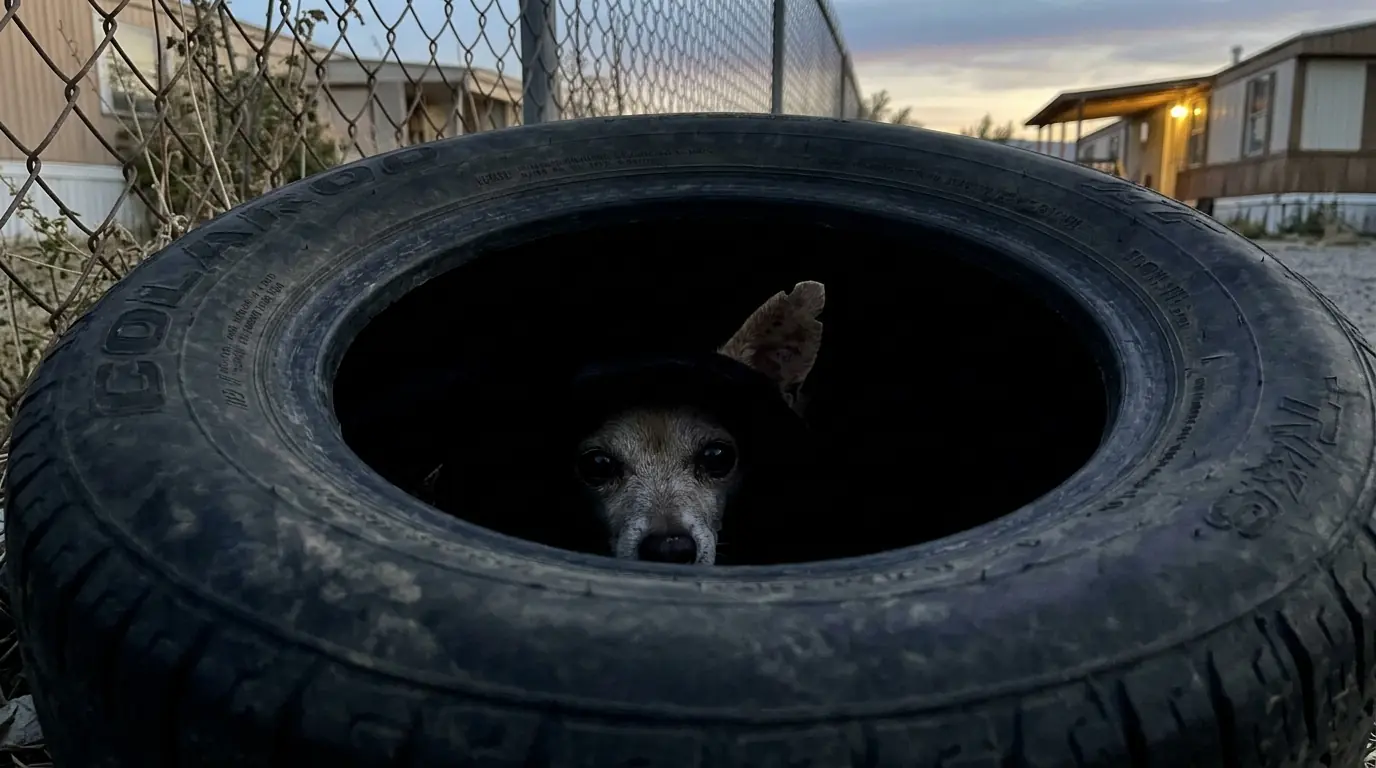
Most people passing the fence would never know Taco was there.
The old tire looks like exactly what it is—something discarded beside the edge of a mobile-home park in New Mexico.
Then, if you look closely into the dark center, two tiny eyes appear.
Below them is the tip of a nose.
The rest of Taco has disappeared inside.
The approximately nine-year-old Chihuahua has learned how to curl his thin body deep within the hollow center of the tire, using the narrow space as a hiding place whenever darkness falls or the sound of an approaching vehicle frightens him.
Sometimes he remains there for hours.
His injured front leg is tucked beneath him.
One ear, permanently changed by an older injury, sits unevenly against his head.
From the road, Taco is almost invisible.
That may be exactly why he keeps coming back.
But the hiding place creates a troubling question of its own.
What has life outside been like for a senior dog when crawling inside an abandoned tire feels safer than remaining where anyone can see him?
Taco Had Been Living Around the Mobile-Home Park for Some Time
Residents had caught glimpses of the little dog in different parts of the area.
Taco was rarely far from cover.
He moved along fences.
He stayed close to structures.
He crossed open spaces quickly when he had to.
At around nine years old, he was no longer a young Chihuahua.
His body showed it.
Taco was thin.
One front leg caused him to limp.
One ear carried evidence of an old injury that had already healed into a permanent change.
Exactly how he had acquired either injury was unknown.
There was no reason to invent an explanation.
The important fact was that Taco was navigating outdoor life with physical problems that had clearly existed for more than a single afternoon.
The Tire Was Different From His Other Hiding Places
During daylight, Taco might shelter beside a structure or stay close to fencing.
But when something frightened him, the tire became especially important.
It lay on its side near the fence.
The opening was just large enough for Taco.
A larger dog would never have fit comfortably.
Taco could.
He lowered his body, stepped through the circular opening, and curled himself into the dark interior.
Once he moved deep enough inside, his tan body nearly disappeared against the shadows.
From several yards away, the tire looked empty.
The Sound of a Vehicle Could Send Him Straight Toward It
Taco did not always wait until a vehicle was beside him.
Sometimes the sound was enough.
An engine approached.
His head lifted.
His body tightened.
Then Taco moved toward the tire.
Because of his limp, the movement was not perfectly smooth.
His front leg shortened one step.
The other compensated.
Still, he hurried as much as his body allowed.
At the tire, he lowered himself and slipped inside.
Seconds later, there was almost no dog left to see.
Only the eyes.
Sometimes just the nose.
Then darkness.
Hiding Is a Normal Survival Strategy for a Frightened Dog
Dogs do not all respond to fear in the same way.
Some increase distance by running.
Some bark.
Some freeze.
Some seek a confined space.
For a very small dog like Taco, hiding can be remarkably effective.
His size allows him to enter places that larger animals and people cannot easily reach.