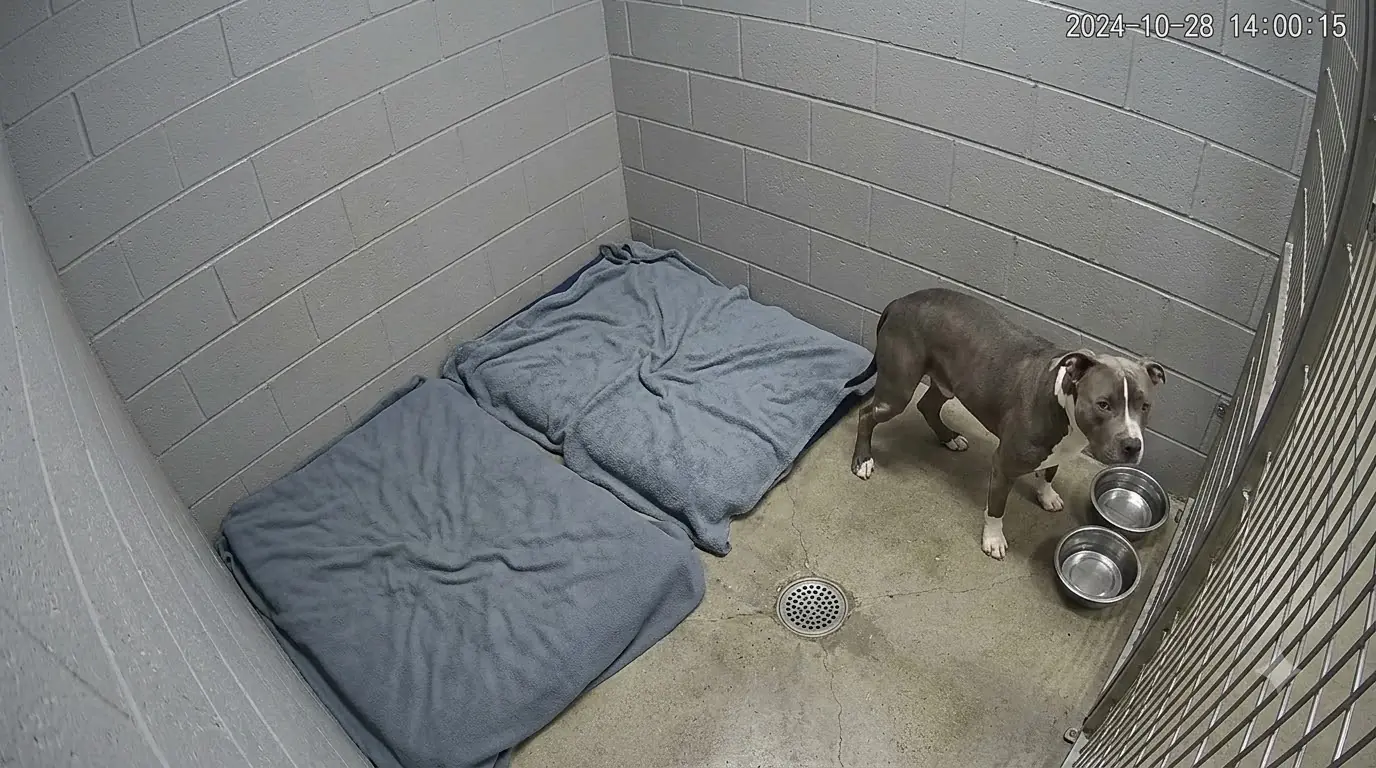
Tank's back leg did not look badly injured.
That was what made the first episode so difficult to understand.
The 8-year-old American Pit Bull Terrier was resting inside his medical kennel when he suddenly spun around.
His attention locked onto one hind leg.
A low growl came from his throat.
Then Tank lunged toward his own limb and bit down.
Hard.
A caregiver immediately moved to stop the episode before Tank could cause serious damage to himself.
Eventually, Tank released the leg.
The frantic movement ended almost as quickly as it had begun.
But Tank did not return to normal.
He lowered himself onto the floor.
His body trembled.
His eyes remained fixed on the same hind leg.
And when he tried to reposition himself, he refused to let that foot touch the ground.
There was still no large wound explaining what everyone had just witnessed.
That became the frightening part.
If Tank wasn't attacking an obvious injury, what was he feeling inside that leg?
At First, Staff Looked for Something Physical on the Surface
The obvious first question was whether Tank had hurt himself.
A cut.
A puncture.
A damaged nail.
Swelling.
Something caught between his toes.
An irritated patch of skin.
Any of those could make a dog suddenly focus on one limb.
But Tank's behavior appeared far more intense than the visible findings could immediately explain.
There was no major external injury that clearly accounted for the episodes.
That did not mean the leg was fine.
It meant the source of the problem might not be easy to see.
Then Tank Did It Again
He had been lying quietly.
Nothing obvious was touching the leg.
Suddenly his head snapped around.
His body twisted.
He growled toward his own hindquarters and began biting at the same limb.
This wasn't casual licking.
It wasn't ordinary grooming.
Tank was biting hard enough that staff worried the behavior itself could become a serious injury.
Once the episode ended, he withdrew again.
Trembling.
Watching the leg.
Keeping it lifted.
Now there was a pattern.
The Shelter Couldn't Treat It as a Behavioral Quirk
Dogs may lick or chew themselves for many relatively common reasons.
Skin irritation can do it.
Allergies can do it.
Parasites can cause intense itching.
Pain can cause attention toward a body part.
Stress can also contribute to repetitive self-directed behavior.
But Tank's episodes had features that demanded closer medical attention.
They began abruptly.
They were intense.
He seemed distressed.
And afterward, he refused to bear weight on the limb.
That last detail was especially important.
Tank Was Acting Like the Leg Hurt Even After the Biting Stopped
Once the episode ended, staff watched what happened next.
Tank did not immediately stand and walk normally.
He remained down.
When he shifted position, the affected leg stayed guarded.
When he attempted to rise, he avoided placing normal weight through it.
His body sometimes continued trembling.
Those observations suggested that whatever triggered the biting could be associated with significant discomfort.
But the location of that discomfort was still uncertain.
Pain Doesn't Always Come From Where a Dog Appears to Feel It
That became an important possibility in Tank's case.
A dog focusing intensely on a hind leg may indeed have a problem in that leg.
But pain and abnormal sensation can sometimes originate farther along the nervous system.
Problems involving nerves or the spine may produce sensations in a limb even when the skin itself looks relatively normal.
A dog cannot tell caregivers that something feels burning, electric, numb, tingling, or suddenly painful.
People only see the response.
For Tank, that response was violent.
Neuropathic Pain Became One of the Questions
Neuropathic pain occurs when the nervous system itself is involved in generating or transmitting abnormal pain signals.
It can be difficult to recognize because the affected area may not contain the kind of visible injury people expect.
Whether that was happening to Tank remained unknown.
But the possibility mattered because repeatedly treating only the surface of his leg would not solve a problem originating in a nerve or elsewhere along the neurological pathway.
The veterinary team needed to evaluate the entire pattern.
His Spine Could Not Be Ignored
Tank's back and neurological function also required attention.
Was there pain when he moved?
Did his gait change before the biting episodes?
Was one hind leg weaker?
Did he drag his toes?
Did his paw placement look abnormal?
Was there discomfort associated with his lower back or another part of the spine?
Could a spinal problem be affecting nerves supplying the limb?
These were questions for veterinary examination.
The shelter could not answer them by looking at Tank's skin.
Staff Stopped Letting Him Walk More Than Necessary
Tank was already refusing to place the affected leg normally.
There was no reason to repeatedly walk him around the medical area to see whether he would eventually use it.
If an orthopedic, spinal, or neurological problem was present, unnecessary movement could increase pain or create additional risk.
His environment was adjusted so essential things were close.
Water.
Bedding.
Care.
Tank did not have to cross the room to prove that his leg still worked.
Then Another Episode Began While He Was Lying Down
That detail caught staff's attention.
Tank had not been running.
He had not just slipped.
He wasn't putting weight through the limb.
He was resting.
Then suddenly his head whipped backward.
His attention fixed on the hind leg.
The growling started.
Tank bit at himself.
The episode had appeared without an obvious external trigger.
That made staff even more interested in what happened immediately before the biting began.
Was There a Warning Sign?
Caregivers started watching Tank more carefully.
Did the muscles in the leg twitch first?
Did he suddenly look toward his hindquarters?
Did his skin ripple?
Did his paw move?
Did his expression change?
Did he become restless?
Was there any unusual movement of the tail or back?
Or did the biting truly appear without warning?
A few seconds before an episode could contain an important clue.
The Team Also Had to Consider Whether These Were Neurological Events
Tank's behavior did not automatically mean he was having seizures.
But unusual episodic behavior can sometimes require neurological investigation.
Certain focal neurological events may look very different from the classic whole-body convulsion many people associate with seizures.
Depending on what part of the nervous system is involved, an episode may produce unusual movements, sensations, or behaviors.
Tank's veterinary team had to keep the differential broad.
The biting itself could not establish the cause.
The Most Immediate Danger Was Tank's Own Teeth
Whatever Tank was experiencing, his reaction could make the situation worse.
A leg with no major external wound could quickly develop one if a powerful dog repeatedly bit it.
Skin could tear.
Soft tissues could be damaged.
Infection could become another concern.
The medical problem underneath the behavior might remain unresolved while a second problem—self-inflicted injury—developed on top of it.
Preventing that became urgent.
Intervention Had to Be Safe
A dog in the middle of an intense pain or neurological episode may behave unpredictably.
Staff could not casually put their hands between Tank's mouth and hind leg.
The goal was to interrupt dangerous self-trauma using methods appropriate to the situation and veterinary guidance while avoiding additional injury to Tank or caregivers.
Punishment was not appropriate.
Tank wasn't being “bad.”
Something was happening that made him turn violently on his own body.
Protective Measures Could Buy Time, Not Provide the Answer
Depending on veterinary guidance and Tank's condition, preventing access to the leg might become necessary to reduce self-injury.
But physically stopping Tank from reaching the limb would only address the immediate danger.
If severe pain, abnormal sensation, or another neurological process was driving the episodes, the sensation could still be present.
Tank might simply be unable to bite the place he was focused on.
That is why protection and diagnosis had to happen together.
Between Episodes, Tank Watched the Leg
This became one of the most unsettling parts of the pattern.
He would lie down.
The frantic biting had stopped.
But his attention remained fixed behind him.
Sometimes Tank stared at the limb for extended periods.
His body stayed tense.
If he repositioned, he seemed reluctant to let the foot touch the floor.
Staff could not know what Tank perceived when he looked at it.
They could only see that the limb continued to matter even after the dramatic episode was over.
A Normal-Looking Leg Was No Longer Reassuring
The absence of a large wound had initially created uncertainty.
Now staff understood that it could not be used as evidence that Tank wasn't hurting.