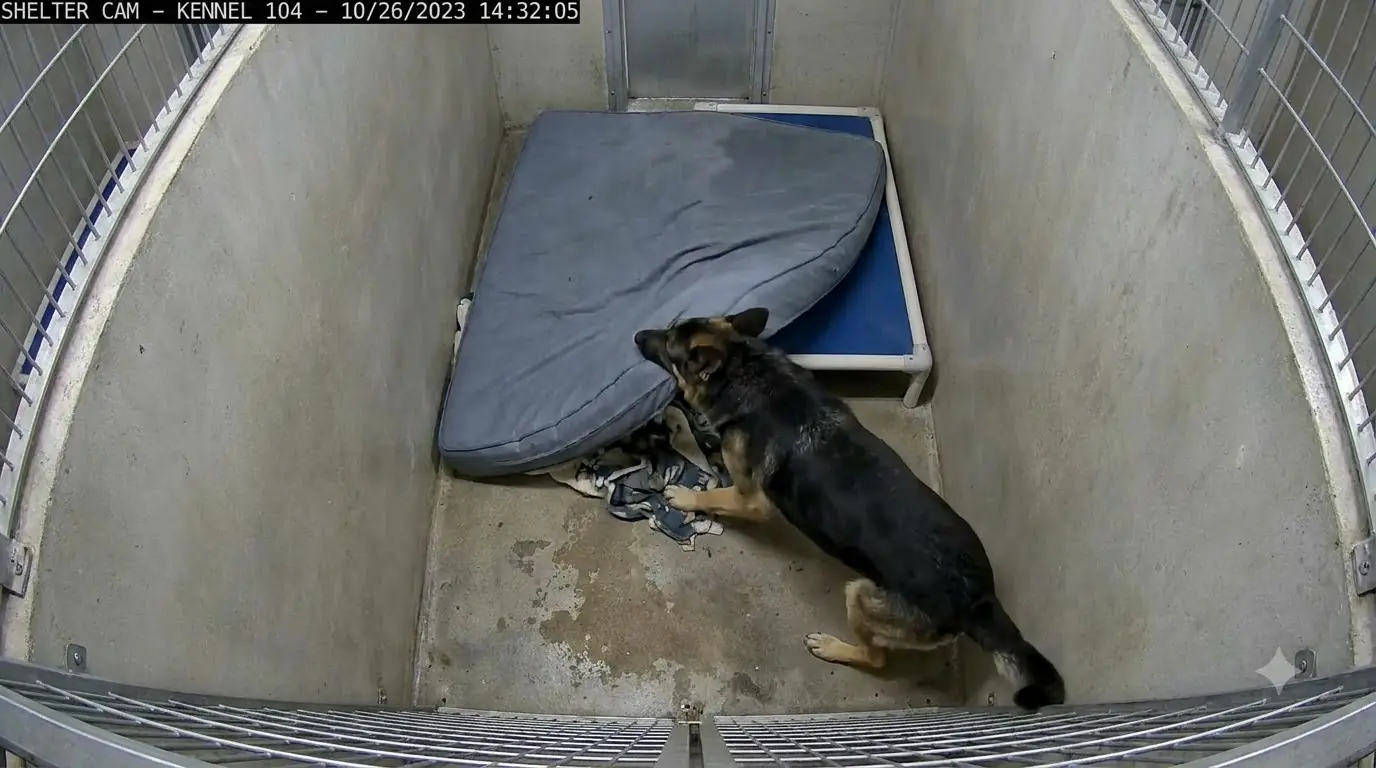
Tank could be completely still when it started.
The 9-year-old German Shepherd would be lying on his mattress inside the shelter kennel, sometimes appearing settled after another restless period of pacing.
Then, without an obvious warning, he would spring up.
His head snapped toward the bedding.
His jaws closed around the mattress.
Tank pulled hard.
Released it.
Bit again.
He pawed at the surface and yanked the edge upward as though something beneath it had suddenly become intolerable.
Seconds later, he abandoned the bed entirely.
Tank rushed toward the metal kennel door.
Then he stopped.
His body pressed against the bars.
His legs trembled beneath him.
From the hallway, the entire episode could easily look like a dog suddenly becoming destructive.
But then a shelter worker entered the kennel and did something simple.
They didn't touch Tank.
They sat down against the wall.
Tank looked toward them.
He didn't charge over.
He slowly lowered himself to the floor.
Then he began crawling.
When he finally reached the worker, Tank pushed his head between the person's knees and stayed there.
His body was still shaking.
That was when staff began asking a different question.
What if Tank wasn't attacking his bed because he wanted to destroy it?
What if something was happening to him?
The Pacing Had Started Before the Mattress Episodes
Tank had already been showing changes.
He became restless.
He walked around the kennel more than usual.
Sometimes he seemed unable to remain settled for long.
He would lie down.
Get back up.
Move elsewhere.
Circle.
Then try again.
In a senior dog, that kind of change deserves attention.
Restlessness can have many possible explanations.
Pain can make lying in one position uncomfortable.
Anxiety or environmental stress can interfere with settling.
Some medical conditions can cause agitation.
Changes involving the nervous system or cognition can also alter behavior.
The shelter could observe Tank pacing.
It could not determine the cause from pacing alone.
Then the mattress episodes began.
The First One Looked Like Destruction
A caregiver heard movement from Tank's kennel.
When they looked over, Tank had the mattress between his teeth.
He was pulling with enough force to move it across the floor.
His front paws dug into the bedding.
He released it and immediately grabbed another section.
Then, almost as suddenly as he had started, Tank stopped.
He moved away from the mattress.
He went straight to the kennel gate.
There he stood trembling.
That final part did not fit neatly with a dog simply entertaining himself by tearing up bedding.
Tank did not look relaxed afterward.
He did not settle down with the mattress.
He appeared profoundly unsettled.
Then It Happened Again
Tank was resting.
There was no obvious interaction occurring at the kennel gate.
Suddenly, he got up.
The mattress became the focus again.
Bite.
Pull.
Release.
Paw.
Bite again.
Then Tank fled from it.
This time staff paid attention to the entire sequence rather than only the damage to the bed.
The behavior seemed episodic.
There was a period before it.
A sudden burst of abnormal activity.
Then a visibly distressed period afterward.
That pattern was important.
Staff Stopped Calling It “Bad Behavior”
A shredded mattress is inconvenient.
But replacing bedding is not the biggest concern when a senior dog suddenly develops a new, intense behavior.
Tank was 9.
This was a change.
And behavior changes can sometimes be one of the first visible signs that an animal is uncomfortable or medically unwell.
So caregivers resisted the simplest interpretation.
Tank was not punished.
Nobody shouted at him for damaging shelter property.
Nobody assumed he needed stricter discipline.
Instead, the veterinary team needed to know what staff had been seeing.
Pain Was One Possibility
Tank could not point to a painful area.
He could not explain whether lying on the mattress made something hurt.
But pain can alter behavior in unexpected ways.
A dog that cannot become comfortable may repeatedly reposition itself.
It may appear restless.
It may suddenly react to movement or pressure.
It may become reluctant to use a particular resting position.
That did not prove pain was causing Tank's episodes.
It simply meant pain had to remain on the list of possibilities.
Especially in a senior dog whose behavior had changed.
Panic or Severe Stress Could Look Dramatic Too
The shelter itself can be a difficult environment for some dogs.
Noise comes unpredictably.
Dogs bark.
Metal doors move.
People appear and disappear.
Tank's trembling at the gate and the way he sought proximity to a quiet caregiver raised another possibility: the episodes could have a strong fear or panic component.
But staff could not diagnose an anxiety disorder from one scene either.
The important point was that Tank looked distressed.
Whether that distress originated primarily from his environment, his body, his nervous system, or some combination still needed investigation.
The Neurological Question Couldn't Be Ignored
Tank's age and the unusual, sudden nature of the episodes also made neurological causes something the veterinary team needed to consider.
Abnormal behavior can sometimes accompany neurological disease.
Depending on what was happening, veterinarians would want to know whether Tank showed other changes too.
Was his gait normal?
Did he appear disoriented?
Was he circling consistently in one direction?
Did he respond normally during an episode?
Were there unusual movements?
Did he seem aware of his surroundings immediately afterward?
Had his sleep pattern changed?
Did he stare at walls or objects?
Were there any other signs suggesting altered neurological function?
The mattress could not answer those questions.
Careful observation might.
Then a Worker Entered During the Aftermath
Tank had already abandoned the bed.
He was standing at the gate.
His body was pressed close to the bars.
His legs trembled.
A shelter worker opened the kennel slowly.
Tank did not rush toward them.
The person did not immediately approach him either.
They walked to the side wall.
Then sat on the floor.
Several feet separated them.
Tank remained near the gate.
For a while, nothing changed.
Then his posture lowered.
Tank Started Moving Toward the Person
Not running.
Not jumping into their lap.
Tank lowered himself until his body was close to the floor.
He moved forward.
Stopped.
Then crawled farther.
The worker remained seated.
No hands reached toward him.
Tank closed the distance himself.
When he reached the person's legs, he collapsed down beside them.
Then he pushed his muzzle forward.
His forehead disappeared between the worker's knees.
Tank stayed there.
His body was still trembling.
That Moment Changed How Staff Looked at the Bed
The mattress had been the most dramatic part of the episode.
But perhaps it wasn't the most important.
Tank's behavior afterward suggested that whatever had just occurred had left him needing time to settle.
The worker's presence did not instantly stop the shaking.
There was no miraculous transformation.
But Tank chose to remain close.
And unlike the frantic activity around the mattress, his movements gradually became quieter.
Staff could not conclude that human contact was “curing” the episodes.
They could, however, recognize that low-pressure companionship seemed easier for Tank to tolerate afterward than demands or restraint.
Nobody Forced Him Back Onto the Mattress
If the bed itself had somehow become associated with discomfort during an episode, immediately putting Tank back onto it would accomplish little.
Caregivers instead focused on keeping him safe and comfortable.