Tank’s Face Is So Badly Swollen He Can Barely Open One Eye—And the Wounds Around It Raise an Even Bigger Concern
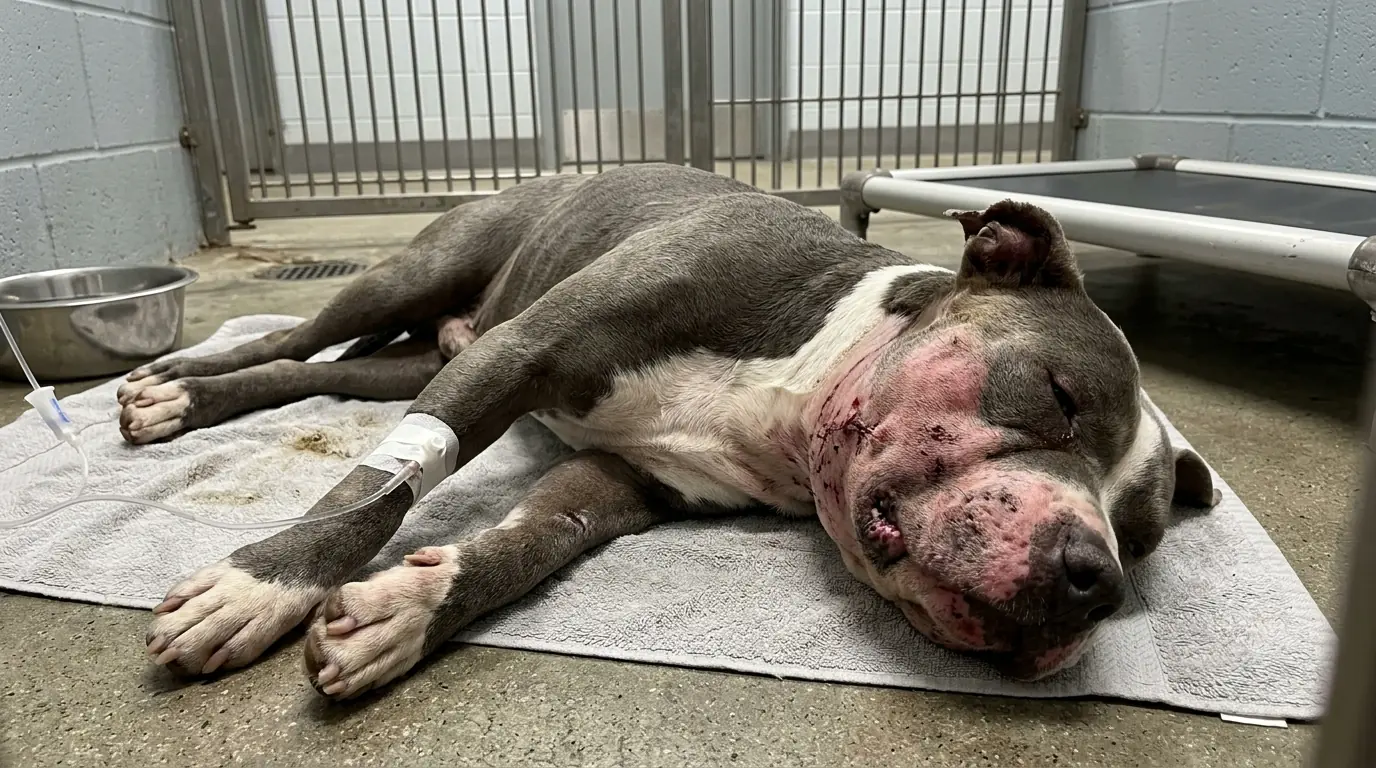
When Tank arrived at the shelter, it was difficult to know where to look first.
The five-year-old American Pit Bull Terrier was exhausted, dirty, and visibly underweight from what appeared to have been a long stretch of surviving outdoors. But it was his face that immediately drew the attention of the medical team.
One side was badly swollen.
His cheek looked enlarged and distorted beneath several irritated wounds. Patches of fur around the injured areas were missing, and part of the surrounding skin had already been shaved so staff could examine what was happening underneath.
One ear also carried an older tear that appeared to have healed unevenly.
Most concerning of all, Tank could barely open one of his eyes.
He lay flat on a towel in the recovery kennel with his head tilted toward the less painful side. From a distance, he almost looked as though he were sleeping.
Up close, however, it was obvious that Tank was dealing with much more than exhaustion.
And the swelling was only the beginning of what the shelter needed to understand.
No One Knew How Long Tank Had Been Living Like This
Tank had been found wandering alone before he was brought into shelter care.
There was no medical history attached to him. No one could tell staff when the first wound appeared, how the damage to his ear occurred, or exactly how long the swelling had been developing.
That uncertainty mattered.
A fresh superficial injury can look frightening while remaining relatively straightforward to treat. A wound that has been contaminated and left untreated for days, however, can become a much more complicated medical problem.
Tank's condition suggested that whatever had happened to him had not happened moments before he was found.
His body showed the accumulated effects of life outside.
His coat was rough. Several areas of skin around his face were irritated. His old ear injury was another reminder that this was probably not the first time Tank had been hurt.
But the medical team could not simply look at him and create a story about his past.
They had to work with what they could actually see.
And what they could see was enough to make his facial swelling a priority.
The Swelling Was Affecting More Than Tank’s Appearance
Facial swelling can have many possible causes in dogs, ranging from trauma and localized infection to abscesses, dental disease, allergic reactions, insect or animal bites, and other underlying conditions.
With Tank, the nearby wounds made infection and trauma important possibilities to investigate.
But shelter staff could not assume that the obvious wounds explained everything.
The location of the swelling was especially concerning because it extended toward his eye.
Tank's eyelids were so swollen that one eye remained almost completely closed while he rested.
That made it important to determine whether the eye itself had been injured or whether swelling in the surrounding tissue was simply preventing him from opening it normally.
There was another concern as well.
Pain.
Dogs do not always express pain in ways people expect. Some cry or whimper, but others become extremely quiet. They may stop moving, lower their head, avoid being touched, refuse food, or simply remain in one position for long periods.
Tank was quiet.
Very quiet.
He spent much of his early time in the medical kennel lying with his body pressed against the bedding and his swollen cheek angled carefully to one side.
Every movement seemed deliberate.
When sounds came from the hallway, his better eye would sometimes open.
His ears might shift slightly.
But he rarely lifted his entire head.
For a strong adult pit bull who should have been capable of much more movement, that stillness said something important.
Tank did not need to make noise for staff to understand that he was uncomfortable.
The First Goal Wasn’t to Make Tank Look Better
The shaved patches around Tank's face made his appearance even more dramatic.
But they served a practical purpose.
Dense fur can hide the true boundaries of a wound. Clipping hair away gives veterinary professionals better access to the skin and makes it easier to examine, clean, and monitor an injured area.
What mattered was not restoring Tank's appearance.
It was figuring out what was happening underneath the swelling.