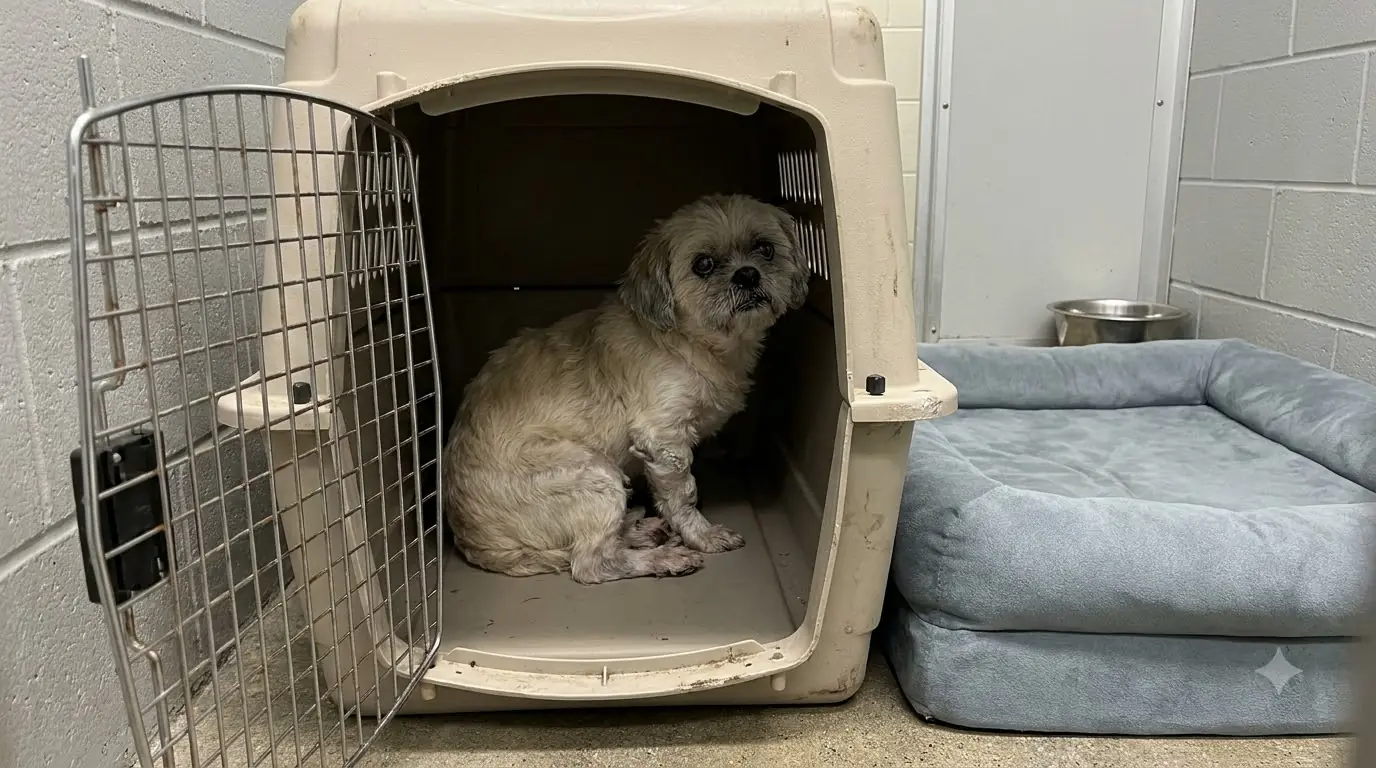
Teddy has more room now.
There is a soft bed in his kennel, enough space to stretch his legs, and no closed crate door keeping him confined.
But when the senior Shih Tzu mix is given the choice of where to rest, staff often find him somewhere else.
Inside an open carrier.
He walks slowly toward it, lowers his stiff body, and crawls through the opening. Then Teddy turns as much as his body allows and folds himself into the back corner.
His legs tuck underneath him.
His spine curves.
His entire body becomes remarkably small.
Staff initially wondered why a dog with so much more space available would repeatedly choose the tightest place in the kennel.
Then they considered the condition Teddy had been in when rescuers found him.
It Wasn't Just a Crate He Had Been Sleeping In
Teddy had been rescued from an apartment where he had apparently spent far too much time confined inside a crate that was too small for normal movement.
By the time he came into care, the consequences were visible.
His back was stiff.
His hind legs were weak.
Several areas of his skin had developed thickened, callused patches where his body had repeatedly pressed against hard surfaces.
Teddy could move, but he did so cautiously.
Standing up required effort.
Turning could be awkward.
Stretching his body into a normal position was not something he seemed immediately comfortable doing.
Staff could not reconstruct every hour Teddy had spent before rescue.
But his physical condition made one thing clear: this was not simply a senior dog who preferred sleeping in small spaces.
His body needed attention.
His Age Was Only Part of the Mobility Problem
Because Teddy was a senior, some stiffness would not necessarily have been surprising.
But the rescue could not assume age explained everything.
Prolonged restriction can contribute to loss of muscle strength and reduced mobility, particularly in an older dog who has had too few opportunities to move normally.
The veterinary team therefore had to look at Teddy as a whole.
His gait.
His hind-leg strength.
His ability to rise and turn.
The condition of his skin.
His comfort when different parts of his body were handled.
And, importantly, how much movement he could tolerate without becoming exhausted or uncomfortable.
There was no expectation that Teddy would arrive, receive a soft bed, and suddenly begin moving like a younger dog.
His body had adapted to a very restricted life.
Changing his surroundings was immediate.
Changing what that life had done to his body would take much longer.
Then Teddy Started Choosing the Carrier
The rescue had prepared a larger sleeping area for him.
There was room to lie on his side.
Room to reposition.
Room to stretch out in a way that would reduce constant pressure on the same areas of skin.
Teddy sometimes used it.
But staff kept finding him inside the open carrier.
At first, they simply moved him back toward the bed.
Then he returned.
Another time, the carrier was left open after routine handling.
Teddy crawled inside again and folded himself into the corner.
He wasn't being locked in.
Nobody was putting him there.
The door remained open.
Still, he kept choosing it.
That was when staff stopped treating the behavior as something they simply needed to correct.
His Body Still Folded Into the Same Small Shape
The way Teddy rested was particularly striking.
Even with space available, he often tucked himself tightly together.
He did not immediately stretch his hind legs behind him.
He did not sprawl across the middle of the kennel.
He made himself compact.
It would be tempting to say Teddy believed he was still trapped or that he did not understand he was free.
Staff could not know that.
What they could see was a senior dog repeatedly returning to a confined resting position after apparently living with severe restriction for an extended period.
Familiarity, physical comfort, habit and the security some dogs find in enclosed spaces could all influence that choice.
So staff decided not to force Teddy out.
Instead, they changed what happened around him.
They Made the Larger Space Easier to Choose
Teddy's carrier remained available when it was safe to do so.
But his caregivers also worked to make his other resting options comfortable and easy to access.
His bedding was kept close.
He did not have to cross a slippery floor to reach it.
His environment was arranged so his weak hind legs did not have to work harder than necessary.
And his medical needs became part of the daily routine.
The callused areas of skin needed monitoring.
His mobility needed support appropriate for an older dog.
His activity had to increase gradually rather than being forced simply because he finally had room to move.
Staff wanted Teddy using his body again.
They did not want him pushed beyond what that body could currently manage.
Then they noticed the first small change.
One Day, Teddy Came Out and Didn't Immediately Go Back
He crawled from the carrier.
Straightened as much as he comfortably could.
Then took several slow steps across the kennel.
His hind legs were still weak.
His gait still looked stiff.
But instead of turning around and disappearing back inside, Teddy stopped beside the larger bed.
He sniffed it.
Put one front paw onto the bedding.
Then another.
Eventually, he lowered himself down.
He did not stretch out.
Not yet.
He curled tightly there too.
But this time, he had chosen the larger bed.
For staff, that mattered more than whether Teddy looked perfectly relaxed.
His Progress Started Showing Up in Inches
There was no dramatic transformation.
Some days Teddy still preferred the carrier.
Sometimes he would use the bed during the day and return to the smaller space later.
His physical improvement was equally gradual.
A slightly easier rise.
A few more steps before resting.
A little less hesitation when repositioning his hindquarters.
Staff continued watching for discomfort because an older dog with stiffness and weakness may require ongoing management rather than a simple rehabilitation timeline.
The goal was not to make Teddy run.
It was to help ordinary movements become easier.
Standing.
Turning.
Walking to his water.
Changing sleeping positions.
And eventually, perhaps, discovering that his body no longer needed to remain folded into such a small space.
The First Time He Stretched Out Got Everyone's Attention
It happened on the larger bed.
Teddy had already been sleeping there for a while when one of his caregivers noticed that his position looked different.
His body wasn't curled as tightly as usual.
One hind leg extended farther away from his belly.
Then Teddy shifted again.
His torso lengthened across the bedding.
It wasn't a dramatic stretch.
He didn't suddenly straighten every stiff joint.
But he was occupying more space than staff were accustomed to seeing him use.
For a dog who repeatedly folded himself into the corner of a carrier, that small change was difficult to overlook.
Nobody disturbed him.
They let him sleep.
Teddy Still Has a Senior Body
More room cannot erase what prolonged confinement may have contributed to.
Neither can a few weeks of better care erase age-related changes that may exist independently of his previous living conditions.
Teddy's caregivers continue to pay attention to his comfort, mobility and skin.
He needs appropriate movement without being overworked.
He needs surfaces that give his feet traction.
He needs bedding that reduces pressure on the areas that have already been callused.
And he needs time.
There is no benefit in forcing him to demonstrate that he no longer wants the carrier.
The important change is that he is beginning to have other choices.
He Still Crawls Inside
The carrier has not lost its appeal.
There are still times when Teddy walks toward the opening, lowers himself carefully and disappears into the back.
Then he turns.
Tucks his weak hind legs close.
And curls himself into that familiar small shape.
The door stays open.
That is the part that matters now.
Nobody closes it behind him.
And increasingly, Teddy comes back out on his own.
Sometimes he walks to his water.
Sometimes he watches activity from the kennel entrance.
Sometimes he chooses the larger bed instead.
His Kennel Looks Very Different From the Place He Came From
Teddy can stretch out if he wants to.
He can change positions.
He can leave his resting place.
He can walk away from the carrier.
His body is still learning what to do with that extra room.
That may take longer than changing the room itself did.
So staff are not measuring Teddy's progress by whether he stops entering the carrier altogether.
They are watching something smaller.
Whether he can comfortably come back out.
Whether he spends a little longer elsewhere.
Whether his legs become stronger.
Whether his resting positions gradually change.
Whether he begins using the space that is finally available to him.
And Some Nights, Teddy Still Chooses the Smallest Corner
He crawls into the same open carrier and curls up until his senior body seems far smaller than it really is.
It is the behavior that first made staff stop and look more closely at what his previous confinement may have left behind.
But now there is another image too.
A soft bed only a short distance away.
An open carrier door.
And Teddy slowly emerging from it when he is ready.
He may still return to the small space he knows.
The difference is that now, Teddy is finally allowed to leave it.