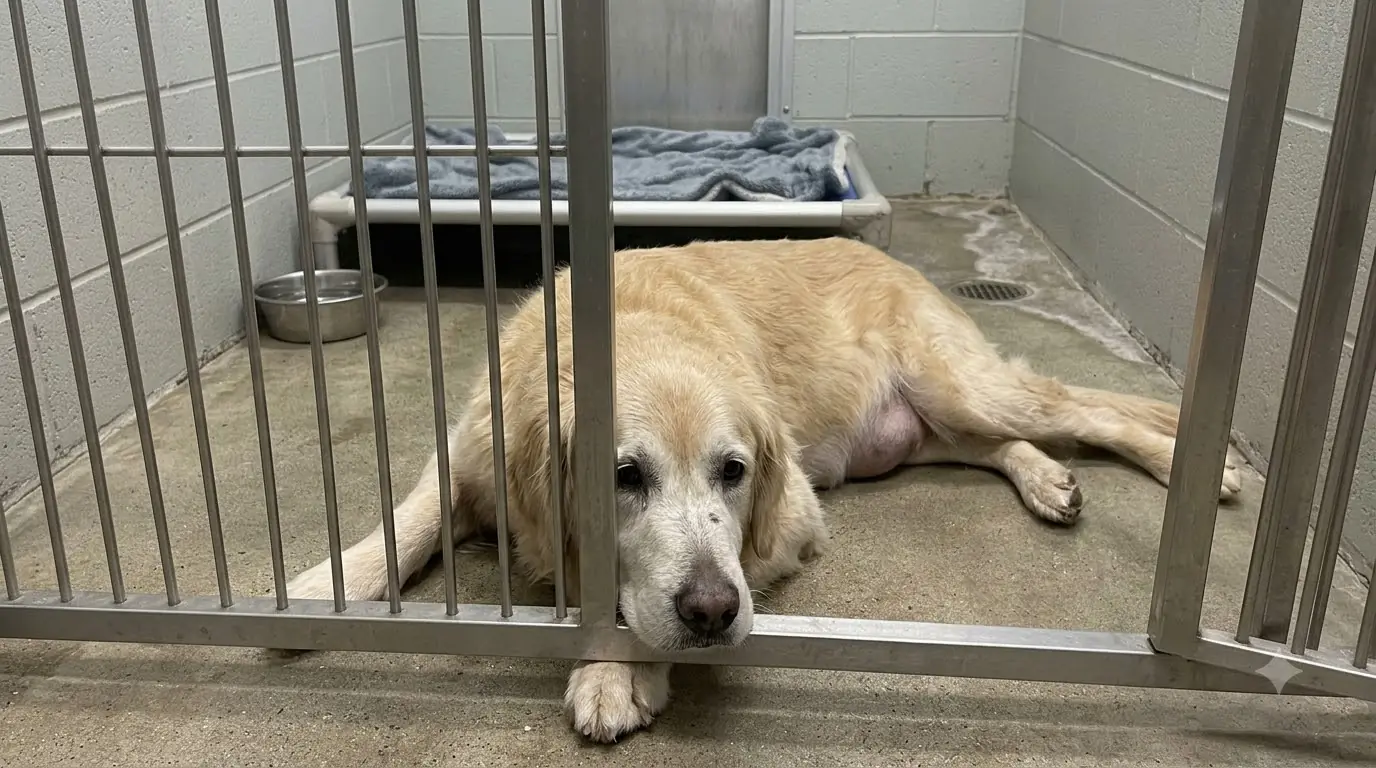
Teddy's bed is only a few feet from the kennel gate.
For a healthy dog, the distance would mean nothing.
For the 12-year-old Golden Retriever, it has become a journey.
Teddy is living with a large abdominal mass, and his body has become severely depleted. His hind legs can suddenly buckle even when he has been standing for only a few seconds.
Most of the day, he remains on his orthopedic bed.
Then someone stops outside the kennel.
Teddy notices.
His head lifts.
His front paws shift beneath him.
And despite everything his body is telling him, he tries to get up.
The First Few Steps Are Usually the Hardest
Teddy pushes through his front legs first.
His chest rises.
Then he works his hindquarters underneath himself.
For a moment, all four feet are on the floor.
He takes one step.
Then another.
His rear legs begin trembling.
Sometimes he makes it halfway.
Sometimes he barely gets off the bed.
Then his hindquarters collapse.
Teddy goes down.
Staff move toward him, expecting the attempt to be over.
But Teddy rests for a moment.
Then his front legs start working again.
He Doesn't Stand the Second Time
Often, Teddy no longer has enough strength to get fully upright.
So he changes how he moves.
He plants his front paws.
Pulls his chest forward.
His weakened hindquarters follow across the floor.
A few inches.
Pause.
Another pull.
Then another.
The visitor may still be standing at the gate.
Teddy keeps going.
Eventually, his muzzle reaches the bars.
That is where he stops.
Staff Began Realizing the Greeting Was Costing Him Too Much
At first, Teddy's effort was hard not to admire.
He fell.
He kept going.
He reached the gate anyway.
But medically, the pattern was not reassuring.
Teddy was already weak.
His hind legs were failing unpredictably.
A large abdominal mass was placing additional concern around his overall condition.
Repeatedly crossing the kennel until he collapsed was not a harmless routine.
It was a sign that his body could no longer support the behavior he still wanted to perform.
The Tumor Changed the Bigger Picture
Teddy's caregivers could not look at his weak legs in isolation.