Teen’s “Genius” Escape Plan Backfires, Ends With a 71-Year Sentence
At around 2:40 in the afternoon on December 3, 2021, a police officer in Solon, Ohio, noticed a blue Ford Fusion moving through the city.
There was nothing immediately dramatic about the scene.
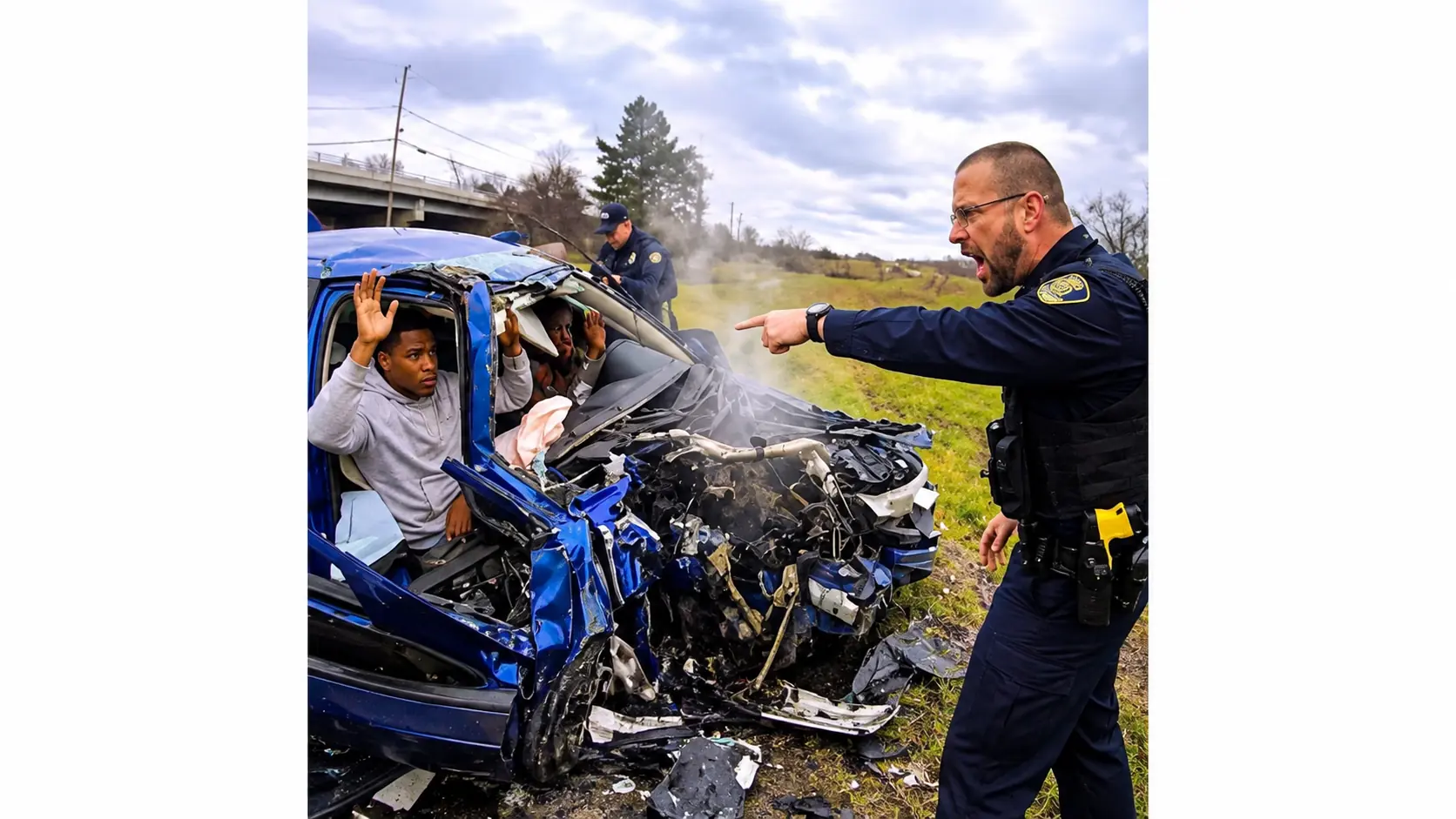
It was the middle of the day. Traffic was moving. People were going about their normal routines. Drivers were heading through intersections with no reason to believe that, within minutes, one of those ordinary stretches of roadway would become the scene of a violent crash.
The officer did what police officers do thousands of times every day.
He ran the vehicle’s registration.
That simple computer check changed everything.
The Ford Fusion had been reported stolen.
And it had not simply disappeared from a parking lot or been taken while someone left the keys inside.
According to the information connected to the vehicle, it had been stolen at gunpoint during an aggravated robbery in Cleveland just one day earlier.
That meant whoever was driving it might not be dealing with a simple auto-theft investigation.
There was already the possibility of a firearm.
There was already the possibility of violence.
The officer initiated a traffic stop.
What he could not know yet was that the two young men inside that Ford had a history that was becoming more serious by the day.
He could not know exactly what had happened when the Ford was taken.
He could not know that another victim had reportedly been shot during the carjacking.
He could not know how desperate the suspects might be to avoid being arrested.
And he certainly could not know that, before this pursuit was over, an innocent woman would lose her life.
The patrol car moved into position.
Emergency lights came on.
Instead of pulling over, the Ford accelerated.
The driver was running.
Over the police radio came the first urgent update.
The stolen vehicle was eastbound on Solon Road.
It was taking off.
A traffic stop had just turned into a pursuit.
The officer followed.
At first, the numbers were concerning but not extraordinary for a fleeing vehicle.
Sixty miles an hour.
Then faster.
Traffic lights.
Intersections.
Other cars.
The pursuit continued east.
The speed climbed.
Seventy-five miles an hour.
The Ford passed through the area while officers communicated over the radio, trying to anticipate where it might go.
The driver was not slowing down.
He was not looking for a safe place to surrender.
He was putting distance between himself and the cruiser behind him.
Inside the stolen Ford were two young men.
The driver was identified in the source material as 19-year-old J. Marlin Hayes.
In the passenger seat was 20-year-old Rontel Parks.
They were barely out of their teenage years.
But according to the case account, neither of them was entering the criminal justice system for the first time.
J. Marlin had already been caught distributing drugs at 18.
More importantly, both young men had allegedly been involved in another vehicle theft only four days earlier, on November 29.
In that incident, according to the account, a vehicle owner had been threatened with a firearm.
The suspects demanded her wallet.
Then they drove away in her vehicle.
Four days later, they were now inside another stolen car.
And this time, a police officer was behind them.
The Ford raced farther ahead.
Officers attempted to coordinate.
They discussed possible roads.
Possible turns.
Possible escape routes.
The pursuing officer eventually lost sight of the vehicle as it rounded a bend and moved out of Solon toward the surrounding area.
That moment created a difficult decision.
High-speed pursuits are inherently dangerous.
The suspect vehicle may be dangerous.
But the police vehicles chasing it can also increase the danger to everyone else on the road.
The farther the Ford got ahead, the less control the pursuing officer had over the situation.
Eventually, the officer announced that he was terminating the active pursuit for the time being.
The Ford had gained significant distance.
Rather than continue blindly at dangerous speeds, officers could spread out and watch the major routes.
Maybe the suspects would double back.
Maybe another unit would spot them.
Maybe police could get ahead of the vehicle instead of simply chasing from behind.
For a few moments, it might have seemed as if the immediate danger was decreasing.
The primary cruiser was no longer right behind the Ford.
But the suspects had not stopped.
They had not abandoned the vehicle.
And they had not decided to surrender.
They were still moving through an area filled with people who had absolutely nothing to do with the crimes that had brought police to the scene.
More officers were alerted.
Units positioned themselves along likely routes.
Police discussed intersections where they might safely watch for the Ford.
They considered using stop sticks.
The concept is simple.
A strip of spikes is placed across or near the roadway.
If the fleeing vehicle drives over it, the tires are punctured.
Ideally, the tires slowly lose air, reducing the vehicle’s ability to continue at high speed.
But deploying stop sticks during a pursuit is dangerous.
An officer often has to get close enough to the roadway to place or throw the device into the path of a vehicle that may be traveling seventy, eighty, or even ninety miles per hour.
And if a fleeing driver sees the spikes at the last moment, there is always the possibility that he will swerve.
That possibility was about to become critically important.
As units converged, a sergeant spotted the stolen Ford again.
The radio traffic immediately changed.
The car was coming.
It had one headlight.
It was traveling at around eighty miles per hour.
And it was swerving.
One officer warned another that the Ford was coming directly toward him.
The words over the radio came quickly.
The situation was happening too fast for anyone to pause and carefully calculate every possible outcome.
Then came the impact.
A violent crash.
Almost immediately, officers began shouting for additional units.
What had been a vehicle pursuit was now a mass-casualty scene.
The blue Ford had collided with a white pickup truck carrying an elderly couple.
Another vehicle was also struck.
The roadway became a chaotic mixture of wrecked vehicles, injured people, police officers, damaged metal, shattered glass, and uncertainty.
No one yet knew exactly how badly everyone was hurt.
No one knew whether the suspects were still armed.
No one knew whether there were additional occupants inside the stolen Ford.
And no one knew that one of the innocent people caught in the crash was in the final hours of her life.
Officers rushed toward the vehicles.
Commands were shouted at the suspects.
Hands where they could be seen.
Do not move.
Do not reach.
Stay where you are.
The officers were suddenly forced to perform two very different jobs at the same time.
The people inside the stolen Ford were suspected of fleeing police in a stolen vehicle associated with an armed robbery.
They could be dangerous.
But they were also injured.
The innocent people in the vehicles they had struck needed immediate medical attention.
And officers had only seconds to decide who needed help first and how to provide that help without exposing themselves or anyone else to a weapon.
One of the first civilians officers reached was an elderly man.
He was bleeding.
He told them he was on blood thinners.
That statement matters in an emergency.
An injury that might be manageable for someone else can become far more dangerous for a person taking medication that reduces the blood’s ability to clot.
The man was identified as 89-year-old Norman Schultz.
His immediate concern was not himself.
It was his wife.
He asked officers to check on her.
His wife, 85-year-old Sally Schultz, was inside the white pickup truck.
She was shaken.