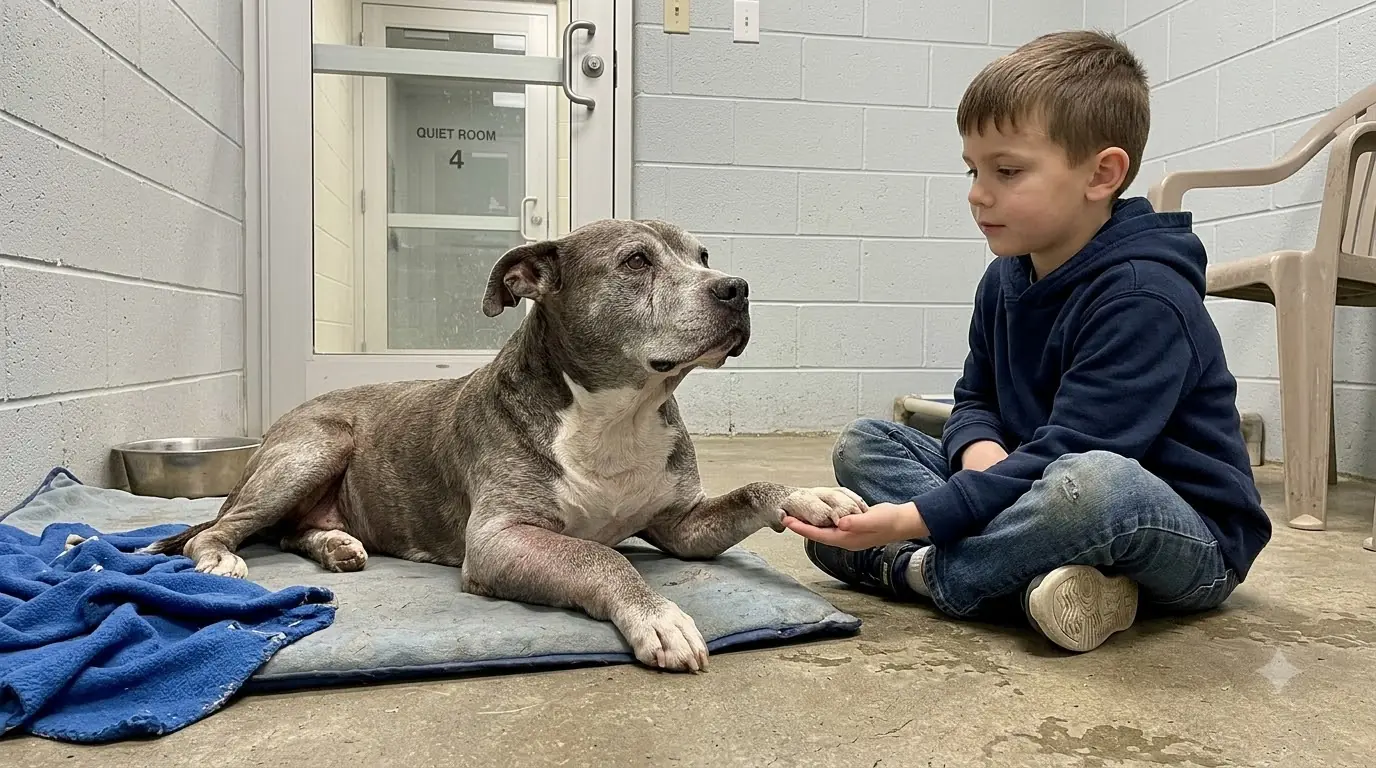
The boy was not asked to touch her.
He was simply asked to sit quietly beside the mattress.
The senior Pit Bull mix was resting in one of the shelter's quiet rooms, away from the constant movement of the main kennel hallway. One of her front legs was visibly swollen. Even at rest, the difference between the two forelimbs was difficult to miss.
Bone cancer had changed the way she moved.
Walking hurt.
Standing required thought.
Turning too quickly could leave her struggling to rebalance.
So when the boy lowered himself onto the floor beside her, staff expected the dog to remain exactly where she was.
For several minutes, that was what happened.
The boy kept a respectful distance. He did not lean over her. He did not reach toward the swollen limb. He rested one hand loosely on the floor, palm facing upward.
The dog watched him.
Then her weight shifted.
Not through the painful leg.
Through the other one.
Slowly, she lifted her healthier front paw from the mattress.
She extended it toward him.
Her paw landed in the middle of his open hand.
The boy looked toward the shelter staff before doing anything else.
They told him he could remain still.
So he did.
His fingers did not close tightly around her paw. He simply let it rest there.
After a while, he moved his hand.
Her paw returned to the mattress.
A few seconds passed.
Then she lifted it again.
She reached toward the place his hand had been.
The boy put his palm back down.
Her paw settled into it.
That happened again before the visit ended.
And then again.
For a dog whose body had made movement increasingly expensive, staff could not ignore the fact that she kept choosing to make this one.
The Swollen Leg Had Been the First Warning
Her cancer diagnosis had not begun with a dramatic emergency.
It began with a limp.
The senior Pit Bull mix had been favoring one front leg, and the limb appeared enlarged in a way that could not be explained simply by normal age-related stiffness.
Senior dogs limp for many reasons.
Arthritis is common.
Soft-tissue injuries happen.
Nail and paw problems can alter gait.
Joint disease can cause pain.
A dog can compensate for discomfort elsewhere in the body.
That was why shelter medical staff did not look at an older dog with a limp and automatically decide they knew the cause.
They examined her.
The swelling made further investigation necessary.
Her orthopedic examination identified significant pain associated with the affected limb. The enlargement appeared to involve more than superficial tissue.
Radiographs followed.
The images raised the concern everyone had hoped not to find.
The bone itself was abnormal.
Further veterinary assessment supported a diagnosis of primary bone cancer, consistent with osteosarcoma.
It explained the swelling.
It explained the worsening limp.
And it changed nearly every decision the shelter would make for her from that point forward.
There Was No Simple Way to Make the Leg Normal Again
Bone cancer is not a swollen joint that can simply be rested until it improves.
The disease damages bone from within.
As affected bone becomes structurally compromised, pain can become substantial and the risk of a pathologic fracture becomes an important concern.
That meant shelter staff had to think about the senior dog's movement differently.
Her walks were not opportunities to push endurance.
Her limp was not something to rehabilitate through.
The swollen limb needed protection.
Comfort became central.
The medical team considered her entire condition rather than one radiograph in isolation: her age, overall health, extent of disease, pain level, mobility, quality of life, and what treatment options were realistically available.
The rescue also had to be careful about what it promised.
Cancer treatment does not guarantee cure.
Palliative care does not mean giving up.
And a good day does not mean the disease has disappeared.
For this dog, every plan had to begin with the same question.
Was she comfortable enough to enjoy what she was doing?
The Quiet Room Became Her Main Space
The regular kennel environment was simply too busy.
Dogs rushed toward gates.
Bowls moved.
Doors opened.
Excited animals could pull toward one another in hallways.
Even an accidental collision could be dangerous for a dog with a bone weakened by cancer.
So she was given a quieter setup.
Her mattress was thick and supportive.
The floor around it had traction.
Food and water were positioned close enough that she did not need to make unnecessary trips.
Her route outside was kept short and controlled.
Staff avoided situations that might cause her to pivot sharply or jump.
Nobody wanted her slipping.
Nobody wanted her trying to keep up with a younger dog.
Nobody wanted a moment of excitement to become a medical emergency.
At first glance, it could have looked like her world had become very small.
In reality, staff were trying to make that smaller world comfortable enough that she could still make choices inside it.
She Still Wanted Company
Cancer had changed her mobility more than her interest in people.
When familiar caregivers entered, her eyes followed them.
Sometimes her tail moved against the bedding.
That movement was never treated as proof that she was pain-free or automatically happy. Tail movement has to be read with the rest of a dog's body.
What mattered more was what she chose to do.
She accepted people sitting near her.
She sometimes shifted closer.
She remained relaxed during quiet contact.
She ate treats when her appetite was good.
She sniffed new blankets.
She watched activity from the doorway.
And occasionally, she offered a paw.
Staff had seen versions of the behavior before.
But the interaction with the boy made them pay closer attention to it.
The Child Had Been Given Very Specific Instructions
The boy was visiting the shelter with an adult.
Because of the dog's condition, any interaction had to be controlled.
He was told about the painful leg.
He understood that he should not touch it.
He was asked not to hug her.
He should not climb onto the mattress.
He should not encourage her to stand.
If she moved away, he should let her.
If she remained asleep, he should not wake her.
The simplest option was sitting nearby.
That was what he chose.
Staff positioned him on the side of her healthier front leg.
The swollen limb remained protected on the opposite side.
For a while, they shared the room without contact.
Then the boy placed his hand on the floor.
Her Paw Moved Before the Rest of Her Body Did
The dog did not stand.
She did not need to.
She lifted her head slightly.
Her eyes moved toward the hand.
Then the healthier paw came up.
For a senior dog lying on her side or chest, lifting one front foot requires a small shift in balance.
With the opposite front limb painful, even that adjustment had to be made carefully.
She managed it.
Her paw reached the boy's palm.
Then her muscles relaxed.
The weight of her foot settled into his hand.
The boy smiled, but staff kept the interaction calm.
Excitement would have encouraged movement she did not need.
So he simply sat with her paw resting across his fingers.
Then He Thought She Was Finished
After a short period, the boy slowly withdrew his hand.
The dog's paw returned to the mattress.
He placed both hands in his lap.
The senior Pit Bull remained still.
Several seconds passed.
Then her healthy paw lifted again.
It moved forward.
Not far.
Just enough to reach toward him.
The boy noticed.
He lowered his hand.
The paw landed there again.
No one needed to assign a complicated human emotion to it.
The observable behavior was already specific.
When his hand was available, she repeatedly placed her paw into it.
When contact ended, she sometimes initiated it again.
Staff Did Not Turn It Into a Trick
That distinction mattered.
Many dogs are taught to "shake."
Some learn that offering a paw produces attention or food.
The rescue did not know whether this dog had learned that behavior earlier in life.
Her complete history was unavailable.
It was entirely possible that someone had once taught her to give a paw.
It was also possible that pawing had simply become one of the ways she initiated contact.
Staff did not claim to know.
What they did know was that nobody in the quiet room was cueing her.
No one said "shake."
No one repeatedly asked for the behavior.
No treat appeared each time she did it.
The boy's open hand was simply there.
She kept using it.
The Painful Leg Stayed Almost Completely Still
There was another detail staff watched closely.
She offered only the healthier front paw.
The swollen leg remained protected.
When she repositioned herself, she moved cautiously around it.
When rising, she tried to reduce the load passing through that side.
Her limp was obvious on short bathroom walks.
That behavior aligned with what the veterinary team already knew.
The limb hurt.
Pain medication could reduce discomfort.
Environmental management could reduce unnecessary strain.
Neither could make the cancerous bone healthy again.
That reality remained present even during the gentlest moments.
Pain Control Was Reassessed Constantly
Cancer pain is not something a rescue should describe as a fixed problem with a single permanent medication plan.
Her comfort was monitored day by day.
Staff watched how easily she rested.
How she rose.
Whether she could find a comfortable sleeping position.
Whether she ate.
Whether she showed interest in familiar people and surroundings.
Whether she panted at rest without another explanation.
Whether she guarded the limb.
Whether her willingness to move changed.
Whether nights became more restless.
The veterinary team used multimodal pain management appropriate to her condition and adjusted the plan as needed.
The goal was not to make her appear normal.
The goal was to prevent avoidable suffering while preserving the activities she still appeared to enjoy.
Good Days Looked Surprisingly Ordinary
On a good morning, she ate breakfast.
She went outside slowly.
She sniffed.
She returned to the quiet room.
She settled onto the mattress.
Someone sat beside her.
Nothing dramatic happened.
That was a good day.
Sometimes she was interested in a food-filled enrichment item that could be used while lying down.
Sometimes she watched the doorway.
Sometimes she slept deeply enough that staff entered and left without waking her.
The rescue began measuring her days less by how far she could walk and more by whether she could comfortably participate in the small things she still chose.
Harder Days Were Important Too
There were mornings when rising took longer.
Days when the limp was more pronounced.
Times when she seemed unable to settle as easily.
Those changes were documented.
A terminal diagnosis can tempt people to treat every difficult day as the end or every good day as evidence that the end is far away.
Neither is reliable.
Quality of life has to be evaluated as a pattern.
The veterinary team considered pain, mobility, appetite, hydration, hygiene, rest, engagement, and whether enjoyable experiences continued to outweigh distress.
Her cancer did not permit endless postponement of difficult decisions.
It required honest observation.
The Boy Returned
During another quiet visit, the senior dog was already resting when the boy entered.
He remembered the rules.
He sat beside the mattress.
This time, he did not immediately put his hand down.
The dog looked at him.
Her head remained on the bedding.
Several moments passed.
Then the boy slowly lowered his palm to the floor.
The healthy paw lifted.
It landed in his hand.
The movement had become familiar enough that nobody reacted loudly.
He held it loosely.
Eventually, he let go.
The dog rested.
Then the paw came forward again.
She Didn't Do It Every Time
That became important as the visits continued.
There were days when the boy offered his hand and she ignored it.
Sometimes she was sleeping.
Sometimes she appeared tired.
Once, she sniffed his fingers and put her head back down without lifting her paw.
Nobody tried to coax the behavior out of her.
If it had become something she was required to perform, it would have lost the very thing that made staff notice it in the first place.
Choice.
On the days when she wanted contact, she initiated it.
On the days when she wanted sleep, she slept.
Her World Was Adapted Around What She Could Still Do
As mobility became more difficult, unnecessary distances were reduced further.
The quiet room remained easy to navigate.
Her bed provided enough support to cushion pressure points without being so unstable that getting up became difficult.
Rugs and nonslip surfaces helped her healthier limbs maintain traction.
A harness could provide assistance when necessary without placing pressure directly on the affected area.
Outdoor time remained controlled.
There were no stairs she needed to conquer to prove anything.
No long walks designed to create an inspirational recovery sequence.
There was no recovery from the cancer itself to document.
There was management.
Comfort.
Observation.
And time.
The Shelter Was Careful About Adoption Expectations
A terminally ill senior dog can still be considered for an appropriate hospice or palliative placement when the right home and medical support are available.
But the rescue would never present her as an ordinary senior adoption.
Anyone considering bringing her home needed to understand the diagnosis.
They needed to understand the possibility of sudden deterioration.
They needed a relationship with veterinary care.
They needed to recognize that a cancer-weakened bone could fracture.
They needed to know that the purpose of placement would not be to chase an impossible cure.
It would be to protect quality of life for however much good time remained.
The rescue did not hide those realities behind an emotional photograph.
The swollen leg was part of her story.
So was the paw she kept offering.
Both had to be seen.
She Still Had Preferences
Illness did not erase her personality.
She preferred certain blankets.
She liked quiet company more than a crowded room.
She could become interested when food arrived.
She had people she recognized more quickly than others.
Some days she wanted her head scratched.
Other days she preferred someone simply sitting nearby.
The boy learned that too.
He stopped assuming that every visit would involve her paw.
He would enter.
Sit.
Wait.
Sometimes the paw came.
Sometimes it did not.
That made the moments when she offered it feel less like a repeated trick and more like what they actually were: one of the interactions she continued to choose.
The Swelling Became Harder to Ignore
As the disease progressed, the affected limb remained visibly abnormal.
Staff could not measure quality of life by appearance alone, but physical changes required continued veterinary reassessment.
Her gait was monitored closely.
So was her ability to bear enough weight through the other three limbs.
The team remained particularly alert for any sudden increase in pain or inability to use the affected leg, because those changes could indicate a serious complication.
There was no responsible version of her story in which the swollen limb slowly returned to normal.
It did not.
The cancer remained.
The medical plan evolved around that truth.
What Changed Was How Little She Had to Ask of Her Body
Earlier, she still walked the short route outside with careful support.
As movement became more costly, everything she needed was brought closer.
She did not have to cross a kennel to find water.
She did not have to stand to receive affection.
She did not have to follow people to remain included.
People came to her.
That allowed her remaining energy to be spent on choices rather than necessities.
A trip outside.
A long sniff.
A meal.
Changing sleeping positions.
Lifting her head when someone familiar entered.
Raising one paw.
One Afternoon, the Boy Moved Farther Away
During a later visit, he had been sitting close to the mattress when he shifted backward.
The dog's healthy paw had been resting in his hand.
Contact broke.
The paw returned to the bed.
The boy settled several inches farther away.
For a moment, the dog watched him.
Then she lifted the paw.
It extended toward the empty space.
She could not reach him from where she was.
Staff did not allow her to struggle upright.
The boy understood.
He moved closer.
He put his hand beneath the paw.
She lowered it.
Then her head went back onto the mattress.
That was the entire interaction.
Nobody Needed Her to Reach Farther
By then, staff understood what made the behavior meaningful.
It was not the distance.
It was not how many times she repeated it.
It was certainly not a test of whether she could overcome cancer through determination.
She could not.
The important part was that she still had things she wanted to do.
And caregivers could make those things easy enough that she did not have to hurt herself doing them.
If she wanted a hand, the hand could come closer.
If she wanted outside, she could be supported.
If she wanted sleep, the room could stay quiet.
Palliative care often looks less like fighting and more like removing unnecessary battles.
Her Future Could Not Be Measured in Promises
Nobody at the shelter could responsibly promise months.
Nobody could promise that tomorrow would look like today.
Bone cancer does not follow an emotional storytelling schedule.
The rescue's responsibility was to continue evaluating her comfort honestly and to make humane decisions before suffering became the dominant feature of her life.
That meant the ending of her story could never be defined by how long everyone managed to keep her with them.
It had to be defined by how well they protected the time she still had.
The Paw Still Comes Up
On a recent quiet afternoon, the senior Pit Bull mix was lying on the same kind of thick mattress.
Her swollen front leg rested where she could keep pressure off it.
The healthier paw was tucked beneath her chest.
The boy sat beside her.
He did not ask for anything.
He placed his hand on the floor.
For several seconds, she remained still.
Then the healthy paw slid forward.
It landed across his palm.
He held it gently.
After a while, his hand shifted and the paw slipped free.
Earlier in their visits, she might have immediately reached again.
This time, she waited.
Her eyes remained partly closed.
The boy left his palm nearby.
Eventually, the paw moved.
Only a few inches.
He saw it and brought his hand the rest of the way.
Her paw settled into his palm without requiring her to shift the painful side of her body at all.
That is how staff handle the moment now.
They do not make her reach farther than she needs to.
They do not ask her to stand.
They do not ask for the paw.
They do not pretend that the swollen leg is getting better.
Her cancer is still there.
Her mobility is more limited than it once was, and every change is evaluated with the seriousness her diagnosis requires.
But the healthier paw still lifts when she chooses.
And when it reaches toward an open hand, nobody waits to see how far a sick senior dog is willing to stretch.
They move the hand closer.