The first thing everyone remembered was not the sound of Sergeant Armiri Vale hitting the table.
It was the silence afterward.
The mess hall at Fort Red Mesa, Nevada, was usually loud even when nothing important was happening. Trays hit plastic surfaces. Coffee machines hissed. Boots scraped against the floor. Soldiers talked too loudly because the room was too open to feel private. But that morning, just after 7:40, every sound seemed to vanish at once when Captain Joel Mercer stepped in front of Sergeant Armiri Vale and shoved her backward with both hands.
Armiri stumbled into the long dining table behind her.
Her hip struck the edge. A metal tray flipped. Eggs, toast, and a paper cup of coffee scattered across the floor. A chair tipped sideways and clattered against the tile. For half a second, her body folded with the impact, one hand catching the table to keep herself from going all the way down.
No one moved.
That was what investigators would later ask about again and again. Why did nobody move? Why did thirty people in uniform watch a captain put his hands on a sergeant in the middle of a mess hall and freeze?
The answer was ugly, but not complicated.
Joel Mercer was not just any officer.
He was the convoy commander from the night before, the man already telling everyone that a failed operation in the Nevada desert had gone wrong because Sergeant Armiri Vale broke discipline, opened a radio channel without permission, and panicked under pressure. By breakfast, that story had moved through the unit faster than any official report. Some people believed it. Some people did not. Most people were waiting to see which version the chain of command would choose.
Joel did not wait.
He stepped toward Armiri while she was still bracing herself against the table.
His jaw was tight. His uniform was perfect. His voice was controlled in the way angry men sound when they want witnesses to mistake cruelty for authority.
“You cost us the entire operation,” he said.
Armiri did not answer.
That seemed to make him angrier.
She was twenty-nine years old, a logistics sergeant with a reputation for being precise, quiet, and difficult to intimidate. She was not physically large, and she did not try to look harder than she was. But soldiers who worked with her knew she read manifests like crime scenes. She noticed broken seals, bad timestamps, misnumbered pallets, missing initials, route changes that did not belong. That was why Joel hated her. Not because she was weak.
Because she paid attention.
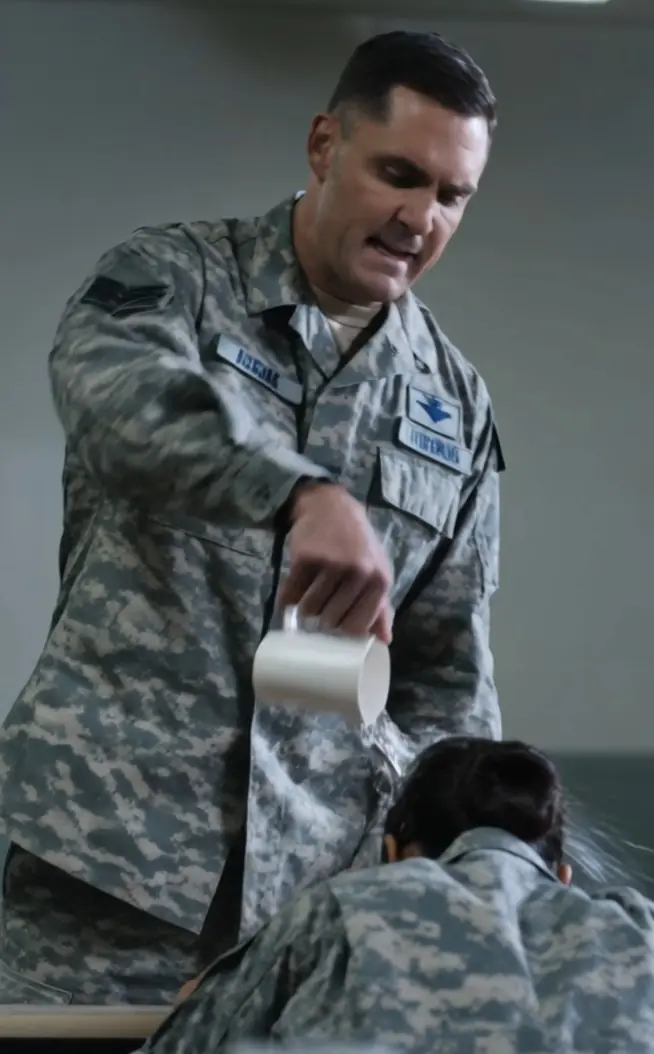
Joel reached for the clear plastic cup on the table beside him.
Armiri saw the movement. So did everyone else.
No one stopped him.
He turned the cup over above her shoulder and poured cold water down the front of her uniform.
The water struck her collar, ran down her chest, and darkened the fabric across her stomach. A few soldiers shifted in their seats, stunned by the humiliation more than the force. In a room full of people trained to respond to threat, the worst thing was how ordinary Joel made it look. Not like a sudden loss of control. Like punishment.
Then he said the sentence that broke his career.
“If it wasn’t for you yesterday, we would have completed the mission.”
Armiri’s fingers tightened on the table.
She still did not speak.
Slowly, she pushed herself upright.
Her face was wet now, but not from tears. Water dripped from her chin onto the floor. Her eyes lifted to Joel’s, and the anger in them changed the air in the room. It was not panic. It was not embarrassment. It was the face of someone who had been waiting for the right man to say the wrong thing in front of the right witnesses.
Joel stood close enough that their boots almost touched.
He expected her to step back.
She did not.
For three seconds, they faced each other in silence.
Then the mess hall door opened behind him.
Lieutenant Colonel Charles Harlan stood in the doorway.
He did not rush in. He did not shout. He did not ask what was going on like a man entering a scene he did not understand. He stepped through the door slowly, looked at Armiri’s soaked uniform, looked at the overturned chair, looked at Joel’s hand still holding the empty cup, and then shook his head once.
It was not surprise.
It was disappointment sharpened into confirmation.
Joel turned halfway.
“Sir—”
Charles raised one hand.
Joel stopped.
Two Military Police officers entered behind Charles.
The room seemed to shrink.
Charles looked directly at Joel and said, “Captain Mercer, step away from Sergeant Vale.”
Joel’s face changed, but only slightly.
“Sir, this is a disciplinary matter.”
“No,” Charles said. “This is an evidentiary matter.”
Joel blinked.
Armiri remained still.
Charles walked closer. His voice stayed low, but every person in the room heard it.
“Did you just say yesterday’s mission?”
Joel’s mouth opened.
Nothing came out.
Charles waited.
That silence did more damage than any confession.
Joel tried again. “Sir, Sergeant Vale interfered with a classified movement. She violated radio discipline, compromised our location, and caused the failure of—”
Charles cut him off.
“The approved convoy did not fail.”
Joel stared at him.
Charles stepped closer.
“The approved convoy completed its assigned movement. The only thing that failed yesterday was the unauthorized transfer you tried to hide inside it.”
The room went dead quiet.
Joel looked over Charles’s shoulder at the Military Police, then back at Armiri.
“You don’t know what she did,” he said.
Charles’s face hardened.
“I know exactly what she did. Sergeant Vale reported it before you came back.”
That was the first real crack.
Several soldiers looked at Armiri then, not with suspicion, but with something closer to shock. She had not been silent because she had no defense. She had been silent because the defense was already moving somewhere outside Joel’s control.
Charles turned slightly toward the two Military Police officers.
“Take Captain Mercer into custody.”
Joel stepped back.
“Sir, you are making a mistake.”
Charles did not blink.
“The mistake was believing you could drag a criminal transfer through my command and blame the one soldier who noticed.”
The MPs moved in.
Joel resisted just enough to make it worse. He jerked one arm away when the first officer reached him, and for a second it looked like he might try to make the room choose sides. He looked at the soldiers at the tables — the ones he had led, threatened, praised, and used. None of them stood.
Armiri watched him without speaking.
The water had begun to drip from the hem of her jacket.
Joel’s eyes locked on hers.
“This is not over,” he said.
Armiri finally spoke.
Her voice was quiet.
“It was over when you changed the route before I touched the radio.”
That sentence landed in the mess hall like a second arrest.
Joel turned toward her, but the MPs already had his arms.
Charles looked to the room.
“No one leaves. All personal devices on the tables. All convoy personnel from last night remain available for CID interviews. Anyone who attempts to alter, delete, or coordinate a statement will answer for it.”
Then he looked at Armiri.
“Sergeant Vale, medical first. Statement after.”
Armiri nodded once.
She did not salute.
Charles did not ask her to.
Later, when the incident became part of the official record, people outside the base would describe the mess hall scene as the moment Captain Joel Mercer was exposed. That was dramatic, and it was partly true. But the real exposure began eighteen hours earlier, in the Nevada desert, when Sergeant Armiri Vale saw one code on a manifest that did not belong.
M-17.
That was all it said.
Three characters on a line of cargo data that should have been routine.
The mission the night before was officially simple. Move secured communications equipment from a test storage bay near Fort Red Mesa to a hardened depot north of the installation. It was a nighttime movement because of heat, scheduling, and the usual security preferences attached to sensitive equipment. Nothing about the operation was supposed to be unusual. Three vehicles. Six escort personnel. One cargo truck. One signed manifest. One approved route.
Captain Joel Mercer commanded the convoy.
Sergeant Armiri Vale handled manifest verification and internal comms.
Specialist Nolan Briggs rode in the cargo truck as load assistant.
The approved route was direct, monitored, and boring.
That was how Armiri preferred it.
Boring meant clean. Boring meant documented. Boring meant if something went wrong, the record would still make sense in the morning.
At 17:40, twenty minutes before movement, Joel walked into the staging bay with a folded paper route card in his hand and told the convoy team there had been a route update.
Armiri asked who issued it.
Joel said, “Command.”
Armiri asked for the authorization code.
Joel looked at her as if the question itself was disrespectful.
“You have the updated card.”
“I need the authorization code.”
“You need to execute.”
The others watched without speaking.
Joel had a way of making ordinary procedure sound like personal resistance. That was one of his talents. He could take a soldier asking for the required code and turn it into an accusation of disloyalty with a single stare.
Armiri did not back down.
“Sir, if the route changed after final manifest lock, I need the logged code.”
Joel stepped closer.
“You are not the mission commander, Sergeant.”
“No, sir. I’m the manifest NCO.”
“And you have the manifest.”
“I have a manifest with an item that is not on the approved movement sheet.”
That was when Joel’s eyes shifted.
Only for a second.
But Armiri saw it.
“What item?” he asked.
She turned the tablet toward him.
“M-17.”
Joel did not look at the screen long enough to read it. That was another thing she noticed later. He did not need to read it.
He already knew.
“Administrative carryover,” he said.
“From what?”
“Depot internal.”
“It is sealed as physical cargo.”
“Then document it as such.”
“It has no linked approval.”
Joel leaned closer and lowered his voice.
“Sergeant Vale, you are very good at turning a clean movement into a paperwork seminar. Tonight is not the night.”
She held his gaze.
“Sir, clean movements do not have unapproved cargo.”
For a moment, Joel’s face went still.
Then he smiled.
Not warmly.
“Load it.”
Armiri did not know yet that M-17 was not equipment.
She did not know it was evidence.
She did not know Lieutenant Colonel Charles Harlan had scheduled a depot audit for the next morning and that several people had been trying to move one sealed container out before he opened the books. She only knew the manifest had a line item that did not belong, and the officer in charge of the convoy had no legitimate answer.
Specialist Nolan Briggs knew a little more.
He waited until Joel moved away, then leaned near Armiri while pretending to check a tie-down strap.
“You saw M-17?” he whispered.
Armiri did not look at him.
“Yes.”
“I saw that code once before.”
“Where?”
Nolan’s face tightened.
“Old internal report. Missing inventory case. It got buried.”
Armiri finally looked at him.
“What kind of inventory?”
Nolan opened his mouth, then stopped when Joel turned back toward them from across the bay.
“Briggs,” Joel called. “Problem?”
Nolan straightened.
“No, sir.”
Joel’s eyes moved from Nolan to Armiri.
“Then finish the load.”
The container marked M-17 was smaller than the others, matte black, hard-sided, with two seals. One seal was standard. The second was wrong.
Armiri saw it immediately.
Not broken. Not missing. Wrong.
The wrong color. The wrong lot number. The wrong sequence for that shipment class. Anyone else might have ignored it. Armiri did not.
She took a photo with her authorized documentation device.
Joel saw her do it.
He did not stop her.
That should have reassured her.
Instead, it made her more uneasy.
Men who do not fear documentation usually have a way to challenge the document later.
At 18:07, the convoy left Fort Red Mesa.
The sun had dropped behind the desert ridges, leaving the road in that blue-gray Nevada light where distance becomes deceptive. The vehicles moved in formation along the approved route for twenty-three minutes. Then Joel’s voice came over the internal channel.
“Convoy, prepare for deviation. Road condition change ahead.”
Armiri looked at the route screen.
No road condition update.
No dispatch note.
No traffic alert.
“Sir,” she said over comms, “I have no route hazard on the approved channel.”
“Local update.”
“From who?”
“Execute the turn, Sergeant.”
The lead vehicle turned off the main route onto a narrower service road that ran between low desert rises and old fencing from a decommissioned training area. The road was paved at first, then rougher, then almost empty. Armiri watched the GPS track pull away from the approved path.
She switched to the secondary command channel.
Joel’s voice came in immediately, sharp.
“Sergeant Vale, maintain internal comms only.”
“Sir, deviation must be reported.”
“Signal interference in this section. We’re going dark for eleven minutes.”
That number stayed with her.
Eleven minutes.
Too exact for interference.
Too convenient for an accident.
Armiri looked at her tablet. The system showed a partial disruption, but not total. Enough to justify a delay if someone wanted one. Not enough to require silence. She quietly enabled local recording on her own device, saving route data internally instead of relying on the convoy network.
Nolan Briggs watched her from the cargo truck monitor feed.
His eyes told her he understood.
The convoy continued into the dark.
At 18:42, they stopped near a civilian warehouse that was not on any approved military route. The building sat beside an access road with no visible signage, surrounded by old chain-link fencing and two floodlights mounted too high to illuminate the corners. A black civilian SUV waited near the loading doors with its engine running.
Armiri felt every nerve in her body sharpen.
Joel stepped out of the lead vehicle.
So did two soldiers from the escort team.
The black SUV door opened, and a man in contractor clothing stepped out. No uniform. No visible base credentials. He carried a thin envelope in one hand and a small case in the other. He did not look around like someone surprised by a military convoy stopping at a civilian warehouse after dark.
He looked like someone who had been waiting.
Nolan’s voice came quietly through a private short-range channel.
“Sergeant.”
Armiri answered without moving her lips much.
“I see him.”
“This isn’t a mission,” Nolan said.
Armiri watched Joel point toward the cargo truck.
Nolan finished the sentence.
“It’s a handoff.”
That was the moment the operation became more than suspicious. It became criminal, though Armiri still did not know the full shape of it. She knew only that the convoy commander had diverted an official movement, silenced external communication, brought them to an unauthorized civilian location, and was now speaking with a contractor beside a container that should not have been on the manifest.
She opened the command channel again.
Joel’s head snapped toward her vehicle before she even spoke.
“Do not transmit,” he said.
“Sir, we are off route at an unauthorized location with a civilian vehicle present.”
“Sergeant—”
“I am required to report this.”
Joel walked toward her vehicle fast.
His voice dropped into something colder.
“You are required to obey lawful orders.”
“Yes, sir.”
“This is lawful.”
“Then authenticate it.”
The contractor by the SUV shifted uneasily.
Nolan moved toward the rear of the cargo truck, pretending to inspect the load. That was when he saw the M-17 seal had been cut.
Not removed.
Cut.
A new seal had been threaded through loosely in its place.
“Nolan?” Armiri said softly.
He looked up.
His face had gone pale.
“The seal’s changed.”
Joel heard him.
For half a second, everyone seemed to move at once.
The contractor turned toward the black SUV. Joel shouted for Nolan to step away from the cargo. Armiri brought the command channel live and transmitted the convoy’s location before Joel could physically reach her vehicle. The lead driver swore over the internal net. One of the escort soldiers asked what was happening.
Then a metal door slammed somewhere inside the warehouse.
The contractor grabbed at M-17.
Nolan lunged to stop him.
The struggle lasted maybe three seconds.
Nolan caught the side handle of the container. The contractor jerked it free. Joel shouted, “Stand down!” but not at the contractor.
At Nolan.
Nolan did not stand down.
The contractor struck him with the edge of the small case he was carrying, hard enough to split the skin near Nolan’s temple. Nolan fell against the cargo lift. The container dropped halfway, striking the metal platform with a sound that echoed across the loading bay.
Armiri’s transmission went through.
“Command, this is Sergeant Vale with Convoy Red Mesa Three. We are off approved route at unauthorized civilian warehouse. Unlisted cargo item M-17 compromised. Request immediate command response.”
Joel reached her vehicle and yanked open the passenger door.
“What did you just do?”
Armiri looked at him.
“My job.”
He leaned in close enough that the smell of dust and anger came with him.
“You have no idea what you just broke.”
Behind him, the contractor abandoned the container and ran for the SUV.
Joel turned, saw the man getting away, and for the first time Armiri saw true panic on his face.
Not anger.
Panic.
The black SUV peeled away into the dark before anyone could block it.
The convoy did not move for twelve minutes.
Those twelve minutes became the center of three investigations.
During that time, Joel tried to regain control of the scene. He ordered the soldiers away from the cargo truck. He demanded Armiri shut down her device. He told the lead driver to report a mechanical issue, not an unauthorized stop. He told the escort team that anyone repeating Sergeant Vale’s “confused transmission” before command review would be considered part of the compromise.
But the transmission had already gone through.
Lieutenant Colonel Charles Harlan heard it in the command center.
Charles was not supposed to be on the floor that night. He had stayed late because the audit scheduled for the next morning had already produced irregularities in depot records. Missing cross-references. Duplicate shipment numbers. Contractor invoices that did not match cargo movement. He had not yet accused anyone because accusations without records are noise.
Then Armiri’s voice came through.
M-17.
That was the missing thread.
Charles knew the code.
He had seen it buried in an older discrepancy report three months earlier, attached to sealed materials that should have remained in evidence storage after an internal inquiry into contractor diversion. If M-17 was on a convoy manifest now, someone had moved it without authorization.
He immediately ordered response units to the convoy’s transmitted location.
He also ordered Military Police to quietly locate Sergeant Armiri Vale when the convoy returned and ensure she was not isolated with Joel.
That order mattered later.
Because Joel tried.
The convoy returned to Fort Red Mesa just after 21:00.
Nolan Briggs was taken to the medical clinic with a head injury and a fractured wrist. M-17 was placed under temporary guard, but only after Joel attempted to route it back through his own section. Armiri refused to sign the post-movement report. Joel wrote one anyway.
His version was fast, polished, and false.
According to Joel, the convoy diverted due to a reported road hazard. During the deviation, Sergeant Armiri Vale violated radio discipline by transmitting unsecured information, drawing attention to the convoy’s position. A civilian vehicle approached during the confusion. Specialist Briggs was injured while failing to follow safety instructions. Sensitive material may have been compromised due to Armiri’s improper communication.
It was a good lie because it contained pieces of truth.
There had been a deviation.
Armiri had transmitted.
A civilian vehicle had approached.
Nolan had been injured.
Sensitive material had been compromised.
Joel rearranged those facts into a story where the only disciplined officer in the convoy became the danger.
By 23:30, he had begun telling it aloud.
By breakfast, half the unit had heard some version of it.
Armiri spent the night doing two things.
First, she submitted her local GPS recording and seal photos to Lieutenant Colonel Charles Harlan through a secure reporting channel.
Second, she sent him a message with only one line:
If I disappear from the report, check my bodycam.
Charles read it at 00:18.
He did not reply with reassurance.
He replied with instruction.
Do not confront Mercer. Preserve all files. Report to mess as normal.
That was when Armiri understood Charles was not only receiving her report.
He was building a trap.
Joel built one too.
He needed Armiri to look unstable. Angry. Emotional. Guilty. He needed witnesses to see her lose control so that the investigation could become about her conduct instead of his route. The mess hall gave him an audience. The water gave him humiliation. The shove gave him provocation. He thought if she shouted, swung, or even cursed in front of enough soldiers, he could write her reaction into the narrative.
But Armiri did not react the way he needed.
She stood.
She looked at him.
And she let him speak first.
“If it wasn’t for you yesterday, we would have completed the mission.”
He meant it as blame.
Charles heard it as evidence.
Because the official mission had not required completion at the warehouse. The official mission was a movement between two military points. The only “mission” that Armiri had stopped was the unofficial handoff Joel was not supposed to admit existed.
That was why Charles asked the question at the door.
“Did you just say yesterday’s mission?”
Not because he did not know.
Because he wanted everyone else to hear Joel fail to explain it.
After Joel was taken from the mess hall, the base changed tone within minutes. Soldiers who had whispered about Armiri at breakfast now avoided each other’s eyes. Officers who had heard Joel’s early version suddenly became careful with language. The Military Police sealed the convoy vehicles. CID took possession of communications logs, body camera files, manifest tablets, cargo photos, and the damaged seal from M-17.
Armiri was taken to medical first.
A bruise had formed along her lower back where she hit the table. The front of her uniform was still damp. A medic asked if she wanted to file a separate assault statement before or after the convoy interview.
Armiri said, “Both are the same case.”
The CID investigator looked up.
Armiri continued.
“He put hands on me today because he couldn’t erase what I saw yesterday.”
That sentence became the opening frame of the investigation.
Captain Joel Mercer’s first interview lasted forty-one minutes.
He entered angry, but controlled. He was a captain. He knew rank could fill silence if he let it. He called the mess hall incident unfortunate. He said emotions were high. He said Sergeant Vale had compromised a sensitive movement and then presented herself as a whistleblower to avoid discipline. He denied any unlawful transfer. He denied knowing the contractor. He denied that M-17 was outside approved cargo.
Then the CID agent placed the official manifest on the table.
No M-17.
Joel looked at it.
“That may be an incomplete export.”
The agent placed the depot movement authorization beside it.
No M-17.
Joel shifted.
“That code may have been generated locally.”
The agent placed Armiri’s pre-departure seal photo on the table.
Joel stopped talking.
The photo showed M-17 before the convoy left, with the wrong seal already attached.
“Do you recognize this container?” the agent asked.
Joel said, “I recognize a container.”
“Do you recognize the seal?”
“No.”
“You signed the load release.”
“For the convoy as a whole.”
“You signed for all cargo listed.”
“Yes.”
“M-17 was not listed.”
Joel’s jaw moved slightly.
“I relied on my logistics NCO.”
The agent looked at him.
“Sergeant Vale?”
“Yes.”
“The same soldier who questioned the item before departure?”
Joel realized the corner too late.
“She created confusion,” he said.
“She documented confusion,” the agent replied.
The difference mattered.
Nolan Briggs woke in the medical clinic around noon.
His head hurt badly enough that the light bothered him, and his wrist was splinted, but he was lucid. His first statement confirmed the part Joel needed buried: M-17’s seal was wrong before departure, cut during the unauthorized stop, and the contractor tried to take it from the cargo truck while Joel ordered Nolan to stand down.
When asked if Joel knew the contractor, Nolan hesitated.
Then he said, “The contractor called him Joel.”
The investigator paused.
“Not Captain Mercer?”
“No.”
“Not sir?”
“No.”
“Joel.”
“Yes.”
“How did Captain Mercer react?”
“Like it wasn’t the first time.”
That statement moved the case from misconduct into conspiracy.
CID pulled phone records next.
Joel’s official phone showed nothing useful. That did not surprise anyone. His personal phone showed normal patterns. Calls to family. Texts to fellow officers. Gym schedule. Restaurant confirmations. A man who knew how to keep the wrong things off the obvious device.
But near the civilian warehouse, during the eleven-minute communications gap, investigators found activity from a prepaid phone that had connected to a tower less than one mile from the unauthorized stop. That phone had exchanged multiple short messages over the previous two weeks with another prepaid device that traveled near Joel’s quarters, the motor pool, and the convoy staging bay.
One recovered message read:
Bring M-17 before Harlan audits the depot.
There were no names in the message.
There did not need to be.
Charles Harlan had scheduled exactly one audit.
And Joel Mercer had changed exactly one route.
The contractor was identified through security footage from a gas station near the warehouse. His name was Caleb Stroud, a field operations manager for Raven Crest Defense Services, a private contractor that had done limited support work on base systems and off-site storage. Raven Crest had no approved role in the convoy movement. It did, however, appear in three invoices tied to “equipment transfer consultation” on dates that matched earlier depot irregularities.
Charles Harlan had been circling Raven Crest before Armiri ever saw M-17.
That became the part Joel never understood.
He thought Armiri started the investigation.
She did not.
She gave Charles the missing proof.
For months, Charles had been reviewing strange inventory movements that looked like paperwork errors when viewed individually. A shipment delayed here. A seal replaced there. A contractor invoice attached to the wrong storage class. A missing pallet later marked as duplicate. None of it was large enough to accuse a captain or a contractor of criminal conduct. But together, the pattern suggested someone inside Fort Red Mesa had been moving sensitive material into temporary gaps where private contractors could access, copy, swap, or destroy evidence before audits caught up.
M-17 was not ordinary equipment.
It was a sealed evidence package from an earlier inquiry into diverted communication components and falsified depot transfers. Inside were drives, records, serial number lists, seal logs, and internal statements that could tie military personnel to civilian contractors. It had been stored pending further review. It was not supposed to move without senior authorization.
If Joel got M-17 out before Charles opened the audit, the older case could collapse.
If Armiri had signed it through as routine cargo, the package might have disappeared into a contractor warehouse and reappeared later as damaged, incomplete, or never at all.
That was why Joel needed her quiet.
That was why Nolan was struck.
That was why the mess hall assault happened.
Not because Joel lost control.
Because his control had failed.
The investigation grew wider on the second day.
A search of Joel’s office found nothing obvious at first. He had cleaned it well. Too well. The desk drawers contained standard forms, training schedules, a spare cap, protein bars, and a framed photograph with two former deployment buddies. His laptop looked normal until digital forensics recovered a deleted file from unallocated space.
The file name was ordinary: clean transfer.
Inside was a timing grid.
Convoy departure. Approved route marker. Deviation point. Projected external signal interference. Warehouse arrival. Cargo handoff. Return route. Post-movement report language.
At the bottom were three notes:
Keep Vale off final verification.
Briggs manageable.
If Harlan asks, road hazard.
The room where investigators reviewed the file went quiet.
Armiri was not paranoid.
Nolan was not confused.
Charles was not overreacting.
Joel had planned for each of them.
But the file contained one line that hit harder than the rest:
If Vale notices the seal, remove her from the after-action report.
That explained the attempted erasure.
Joel’s first report had described Armiri’s radio transmission but minimized her manifest role. It referred to “convoy personnel” discovering the seal issue after the fact. It framed her as a communications problem, not the soldier who found the cargo irregularity before departure.
He was writing her out of the evidence while blaming her for the outcome.
When Armiri read that line later, she did not speak for almost a full minute.
Then she said, “He was going to make me disappear on paper.”
The CID agent nodded.
“Yes.”
Armiri looked through the observation window toward the hallway where soldiers moved past, pretending not to stare.
“That’s worse than the water.”
The agent understood.
The shove left a bruise.
The report could have ended her career.
Joel changed strategy on the third day.
When denial failed, he tried contamination.
Through his attorney and informal loyalists still moving inside the unit, Joel began floating a new version: Armiri had accepted outside money to disrupt the convoy. She had known the contractor would appear. She opened the radio channel at the exact moment needed to create a record that made Joel look guilty. She had staged her silence in the mess hall because Charles was protecting her for reasons unknown.
It was a desperate theory.
Desperate theories can still poison a unit if they travel fast enough.
Two junior soldiers submitted statements claiming Armiri had been “agitated” before the convoy and had expressed distrust of Joel. Another said she appeared “eager” to challenge command. A third suggested Nolan Briggs and Armiri had spoken privately in a way that seemed coordinated.
CID checked the metadata on the statements.
All three documents had been created from the same template.
One had a creation timestamp from before the convoy returned.
Before the alleged observations could have been written.
When confronted, the youngest soldier broke.
He admitted Joel had called him after midnight and told him to “protect the chain” by signing a prepared statement. Joel warned that if Armiri’s version became official, everyone on the convoy could be accused of participating in an unauthorized transfer. The soldier said he signed because he was scared.
“Scared of what?” the investigator asked.
The soldier looked down.
“Of him making me the next reason it failed.”
Joel’s influence did not vanish when the MPs took him from the mess hall. That was the part Charles understood better than anyone. Corruption inside a command does not sit in one chair. It spreads through favors, threats, loyalty, fear, career ambition, and silence.
So Charles widened the protection around Armiri.
Her temporary quarters were moved. Her access badge was reissued. Her devices were copied and secured. She was told not to walk alone after dark, not because the base was unsafe in the ordinary sense, but because the people most invested in discrediting her still had keys, ranks, and friends.
That night, she received a message from an unknown number.
You should have stayed wet and quiet.
Armiri stared at the screen.
For a moment, the mess hall returned: water running down her uniform, soldiers watching, Joel’s face inches from hers.
Then she forwarded the message to CID.
Digital tracing placed the sender near officer housing.
Not Joel’s quarters.
Major Edwin Valez’s.
Valez was the depot logistics major who had approved the final cargo staging window for Joel’s convoy. He had not been at the mess hall. He had not appeared in Joel’s early report. He had described the M-17 issue as “likely clerical misalignment” and urged Charles not to let one sergeant’s alarm “create a witch hunt.”
Now a threatening message to Armiri had passed through a device near his building.
When investigators searched Major Valez’s office, they found a second routing sheet for M-17, printed, unsigned, and hidden inside a folder labeled maintenance summaries. The sheet listed M-17 as “temporary contractor review material.” That classification did not exist.
The signature block was blank.
But forensic indentation analysis on the sheet beneath it revealed pressure marks from a document previously signed on top.
Joel Mercer.
Caleb Stroud.
Edwin Valez.
The chain was no longer theoretical.
Raven Crest Defense Services tried to distance itself immediately. Their public legal statement said any improper contact by Caleb Stroud was outside company policy and unknown to leadership. CID and federal investigators were less interested in the statement than the bank records.
Stroud had received payments through a subcontracting shell tied to Raven Crest. Joel’s personal accounts showed no direct deposits that looked suspicious, but his brother’s landscaping business had received three “consulting” payments from the same shell company. Major Valez’s wife had been paid by a separate training vendor connected to Raven Crest leadership.
No one had written “bribe” on a bank transfer.
They never do.
But the pattern was there.
The money moved around the rank structure like water finding cracks.
Meanwhile, M-17 had disappeared again.
That was the worst moment of the investigation.
After the convoy returned, the package had been placed under temporary guard, then transferred to a secure holding area. But during the first hours of confusion — before Charles fully locked down the depot — someone moved it under a false evidence relocation entry. The entry used a valid credentials token from a warrant officer who was on medical leave and had not logged in for four days.
For nine hours, no one knew where M-17 was.
Joel’s people had almost succeeded anyway.
The package was found the next morning in an abandoned contractor truck near the Nevada-California border, after a highway patrol officer checked a vehicle left behind a closed fuel station. The truck’s plates were registered to a subcontractor that had done work for Raven Crest. The cargo area was empty except for one sealed hard case shoved beneath a tarp.
M-17.
The seal was damaged.
But the contents were there.
When Charles stood in the evidence room and watched the case open, he did not look relieved. He looked angry in a way Armiri had not seen before.
Inside were data drives, printed seal logs, depot shipment corrections, contractor access lists, and video clips from loading areas where cargo had been swapped after official verification. One clip showed Captain Joel Mercer meeting Caleb Stroud three weeks before the convoy. They stood beside a loading bay after hours. Joel was not in dress uniform. Stroud handed him a folded document.
The audio was weak but usable.
Stroud said, “Vale checks seals herself.”
Joel replied, “I’ll keep her off the final pass.”
Stroud said, “If she notices?”
Joel said, “Then she becomes the problem.”
That was the line Charles replayed twice.
Then he turned the video off.
No one spoke.
Armiri was not in the room when they first played it. Charles chose to tell her personally. He found her outside the medical clinic, sitting on a bench with a paper cup of coffee she had not touched. The Nevada afternoon was bright and dry, the kind of light that makes every shadow look hard-edged.
“They found M-17,” he said.
Armiri looked up.
“Intact?”
“Enough.”
She nodded.
Charles sat beside her, leaving space.
“There is video,” he said.
“Of Joel?”
“Yes.”
“What does it show?”
Charles looked toward the training field in the distance.
“It shows he knew you were the one who would catch it.”
Armiri breathed out slowly.
For the first time since the mess hall, her face changed.
Not relief.
Something closer to grief.
“That’s why he did it in front of everyone,” she said.
Charles looked at her.
“The mess hall?”
“He needed them to remember me as the problem before the evidence made me the witness.”
Charles did not answer.
Because she was right.
The military hearing began six weeks later.
By then, the internal case had become federal. Raven Crest executives were under subpoena. Major Valez had been relieved of duty. Caleb Stroud had been arrested trying to leave the country through a private charter connection. Nolan Briggs was recovering from his injuries. Armiri had been transferred temporarily outside Joel’s chain for protection. Joel remained in confinement, but his defense strategy was obvious before the first day began.
Attack Armiri.
He had no choice.
If the panel believed Armiri was credible, the case became a conspiracy with documents, route data, video, money trails, and witness intimidation. If the panel doubted her, Joel could try to turn the entire investigation into a story of overreaction started by a resentful subordinate and amplified by Charles Harlan’s audit politics.
Joel entered the hearing room in uniform.
He looked thinner, but still polished. Men like Joel understand appearance as armor. His ribbons were straight. His jaw was clean-shaven. His face carried a controlled injury, as if he were the one betrayed by the institution.
Armiri sat across the room.
She did not look at him until the proceedings began.
When she did, he gave her the faintest smile.
She did not smile back.
The government opened not with the warehouse, not with M-17, but with the mess hall.
That surprised Joel.
His defense wanted the mess hall treated as emotional noise, a minor physical incident separate from the convoy. Military prosecutors saw it differently. It was witness intimidation in public, and it contained Joel’s own words connecting Armiri’s actions to the unauthorized mission.
The video from the mess hall camera played on the screen.
No sound at first.
Joel entering. Armiri at the table. Joel stepping in close. The shove. The water. Armiri rising. Charles entering. MPs behind him.
Then they played the audio from a nearby hallway camera synced with the room.
“If it wasn’t for you yesterday, we would have completed the mission.”
The prosecutor paused the video.
“Captain Mercer did not say the convoy would have been safe. He did not say the approved movement would have been clean. He said we would have completed the mission. Members of the panel, the evidence will show he was not talking about the official mission. He was talking about the illegal one.”
Joel stared at the table.
His attorney objected to interpretation.
The military judge allowed the prosecution to proceed, noting that context would determine weight.
Context arrived quickly.
Armiri testified for nearly four hours.
She did not dramatize the shove. She did not describe the water with emotional language. She did not try to win sympathy by making the room relive her humiliation. That restraint helped her. She described what happened because it mattered as evidence.
“Why didn’t you respond when Captain Mercer accused you?” the prosecutor asked.
Armiri sat straight.
“Because I needed him to speak before I did.”
“Why?”
“Because if I defended myself first, he would say I was creating a story. If he spoke first, he might reveal his own.”
“What did he reveal?”
“That he believed there was a mission I had stopped.”
The prosecutor asked, “And had you stopped one?”
“Yes.”
“The approved convoy?”
“No.”
“What did you stop?”
Armiri looked directly at Joel.
“An unauthorized handoff of M-17.”
Joel’s attorney rose on cross-examination with the smoothness of someone who believed pressure could still work.
“Sergeant Vale, you have described yourself as precise.”
“I try to be.”
“Difficult to satisfy?”
“I follow verification requirements.”
“Isn’t it true some officers found you combative?”
“Some officers found my paperwork inconvenient.”
A few people shifted in the room.
The attorney continued.
“Captain Mercer was your superior.”
“Yes.”
“You disagreed with his route decision.”
“I asked for authentication.”
“You opened a radio channel after being told not to.”
“Yes.”
“So you disobeyed a direct order.”
“I disobeyed an unlawful restriction on required reporting.”
“That is your interpretation.”
“It was also Lieutenant Colonel Harlan’s.”
The attorney tried to turn her silence in the mess hall into calculation.
“You allowed Captain Mercer to become angry.”
Armiri looked at him.
“I did not control Captain Mercer’s hands.”
The room went still.
The attorney moved on.
Nolan Briggs testified after Armiri.
He was not as composed. His memory came in fragments, but the fragments were clear enough. M-17’s wrong seal. Joel’s route change. The black SUV. The contractor calling him Joel. The strike that broke Nolan’s wrist. Joel ordering Nolan to stand down while the contractor took the container.
The defense pushed hard on his injury.
“You had a head wound.”
“Yes.”
“You were confused.”
“I was bleeding. Not blind.”
“You may have misheard the contractor.”
“No.”
“You are certain he called Captain Mercer by first name?”
“Yes.”
“How can you be certain?”
Nolan looked at Joel.
“Because nobody who respected him called him that.”
The line was not meant as humor.
But it cut.
Major Valez took a plea before he testified.
That was the moment Joel knew the wall had fallen.
Valez admitted he helped insert M-17 into a false cargo staging window, expecting Joel to move it through a “contractor review” channel before Charles Harlan’s audit. He claimed he did not know Joel planned to confront Armiri physically. Prosecutors did not need him to know. They needed him to place Joel inside the conspiracy before the convoy left.
He did.
Caleb Stroud testified through a cooperation agreement with federal prosecutors. He confirmed Raven Crest wanted M-17 removed because it contained evidence of prior diversion schemes and payments. He confirmed Joel was the military access point. He confirmed the eleven-minute communications gap was planned. He confirmed the civilian warehouse was the transfer location.
Then the prosecutor asked, “What was the plan if Sergeant Vale questioned the seal?”
Stroud hesitated.
“Answer the question,” the judge said.
Stroud looked down.
“Captain Mercer said he could handle her.”
“How?”
“He said he’d write her out or break her down.”
Armiri looked straight ahead.
Charles closed his eyes for half a second.
Joel showed no expression.
That absence of reaction hurt him more than anger would have.
The final evidence was the video from M-17.
Joel and Stroud at the loading bay.
Vale checks seals herself.
I’ll keep her off the final pass.
If she notices?
Then she becomes the problem.
The prosecutor did not need to explain much after that.
Joel had made Armiri the problem because she saw the crime before the crime could finish.
When Joel finally spoke in his own defense, he chose not to testify under oath. His attorney issued statements about command pressure, ambiguous contractor relationships, operational confusion, and Sergeant Vale’s unauthorized communication. It sounded professional. It sounded complex. It sounded like a man trying to rebuild fog after everyone had already seen the road.
But the hearing panel had the route data.
The manifest.
The seal photos.
The prepaid phone messages.
The deleted clean transfer file.
The fake statements.
The M-17 video.
The threat to Armiri.
The mess hall footage.
And Joel’s own sentence.
If it wasn’t for you yesterday, we would have completed the mission.
The panel found Captain Joel Mercer guilty on the major charges referred in the military proceeding: assault against a subordinate, false official statement, obstruction, witness intimidation, conspiracy connected to the unauthorized movement, and conduct unbecoming an officer. Federal charges remained pending for the contractor side of the case, including bribery, fraud, and theft-related offenses tied to the Raven Crest network.
Joel did not look at Armiri when the findings were read.
He looked at Charles.
That was telling.
Men like Joel often direct their final resentment not at the person they harmed, but at the person whose authority they failed to corrupt.
Charles looked back without expression.
After the hearing, Armiri stepped outside alone.
The Nevada sun was bright. Too bright after weeks of windowless rooms and recorded statements. She stood near a concrete walkway behind the hearing building and closed her eyes for a moment. She had won, people would say. Joel was finished. The false report was corrected. M-17 had been recovered. Raven Crest was under federal investigation. Major Valez was gone. Nolan had testified. Charles had backed her.
But victory is a strange word for something that begins with humiliation.
She still remembered the mess hall.
Not the shove most. Not even the water. She remembered the eyes. Soldiers watching her, trying to decide whether the truth would be safe to stand near. Some later apologized. Some did not. A few avoided her because apologies require admitting cowardice, and not everyone can carry that weight.
Charles found her there.
He did not come too close.
“Sergeant Vale.”
She opened her eyes.
“Sir.”
“The corrected report is signed.”
He handed her a folder.
She looked at it but did not open it.
“What does it say?”
“The first line says: Sergeant Armiri Vale prevented the unlawful transfer of military evidence during Convoy Red Mesa Three.”
For a moment, Armiri could not speak.
Then she took the folder.
Her fingers tightened on the edge.
“That line should have been easy to write.”
Charles nodded.
“Yes.”
“It wasn’t.”
“No.”
She looked at him.
“You knew he might come at me in the mess hall?”
Charles’s face changed.
“I suspected he would try to provoke you. I did not expect him to put hands on you.”
“You had MPs outside.”
“Yes.”
“But not inside.”
“No.”
The answer was honest.
Not comforting.
Armiri looked toward the training field.
“He needed an audience.”
Charles said, “So did the arrest.”
She turned back to him.
He continued.
“What happened to you in that room should not have happened. But once he chose to do it publicly, I wanted the record to be public too.”
Armiri was quiet for a long time.
Then she said, “Next time, put the MPs inside.”
Charles accepted that without defense.
“I will.”
The case did not end with Joel.
Cases like that rarely do.
Raven Crest lost contracts almost immediately, then fought in court to keep records sealed. Federal investigators followed money from the contractor to shell vendors, then to relatives of military personnel, then to consulting firms that existed mostly on paper. Major Valez cooperated enough to reduce some exposure but not enough to look clean. Caleb Stroud tried to become a smaller villain by pointing upward. Several officers who had signed false or misleading statements received discipline of varying severity.
Nolan Briggs returned to duty months later with a scar near his temple and a wrist that ached when the weather changed.
He and Armiri did not become dramatic best friends, despite what people later liked to imagine. Real cases rarely create perfect bonds. They shared a respect that did not require constant conversation. Once, in the dining facility, he raised a cup of water in her direction with a grim smile.
She almost laughed.
Almost.
The mess hall table was replaced.
That seemed unnecessary to some people. It had not been broken beyond repair. But Charles ordered it removed anyway. Officially, it was damaged property. Unofficially, everyone knew why. Some objects become witnesses. Some rooms hold a version of a person you do not want them forced to meet every morning.
Armiri returned to the mess hall two weeks later.
The room quieted when she entered.
She hated that.
Then a young private stood and moved his tray from the end of a table.
“Sergeant,” he said, “seat’s open.”
It was awkward.
It was small.
It was not enough.
But it was something.
Armiri sat.
No one mentioned Joel.
No one needed to.
The official investigative summary later described the mess hall confrontation as a “public intimidation attempt following a compromised unauthorized transfer.” That language was accurate and bloodless. It did not capture water running down Armiri’s uniform. It did not capture the shock of soldiers who knew better but froze. It did not capture Joel’s expression when Charles asked him about the mission. It did not capture the moment Armiri stood up slowly, face to face with the man trying to turn her into a scapegoat, and said nothing because silence had become strategy.
But official summaries are not built to carry shame.
They carry findings.
The findings were enough.
Captain Joel Mercer assaulted a subordinate because she witnessed his role in an illegal transfer. He falsified reports to blame her. He coordinated with a contractor to remove evidence before an audit. He attempted to isolate, discredit, and intimidate the one soldier who had documented the route, the seal, the handoff, and the lie.
And he failed because he misread Armiri Vale.
He thought her quiet meant fear.
It meant record preservation.
He thought her refusal to argue meant weakness.
It meant timing.
He thought pouring water on her would make the room remember her as humiliated.
Instead, the room remembered him holding the empty cup when Charles Harlan walked through the door.
Years later, the case was taught in closed military ethics briefings, stripped of some names but never the central lesson. Instructors would play the mess hall clip up to the moment Joel said the sentence.
“If it wasn’t for you yesterday, we would have completed the mission.”
Then they would pause it.
“What did he just admit?” they asked.
Young officers usually answered too quickly.
That she disrupted the mission.
That she violated chain of command.
That he was angry about the convoy.
Then the instructor would shake his head.
“No. He admitted there was a mission separate from the one on paper.”
That was the lesson.
Corruption rarely announces itself as corruption.
It calls itself urgency. Loyalty. Mission success. Chain of command. Need-to-know. Operational flexibility. It takes words that soldiers respect and bends them around a hidden purpose. The only way to catch it is to notice when the words stop matching the record.
Armiri noticed.
Nolan noticed too late and paid for it.
Charles suspected but needed proof.
Joel supplied the proof when he lost patience in front of witnesses.
The final public account, released long after the federal side concluded, did not include every sensitive detail of M-17. It could not. But it did confirm the core: a captain at a Nevada military installation attempted to move sealed evidence through an unauthorized contractor transfer, falsified records, and assaulted a subordinate who had reported the irregularity. The contractor network faced prosecution. Multiple personnel were disciplined. Sergeant Armiri Vale was formally commended for preventing unlawful removal of evidence.
Armiri did not attend the commendation ceremony at first.
Charles had to order her.
She stood in a clean uniform, back straight, face unreadable, while an officer read words about integrity and courage. People clapped. Cameras took photos. Someone called her a hero afterward, and she disliked the word immediately.
Hero sounded too simple.
She had been scared.
She had hesitated.
She had wondered if reporting Joel would destroy her career.
She had replayed the moment at the warehouse when Nolan fell and asked herself if she should have moved sooner. She had replayed the mess hall and wondered if silence had cost her dignity before it saved her credibility.
Courage did not feel like a clean thing inside her.
It felt like doing the next documented step while anger tried to take the wheel.
After the ceremony, Charles found her near the hallway exit.
“You hate this,” he said.
“Yes, sir.”
“The attention?”
“The simplification.”
He nodded.
“That never goes away.”
Armiri looked at him.
“Does the report stay corrected?”
“Yes.”
“Then I can live with the rest.”
That was the real ending for her.
Not applause.
Not Joel in custody.
Not headlines.
A corrected report.
Because in military life, records outlive rooms. They outlive rumors, water stains, bruises, and the expressions people wear when they choose not to help. Joel tried to build a record where Armiri was the failure. Charles replaced it with the truth.
The truth did not undo the harm.
But it made the harm unable to finish its work.
Captain Joel Mercer’s name became attached to the case for obvious reasons. He pushed her. He poured the water. He said the line. He got arrested. But people who studied the case closely understood that Joel was not the only warning inside it.
The warning was also in the room.
Thirty soldiers saw authority become abuse before their eyes and froze because the uniform doing the harm outranked the uniform receiving it. Some were young. Some were confused. Some were afraid. Some were waiting for someone else. That was human, but it was also dangerous. The military cannot function if every order becomes a debate, but it also cannot survive if rank becomes a shield for crime.
That became Charles’s focus afterward.
He changed reporting procedures for manifest disputes. He required independent verification for late route changes. He removed single-officer control over certain convoy deviations. He pushed for protected reporting channels that did not route through the same command that might be compromised.
None of those changes sounded dramatic.
They were paperwork, access controls, redundant signatures, audit alerts, and training slides.
Armiri appreciated them more than speeches.
Because Joel’s crime had lived in paperwork before it ever reached the mess hall.
The wrong seal.
The false route card.
The unauthorized cargo code.
The missing approval.
The fake statements.
The clean transfer file.
The attempt to erase her from the after-action report.
By the time Joel put his hands on her, the violence had already been happening in documents for hours.
The shove only made it visible.
On Armiri’s last day at Fort Red Mesa before transferring to another assignment, she walked past the convoy staging bay alone. The desert wind pushed dust against the doors. The bay was quieter now. New personnel. New procedures. New locks. M-17 was gone, secured in a federal evidence facility. Raven Crest’s access badges had been revoked. Joel’s office had been reassigned.
The place looked ordinary again.
That bothered her.
Places always do that.
They absorb what happened and go back to functioning.
She stood near the spot where she first saw M-17 on the manifest and thought about how small the beginning had been. Three characters. One bad seal. One officer who would not authenticate a route. One specialist whispering that he had seen the code before.
People imagine major cases begin with dramatic evidence.
Sometimes they begin with a line item that does not belong.
Nolan found her there.
“Didn’t think you’d come back to this bay,” he said.
“Neither did I.”
He looked toward the loading doors.
“You ever wonder what would’ve happened if we let it go?”
Armiri answered immediately.
“No.”
He looked at her.
She said, “I know what would’ve happened. M-17 disappears. Joel files the report. Charles audits an empty hole. You and I become unreliable. Raven Crest keeps moving. Someone else gets hurt later.”
Nolan nodded slowly.
“Yeah.”
Armiri looked at the floor where the convoy tires had once left dust tracks.
“What I wonder is how many times it worked before us.”
Nolan did not answer.
Because that was the question no verdict could fully settle.
Joel’s case proved what happened once.
M-17 suggested it had happened before.
The older records suggested a network that had been operating long enough to become confident. Confident enough to route evidence through a convoy. Confident enough to use a captain. Confident enough to assume a sergeant checking a seal could be managed, erased, or broken down in public.
That confidence was the real enemy.
Armiri left the bay without looking back.
The mess hall was crowded when she passed it.
She did not go in.
She did not need to.
She could still see it if she wanted: the table, the cup, Joel’s face, Charles in the doorway, the MPs behind him. But the memory had changed. At first, it belonged to humiliation. Then anger. Then evidence. Now it belonged to something else.
A point of failure.
Joel’s failure.
He had built a hidden mission inside an official one. He had planned the route, the gap, the handoff, the report, the scapegoat. He had calculated career pressure, rank, fear, and silence. He had accounted for almost everything.
But he had not accounted for Armiri Vale standing up slowly, soaked and furious, and saying nothing until his own words had nowhere left to hide.
The case ended with charges, reports, transfers, and reforms.
But the sentence people remembered was still Joel’s.
“If it wasn’t for you yesterday, we would have completed the mission.”
He meant it as an accusation.
It became the confession.
And in the final corrected record, buried beneath formal language and legal findings, the truth was simpler than any report could make it sound:
Captain Joel Mercer did not fall because Sergeant Armiri Vale fought him in the mess hall.
He fell because she refused to become the story he wrote for her.