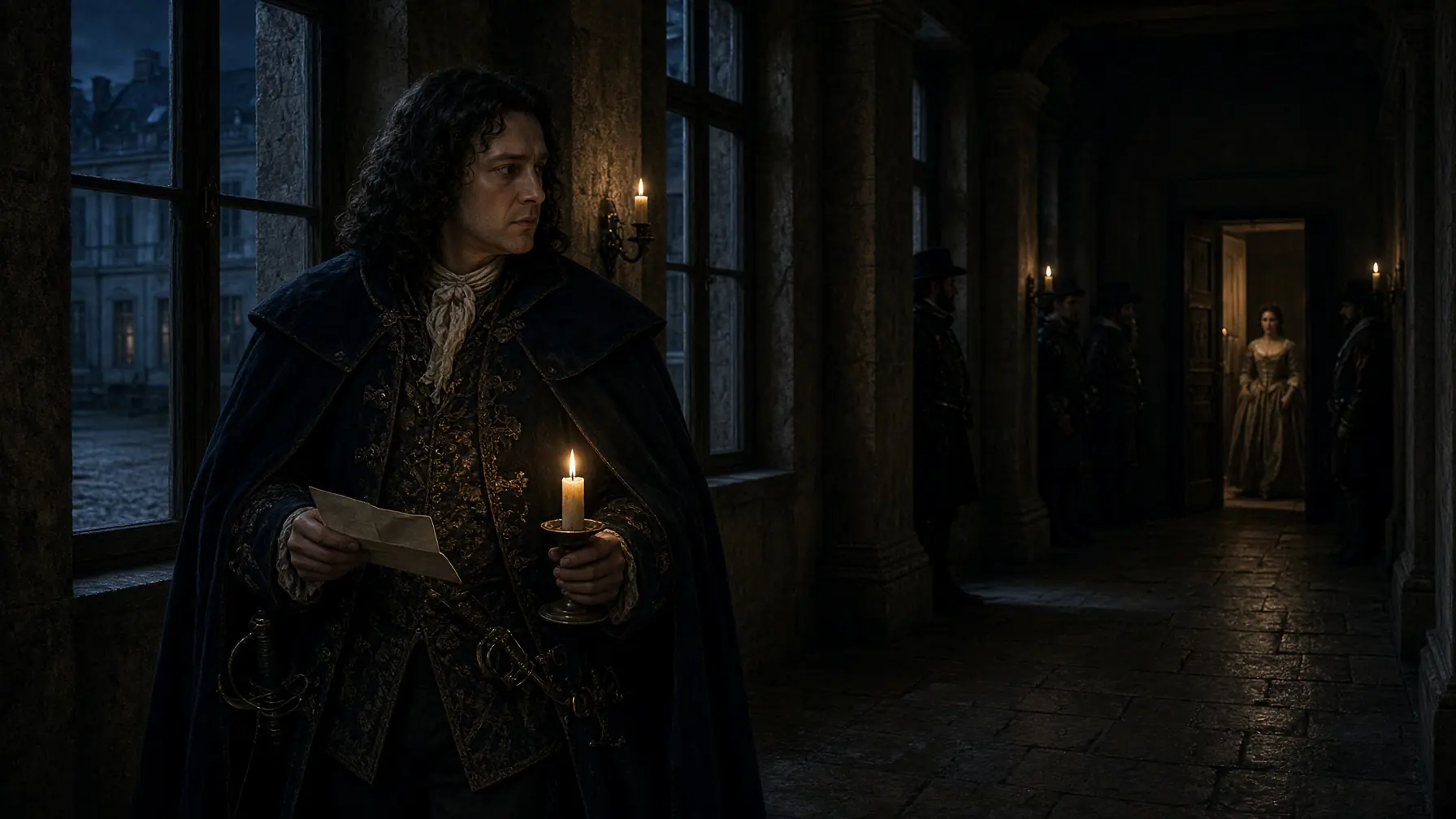
One night in the summer of 1694, Count Philip Christoph von Königsmarck entered the Leine Palace in Hanover.
Then he disappeared.
He was never publicly seen alive again.
His disappearance was immediately tangled with one of the most dangerous scandals at the Hanoverian court: his relationship with Sophia Dorothea of Celle, the wife of Georg Ludwig—the future King George I of Great Britain. Modern biographical scholarship describes Königsmarck as having been killed inside the palace during the night of July 11–12, 1694, although older accounts emphasize how deliberately the affair was obscured and how difficult it became to reconstruct exactly what happened. His body was never publicly produced.
Within months, Sophia Dorothea’s marriage was over.
She was separated from her two children and sent to Ahlden, where she would remain for the rest of her life.
Twenty years later, her former husband crossed the North Sea and became King George I of Great Britain.
Sophia Dorothea did not accompany him as queen.
She was still confined.
She would remain so until her death in 1726.
It is an extraordinary ending to a marriage that had begun as an act of dynastic calculation. But behind the imprisonment lies an even darker question.
What exactly happened inside the Hanoverian palace on the night Königsmarck vanished—and why did Sophia Dorothea pay for the scandal with more than three decades of her freedom?
A Marriage That Was Political From the Beginning
Sophia Dorothea was born in 1666, the only surviving child of Georg Wilhelm, Duke of Brunswick-Lüneburg-Celle, and Éléonore d’Olbreuse.
Her family circumstances were complicated even before she entered the Hanoverian court.
Her parents’ relationship had not begun as a conventional dynastic marriage. Éléonore was of French Huguenot noble background, and questions surrounding Sophia Dorothea’s status initially complicated her position within Germany’s intensely rank-conscious aristocratic world. Georg Wilhelm eventually formally married Éléonore, strengthening their daughter’s standing.
Sophia Dorothea was also an heiress.
That mattered enormously.
In 1682, at about 16, she married her first cousin Georg Ludwig, son of Ernst August of Hanover and Sophia of the Palatinate. Georg Ludwig was approximately six years older and would eventually become elector of Hanover and, much later, king of Great Britain.
The union brought together important branches of the House of Brunswick-Lüneburg. Deutsche Biographie records the marriage as taking place on November 21, 1682.
It produced two children.
Their son Georg August, born in 1683, would eventually become Britain’s King George II.
Their daughter, also named Sophia Dorothea, born in 1687, would marry the future Frederick William I of Prussia and become the mother of Frederick the Great.
On paper, therefore, the marriage was extraordinarily successful.
It produced precisely what dynastic Europe demanded: heirs connecting powerful ruling houses.
Privately, it was deeply unhappy.
Georg Ludwig maintained relationships outside the marriage. Sophia Dorothea became increasingly isolated within the Hanoverian court, where relations with members of her husband’s family were difficult.
And into that unhappy world stepped Philip Christoph von Königsmarck.
The Count at the Center of the Scandal
Königsmarck came from a prominent aristocratic military family with Swedish connections.
He was well traveled, had spent time at Oxford, pursued a military career, and entered Hanoverian service as an officer. He was exactly the kind of cosmopolitan nobleman who could move naturally through European courts.
He also knew Sophia Dorothea.
By the early 1690s, their relationship had become intensely close.
This is where the historical record becomes especially interesting—and where older accounts must be handled carefully.
Nineteenth-century historical writing sometimes dismissed supposed love letters between Sophia Dorothea and Königsmarck as fraudulent. Later scholarship, however, reached a different conclusion about the surviving correspondence. The Neue Deutsche Biographie describes their relationship as a genuine, passionate affair beginning around 1690 and regards substantial portions of their correspondence as authentic evidence of adultery.
Whatever precise boundaries are placed around their physical relationship, the political danger was unmistakable.
Sophia Dorothea was not simply an aristocratic woman involved in a private romance.
She was married to the heir of Hanover.
And Königsmarck was becoming involved in plans that could potentially remove her from her husband’s control.
Sophia Dorothea wanted out.
The couple appear to have discussed escape while she sought separation from Georg Ludwig. Königsmarck himself was preparing to leave Hanoverian service and had obtained a position connected with Saxony.