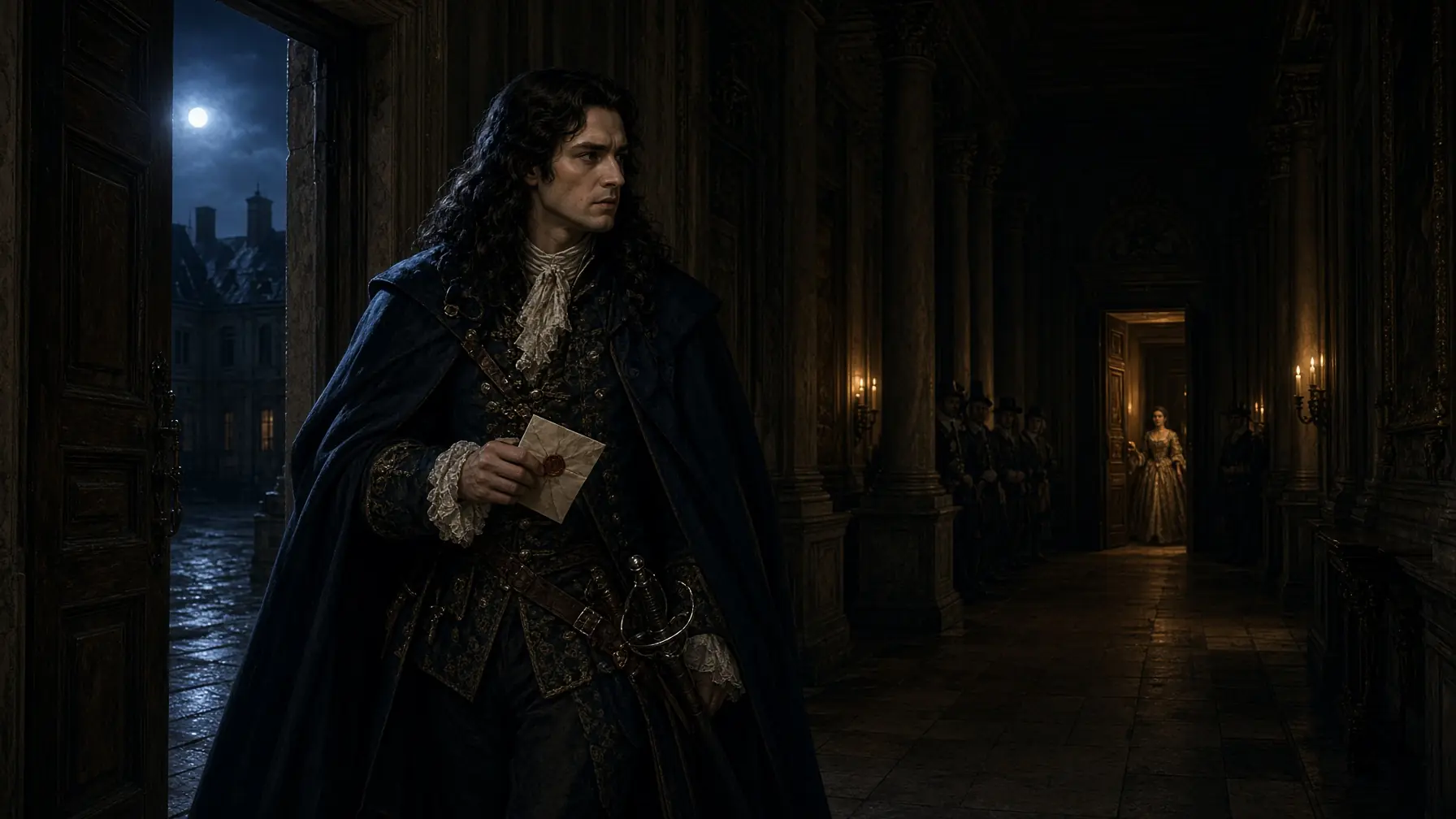
One night in July 1694, Count Philip Christoph von Königsmarck entered the Leine Palace in Hanover.
He was 29 years old, an aristocrat, a soldier, and a man whose relationship with one of the most important married women at the Hanoverian court had become dangerously intimate.
That woman was Sophia Dorothea of Celle.
Her husband was Georg Ludwig of Hanover—the future King George I of Great Britain.
Königsmarck entered the palace in circumstances connected to Sophia Dorothea and their plans to escape the situation in Hanover.
Then he disappeared.
He was never publicly seen alive again.
No body was officially produced. There was no public murder trial establishing exactly what happened. Königsmarck seemed simply to vanish inside a royal residence.
Modern German biographical scholarship goes considerably further than the cautious official silence of the time: the Neue Deutsche Biographie concludes that Königsmarck was murdered inside the Leine Palace during the night of July 11–12, 1694, by four courtiers, and that his body disappeared into the River Leine. Older scholarship, however, stressed that the surviving documentation could not formally prove every detail of the Hanoverian court’s responsibility.
What happened immediately afterward made the disappearance even more suspicious.
Sophia Dorothea was separated from her husband.
Their marriage was dissolved.
She was sent to Ahlden Castle and confined there for the rest of her life.
She would spend approximately 32 years at Ahlden.
Königsmarck vanished in a single night.
Sophia Dorothea effectively vanished from public royal life for more than three decades.
And behind both fates was a relationship that the Hanoverian dynasty desperately needed to contain.
Sophia Dorothea Had Been Trapped in an Unhappy Dynastic Marriage
Sophia Dorothea was born in 1666, the daughter of Georg Wilhelm, Duke of Brunswick-Lüneburg-Celle, and Éléonore d’Olbreuse.
She was an important heiress.
In 1682, when she was still a teenager, she married her first cousin Georg Ludwig, son of Ernst August of Hanover.
The marriage united important branches of the House of Brunswick-Lüneburg.
It was politically useful.
Personally, it was deeply unhappy.
The couple nevertheless produced two children whose descendants would become enormously important to European history.
Their son Georg August would eventually become King George II of Great Britain.
Their daughter, also named Sophia Dorothea, would marry Frederick William I of Prussia and become the mother of Frederick the Great.
But producing heirs did not repair the marriage.
Georg Ludwig had relationships with other women. Most notably, he maintained a long relationship with Melusine von der Schulenburg.
Sophia Dorothea increasingly found herself in a marriage from which escape was extraordinarily difficult.
A seventeenth-century dynastic princess could not simply obtain a modern divorce, move away, and begin another life.
Her marriage belonged partly to her family and dynasty.
Then Philip Christoph von Königsmarck entered the story.
The Letters Changed What Historians Could Know
Königsmarck was not a mysterious stranger who suddenly appeared at court.
He came from a prominent aristocratic family with Swedish connections and pursued the kind of international military career common among European noblemen of his era. He served in Hanover and moved comfortably through aristocratic society.
His relationship with Sophia Dorothea became increasingly intimate around the beginning of the 1690s.
For a long time, historians argued over whether the famous correspondence attributed to the pair was authentic.
Older scholarship could be deeply skeptical. A nineteenth-century biographical account, for example, dismissed the supposed letters as forgeries and questioned whether the relationship had truly been adulterous.
Later research reached a very different conclusion.