The laughter began before the auctioneer even reached the tractor.
It started with two men standing beside the equipment shed, grew when a third noticed the small girl climbing onto the running board, and spread until nearly half the people gathered in the muddy Nebraska farmyard had turned to watch.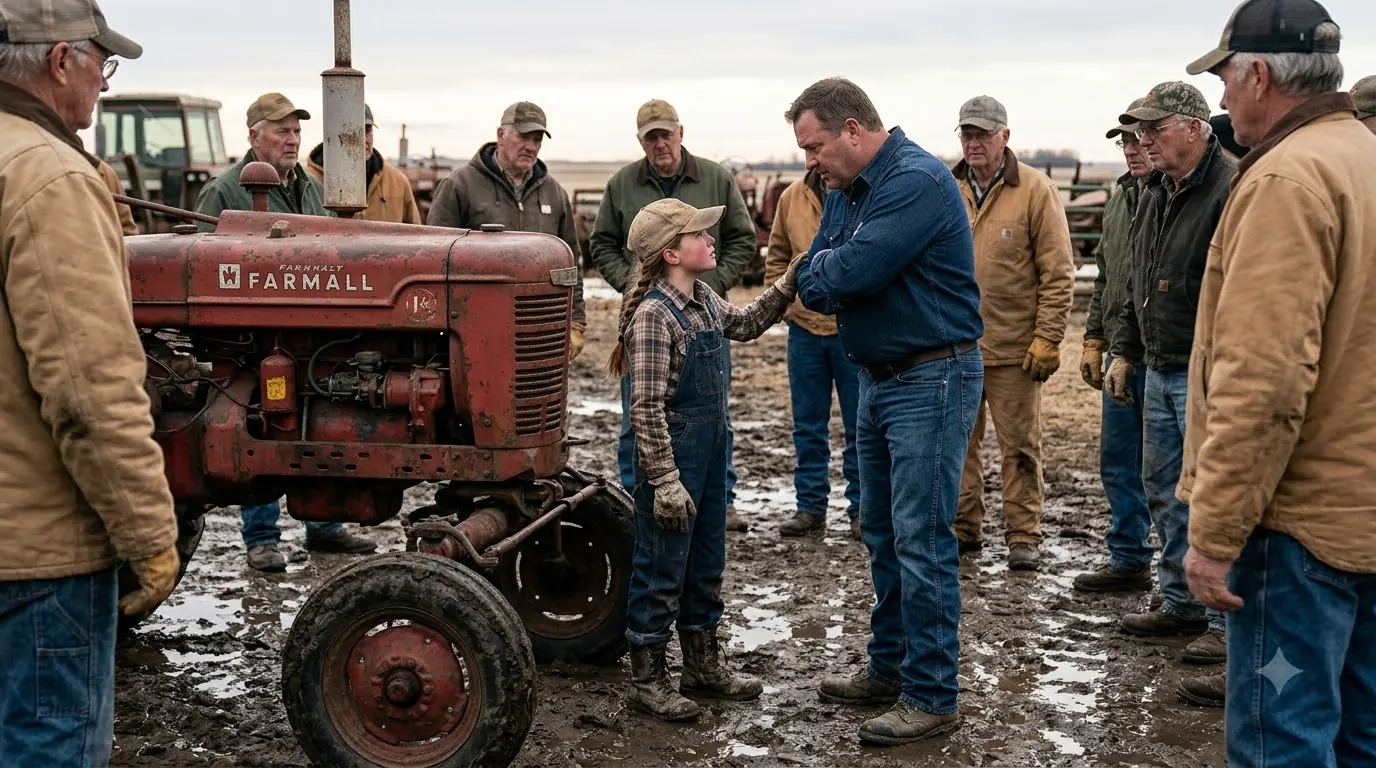
The tractor was an old Farmall, its red paint burned brown by decades of sun, its grille dented, its exhaust pipe leaning slightly to the left. Rust had crept around the wheel hubs. One headlamp was missing. The seat had been repaired with baling wire and a piece of cracked black vinyl.
To most of the men at the auction, it looked like what the dealer had been calling it all morning.
Scrap with tires.
But the eleven-year-old girl standing beside it did not see scrap.
She saw her father.
She saw his large hands wrapped around the steering wheel.
She saw him teaching her how to feather the clutch without killing the engine.
She remembered sitting on the toolbox beside him when she was six, barely tall enough to see over the hood, while they crawled between soybean rows on warm September evenings.
She remembered him tapping the temperature gauge and saying, “Machines talk before they quit. Most people just don't listen.”
And she remembered the last winter they had together.
Her father sitting at the kitchen table after midnight with unpaid bills spread around him, his face exhausted but still smiling when she came downstairs for water.
He had covered the papers with both hands.
“You should be asleep.”
She had climbed onto the chair beside him.
“Are we losing the farm?”
He had looked at her for a long time.
Then he had said something she never forgot.
“Land doesn't disappear because money gets tight.”
She had frowned.
“What does that mean?”
“It means problems change.”
“Sometimes we change with them.”
“And sometimes we fight harder.”
Three months later, he was gone.
Not in a dramatic accident.
Not in a moment anyone could blame.
A heart condition nobody knew he had.
Forty-two years old.
He walked into the machine shed one cold March morning and never walked back out.
Now, nine months later, the farm was still there.
So were the bills.
And standing beside the old Farmall with one small hand pressed against its rusted hood was the only daughter he had left behind.
Her name was Clara Bennett.
Eleven years old.
Brown hair braided down her back.
Sun-freckled cheeks.
Worn denim overalls over a faded green plaid shirt.
Work boots her mother had bought one size too large because children grew faster than farm budgets.
A tan cap that had belonged to her father.
She wore it every day she was allowed.
Across from her stood a man named Calvin Mercer.
He was fifty-four, broad through the chest, silver beginning to show at his temples, and dressed far too cleanly for a farm auction.
Dark denim shirt.
Expensive brown boots.
Heavy watch.
New pickup parked near the road without a single streak of mud across its doors.
Mercer bought failing farms.
That was the polite version.
The less polite version was what people said at diners after he left.
He waited.
He watched.
He learned which family had a bad year, which bank note was coming due, which farmer had been injured, which marriage was breaking, which children had moved away.
Then he arrived with cash.
Sometimes the offer saved people.
Sometimes it merely gave them a cleaner way to lose.
Clara’s mother had refused him three times.
The fourth offer arrived two weeks before the auction.
It was the largest.
Still far below what Clara believed the land was worth.
Mercer had smiled across their kitchen table as though he were doing them a favor.
“You have one hundred eighty-seven acres and more debt than your husband ever told you.”
Clara’s mother had gone pale.
Clara had been listening from the hallway.
Mercer continued.
“You can keep the house for six months.”
“I'll take the acreage, equipment, and grain rights.”
Her mother said:
“No.”
Mercer leaned back.
“You’re not farming this alone.”
“No.”
“I have a daughter.”
He laughed.
Clara remembered that laugh.
“She’s eleven.”
Her mother’s expression hardened.
“And she knows more about this farm than half the men you employ.”
Mercer stood.
“Then she’s old enough to understand arithmetic.”
He left the contract behind.
Her mother burned it in the kitchen stove.
Clara watched the paper curl black.
Two weeks later, however, they agreed to sell equipment.
Not the land.
Never the land.
But almost everything else.
The newer tractor.
The planter.
The large grain wagon.
The disc.
The baler.
The pickup her father used for fieldwork.
Anything with enough value to reduce the operating debt before spring.
The old Farmall was supposed to go too.
That was where Clara drew her line.
She had begged.
Her mother had cried.
They had argued.
Her mother finally said: