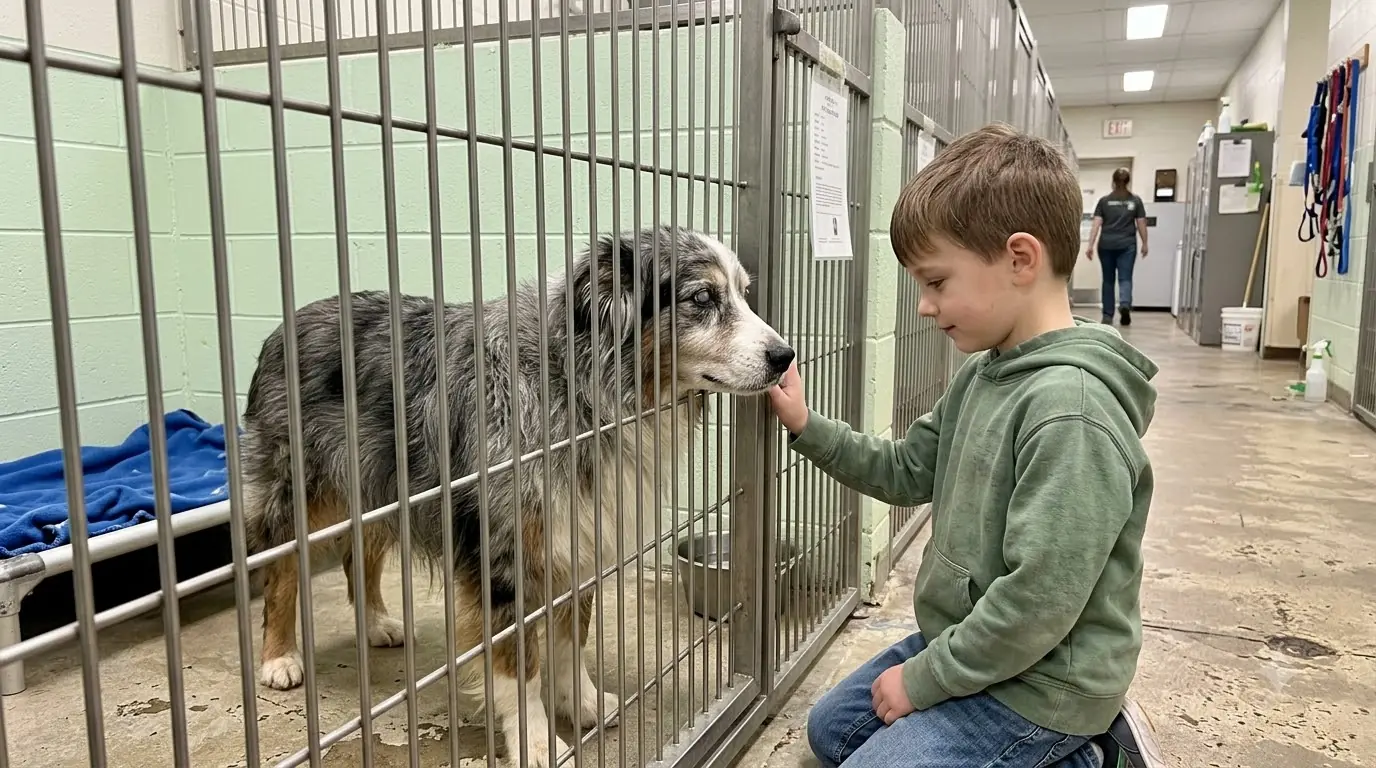
The little boy called his name more than once.
The senior Australian Shepherd did not lift his head.
He did not turn toward the voice.
He did not move when footsteps passed in the hallway or when another kennel door closed several rooms away.
He remained curled on his bedding at the far end of the kennel, sleeping so deeply that, to someone who did not know his medical history, he almost looked unaware that anyone was there at all.
The boy tried again.
Still nothing.
A shelter caregiver quietly explained that calling louder would not help.
The old dog could barely hear anymore.
His vision had declined too.
The boy stopped calling.
Instead, he knelt outside the kennel gate.
He slipped his fingers around one of the metal bars and left his hand there.
Then he waited.
For several minutes, nothing changed.
The Australian Shepherd slept.
Eventually, his head lifted.
Not because he had heard the boy.
Staff could not say what woke him. It might have been movement, vibration, scent, or simply the natural end of a deep sleep cycle.
He blinked toward the front of the kennel.
His aging eyes seemed to take time to make sense of the shape waiting beyond the gate.
Then he stood.
Slowly.
He walked toward it.
When he reached the front, he did not immediately find the boy's hand.
His nose moved along the bars.
He sniffed one opening.
Then another.
His muzzle traveled slowly along the metal until it reached the boy's fingers.
He stopped.
The boy did not reach through to grab him.
He kept his hand exactly where it was.
The old dog sniffed again.
Then he turned his head sideways and pressed his cheek against the narrow opening beside the boy's fingers.
For a few quiet seconds, the side of his face rested against the gate.
The boy's fingertips touched the fur on his cheek.
The dog had not heard a single time the child called for him.
But once he realized someone was waiting, he came all the way to the gate to find him.
Most People Thought He Was Ignoring Them
That misunderstanding had followed the Australian Shepherd almost from the moment he entered the shelter.
People would walk down the kennel row.
Other dogs reacted.
Some barked.
Some stood at their gates.
Some followed visitors from one end of the kennel to the other.
The senior Australian Shepherd often did nothing.
He slept.
Sometimes a person stopped in front of him and spoke.
No response.
They said his name.
Nothing.
They made a kissing sound.
Nothing.
They moved on.
From the hallway, it could look like disinterest.
Staff knew differently.
His lack of response was not a personality flaw.
He was not refusing to acknowledge people.
Much of the time, he simply did not know they were there.
His Hearing Loss Was Significant
Senior dogs can experience progressive hearing loss as structures involved in hearing deteriorate with age.
But shelter medical teams do not assume that every older dog who fails to respond is simply "deaf from old age."
His ears were examined.
Potential causes of discomfort or treatable obstruction needed to be considered.
Staff also observed his responses to different environmental sounds when he was not watching the source.
He reacted inconsistently to ordinary noises.
Voices often produced no visible response at all.
Louder environmental sounds could occasionally coincide with a reaction, but it was difficult to know whether he had heard them directly or detected associated vibration and movement.
Functionally, staff treated him as a dog with profound hearing impairment.
That meant changing how everyone approached him.
His Eyes Were Failing Him Too
Hearing was only part of the problem.
His vision was diminished.
The veterinary team evaluated his eyes and general senior health, separating what could be observed from what could actually be diagnosed.
He was not necessarily living in complete darkness.
He could still detect some visual information.
Movement seemed easier for him to notice than fine detail.
Strong contrast helped.
At close range, he could navigate familiar objects.
But his visual world was clearly not what it had once been.
That combination—severe hearing loss and declining sight—made ordinary shelter life particularly challenging.
A dog who cannot hear someone approaching can rely on vision.
A dog who cannot see clearly can rely on hearing.
He was losing both.
Sleep Became One of the Most Misunderstood Parts of His Day
He slept deeply.
Very deeply.
That was especially noticeable in the shelter.
A metal bowl could be moved nearby.
Another dog might bark.
People could pass his kennel.
He often remained asleep.
Staff learned never to interpret that as evidence that nothing bothered him.
More importantly, they learned not to wake him carelessly.
A dog who cannot hear an approaching person may startle if touched suddenly while asleep.
Add reduced vision, and the moment after waking can be confusing.
So caregivers developed a predictable routine.
They approached where he had the best chance of seeing them.
When he was sleeping, they avoided suddenly reaching down over his body.
Depending on the situation, they used gentle floor vibration from a safe distance or allowed scent and movement to announce their presence.
Then they gave him time.
That last part mattered.
He needed time to wake.
Time to orient.
Time to determine where someone was.
He Was Not an Unfriendly Dog
Once he knew a person was present, his behavior often changed.
His nose became active.
He moved toward scent.
At close range, he accepted gentle contact.
With familiar caregivers, he sometimes leaned his body against a leg.
He could enjoy slow scratches along his shoulder and neck.
He was not constantly seeking affection, and staff did not force it.
Some days he preferred to settle back onto his bed.
But the dog people saw sleeping at the end of the kennel was not the whole dog.
The difficulty was getting visitors to wait long enough to meet the rest of him.
The Boy Almost Walked Past Too
The child had been moving through the shelter with an adult when he noticed the Australian Shepherd.
The old dog was asleep.
The boy stopped.
He spoke to him.
There was no response.
He tried the dog's name.
Nothing.
The adult might easily have encouraged him to keep moving.
There were other dogs standing at their gates.
Dogs who could see him immediately.
Dogs who responded when he spoke.
Dogs who made it obvious that they wanted attention.
Instead, the boy remained there.
A staff member explained that the Australian Shepherd was almost completely deaf and had trouble seeing.
The child looked back into the kennel.
Then he knelt.
Calling Louder Would Not Bring Him Closer
That was the first thing the boy had to understand.
People naturally repeat themselves when someone does not respond.
With a deaf dog, increasing volume may accomplish nothing.
The shelter had been teaching visitors and volunteers to communicate with the Australian Shepherd in ways he could actually perceive.
Visual signals worked when he was looking directly at the person and close enough to see them.
Gentle tactile cues could be useful once contact had been established.
Scent was enormously important.
Predictability was important.
Sudden approaches were not.
The boy stopped using his voice to get the dog's attention.
He simply put his hand against the gate.
The Hand Stayed There for a Long Time
The child did not wave it through the bars.
He did not tap repeatedly.
He did not reach far into the kennel.
He placed his hand where the dog could investigate it safely if he chose to approach.
Then he waited.
The Australian Shepherd continued sleeping.
That waiting changed the interaction.
There was no pressure on the dog to respond quickly.
No one tried to manufacture a touching moment.
If he had slept through the entire visit, staff would have let him sleep.
A senior dog did not owe anyone an interaction.
Eventually, however, he woke.
At First, He Only Saw a Shape
His head came up.
His eyes blinked.
The boy was directly beyond the gate, but the dog did not immediately rush toward him.
He stared.
His head changed angle slightly.
Staff had seen this before.
With reduced vision, he sometimes seemed to need several moments to process unfamiliar shapes.
The child stayed still.
The dog stood.
Standing itself took time.
His front feet positioned beneath him.
His hindquarters followed more slowly.
Like many seniors, he carried some age-related stiffness.
He paused once upright.
Then he began walking.
He Did Not Walk Directly to the Hand
That was one of the details that made the moment so difficult to forget.
From the boy's side of the gate, his hand was obvious.
From the dog's side, apparently it was not.
The Australian Shepherd approached the general area.
Then his nose took over.
He sniffed the floor near the gate.
His muzzle lifted.
He investigated one section of bars.
Nothing.
He moved several inches.
Sniffed again.
The boy's fingers remained still.
The dog's nose finally reached them.
He inhaled.
Stopped.
Then returned to the same spot.
He had found what his eyes could not locate precisely from across the kennel.
His Cheek Went Against the Bars
The boy did not pull his hand away.
The Australian Shepherd shifted his head.
Instead of merely sniffing the fingers, he turned his face sideways.
His cheek pressed against the opening.
The metal gate separated most of them.
But not completely.
The boy could reach the fur along the side of his face with his fingertips.
He stroked once.
Stopped.
The dog remained there.
So the boy touched his cheek again.
The Australian Shepherd leaned a little more firmly against the gate.
There was no way to know exactly what the dog was thinking.
Staff did not claim he understood that a child had been calling him.
They did not claim he knew the boy had waited.
They did not need to.
The observable behavior was enough.
He had awakened.
He had noticed someone.
He had walked across the kennel.
He had searched with his nose until he found the hand.
And once he found it, he chose to remain against it.
The Gate Had Become Important to Him
After that interaction, staff paid closer attention to what happened when people waited at the front of his kennel.
There was a pattern.
If he was awake and noticed someone, he often approached slowly.
If he could not identify them visually, he sniffed.
Once he recognized a familiar scent, his posture often softened.
Sometimes he leaned against the gate.
Sometimes he turned away.
Sometimes he returned to bed.
His choices varied.
That was normal.
But the shelter realized that his apparent lack of engagement from a distance was hiding a much more social dog at close range.
The challenge was that many visitors never stayed long enough to discover it.
Other Dogs Could Ask for Attention More Easily
The Australian Shepherd could not compete with them.
A younger dog could hear footsteps approaching and run to the front.
A dog with normal vision could notice a visitor from across the room.
A vocal dog could bark.
An excited dog could bounce against the gate.
This senior often slept through the entire opportunity.
By the time he woke, the person might already be three kennels away.
It was not that nobody ever stopped for him.
People did.
But his disability changed the timing of every interaction.
He needed people who were willing to wait.
Staff Changed His Environment
The shelter could not restore the sensory abilities he had lost, but it could make his surroundings easier to understand.
His bed remained in a consistent location.
Water was kept predictable.
Unnecessary obstacles were avoided.
Nonslip surfaces helped with senior mobility.
Strong visual contrast was used where practical.
Caregivers tried not to rearrange his space without a reason.
Predictable pathways matter for dogs with impaired vision.
Scent landmarks can help too.
The goal was not to create a completely sterile environment.
It was to give him enough consistency that he did not have to rediscover his world every morning.
He Learned People Through Other Signals
A familiar caregiver did not always need a voice.
He could recognize scent.
He could notice the way someone approached.
He could learn a touch cue.
When awake and looking, he could respond to broad, clear hand signals within his remaining visual range.
Staff used reward-based methods to help him associate those cues with ordinary routines.
Going outside.
Returning to his bed.
Receiving food.
Accepting handling.
The communication was imperfect.
It did not need to be perfect.
It needed to be understandable.
His Walks Became Slower but More Deliberate
Outside, the Australian Shepherd was given time.
He did not move like a young herding dog.
He sniffed extensively.
Changes in surface texture helped him understand where he was.
Handlers avoided pulling him abruptly in a direction he had not detected.
Curbs and steps required attention.
If he hesitated, he was given information and time rather than dragged forward.
His nose often seemed to tell him more about the environment than his eyes did.
That was especially obvious when a familiar person stood nearby.
He might not visually identify them immediately.
Then his nose lifted.
A few sniffs later, his body changed.
He approached.
The Boy Visited Again
This time, staff did not encourage him to call the dog's name first.
The boy already understood.
He approached the kennel slowly.
The Australian Shepherd was asleep again.
Almost exactly where he had been the first time.
The boy knelt.
His hand went to the bars.
And once again, nothing happened immediately.
He waited.
Eventually, the dog woke.
This time, he seemed to notice the figure at the gate a little sooner.
He stood.
Walked forward.
His nose began searching.
The boy did not move his hand to meet him.
The dog found it.
Then his cheek went to the same section of gate.
Not Every Visit Happened That Way
There were days when the Australian Shepherd woke and chose not to approach.
Sometimes he needed to go outside.
Sometimes food was more interesting.
Sometimes he simply changed position and returned to sleep.
The boy was taught to respect those days too.
A relationship with a disabled senior dog cannot be built around expecting the same emotional behavior on command.
The dog had to retain the right to say no by walking away, turning his head, or remaining where he was.
That made the moments when he approached more meaningful, not less.
His Medical Needs Went Beyond Hearing and Vision
Age rarely arrives as a single issue.
The shelter evaluated his overall senior health.
His joints were assessed.
Dental condition mattered.
Bloodwork was appropriate to look for common senior concerns and establish a baseline when indicated.
His weight needed to remain healthy because extra pounds would make mobility more difficult.
His nails needed to be kept at a length that supported traction.
Changes in appetite, drinking, elimination, sleep, balance, or behavior could not automatically be blamed on age.
Senior dogs deserve medical investigation too.
"He's old" is not a diagnosis.
There Was No Treatment That Would Make Him Young Again
The rescue was careful about that.
His care could improve comfort.
His environment could reduce confusion.
Treatable eye or ear problems would be addressed if identified.
Pain could be managed.
Mobility could be supported.
But staff could not promise that his hearing would return.
They could not promise that his eyesight would become sharp again.
An adopter would need to love the dog who existed now.
Not wait for him to become the dog he might have been years earlier.
A Home Would Have to Learn His Language
The ideal environment for him would be predictable.
People would need to remember that he might not hear them entering a room.
They would need to avoid startling him awake.
Children would need supervision and the same patient instructions the boy had followed.
Furniture and pathways should not change constantly.
Unsecured stairs could present a risk.
A secure yard or controlled leash routine would matter because calling a deaf dog back from a distance is not a reliable safety plan.
His remaining vision could decline further.
His family would need to adapt with him.
None of those things made his life empty.
They simply changed the way humans had to communicate with him.
The Boy Already Seemed to Understand the Most Important Part
He stopped expecting the dog to come because he called.
He waited until the dog knew he was there.
That small difference changed everything.
During another visit, the Australian Shepherd was awake but facing away from the kennel door.
The boy knelt.
He did not shout.
A caregiver helped create a gentle vibration through the floor from an appropriate distance.
The dog's head turned.
He saw movement.
Then he approached.
His nose searched.
The hand was waiting.
He Began Sleeping Closer to the Front Sometimes
Staff did not claim the boy caused this.
The senior dog's resting choices varied for many reasons.
But as he became more familiar with the shelter routine, caregivers occasionally found him sleeping closer to the front of the kennel instead of always at the far end.
A supportive bed was available there too.
Sometimes he chose it.
That meant visitors had a better chance of noticing him.
It also meant that when he woke, he had less distance to travel before investigating someone at the gate.
For an older dog, reducing unnecessary effort mattered.
He Still Sleeps Through People
That has not changed.
Someone can stop.
Say his name.
Wait briefly.
Receive no response.
And move on.
He may never know they were there.
There is something particularly difficult about watching that happen when staff know what can occur if a person waits just a little longer.
They have seen the difference.
The old dog sleeping at the back of the kennel can look unreachable.
Then he wakes.
He sees a shadow.
His nose begins working.
And suddenly he is making his slow way toward the front.
The Boy Doesn't Call Him Anymore
On one of his more recent visits, the Australian Shepherd was asleep when the child arrived.
The boy approached the gate.
He looked toward the caregiver.
Then he knelt without saying anything.
His hand went to the metal bars.
The dog slept.
A minute passed.
Then another.
His breathing remained slow.
The boy waited.
Eventually, the senior dog's head rose.
His cloudy, aging eyes looked toward the front.
For several seconds, he seemed unsure what he was seeing.
The child did not wave.
He did not call.
He simply stayed where the dog had learned a person might be waiting.
The Australian Shepherd stood.
His joints took a moment to organize beneath him.
Then he walked.
Slowly.
Across the kennel.
His nose reached the gate before he had completely located the hand.
He sniffed left.
Then right.
The boy's fingers stayed still.
The dog's muzzle finally reached them.
He sniffed once.
His head turned.
And that familiar gray-flecked cheek pressed into the narrow space beside the child's hand.
The boy gently moved his fingertips through the fur.
The old dog stayed there.
Someday, his remaining vision may become weaker.
His hearing is unlikely to suddenly return.
There may always be people he sleeps through.
There may always be voices saying his name that never reach him.
But the little boy no longer needs the old dog to hear him calling.
He has learned to put his hand against the gate and wait.
And when the senior Australian Shepherd finally wakes, sees the shape of someone sitting there, and slowly searches the bars with his nose, the hand is still there when he finds it.