Aren had spent twelve years learning which parts of Eldoria belonged to people like him.
The answer was almost none of it.
The market belonged to merchants who shouted when his bare hands touched fruit.
The avenues around the palace belonged to nobles whose carriage drivers expected children like Aren to move before the horses reached them.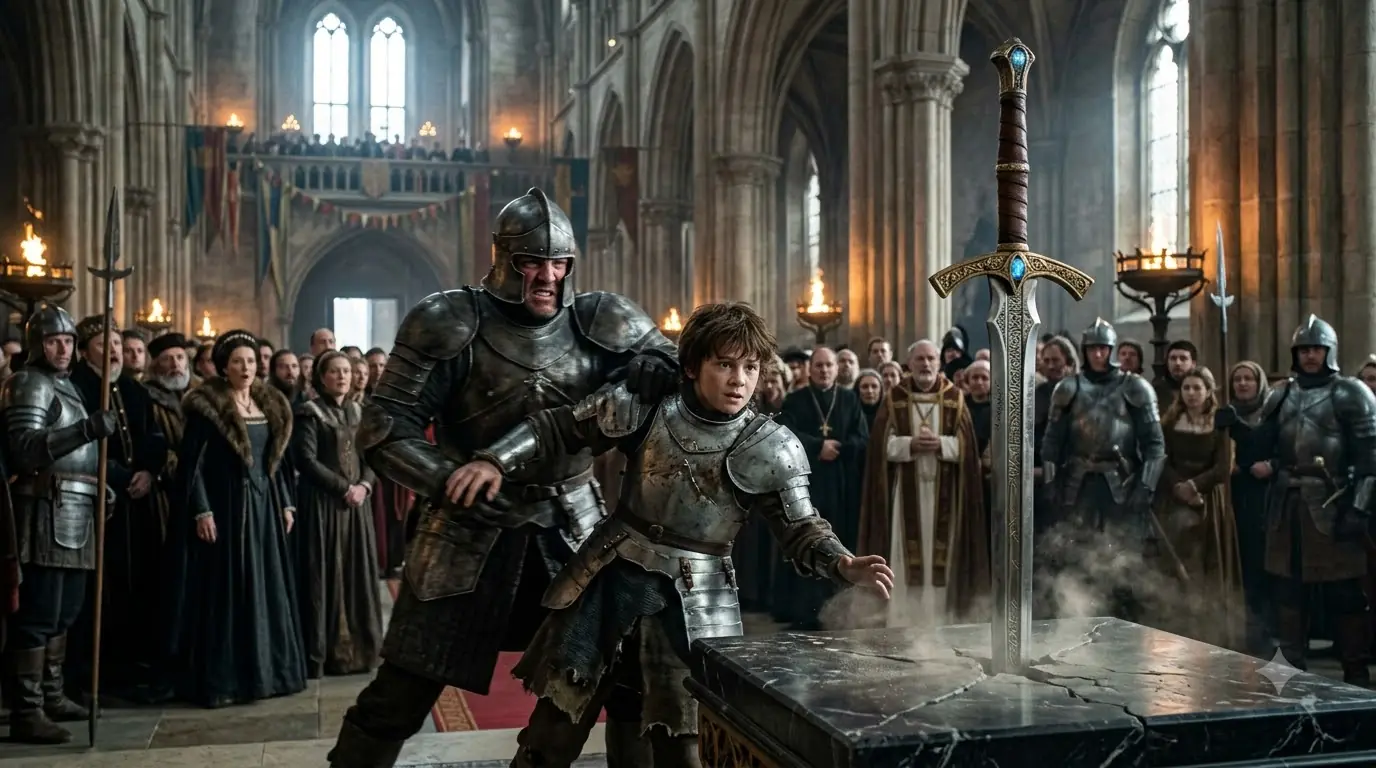
The temples belonged to worshippers with clean clothes.
Even the abandoned storage room beneath the eastern palace wall, where Aren slept during winter, technically belonged to the Crown.
Aren simply knew which watchman looked the other way.
He knew where the bakers placed burned loaves at closing time.
He knew which stable master might exchange two hours of manure shoveling for a bowl of stew.
He knew that guards ignored hungry children until those children wandered too close to anything made of gold.
Most importantly, Aren knew not to expect anyone to remember him.
It was safer that way.
But the mountains remembered.
For a thousand years, the Kingdom of Eldoria had lived beneath seven mountain ranges so large that travelers used their peaks instead of maps.
The people built songs around them.
Fortresses clung to their lower slopes.
Villages carved terraces into their valleys.
And hidden within those mountains, according to every nursery tale in the kingdom, slept the Stone Giants.
The oldest law in Eldoria was shorter than most prayers.
Never awaken them.
No one living knew who had written it.
Nobody even agreed on what the giants had been.
Some stories described monsters who ate armies.
Others claimed they had served the first kings.
Priests called them punishments placed beneath the earth by forgotten gods.
Royal scholars preferred the safe answer.
Myth.
The mountains were stone.
The giants were stories.
The warning survived because traditions often survive long after their reasons are buried.
Every autumn, Eldoria held the Festival of the Crown to celebrate the kingdom’s founding.
Every autumn, people hung gold-and-blue banners along the palace avenue, filled the royal square with musicians and food stalls, and told children exaggerated stories about the ancient Stone Wars.
And every autumn, Aren came for one reason.
Food.
On the morning everything changed, he had already managed to steal half a honey cake and earn a copper coin carrying three crates for a spice merchant who called him “boy” because he never bothered asking his name.
Aren was small for twelve.
Too many years of hunger had left him thin, with narrow shoulders and wrists that looked even smaller beneath the sleeves of a brown coat several sizes too large.
His dark hair refused every attempt to flatten it.
One boot had a hole in the sole.
The other belonged to a dead cobbler’s son and was almost two sizes too big.
He had learned to walk without showing discomfort.
That morning, he moved through the festival crowd with his head low.
He watched hands.
Belts.
Purses.
Food.
Never faces unless necessary.
Faces remembered you.
Hands told you whether you were about to be hit.
A brass horn sounded from the palace steps.
Thousands turned.
Aren used the distraction to slip a small apple from a cart.
He had almost reached an alley when a hand closed around his shoulder.
“You.”
Aren froze.
A Royal Guard stood behind him.
The man was broad enough to block the sun.
Steel shoulder plates reflected festival banners.
His beard was trimmed short beneath a polished helmet.
The apple suddenly felt very heavy in Aren’s hand.
“I paid for it.”
The guard looked toward the fruit seller.
The seller had not even noticed.
“Did you?”
Aren lowered his eyes.
The guard took the apple.
He tossed it back onto the cart.
“Move.”
Aren started to.
Then the ground trembled.
Barely.
A vibration beneath his feet.
He stopped.
The guard frowned.
“Didn’t you hear me?”
Aren did.
But he heard something else too.
A sound he had heard for years.
Only never this loud.
THUMM.
Not thunder.
Not drums.
Something deeper.
The Royal Square had been built around a circular black-marble platform older than the palace itself.
At its center stood a sword.
Everyone in Eldoria knew that sword.
It was called the Kingmaker.
Nobody knew why.