He Kept Trying to Follow Them
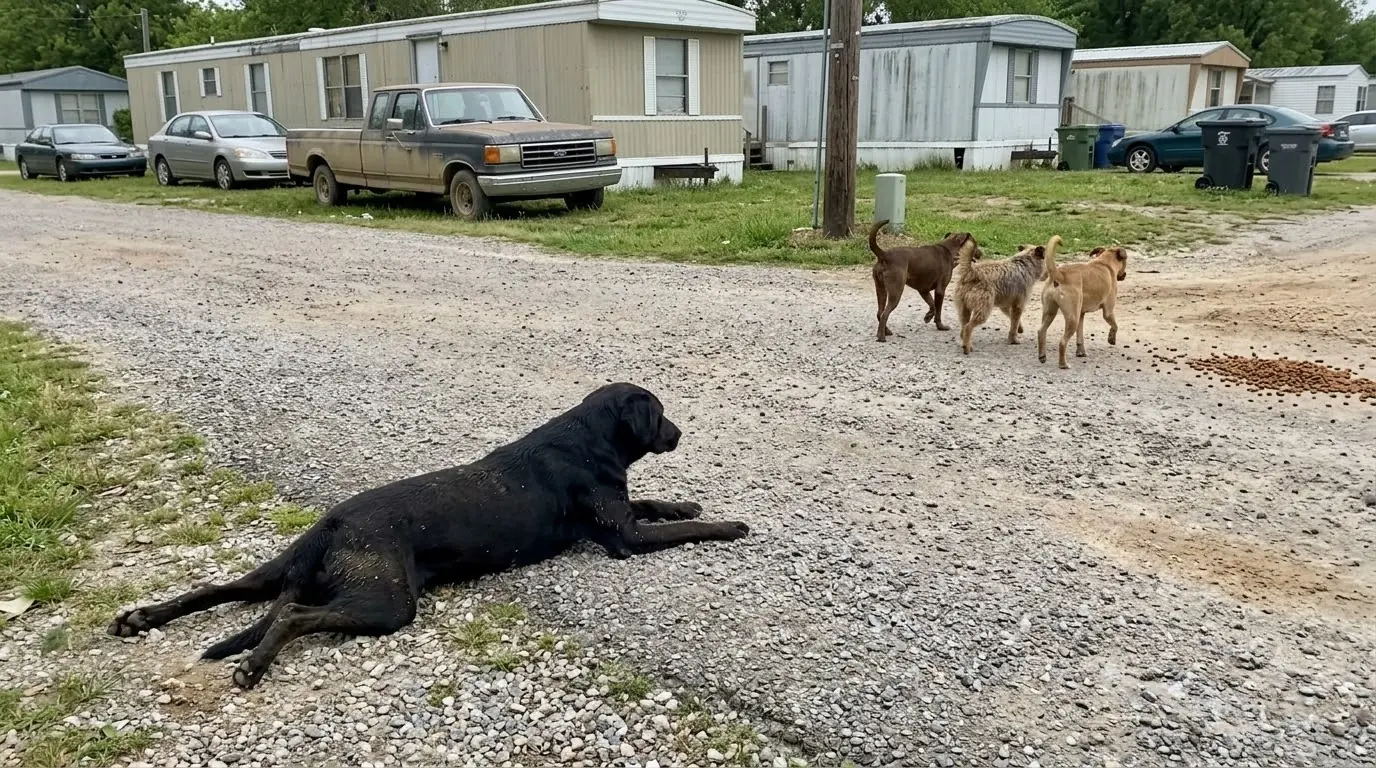
The young Lab mix lifted his head the moment the other dogs started moving.
Several strays had been lingering around the trailer park, drifting between patches of shade, parked vehicles, and the edges of the road where people occasionally left food.
When someone placed a bowl on the opposite side, the other dogs noticed first.
One trotted across.
Then another.
The Lab tried to go with them.
His front legs moved normally.
His shoulders came forward.
His rear legs followed for only a few steps.
Then his hips dropped.
Both back legs folded underneath him.
He hit the dirt near the road shoulder.
For several seconds, he stayed there.
Then he pushed himself up again.
His front feet planted.
His back half rose unsteadily.
He took another step.
Then another.
His hindquarters failed again.
This time he did not immediately try to stand.
He stretched both front legs toward the road.
The other dogs reached the food.
He remained on the near side.
Head up.
Watching.
That was the image witnesses remembered most clearly.
A young dog who wanted to follow the others but whose body repeatedly stopped him before he could get there.
People Around the Trailer Park Had Seen Him Before
The Lab mix had been appearing around the same trailer park for several days.
He was not always alone.
A loose group of stray dogs moved through the area.
They were not necessarily a stable pack in the strict behavioral sense, but they tolerated one another and often appeared around the same food sources.
The young Lab stayed near them when he could.
That became harder as his mobility worsened.
Residents noticed that he moved differently.
At first, some assumed he was tired.
Then they saw the back legs buckle.
He could still use them.
They were not completely paralyzed.
But they did not reliably hold his weight.
The weakness was most obvious when he tried to move quickly.
If the other dogs accelerated, he attempted to match them.
His front end surged forward.
His pelvis lagged.
Then the rear legs folded.
The Road Made the Situation More Dangerous
The trailer park bordered a road used regularly by residents, delivery vehicles, and passing traffic.
For the other dogs, crossing was risky enough.
For the Lab, it was worse.
If his hindquarters failed in the middle of the road, he might not be able to move out of the way.
Witnesses had already seen him collapse near the edge.
That made rescue more urgent.
People were asked not to chase the dogs across traffic.
Food was used to encourage them toward safer areas when possible.
The Lab's limited mobility actually made him easier to keep track of, but harder to approach without frightening him.
A frightened injured dog can still drag or propel himself into danger.
Rescuers Did Not Know How His Pelvis Had Been Injured
The weakness raised immediate suspicion of trauma.
But no one had witnessed an accident.
The rescue could not responsibly state that he had been hit by a car simply because the area contained traffic.
Other possibilities existed.
A fall.
Blunt trauma.
An old untreated injury.
Something that happened elsewhere before he reached the trailer park.
The team documented the facts.
Young male Lab mix.
Severe hind-limb weakness.
Repeated buckling.
Difficulty following other dogs.
No confirmed mechanism of injury.
That was enough to justify a medical evaluation.
Getting Him Away From the Road Had to Happen Slowly
Rescuers approached from the side rather than walking directly toward him.
Food was tossed.
The Lab watched carefully.
He was hungry enough to eat once people created distance.
He did not appear aggressive.
He was wary.
Each time someone stepped too close, he tried to move away.
That movement was costly.
His back legs would push for a few steps.
Then fail.
So the rescue team stopped forcing unnecessary movement.
They positioned themselves to reduce his path toward the road and used food to draw him toward a safer enclosed area.
Once he was close enough, a slip lead could be secured without a chase.
His First Attempt to Walk Toward the Rescue Vehicle Failed
With the lead on, the Lab stood.
His front half came up easily.
His pelvis followed more slowly.
He took several steps.
The right rear leg trembled.
Then both hindquarters sank.
The handler immediately reduced pressure.
No dragging.
No attempt to make him “walk it off.”
The rescue vehicle was moved closer.
A support sling was brought out.
The Lab remained lying down while equipment was positioned.
Then, with his pelvis supported, he tried again.
The Sling Changed His Movement Immediately
Once part of the load was taken off his hindquarters, his front legs no longer had to pull the entire body forward.
He could place the rear paws more deliberately.
The legs still looked weak.
The gait remained abnormal.
But he stayed upright.
That told the rescuers something useful.
The limbs had some function.
His body simply could not sustain normal weight through them.
The team did not diagnose him in the parking area.
They just got him safely into the vehicle.
He Kept Looking Toward the Other Dogs
As he was loaded, the other strays remained at a distance.
Some had returned from the food.
The Lab turned his head toward them repeatedly.
No one could know what he understood about the separation.
The rescue did not claim he was saying goodbye.
They simply documented that his attention stayed oriented toward the dogs he had been trying to follow.
Once inside the vehicle, he settled more quickly.
His front legs stretched forward.
His hindquarters remained awkwardly positioned.
A padded surface supported his pelvis.
The road disappeared behind them.
Pelvic Injuries Can Affect More Than Walking
At the veterinary clinic, the Lab received a careful orthopedic and neurologic examination.
The team needed to know whether the weakness came primarily from pain, instability, nerve injury, spinal involvement, muscle loss, or some combination.
They checked:
-
pelvic stability,
-
hip range of motion,
-
knee and hock function,
-
paw placement,
-
reflexes,
-
muscle tone,
-
spinal pain,
-
response to touch,
-
ability to move the tail,
-
and bladder and bowel function.
Those last points mattered.
Severe pelvic trauma can occasionally affect nerves involved in elimination.
Fortunately, the Lab could urinate and defecate without obvious loss of control.
That was an encouraging sign.
Imaging Confirmed Significant Pelvic Trauma
Radiographs showed an injury involving the pelvis that explained much of the instability and pain.
The exact pattern mattered for treatment.
Some pelvic fractures can heal with strict rest and pain management if the weight-bearing axis remains acceptably stable.
Others require surgery because alignment, joint involvement, or displacement would otherwise compromise function.
In his case, the injury was significant but not a situation where every abnormality automatically required emergency surgery.
The veterinary team reviewed alignment, pain, neurologic status, and expected function carefully.
The immediate priority was stabilization.
His Weakness Was Not Pure Paralysis
This distinction became important.
The Lab could move both rear legs.
He had sensation.
He could place the paws, although not always accurately.
He could bear some weight for short periods with support.
The problem was that the pelvis was painful and unstable enough that full loading caused collapse.
That meant his hindquarters were functionally weak without being completely disconnected neurologically.
Staff explained this carefully in his medical notes.
He was not simply “paralyzed.”
His movement was more complicated than that.
Pain Control Came Before Rehabilitation
No strengthening plan could begin while every step was painful.
The veterinary team established appropriate analgesia.
His movement was restricted.
He was given thick bedding.
The kennel floor had traction.
Food and water were placed within easy reach.
Bathroom trips were short and supported.
The goal was not to make him use the legs as much as possible.
The goal was to protect healing tissue while preserving safe function.
He Still Tried to Follow Activity
The behavior from the road followed him into the medical kennel.
Whenever dogs moved in the hallway, his head came up.
If a kennel door opened, he shifted forward.
Sometimes he tried to stand before staff had positioned the support sling.
His front legs pushed.
His hips rose.
Then the back legs began to fold.
Caregivers learned to intervene early.
Not because they wanted to stop his motivation.
Because repeated uncontrolled collapse could worsen pain or create another injury.
His Front Legs Were Doing Most of the Work
The Lab was young, and his forelimbs were still strong.
He used that strength constantly.
To rise.
To pull himself toward the water bowl.
To turn.
To reposition on bedding.
That compensation helped him remain independent in small ways.
It also placed extra stress on his shoulders, elbows, and wrists.
Staff monitored those areas.
Traction became essential.
A slip in front could leave him with no stable limb to catch himself.
He Wanted Food Badly Enough to Overdo It
The young Lab had a strong appetite.
That was medically helpful.
It was also a problem when meals arrived.
He would try to stand too quickly.
His body moved before the support equipment was ready.
So meals became calm events.
No excited calling.
No bowl waved in front of him.
Food was placed nearby.
If he could eat safely lying down, he did.
There was no reason to make dinner a standing exercise.
His Body Condition Needed Improvement Too
The Lab was thin.
Not skeletal, but underconditioned.
Living outdoors with limited mobility may have made consistent access to food more difficult.
The rescue could not know exactly how much he had been eating.
His nutritional plan supported healing without adding unnecessary body weight.
That balance was important.
He needed calories and protein for tissue repair and muscle maintenance.
He did not need rapid weight gain that would increase load on an injured pelvis.
The First Few Days Were Mostly About Preventing More Damage
His world became small.
Bed.
Water.
Food.
Supported bathroom trips.
Medical checks.
Rest.
For a young Lab, that was frustrating.
His mind wanted more activity than his pelvis could tolerate.
Enrichment had to be low-motion.
Food puzzles that did not roll away.
Chew items appropriate to his medical status.
Scent-based activities within easy reach.
Calm interaction.
Recovery often looks boring from the outside.
Boring was exactly what his pelvis needed.
Rehabilitation Began With Supported Standing
Once the veterinary team felt it was safe, the first exercises were simple.
Stand with sling support.
Place both rear paws correctly.
Hold the position for several seconds.
Rest.
That was enough.
Later came gentle weight shifts.
Not large.
Not forced.
Just enough to encourage the hind limbs to participate without overloading the healing structures.
The Lab's enthusiasm had to be restrained.
The body set the schedule.
Not his age.
His Right Rear Leg Improved Before the Left
As healing progressed, staff noticed asymmetry.
One rear leg began accepting weight more confidently.
The other remained weaker.
That was not unexpected.
Pelvic injuries rarely affect both sides in perfectly equal ways.
The rehabilitation plan adjusted accordingly.
The stronger side could not be allowed to take over everything.
But the weaker side also could not be forced beyond what the injury allowed.
Balance mattered.
The First Time He Crossed the Medical Run Without Falling
The distance was short.
Several feet.
A caregiver positioned the sling.
The Lab stood.
Front paw.
Rear paw.
Another step.
His pelvis swayed.
The sling steadied him.
He kept going.
No collapse.
He reached the other side.
Then he was lowered carefully.
Nobody asked him to do it again immediately.
For him, success was not about repetition until exhaustion.
It was about one controlled sequence.
He Still Watched Other Dogs Move Faster
From his kennel, he could see part of the hallway.
Young dogs walked past on leashes.
Some bounced.
Some pulled.
Some trotted with the effortless gait he did not have.
The Lab noticed.
He often became alert.
Sometimes he tried to rise.
Staff were careful not to romanticize it as jealousy.
Movement attracts attention.
Dogs respond to other dogs.
The important part was practical.
Watching activity increased his own desire to move.
That meant staff needed to protect him from trying more than the pelvis was ready for.
His First Unsupported Stand Lasted Only Seconds
One day, after several weeks of controlled healing, the sling was loosened rather than fully supporting him.
The Lab stood.
Both rear paws remained on the floor.
His hindquarters trembled.
But they held.
Three seconds.
Then five.
Then the caregiver supported him again and helped him lower.
It was a tiny milestone.
But it was the opposite of what witnesses had seen beside the road.
His back legs had once folded almost immediately.
Now they could hold him briefly.
Progress Was Uneven
The next morning, he struggled more.
One rear leg slipped.
His pelvis dropped.
The sling caught him.
That did not mean the prior progress had vanished.
Healing tissue, pain, muscle fatigue, and daily variation all affect mobility.
The rescue tracked patterns rather than judging one moment.
The Roadside Collapse Became the Benchmark Nobody Wanted to Repeat
Staff knew the original story.
Try to follow.
Rear legs buckle.
Fall.
Try again.
Fall again.
Eventually stop at the edge.
That sequence became exactly what rehabilitation tried to prevent.
He did not need more opportunities to collapse.
He needed successful controlled movement.
He Began Taking Short Supported Walks Outside
Once medically cleared, the Lab started going a little farther.
Not across roads.
Not through busy environments.
A quiet flat area.
Good traction.
Support sling.
Several steps.
Pause.
Sniff.
Several more.
The ability to sniff seemed to motivate him without producing the same frantic forward drive he showed when other dogs ran.
That made outdoor rehabilitation valuable.
His Muscles Had Already Started Shrinking
Restricted use has consequences.
The thighs became smaller.
That was expected but still important.
Muscle needed to be rebuilt once the pelvis was ready.
Nutrition alone would not do it.
Neither would long walks.
The answer was progressive load.
A little more.
Then rest.
Then reassess.
A Medical Foster Home Became the Best Next Step
The shelter eventually found a foster experienced with orthopedic recovery.
The house was mostly one level.
Rugs covered smooth flooring.
Stairs were blocked.
A small fenced yard allowed controlled bathroom breaks.
Multiple low beds reduced unnecessary travel.
The foster caregiver understood one of the biggest risks.
He felt better before he was fully healed.
His First Day in Foster Showed That Immediately
The Lab entered the home with support.
He sniffed.
Saw another dog at a distance behind a gate.
His entire posture changed.
He leaned forward.
Tried to accelerate.
The rear legs wobbled.
The caregiver slowed him immediately.
That familiar desire to follow other dogs was still there.
The foster plan had to account for it.
He Was Not Allowed to Run With the Resident Dog
Even when his gait improved, unrestricted play would have been unsafe.
Introductions were controlled.
Visual contact first.
Then calm parallel movement when appropriate.
No wrestling.
No chasing.
No sudden turns.
The Lab wanted to participate.
The foster caregiver's job was to make sure participation did not become reinjury.
His Gait Slowly Became More Even
Weeks passed.
The pelvis stabilized.
Pain decreased.
The weaker rear leg began contributing more.
His stride remained shorter behind than in front.
But the dramatic buckling became less frequent.
He could walk across a room without the back half suddenly folding every few steps.
That was the kind of progress staff wanted.
Functional.
Repeatable.
Safe.
He Started Turning Without Sitting Down
Early in recovery, a turn could destabilize him enough that he had to lower himself.
Later, he learned to make wide arcs.
His rear paws repositioned more accurately.
The pelvis swayed less.
The foster caregiver kept furniture arranged to give him room.
Tight spaces still demanded more control than he had.
The Support Sling Became Insurance Instead of Lift
At first, the caregiver carried meaningful weight through the sling.
Later, the handle could remain almost slack.
The Lab did the work.
The sling was still there in case his hindquarters suddenly failed.
That was an important transition.
Support had not disappeared.
His dependence on it had decreased.
One Day He Tried to Run
It happened when the resident dog moved quickly toward the yard.
The Lab reacted before anyone could redirect him.
His front legs accelerated.
For two or three strides, his rear legs tried to match.
The caregiver shortened the leash and supported him before he could build speed.
He looked frustrated.
His pelvis remained stable.
The incident became a reminder.
Feeling better and being ready are not the same thing.
He Eventually Earned More Freedom
Only after veterinary rechecks and consistent rehabilitation progress did his activity expand.
Longer walks.
More independent movement inside.
Controlled interaction with other dogs.
Still no reckless sprinting.
His body needed time to convert healing into durable strength.
The First Time He Followed Another Dog Across the Yard
It happened slowly.
No road.
No food on the other side.
No sprint.
The foster's resident dog walked toward a shaded corner.
The Lab noticed.
He stood.
Then followed.
Four legs on the ground.
His gait still had a slight unevenness.
But his hindquarters did not fold.
He reached the other dog.
Sniffed the same patch of grass.
Then stood there.
That moment carried no dramatic sound.
It was just the ordinary thing he had been unable to do when rescuers first heard about him.
His Pelvis Will Always Be Part of His Medical History
A significant pelvic injury can have long-term consequences.
Even with good healing, some dogs develop stiffness or arthritis later.
Maintaining a healthy body weight will matter.
Appropriate exercise will matter.
Any future lameness, reluctance to rise, pain, or neurologic change will deserve veterinary attention.
The rescue does not describe him as if nothing happened.
His body healed.
The history remains.
He No Longer Has to Watch From the Edge
The people who first reported him still remember the scene at the trailer park.
Several stray dogs moving toward food.
A young Lab trying desperately to follow.
Front legs going first.
Back legs buckling.
Body hitting the ground.
Then another attempt.
And another.
Until he finally stopped at the road shoulder.
He lay there with both front legs stretched toward the dogs who had made it across.
He could see where they had gone.
He simply could not make his body follow.
Today, he still notices other dogs immediately.
That part has never changed.
If one starts walking, his head turns.
If a familiar dog moves toward the yard, he often gets up.
But now his pelvis rises with him.
The rear paws stay beneath his body.
He takes one step.
Then another.
And instead of ending at the edge while everyone else keeps moving, he can keep going with them.
Not fast.
Not recklessly.
But on all four legs, toward whatever caught his attention in the first place.