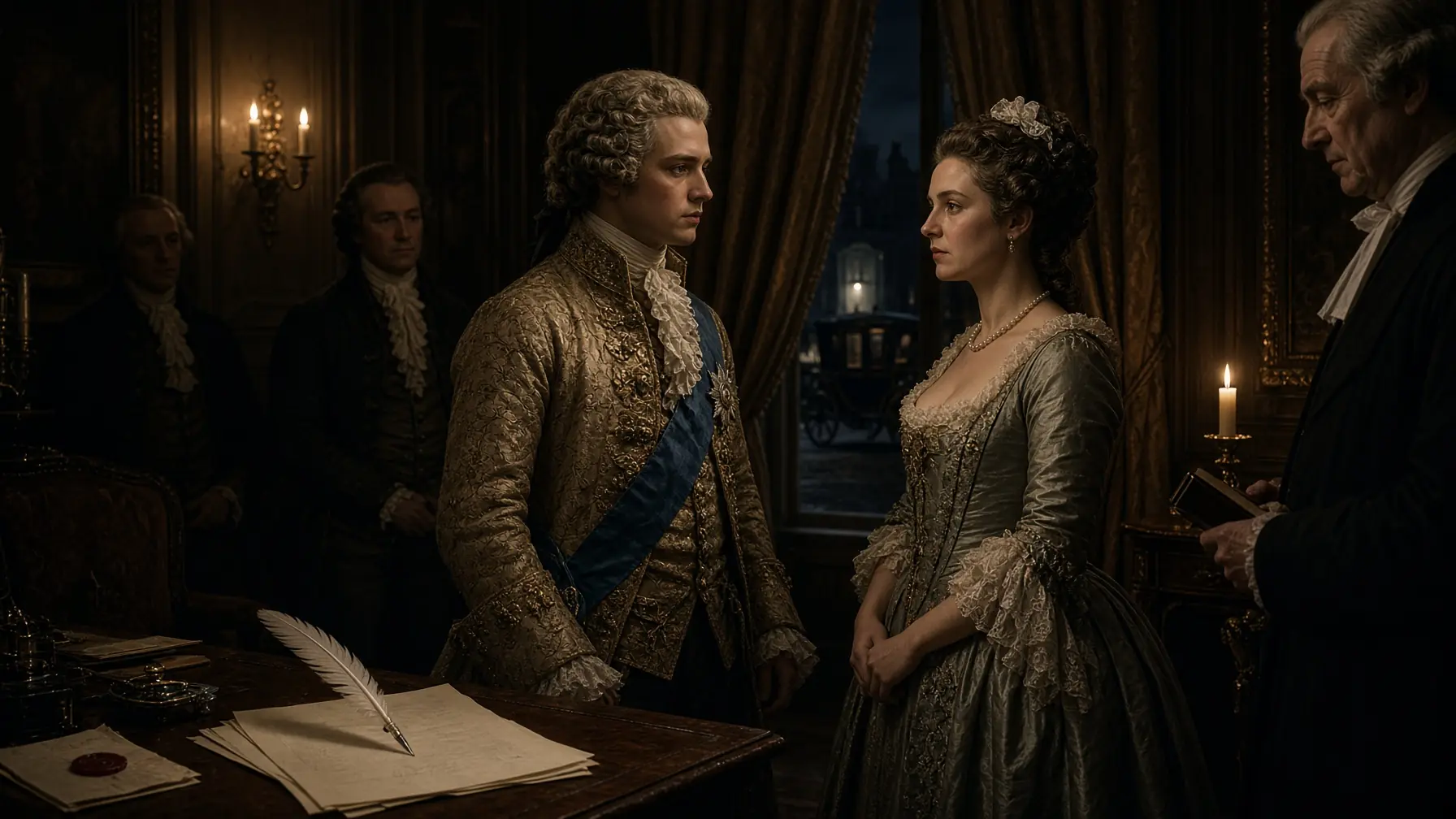
On December 15, 1785, inside a London house, the 23-year-old Prince of Wales went through a marriage ceremony that could never safely become an ordinary royal marriage.
The bride was Maria Fitzherbert.
She was six years older than the prince, twice widowed, socially respected—and Roman Catholic.
The groom was George, eldest son of King George III and the man expected one day to inherit the British throne.
Only a tiny circle witnessed the ceremony. The Reverend Robert Burt officiated, while Maria’s relatives Henry Errington and John Smythe were present. The surviving Royal Archives catalogue still identifies a remarkable fragment dated December 15, 1785: signatures of George and Maria verifying their marriage.
To Maria, the ceremony mattered profoundly.
To British law, however, there was an enormous problem.
George had married without his father’s permission. Under the Royal Marriages Act 1772, that meant the marriage was legally invalid. The Royal Collection itself describes the 1785 ceremony as a secret marriage that was “not valid in English law” because George III had not consented.
But even royal consent would not have solved everything.
Maria was Catholic.
For the heir to the British throne, that fact touched the constitutional settlement governing the Protestant succession. The Royal Archives states that if the marriage had been legally valid, George would have lost his place in the succession because Maria was Roman Catholic.
So Britain was left with a remarkable contradiction.
The future George IV had participated in a marriage ceremony with a woman he desperately wanted as his wife.
Yet constitutionally and legally, she could not become the wife Britain recognized.
When political pressure later forced the relationship into public controversy, George’s allies denied the marriage.
Ten years after the secret ceremony, he officially married another woman.
But Maria kept evidence.
And long after both were dead, some of that evidence eventually entered the Royal Archives—leaving the monarchy with documentary traces of the union it had never legally recognized.
Maria Fitzherbert Was an Unusual Choice for a Future King
Maria Anne Smythe was born in 1756 into a Catholic family.
By the time George met her, she had already lived through two marriages and two bereavements.
She married Edward Weld in 1775. He died that same year after a fall from his horse. In 1778 she married Thomas Fitzherbert, with whom she had a son; both husband and child died, leaving Maria widowed again by 1781. She was financially better provided for after her second husband’s death and subsequently entered London society.
There she encountered George, Prince of Wales.
George was heir to the throne, but his private life was already proving difficult for his father.
The Royal Archives describes the young prince as rebelling against his strict upbringing, embracing extravagant behavior and accumulating serious debts. He also developed close connections with prominent Whig politicians such as Charles James Fox and Richard Brinsley Sheridan.
Then he became infatuated with Maria.
She was not simply another court mistress.
George wanted marriage.
That distinction was crucial to Maria, whose Catholic faith made an informal sexual relationship unacceptable to her.
George pursued her intensely. She initially resisted and left Britain for continental Europe. Evidence preserved in the Royal Archives shows that the Duke of Gloucester knew of the relationship and believed Maria genuinely loved the prince; his correspondence also refers to the social difficulties she endured during her time abroad.
Eventually, she returned.
And George found a solution that satisfied his emotional determination while ignoring the constitutional impossibility.
They would marry secretly.
The Law George Could Not Simply Ignore
George was not an ordinary 23-year-old man.
His marriage was a matter of state.
The Royal Marriages Act had been enacted in 1772 after George III became furious over marriages contracted by two of his brothers without royal approval.
The law placed restrictions on marriages by members of the royal family.
For George, the practical consequence was straightforward: as the king’s son, he could not contract a legally valid marriage without George III’s consent.
He did not have it.
And there was little prospect that his father would approve Maria.
Then came the religious problem.
The British succession after the Glorious Revolution had been deliberately constructed around Protestant monarchy. The Act of Settlement 1701 excluded Catholics from succeeding to the crown and also historically excluded those who married Catholics.