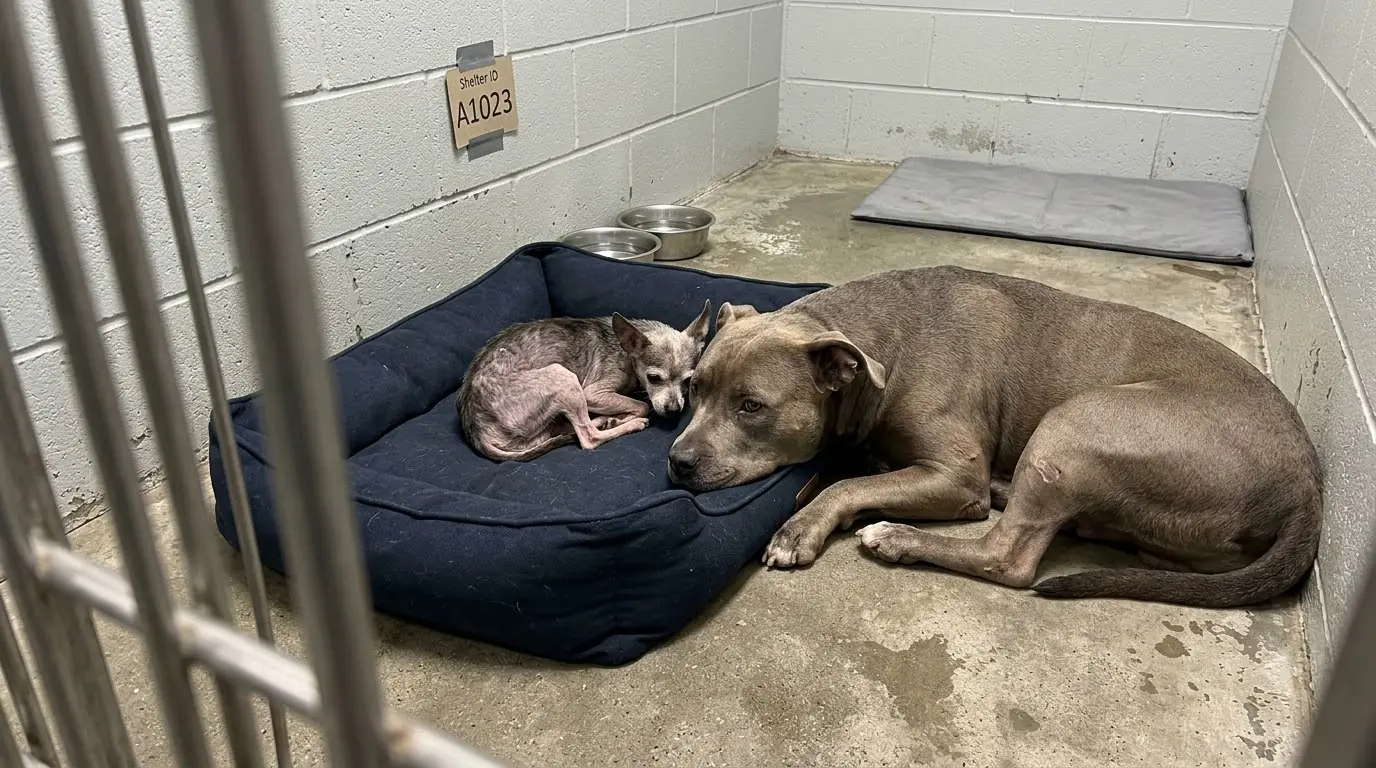
At first, staff thought the bed had moved by accident.
The shared kennel had been set up for two dogs: a large adult Pit Bull mix and a much smaller senior Chihuahua who had arrived with him after the pair lost their housing.
There were two sleeping areas.
One was a thick, supportive kennel mattress large enough for the Pit Bull mix. The other was a smaller padded mat positioned several feet away. Both were covered with washable fleece blankets, and both dogs had enough room to choose where they wanted to settle.
But the next morning, the room looked different.
The large mattress was no longer where staff had left it.
It had been pushed across the concrete until one edge sat close to the Chihuahua's usual corner.
The tiny senior was asleep on top of it.
The Pit Bull mix was not.
He was curled on the sealed concrete beside the mattress, his back following the edge of the bed.
Staff reset the kennel during cleaning.
That evening, both beds were placed back where they belonged.
By morning, the thick mattress had moved again.
The Chihuahua was on it.
The larger dog was on the floor.
After several nights, staff finally saw how it was happening.
The Pit Bull mix lowered his head, pressed his muzzle against the edge of the mattress, and began pushing.
He moved it a few inches.
Stopped.
Repositioned.
Pushed again.
When the mattress was close to the Chihuahua, the big dog stepped away.
The little senior climbed onto it.
Only then did the Pit Bull mix lower himself onto the concrete beside him.
Nobody had trained him to do it.
And nobody yet knew how long these two dogs had been arranging themselves this way before they ever reached the shelter.
They Arrived Together
The rescue knew only part of their history.
The dogs had been living together before intake, and both needed placement after their housing situation ended.
There was no evidence that either dog had been intentionally harmed.
There was also no reason to fill gaps in their history with assumptions.
What staff could document began at intake.
The Pit Bull mix was significantly larger and physically stronger than his companion. He was alert but cautious in the unfamiliar environment, particularly when the hallway became busy.
The Chihuahua presented a different picture.
He was clearly a senior.
His body condition was poor enough that his ribs and spine were easier to feel than they should have been. His coat was thin overall, and much of the hair along his underside was missing.
He trembled frequently.
Some of that trembling could have been related to stress. Small senior dogs can also shake when cold, uncomfortable, frightened, or physically weak.
Staff did not assume one cause.
They began with an examination.
The Chihuahua Needed More Than a Warm Blanket
His thin body and hair loss made temperature regulation an immediate concern.
A dog with reduced body fat has less insulation.
A dog missing significant amounts of coat has even less.
The shelter environment was climate-controlled, but a kennel floor can still feel cold to a small animal, especially one whose abdomen has little fur separating skin from a hard surface.
The medical team evaluated his hydration, body condition, skin, coat, teeth, joints, and general senior health.
Bloodwork was appropriate given his age and poor condition.
His skin required closer attention.
Hair loss can have many causes, including parasites, infection, chronic irritation, endocrine disease, allergy, friction, or combinations of several factors.
The team examined the distribution of the alopecia rather than assigning a diagnosis from appearance alone. Skin sampling and other diagnostics were used when indicated to look for parasites and secondary infection.
His exposed abdominal skin also needed protection.
Whatever had caused the coat loss, the immediate goal was to keep the skin clean, reduce irritation, and prevent him from spending long periods pressed against cold, abrasive surfaces.
The thick kennel mattress helped with all three.
There was just one problem.
It had originally been intended for the larger dog.
The Pit Bull Mix Had His Own Needs
The size difference made it easy to view the larger dog as the healthy one.
Staff were careful not to do that.
He received his own examination.
His body condition, skin, ears, teeth, joints, heart and lungs were assessed. His vaccination and preventive-care needs were addressed according to shelter protocol.
He did not require the same degree of medical support as the Chihuahua, but that did not mean he existed only to take care of the smaller dog.
He had his own stress signals.
During busy periods, he could become watchful.
When unfamiliar people approached the kennel, he sometimes positioned himself closer to the Chihuahua.
When the little dog moved, the Pit Bull often noticed.
But he also enjoyed leaving the kennel independently.
He sniffed on walks.
He accepted treats.
He showed interest in toys.
He could interact with caregivers without the Chihuahua constantly beside him.
That distinction became important.
Staff were beginning to suspect that the dogs had a meaningful social relationship, but they did not want to label them a bonded pair based on a single emotional-looking behavior.
They watched.
The Bed Moved Again the Second Night
After the first morning, the mattress was cleaned and returned to its original location.
The smaller mat was refreshed too.
Staff wanted both dogs to have a choice.
The Chihuahua spent much of the afternoon on the smaller bed.
The Pit Bull mix used the thicker mattress briefly.
Nothing unusual happened.
Then the shelter quieted for the night.
By the following morning, the arrangement had changed.
The thick bed had traveled across the kennel again.
The Chihuahua was curled tightly in the center.
The Pit Bull mix was asleep beside it.
His hip was on the concrete.
His shoulder rested against the mattress edge.
The smaller bed sat empty.
That made the behavior harder to dismiss.
Staff Watched Instead of Guessing
Rather than immediately assigning meaning to the arrangement, caregivers began paying closer attention during evening rounds.
The next time they observed the sequence, it happened slowly.
The Chihuahua had already chosen a sheltered part of the kennel.
The Pit Bull mix approached the thick mattress.
He sniffed it.
Then he put his muzzle against one edge.
Push.
The mattress shifted.
He stepped forward.
Push.
Another few inches.
It was not graceful.
The mattress twisted slightly.
He changed position and pushed from another angle.
Eventually, it reached the smaller dog.
The Chihuahua sniffed the edge.
Then he climbed up.
The Pit Bull remained standing for a short time.
Once the Chihuahua had settled, the larger dog turned in a circle beside the mattress and lowered himself onto the floor.
The entire sequence was quiet.
There was no competition.
No guarding.
No struggle over the bed.
The smaller dog simply ended up on the thick mattress.
Again.
The Concrete Was Not an Acceptable Long-Term Solution
The behavior was touching to watch.
It also created a practical problem.
The Pit Bull mix needed appropriate bedding too.
A large dog repeatedly sleeping directly on hard flooring can develop pressure-related discomfort, particularly over elbows, hips, and other prominent areas.
Shelter staff were not going to preserve an emotionally compelling scene at the expense of his comfort.
So they changed the kennel setup.
A second thick mattress was added.
Now there was no reason for either dog to sleep on the concrete.
That night, staff expected the problem to be solved.
It wasn't.
He Still Moved a Bed
By morning, the two mattresses were no longer separated.
One had been pushed toward the Chihuahua's side.
The second remained nearby.
The Chihuahua was sleeping on the mattress the Pit Bull had moved.
The Pit Bull was lying partly on the other bed.
That detail changed how staff understood the behavior.
It did not appear to be simply about surrendering his only comfortable place.
The larger dog seemed interested in where the Chihuahua's sleeping surface was located.
When the beds were separated, he repeatedly altered the arrangement.
So staff tried another setup.
They placed the two thick beds close together from the beginning.
That night, there was far less pushing.
The Chihuahua climbed onto one.
The Pit Bull circled the other.
Eventually, he lowered himself down with his body near the gap between them.
The beds stayed almost exactly where staff had placed them.
The issue, it seemed, might not have been which dog owned which bed.
Proximity mattered.
The Chihuahua Rarely Slept Far From Him
Over the following days, staff documented other patterns.
When given a larger room with multiple resting options, the Chihuahua usually selected a location near the Pit Bull mix.
Not always touching.
Not always on the same bedding.
But usually close.
During louder periods in the shelter, that distance often became smaller.
The Chihuahua's trembling also varied.
He still shook at times when the larger dog was nearby, so staff knew they could not simply claim the Pit Bull "stopped his shaking."
But when the environment became busy, the little dog frequently moved toward him.
Sometimes he stood underneath the larger dog's chest.
Sometimes he settled against his side.
At other times he chose a covered bed instead.
The Pit Bull did not appear to prevent those independent choices.
That was important.
Separation Gave Staff More Information
Both dogs occasionally needed to leave the shared space individually.
Medical examinations were easier to conduct separately.
The Chihuahua needed skin checks and monitoring.
The Pit Bull needed walks and enrichment appropriate for a larger, more mobile dog.
Staff used those routine separations to observe how each animal functioned independently.
The Pit Bull could leave with a familiar caregiver.
He explored.
He took treats.
He did not spend the entire outing trying to return to the kennel.
The Chihuahua could also remain without him for short periods.
But the smaller dog was more likely to become alert when hallway sounds increased.
When the Pit Bull returned, the Chihuahua usually approached.
The larger dog sniffed him.
Then both settled.
Repeated observations gradually gave staff more confidence that maintaining their relationship was beneficial.
Not because one dog was incapable of existing without the other.
Because, when given choices, they repeatedly chose each other.
The Chihuahua's Recovery Was Slow
Food was introduced carefully.
For a thin senior dog, the goal was not to produce rapid visible weight gain.
The goal was consistent, well-tolerated nutrition.
His meals were portioned according to veterinary recommendations.
Appetite was monitored.
So were stool quality, hydration, and weight trends.
His dental condition was taken into account when selecting an appropriate food texture.
His skin required patience.
Hair does not return overnight, even when an underlying problem is identified and treated.
The bare abdomen remained visible for some time.
That made the nighttime routine particularly noticeable.
The Chihuahua would step onto the thick mattress and turn several times before lowering himself.
On colder-feeling evenings, staff added clean fleece.
He often burrowed into it.
The Pit Bull usually settled nearby.
Staff Tried Giving the Chihuahua the Best Bed From the Beginning
There was another experiment.
Instead of placing the thickest mattress on the Pit Bull's side, caregivers put it directly in the Chihuahua's preferred sleeping area.
A second equally supportive bed went beside it for the larger dog.
No moving should have been necessary.
For several nights, the arrangement worked.
The Chihuahua went straight to his mattress.
The Pit Bull settled beside him.
Then, after a kennel cleaning, the beds were accidentally left several feet apart.
The following morning, they were together again.
The Pit Bull had pushed one across the floor.
By then, the behavior had become less mysterious.
The dogs were showing staff how they preferred their resting space arranged.
The Pit Bull Began Using His Own Bed More Consistently
Once caregivers stopped separating the sleeping areas, the larger dog no longer spent nearly as much time on bare concrete.
That was a meaningful improvement for him.
The emotional story could easily have become, "Big dog gives up everything for tiny friend."
Reality was healthier than that.
He did not need to suffer for the Chihuahua to feel secure.
Both dogs could have comfortable bedding.
Both could receive individual attention.
Both could have independent enrichment.
And both could still sleep close together.
That became the rescue's goal.
The Chihuahua Started Taking Up More Space
One of the first behavioral changes staff noticed was how the little dog slept.
At intake, he frequently curled himself into a very tight shape.
His legs stayed tucked close.
His head disappeared toward his chest.
As his medical condition stabilized and the kennel routine became predictable, his sleeping posture changed.
He still curled up frequently.
He was a small dog who seemed to enjoy warmth.
But sometimes his legs stretched farther out.
Sometimes he slept on his side.
His exposed abdomen was no longer pressed tightly into the coldest available surface.
And on the thick mattress, wrapped partly in fleece, he began looking less like a dog trying to make himself as small as possible.
The Larger Dog Learned the Shelter Routine Too
The Pit Bull mix changed in quieter ways.
He became less watchful when familiar staff approached.
He began anticipating walks.
He showed clear preferences for certain enrichment items.
He could leave the Chihuahua behind for longer individual outings and return without frantic behavior from either dog.
That independence was encouraged.
A relationship between two dogs can be valuable without requiring them to remain physically attached every second.
The shelter wanted each dog to be capable of functioning as an individual.
The Pit Bull deserved time to sniff and move at his own pace.
The Chihuahua deserved individual handling that did not always happen under the larger dog's shadow.
Then they could come back together.
Most of the time, they chose to.
Staff Began Planning for Them as a Pair
By this point, the pattern was supported by more than the bed.
The dogs repeatedly sought proximity.
They settled more readily when housed together.
The Chihuahua often approached the Pit Bull during environmental stress.
After routine separations, they checked in with one another.
Neither prevented the other from interacting independently with people.
Their relationship appeared stable and mutually familiar.
The rescue therefore began considering placement options that would allow them to remain together.
That could make adoption more complicated.
Finding a home for one dog is difficult enough.
Finding a home prepared for a large Pit Bull mix and a medically recovering senior Chihuahua is a narrower search.
But separating dogs simply because placing them together is less convenient would ignore the behavior staff had spent weeks documenting.
The rescue wanted to give them the best chance of staying together if an appropriate home could be found.
Their Needs Could Not Have Been More Different
A future home would need to understand both dogs separately.
The Chihuahua required continued veterinary follow-up.
His weight needed monitoring.
His skin and coat recovery would take time.
Senior health concerns could emerge independently of the issues already identified.
He needed warmth and easy access to comfortable resting places.
The Pit Bull mix required exercise, enrichment, routine preventive care, and opportunities to engage in normal adult-dog behavior.
He could not be expected to spend his entire life lying beside a senior Chihuahua.
If the little dog eventually became less mobile, the larger dog's needs would not disappear.
A successful home would support both.
Together, but not at the expense of either one.
The Bed Became Less Important as the Kennel Improved
Something interesting happened once staff consistently kept two thick beds together.
The dramatic nightly pushing mostly stopped.
There was no longer much to fix.
The Chihuahua knew where the warm bed was.
The Pit Bull had a comfortable place immediately beside him.
Sometimes they slept on separate mattresses.
Sometimes the Chihuahua crossed onto the Pit Bull's bed.
Sometimes the larger dog stretched so far that his paws ended up on the smaller dog's mattress.
The arrangement changed from night to night.
But the distance between them usually remained small.
The behavior that had first caught everyone's attention had served a practical purpose.
It showed staff something about the environment that the dogs could not communicate in words.
They wanted their resting places closer.
So staff listened.
Then Someone Moved the Beds Apart Again
It happened during a particularly thorough kennel cleaning.
Everything was removed.
The floor was sanitized and dried.
Fresh bedding came in.
Two clean mattresses were placed down.
One ended up near the back wall.
The other was several feet away.
Nobody thought much about it.
During the evening check, the Chihuahua was standing near the back of the kennel.
The Pit Bull was beside the other mattress.
A caregiver moved on to the next kennel.
When staff returned later, the larger dog had begun working.
His muzzle was pressed against the bed.
Push.
Pause.
Push again.
The mattress caught briefly against the floor.
He changed angles.
Pushed from the corner.
It moved.
The Chihuahua watched from several feet away.
Eventually, the mattress reached him.
The small dog stepped forward.
He sniffed.
Climbed up.
Turned in a small circle.
Then lowered himself into the fleece.
The Pit Bull stood beside the mattress for a few seconds.
This time there was another thick bed available behind him.
He walked back to it.
Turned around.
Then apparently reconsidered.
He dragged that bed closer too.
By the final evening round, the two mattresses were nearly touching.
One dog occupied each.
The Chihuahua's Coat Began Showing Small Changes
Physical recovery did not happen as neatly as moving furniture.
His weight increased gradually.
His body remained obviously senior.
His skin required continued monitoring and treatment based on the veterinary team's findings.
In areas where follicles remained healthy enough to recover, fine hair began appearing.
Not everywhere at once.
Not thick enough to suddenly hide the abdomen.
But enough that caregivers who handled him daily could see a difference.
His trembling did not vanish either.
He still shook when cold.
He could still tremble during stressful moments.
Age had not disappeared.
But he became more willing to explore outside the kennel.
He showed greater interest in food.
He spent longer periods standing away from the Pit Bull.
Then, when he wanted to rest, he usually returned.
The Pit Bull No Longer Sleeps on Concrete
That may be the most important correction to the original scene.
Staff never wanted his generosity—or whatever combination of learned routine, social preference, and proximity-seeking produced the behavior—to cost him his own physical comfort.
He now has a thick bed too.
Always.
If he chooses the floor briefly, that is his choice.
But appropriate bedding is available.
Most nights, he uses it.
The mattresses are positioned close together because the dogs have made that preference remarkably clear.
The Chihuahua still usually selects the warmer, more enclosed sleeping position.
The Pit Bull tends to stretch farther out.
Their bodies fit the space differently.
Their needs are different.
Their relationship does not erase that.
They Are Not the Same Dogs Who Entered
The Chihuahua is still a senior.
His body will continue aging.
The Pit Bull is still considerably larger and more active.
The pair may need different types of care for the rest of their lives.
But the kennel no longer looks the way it did during their first nights.
There are no ribs pressed against an inadequate sleeping surface.
There is no reason for a large dog to curl himself directly onto concrete because the only thick mattress has been moved elsewhere.
There are two supportive beds.
There are blankets.
There is medical care.
There is food measured for each dog's needs.
There are individual walks and individual examinations.
And at night, there is still usually very little space between them.
He Still Checks Where the Smaller Dog Is Sleeping
Even now, the Pit Bull mix sometimes walks to the Chihuahua's bed before settling.
He sniffs the little dog.
He investigates the blanket.
Sometimes he nudges the mattress.
Usually it does not need to move.
Staff have already placed it where experience has taught them it belongs.
Beside his.
The Chihuahua climbs up without much hesitation now.
He circles.
Settles.
The Pit Bull walks onto his own mattress and lowers his much larger body beside him.
On some nights, the Chihuahua stretches until one tiny foot extends across the narrow gap.
On others, he disappears beneath the fleece and only his head remains visible.
The Pit Bull does not need to give up his bed anymore.
He does not need to sleep on the concrete.
And the Chihuahua no longer has to wait for a mattress to travel across the kennel before he has somewhere warm to lie down.
But every so often, after cleaning or rearranging the room, someone leaves the two beds farther apart than usual.
Staff rarely have to correct it themselves.
By the next check, one mattress has started moving.
A few inches at a time.
Back toward the smaller dog.