Staff Kept Finding Her on the Floor
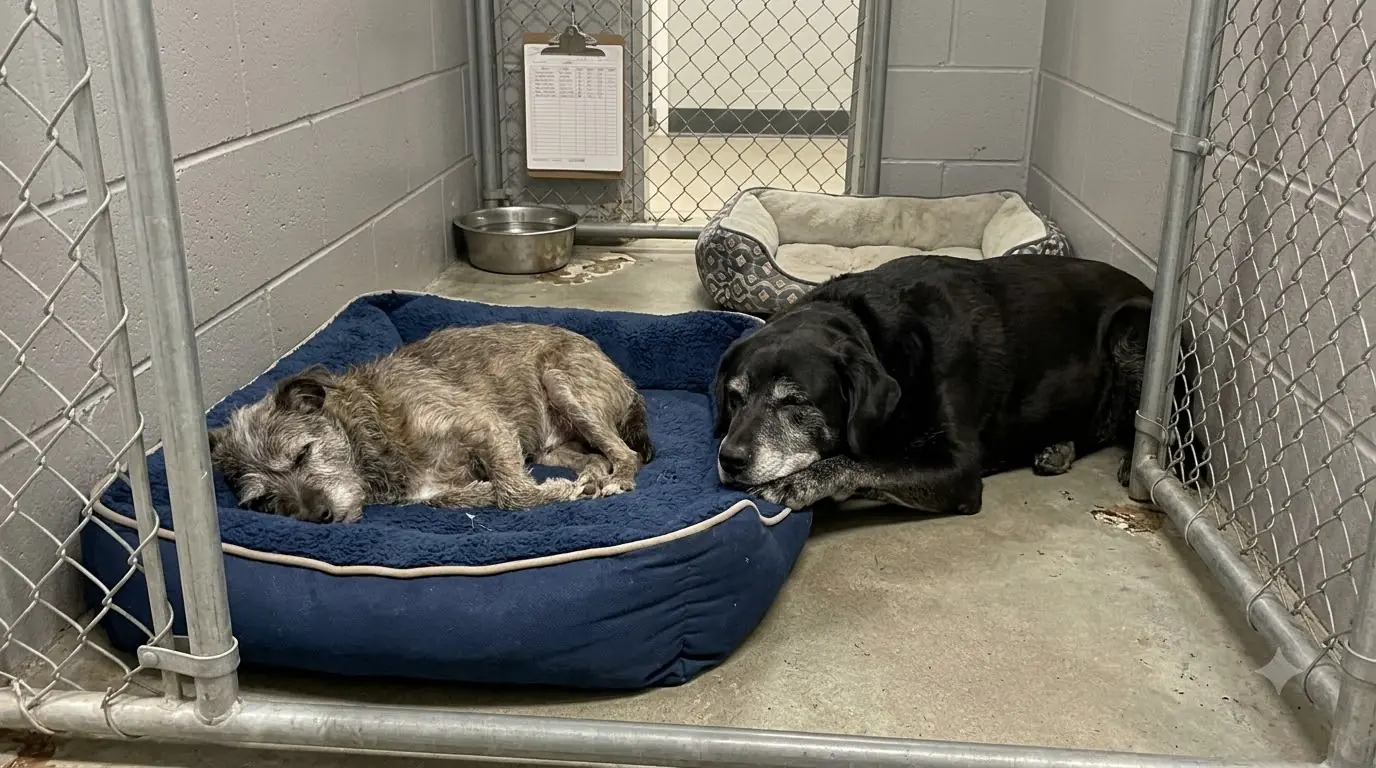
The kennel had two places to sleep.
One was a thick orthopedic bed positioned against the wall.
The other was a padded mat placed only a few feet away.
There was enough room for both senior dogs to rest comfortably.
But almost every time staff checked on them, the same arrangement appeared.
The small Terrier mix was on the orthopedic bed.
The Lab mix was not.
She lay on the floor directly beside it.
Her body stretched along the edge of the mattress.
Her muzzle rested close to the Terrier's front paws.
Sometimes their noses nearly touched.
Sometimes there were only a few inches between them.
The Terrier slept deeply.
The Lab stayed there beside him.
The first time staff saw it, they assumed she had simply chosen the cooler floor.
That would not have been unusual.
Large dogs sometimes prefer firm surfaces, especially if they become warm on thick bedding.
But then they changed the setup.
The second bed was moved closer.
She still slept on the floor.
A different padded mat was added.
She used it occasionally during the day.
At night, she returned to the same place.
Beside the orthopedic bed.
Beside him.
They Had Arrived Together
The two senior dogs entered the shelter through the same intake.
The Terrier mix was much smaller than the Lab, an older dog with a graying face and limited stamina.
The Lab mix was also clearly senior.
Her muzzle had turned pale.
She moved more slowly than a young dog.
But she remained physically steadier than the Terrier.
The available history indicated that the dogs had lived together before entering care.
Exactly how long was not fully documented.
Staff did not immediately describe them as bonded.
That conclusion would need to come from behavior.
So they watched.
When the Terrier was taken several feet away for his examination, the Lab tracked him closely.
She did not panic.
She could take treats.
She remained responsive to people.
But her attention stayed fixed on the direction he had gone.
When she was examined separately, the Terrier behaved similarly.
He remained near the front of his temporary kennel.
He listened.
He waited.
Neither dog was incapable of functioning alone.
But both repeatedly chose proximity when given the opportunity.
The Terrier's Heart Disease Changed the Entire Routine
The small Terrier tired much faster than staff expected from ordinary age alone.
A short walk could leave him breathing harder.
After standing for several minutes, he often looked for a place to lie down.
Sometimes he would stop during a slow outing and remain still until his breathing settled.
That pattern required veterinary evaluation.
Senior dogs can become tired for many reasons.
Arthritis.
Pain.
Deconditioning.
Anemia.
Respiratory disease.
Heart disease.
The rescue did not assume one cause until the examination supported it.
The Terrier's heart sounds raised concern.
Further diagnostic work, including appropriate imaging and cardiac evaluation, confirmed chronic heart disease significant enough to explain his reduced exercise tolerance.
His Condition Required Management, Not a Promise of a Cure
The Terrier's heart disease was not something the shelter could simply make disappear.
The veterinary team's goal was to keep him comfortable and maintain the best quality of life possible.
His resting respiratory rate became an important thing to monitor.
Staff watched for coughing, increased breathing effort, fainting, collapse, abdominal enlargement, worsening weakness, or a major change in appetite.
His medications were prescribed based on his specific cardiac findings.
Exercise had to be moderate.
He could still go outside.
He could still sniff.
He could still participate.
He simply could not be treated like an elderly dog who only needed to “get more exercise.”
His heart set limits his enthusiasm did not always understand.
The Orthopedic Bed Became His Favorite Place
Because he spent so much time resting, his bedding mattered.
The Terrier was small enough that a large thick bed looked almost excessive beneath him.
But it gave his older joints support and kept pressure off his body during long periods of rest.
He took to it quickly.
Once he climbed onto the mattress, he often remained there for hours.
The Lab could easily have shared it.
There was room.
She rarely did.
Instead, she positioned herself along the side.
Sometimes on the padded mat.
More often directly on the floor.
That was what made staff start paying closer attention.
Staff Did Not Assume She Was “Giving” Him the Bed
That interpretation would have been emotionally satisfying.
It would also have gone beyond what anyone could know.
Dogs do not explain why they choose one sleeping surface over another.
The Lab might have preferred the cooler floor.
She might have liked the firmness.
She might have wanted to remain close to the Terrier while avoiding crowding him.
The orthopedic bed may simply have been more comfortable for his small body than hers.
All of those were possible.
What staff could document was the repeated choice.
Two resting spaces.
One small dog almost always on the orthopedic bed.
One larger dog almost always beside him.
That was enough to matter.
Her Muzzle Always Ended Up Near His Paws
The most consistent detail was not the floor.
It was where she placed her head.
The Lab rarely slept facing away from him.
She usually turned toward the edge of the mattress.
Her muzzle came down beside his front legs.
Sometimes the Terrier shifted in his sleep and one paw moved close to her nose.
She stayed there.
If he woke and repositioned, her eyes often opened.
Then closed again once he settled.
The behavior was quiet.
There was no licking.
No dramatic pawing.
No constant physical contact.
Just proximity.
His Heart Disease Made Rest More Important
For the Terrier, sleep was not simply downtime.
His body had less cardiovascular reserve.
Ordinary exertion cost him more.
A calm environment reduced unnecessary demand.
The shelter moved the pair to a quieter area when possible.
Their kennel was arranged so food, water, and the exit were easy to reach.
The Terrier did not need to walk across a large space every time he wanted water.
Short distances mattered.
The Lab benefited from the quieter location too.
They Were Fed Separately
Their sleeping arrangement was peaceful.
Food still required sensible management.
Each dog had a separate bowl.
The Terrier ate more slowly.
The Lab's appetite was stronger.
Staff made sure she did not finish her own meal and then move directly into his.
That was not because there had been aggression.
It was because both animals needed accurate nutrition.
His medications and heart condition made monitoring intake especially important.
Her own senior nutritional needs mattered too.
The fact that they liked to sleep beside each other did not mean every resource should be shared.
The Lab Had Her Own Senior Examination
The Terrier's cardiac disease could easily have taken over the story.
Staff made sure it did not erase the Lab's needs.
She received her own examination.
She had mild to moderate age-related joint stiffness, particularly after long rest.
Her bloodwork was appropriate for her age without revealing an immediate major concern.
Her body condition was monitored.
Her dental health needed routine attention.
She was physically stronger than the Terrier.
She was not medically invisible.
She Could Use the Soft Bed When He Was Gone
One observation helped staff understand that she did not dislike the orthopedic bed.
During one of the Terrier's medical appointments, the Lab remained in the kennel alone.
A caregiver checked later.
She was lying on the orthopedic mattress.
Fully stretched.
Head down.
Asleep.
When the Terrier returned and later climbed onto the bed, the Lab resumed her usual position beside it.
That did not prove sacrifice.
It did prove the bed itself was acceptable to her.
Her choice changed when he was present.
Brief Separations Were Managed Carefully
Because the pair showed strong preference for each other, staff wanted to know whether temporary separation caused significant distress.
The Terrier had medical appointments the Lab did not need.
The Lab needed independent walks that were longer than he could tolerate.
So the shelter built short separations into the routine.
The Lab could leave for a quiet sniffing walk.
The Terrier rested.
He noticed her absence.
He sometimes lifted his head toward the door.
But he did not become frantic.
When she returned, he often became more alert.
The Lab approached the bed.
Sniffed him.
Then settled nearby.
Likewise, she could remain behind while he went for cardiac reassessment.
She watched the hallway but could eat and rest.
That was reassuring.
They Were Attached Without Being Completely Dependent
Over time, staff became more comfortable describing their relationship as strongly bonded.
Not because of one touching sleeping position.
Because of the total pattern.
They chose proximity.
They watched for each other.
They reunited calmly after separation.
They could function independently.
But when given a choice, they repeatedly returned to one another.
That distinction mattered.
The Lab did not need to give up all normal activity because the Terrier tired easily.
The Terrier did not need to accompany her on every outing.
Their relationship benefited both dogs without requiring them to become one animal.
His Heart Condition Had Better and Worse Days
Some mornings, the Terrier seemed relatively bright.
He stood readily.
Ate.
Walked outside.
Sniffed for several minutes.
Other days, fatigue arrived faster.
The rescue monitored those variations carefully.
A bad day in a cardiac patient deserves more attention than simple assumption.
Staff watched his breathing at rest.
Medication schedules stayed consistent.
Any meaningful deterioration would have prompted veterinary reassessment.
His activity was never increased just because one morning looked good.
Chronic heart disease requires restraint even when the dog appears enthusiastic.
The Lab Adjusted Her Pace Outside
During occasional controlled outings together, another behavior became noticeable.
The Lab was capable of walking faster.
She often did when alone.
Beside the Terrier, she moved more slowly.
She stopped when he stopped.
If he spent time sniffing one area, she investigated nearby instead of pulling ahead.
Again, staff could not say she understood his heart condition.
She had simply spent years moving through the world with him, and their pace often matched when together.
She Did Not Hover Over Him
This was another important part of the relationship.
The Lab was not constantly monitoring him.
If the Terrier slept, she could sleep.
If he drank, she did not follow him to the bowl every time.
She enjoyed her own enrichment.
She accepted attention from staff.
She investigated smells independently.
The closeness was most striking during rest.
That kept the relationship from becoming a story about one dog existing only as a caretaker.
She remained herself.
The Shelter Tried Giving Them Two Identical Beds
At one point, staff replaced the second mat with another orthopedic-style bed.
They wondered whether the Lab simply found the original alternative uncomfortable.
That night, the Terrier climbed onto his familiar mattress.
The Lab investigated the new one.
She stood on it briefly.
Then stepped off.
Walked to his bed.
Lowered herself onto the floor beside it.
Muzzle near his front paws.
The second orthopedic bed remained empty.
That Pattern Continued for Days
Morning checks.
Terrier on the bed.
Lab beside it.
Afternoon nap.
Same.
Evening.
Same.
Sometimes she used the second bed when he was awake elsewhere.
When both settled for the night, she returned to the floor next to him.
Staff stopped trying to rearrange the situation.
As long as her joints were protected and she had comfortable alternatives available, she could choose.
They Added Padding Without Moving Her Away
Because she was also a senior dog, staff did not want repeated floor sleeping to worsen her joint stiffness.
A thin supportive mat was placed directly beside the Terrier's orthopedic bed.
The Lab initially pushed part of it aside.
Eventually, she began using it.
That was the compromise.
She could remain exactly where she preferred.
Her elbows and hips no longer had to rest directly on concrete.
The Terrier kept his thicker mattress.
The Arrangement Became More Comfortable Without Changing the Relationship
Soon, nighttime looked almost the same from the doorway.
The Terrier remained elevated slightly on the orthopedic bed.
The Lab lay flush against its edge.
Her muzzle rested near his paws.
Only now, a low padded mat was under her body.
The rescue had not forced the dogs apart in order to solve the comfort problem.
They had adapted the environment around their choices.
Foster Care Offered the Next Test
A foster home experienced with senior dogs became available for both.
That was especially valuable for the Terrier.
A home would make cardiac monitoring easier.
There would be fewer kennel noises.
Bathroom breaks could be shorter and more controlled.
The Lab would also benefit from more room to move at her own pace.
The foster caregiver received detailed instructions.
Medication.
Resting respiratory monitoring.
Exercise limits.
Signs of cardiac deterioration.
Separate feeding.
And one less clinical note:
Do not worry if the Lab ignores her bed and sleeps beside his.
She does that.
The First Night in Foster Care Looked Almost Identical
Two thick beds had been prepared.
The Terrier investigated the nearest one.
He turned twice.
Lay down.
The Lab explored the room longer.
She drank water.
Sniffed the hallway.
Returned.
Then she walked to his bed.
There was more than enough space for her to climb beside him.
She did not.
She lowered herself onto the rug next to it.
Her head came down beside his front paws.
Within half an hour, both were asleep.
New home.
Same arrangement.
The Terrier Rested Better Outside the Shelter
The quieter environment helped him conserve energy.
His disease remained.
But there were fewer unnecessary arousal events.
No neighboring kennel doors.
No long hallways for bathroom trips.
No dogs barking only a few feet away.
His foster caregiver could monitor his resting breathing when he was truly relaxed.
That gave the veterinary team better information.
The Lab Began Taking Longer Individual Walks
The foster arrangement also gave her something the shelter struggled to provide consistently.
Her own pace.
While the Terrier rested, she could take a longer sniffing walk appropriate for her joints and stamina.
She returned without appearing distressed.
The Terrier usually remained asleep or resting.
When she came back, she often checked his bed first.
Then drank.
Then settled.
Their lives did not have to shrink to the same size just because they were being kept together.
His Medical Plan Was Adjusted Over Time
Cardiac disease can change.
Follow-up examinations were important.
Medication could require adjustment depending on symptoms and veterinary findings.
The foster caregiver watched for coughing, fainting, increased effort to breathe, appetite changes, restlessness at night, or unusual abdominal enlargement.
No one assumed stability meant permanence.
The goal was to identify meaningful changes early.
There Were Days When He Barely Left the Bed
On low-energy days, the Terrier spent much of his time resting.
The Lab still went outside.
Ate.
Explored.
Then returned to the same place beside him.
She did not repeatedly nudge him to get up.
She did not pace around him.
She simply settled.
The visual could look sad.
Behaviorally, both dogs appeared calm.
There Were Also Good Days
On stronger mornings, the Terrier followed the Lab into the yard.
He moved slowly.
She adjusted.
They sniffed near each other.
Then he returned inside before she did.
The Lab sometimes stayed out several extra minutes with the foster caregiver.
When she came back, the Terrier was usually on the bed.
She resumed her place beside it.
Staff Could Not Say Whether She Knew He Was Sick
People frequently asked.
Was she giving him the bed because she knew about his heart?
Was she watching over him?
Was she afraid to leave him?
The rescue answered carefully.
There was no way to know.
Dogs respond to one another's behavior, movement, scent, and routine.
The Lab certainly knew he moved slowly and rested often.
Whether she understood illness in anything resembling a human concept was impossible to determine.
The observable behavior was already meaningful enough.
She consistently chose to remain beside him when resting.
The Terrier Began Using Her as a Pillow Sometimes
As they settled into foster care, the arrangement occasionally reversed in small ways.
The Terrier would lie near the edge of the orthopedic bed.
His paw might hang over.
His muzzle sometimes rested close to the Lab's forehead.
Once, he shifted far enough that his chin ended up partly on her shoulder.
She did not move.
They slept that way for almost an hour.
Those moments reinforced that closeness was not entirely one-directional.
The Lab Finally Used Her Own Bed More Often
Over several weeks, she became comfortable enough in the foster home to sleep independently at times.
Afternoon sun through a window became one favorite spot.
Another orthopedic bed near the couch became another.
She might spend an entire afternoon there while the Terrier remained across the room.
That was encouraging.
She had choices.
She did not need constant physical proximity in order to relax.
Nighttime Stayed Different
When the house quieted for the evening, she usually returned.
The Terrier went to his familiar bed.
The Lab came over.
Sometimes she used the thin mat beside it.
Sometimes she lowered herself partly onto her own nearby mattress while keeping her head near him.
But the original arrangement continued often enough that the foster caregiver stopped noticing it as unusual.
Two senior dogs.
One elevated bed.
One body beside it.
The Terrier's Quality of Life Remained the Central Medical Question
With chronic heart disease, the rescue did not measure success by how long they could simply keep him alive.
Comfort mattered.
Interest in food mattered.
Ability to rest mattered.
Breathing mattered.
Enjoyment of short outings mattered.
Good days mattered.
The foster caregiver kept the veterinary team informed.
His condition remained manageable with treatment during this stage.
He was still himself.
Just with a smaller physical reserve.
The Lab's Joints Benefited From the New Mat
The low pad beside his bed turned out to be important for her too.
After sleeping directly on hard flooring, she had sometimes risen stiffly.
With padding beneath her, those first steps became easier.
The rescue continued monitoring her pain and mobility independently.
Being the healthier dog in a pair does not mean being a healthy young dog.
She was aging too.
Their Placement Needed to Account for Two Very Different Seniors
The rescue began looking toward long-term placement with both dogs together if possible.
A future home would need to understand the Terrier's cardiac needs.
Medication.
Veterinary follow-up.
Controlled exercise.
Monitoring.
It would also need to understand the Lab's own aging joints and mobility.
Minimal stairs would be useful.
Nonslip floors would help both.
Multiple beds should be available.
Whether they used them was another matter.
They Did Not Need a Household That Felt Sorry for Them
What they needed was practical care.
Predictable routines.
Appropriate veterinary support.
Space to rest.
Short outings for the Terrier.
Longer individual opportunities for the Lab.
And the freedom to decide where they wanted to sleep.
The rescue had learned not to overmanage the last part.
Staff Once Tried Moving the Lab After She Fell Asleep
Early in the case, before the pattern was fully understood, a caregiver worried about her sleeping directly on the floor.
The Lab was gently encouraged toward the empty padded bed.
She stood.
Moved onto it.
Lay down.
The caregiver left.
When staff checked later, she was back beside the Terrier.
That was one of the moments that convinced the team the location mattered more to her than the mattress.
From then on, they brought comfort to the location she chose instead.
The Orthopedic Bed Has Never Really Been the Point
The image naturally draws attention to it.
A small sick senior dog on a soft mattress.
A larger elderly dog sleeping beside him on a lower surface.
But the important thing was not who had the “better” bed.
It was that the Lab had options and repeatedly chose the place closest to him.
That was what staff could honestly say.
She Still Sleeps Beside His Front Paws
Even now, their nights often end the same way.
The Terrier finishes his evening routine first.
A short bathroom break.
Water.
Medication when scheduled.
Then bed.
He turns carefully on the orthopedic mattress.
Lowers himself.
The Lab may remain standing for another minute.
Sometimes she walks toward her own bed.
Sometimes she even lies there briefly.
Then, eventually, she gets up.
Crosses the small space between them.
And lowers herself beside his mattress.
Her muzzle comes down near his front paws.
He may be awake.
He may already be asleep.
She settles either way.
No One Needs to Decide What She Thinks It Means
The rescue cannot say she understands his diagnosis.
They cannot say she is intentionally sacrificing comfort.
They cannot say she believes it is her job to protect him.
Those explanations belong to people.
The dogs have given staff something simpler and more reliable.
Choice.
Again and again.
Two beds.
Enough room.
Separate routines when needed.
And when the lights go down, the Lab often decides that the place she wants is not the softest bed in the kennel or house.
It is the floor-level mat beside the little Terrier who spends most of his day resting.
He sleeps above her on the orthopedic cushion.
She sleeps below, close enough that her muzzle rests beside his paws.
And although the rescue made sure there would always be another bed waiting for her, she has never needed anyone to explain where it is.
She knows.
She simply keeps choosing him.