The first thing Captain Origi Vale lost that morning was not his temper.
It was his horizon.
One second, the world beyond the aircraft windshield was open and clean: pale Nevada sky, white runway markings, heat beginning to shimmer above the concrete, two ground crewmen stepping away from the nose of the aircraft after final checks. The next second, a glass jar exploded across the front of his canopy and swallowed everything in thick, black-blue paint.
The splash hit the windshield with a hard crack that made Origi flinch inside the cockpit. Dark liquid spread outward in a violent bloom, then ran downward in heavy streaks until the runway disappeared behind a smeared wall of color. For one frozen breath, he could see nothing but paint crawling over the glass where the sky had been.
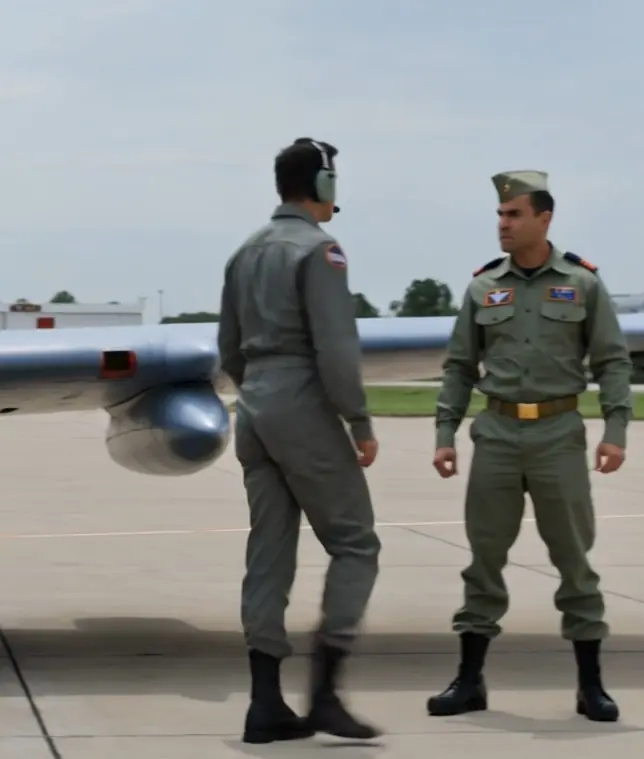
The aircraft was still on the ground.
The engines were not yet at full power.
But Origi understood instantly that if the jar had hit thirty seconds later, or if he had already begun rolling, someone might have died.
He tore his headset off.
Outside the aircraft, the flight line had gone still in that strange way military spaces go still when every person present understands that something has crossed from discipline into danger. A crew chief shouted. A mechanic dropped his clipboard. A young airman near the wing backed away from the nose as if the paint itself might explode.
And standing just beyond the painted canopy, one soldier did not move.
His name was Cacau Brant.
He was in uniform. His boots were planted. His right hand was still half-raised from the throw. Broken glass glittered at his feet. There was no confusion on his face, no panic, no look of a man who had acted without thinking and instantly regretted it. He stared at the cockpit with a hard, arrogant calm, as if he had done exactly what he came to do.
That was what made Origi move so fast.
He unlatched his harness, shoved the cockpit open, and climbed down the access ladder with such force that the metal shook under his boots. The ground crew shouted his name, but he did not stop. He hit the tarmac and walked straight toward Cacau, his flight gloves still on, his jaw locked, the black paint dripping behind him from the aircraft like evidence that was still wet.
Cacau watched him come.
He even smiled.
Not a large smile. Just enough.
That small smile was what Origi later said made the whole thing feel planned.
Origi reached him and grabbed him by the collar with one hand, driving him backward two steps. Cacau’s boots scraped the concrete. The empty throw motion vanished from his posture, replaced by a strange, almost theatrical stillness. Origi held him close enough to see the sweat along his hairline.
“What the hell did you just do?” Origi demanded.
Cacau’s eyes moved past Origi’s shoulder, toward the painted aircraft.
“You weren’t supposed to fly today,” he said.
The words did not come out like an excuse.
They came out like a warning.
Origi tightened his grip. “Say that again.”
Cacau’s expression sharpened. “You heard me.”
That was when Origi saw his left hand move.
At first, he thought Cacau was reaching for a radio, a badge, maybe some folded paper he intended to shove into the argument as proof that he had authority. Then Cacau’s fingers came out from under his outer uniform layer wrapped around a round, dark object that made every sound on the flight line seem to collapse inward.
A grenade.
Not a training dummy. Not something painted bright for exercises. A real grenade in a real hand, held chest-high on an active runway beside an aircraft that had been preparing to move.
The first mechanic who saw it threw himself behind a tow cart.
Someone screamed for everyone to get back.
Origi did not release Cacau right away.
That was the part investigators later slowed down on video, frame by frame. Origi’s hand still locked in Cacau’s collar. Cacau’s arm half-raised. The grenade visible. Ground crew scattering. The painted windshield behind them. For less than two seconds, the pilot and the saboteur stood inside the smallest and most dangerous circle on the base.
Cacau looked proud of it.
“Let go,” he said. “Unless you want this strip to go up with you on it.”
Origi’s face changed.
Not into fear.
Into calculation.
He knew he could overpower Cacau physically. That was not the question. The question was whether one wrong movement could turn the runway into a blast scene. The aircraft behind him was not just metal. It was fuel, classified cargo, flight records, a launch order, and enough chain-of-command pressure to drag half a base into the investigation that would follow.
Then a woman’s voice cut across the tarmac.
“Don’t.”
It was not shouted in panic.
It was spoken with such command that even the men running for cover seemed to freeze at the edge of the sound.
Origi turned his head first.
Then Cacau turned.
At first, annoyance crossed his face, as if he expected a junior officer or security chief trying to insert herself into something he believed he controlled. But the second he saw the woman walking toward them from the operations corridor, the arrogance drained from him so quickly it seemed to physically weaken his stance.
Brigadier General Elara Sloane was not running.
She did not need to.
She came across the flight line with two military police officers behind her, a field intelligence major to her left, and a sealed black folder tucked under one arm. She was in her early fifties, compact, severe, and known across Falcon Ridge Air Base as a commander who did not raise her voice unless the situation had already reached the edge of disaster.
That morning, she raised it once.
“Captain Origi, release him and step back.”
Origi hesitated.
Only for a fraction of a second.
Then he released Cacau’s collar and took two steps backward, hands slightly raised, eyes never leaving the grenade.
Cacau swallowed.
It was the first human thing he had done since the paint hit the glass.
General Sloane stopped several yards away. Her eyes moved from the grenade, to the paint-smeared aircraft, to Cacau’s face. When she spoke again, her voice was cold enough to make the entire flight line listen.
“Cacau Brant,” she said, “you are out of time.”
The grenade remained in his hand.
But his confidence was gone.
That was the moment everyone understood the paint had never been the whole story.
At Falcon Ridge, aircraft launched every day under pressure, but Flight Copper Nine had been different long before Cacau broke onto the runway with a jar in his hand. The assignment had appeared on Origi’s schedule at 02:40 that morning, replacing a routine training flight he had expected to fly after sunrise. He had been asleep less than three hours when the call came.