The toilet brush landed in the gray cleaning bucket with a hard plastic crack.
Every conversation in the employee break room stopped.
The Black woman standing beside the yellow janitorial cart did not flinch.
She simply looked down at the brush, then back at the white supervisor who had thrown it there.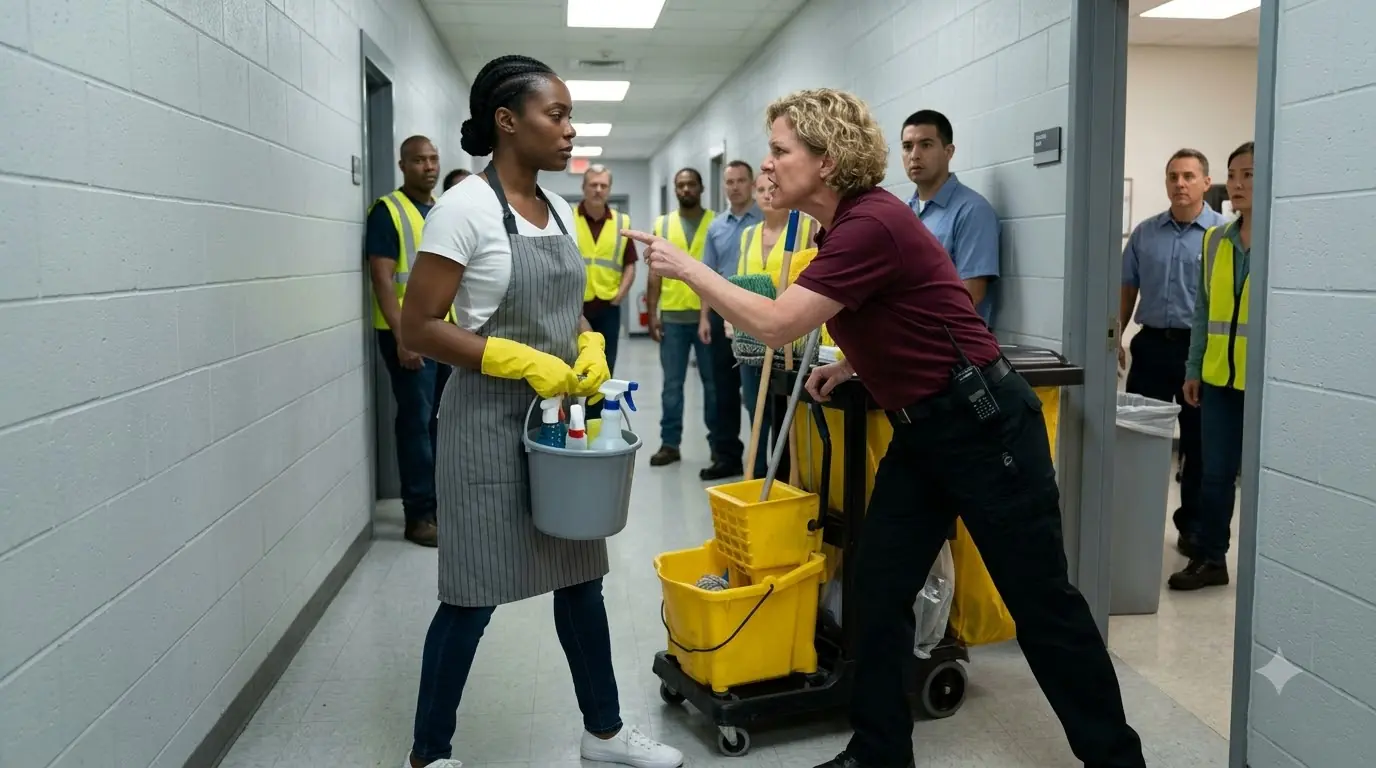
The supervisor was fifty-two, broad through the shoulders, with short curly blonde hair and the permanent expression of someone who had spent too many years believing irritation was evidence of authority. A burgundy company polo stretched across her chest. A radio hung from her belt. Behind her, six employees stood frozen near the coffee counter and service hallway.
Nobody looked surprised.
That bothered the Black woman more than the toilet brush.
The supervisor jabbed one finger toward the restroom corridor.
“Temps who question me scrub toilets. Get moving.”
The woman held a bucket filled with disinfectant, spray bottles, microfiber cloths, sponges, and brushes. Yellow rubber gloves covered her hands. Over a plain white T-shirt she wore a gray vertically striped apron that reached almost to her knees. Dark jeans. White sneakers.
She looked exactly like what the supervisor believed she was.
A temporary sanitation worker.
Replaceable.
Powerless.
Someone whose embarrassment would cost the company nothing.
The woman asked quietly, “You’re certain this is how you treat temporary staff?”
A few employees lowered their eyes.
The supervisor laughed.
Not loudly.
Worse.
Dismissively.
Then she shoved the janitorial cart forward with both hands.
Its front wheel struck the Black woman’s sneaker.
She stepped back once.
Still no anger.
Still no raised voice.
The supervisor mistook restraint for surrender.
“You’re replaceable,” she said. “I decide who gets paid here.”
The door at the end of the corridor opened.
A middle-aged white man in a charcoal suit hurried through carrying a thick blue payroll folder in one hand and a tablet in the other.
He was already speaking.
“Sorry, the bank confirmation took longer than—”
Then he saw the Black woman.
He stopped so abruptly that the folder nearly slipped from his hand.
His face changed.
The employees noticed.
The supervisor did not.
She was still pointing at the restroom.
“Move.”
The man in the suit stared at the yellow gloves.
Then the apron.
Then the toilet brush.
Finally the supervisor.
“What is happening?”
She turned.
Her expression softened immediately.
“Mr. Hayes.”
The man did not answer her.
He walked directly toward the Black woman.
“Ms. Carter.”
The room became still.
The supervisor’s smile vanished.
The man held out the thick folder.
“The entire payroll release is waiting for your signature.”
Nobody breathed.
The Black woman slowly removed one yellow glove.
Then the other.
She placed both on top of the janitorial cart.
She took the folder.
The supervisor looked from the folder to the woman, then toward the employees as if one of them might explain reality to her.
No one did.
The Black woman opened the first page.
At the bottom was a signature line.
NAOMI CARTER
CHIEF EXECUTIVE OFFICER
The supervisor’s mouth opened.
Nothing came out.
Naomi Carter closed the folder.
Then looked at the toilet brush sitting in the cleaning bucket.
She raised her eyes again.
“Ms. Marsh,” she said quietly, “I think we need to talk about who actually decides whether people get paid here.”
Five days earlier, Naomi had never expected to be holding a toilet brush inside one of her own factories.
The idea had begun with a number.
Not a complaint.
Not a video.
Not an emotional phone call.
A number.
Thirty-seven percent.
That was the annualized turnover rate among temporary workers at the Dayton Components Plant in Ohio.
Naomi first noticed it at 6:42 on a Monday morning while reviewing labor reports from the manufacturing division.
She always read them before executive meetings.
Most CEOs said they cared about frontline workers.
Naomi preferred knowing how many of them had quit.
Thirty-seven percent at Dayton.
Nineteen percent across comparable facilities.
That was not automatically scandalous.
Temporary labor turned over faster.