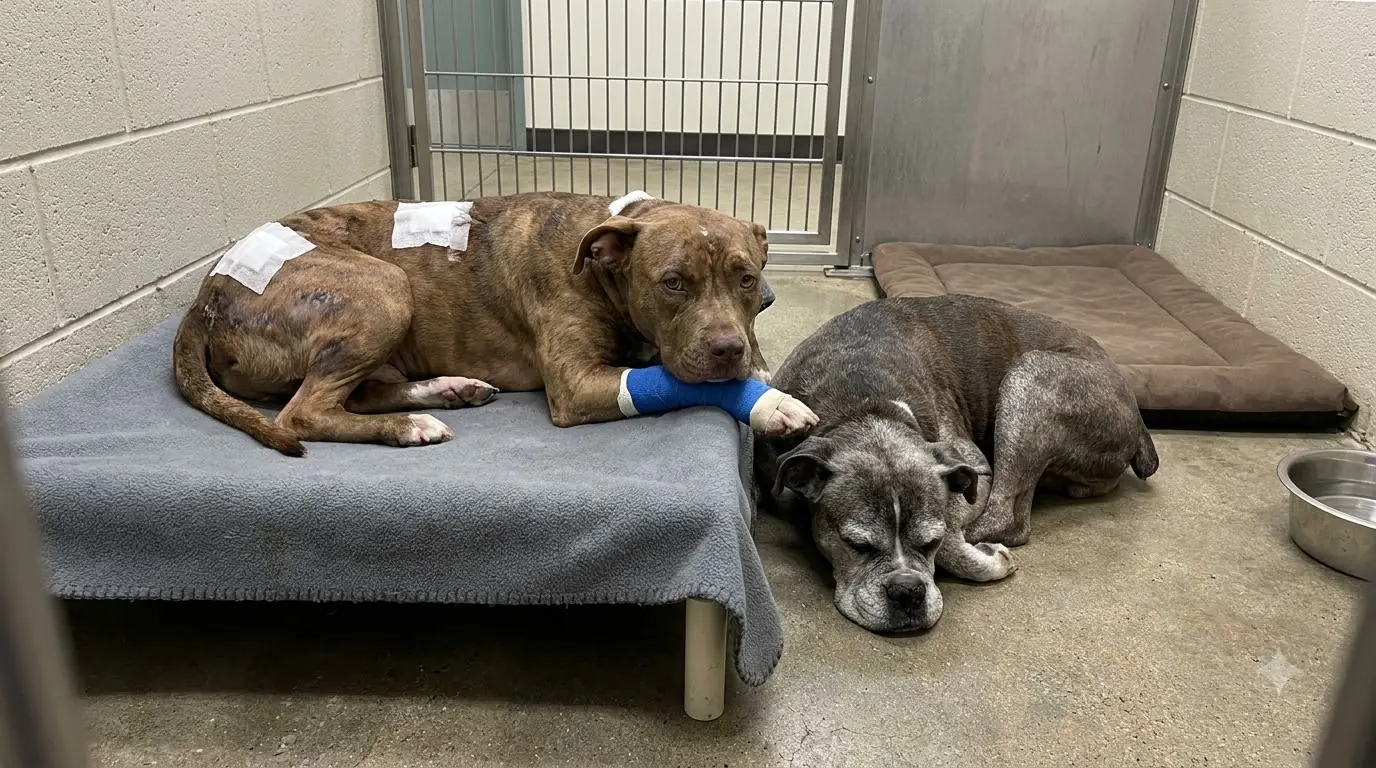
The senior Boxer had a bed of his own.
It was thick enough for his aging joints, positioned only a few feet from the recovery cot, and covered with clean fleece.
He used it during the day.
At night, he left it.
Staff first noticed the pattern after the Pit Bull mix returned from treatment.
Large sections of fur along her back and shoulders had been burned away or clipped so veterinary staff could evaluate the damaged skin beneath. Several areas were covered with medical dressings. One front leg was wrapped in a thick bandage, making the paw look almost twice its normal size.
She spent most of that first evening lying on a low recovery cot.
The Boxer settled on his own bed nearby.
For a while, both dogs slept.
Then the Pit Bull shifted.
The old Boxer opened his eyes.
He stood slowly, his stiff senior legs taking a moment to straighten.
He walked away from the soft bed.
Crossed the short distance between them.
And lowered himself onto the kennel floor beside her cot.
His muzzle came down almost directly beside the bandaged front paw hanging near the edge.
That was where staff found him during the final check.
The next morning, his bed was still empty.
The following night, they placed fresh bedding on it and encouraged him to use it again.
He did.
Until the room became quiet.
Then he got up.
Walked back to her.
And slept on the floor beside that same bandaged paw.
They Had Lived Together Long Before the Fire
The two dogs were not strangers paired together after intake.
The family confirmed that the senior Boxer had been part of the household since the Pit Bull mix was young.
They had shared years of ordinary life before the night that brought them into rescue care.
The details of the fire were documented through the family's account and emergency response information available to the rescue.
Two children had been inside the home when the fire broke out.
The Pit Bull mix followed them as they escaped.
She came out after them, but not before sustaining significant exposure to heat and smoke.
By the time responders were able to get her clear of the structure, portions of the coat over her back and shoulders had been visibly singed.
Her skin showed multiple areas of thermal injury.
One front limb was also badly affected and required substantial bandaging.
The senior Boxer was physically far less injured.
But after both dogs entered recovery care, staff quickly realized that his story was not going to be separate from hers.
Not entirely.
Burns Require More Than Looking at the Skin
The most visible injuries were on the Pit Bull mix's body.
That did not mean the veterinary team's first concern was only the burned coat.
Animals exposed to a house fire can suffer respiratory irritation or inhalation injury even when the outside of the body appears to be the main problem.
Her breathing was evaluated carefully.
Oxygenation was monitored.
Her eyes were examined for irritation or heat-related injury.
Her mouth and nose were checked.
Veterinary staff listened to her lungs and watched for changes in respiratory effort.
Additional diagnostics, including chest imaging, could be considered if the examination or clinical signs suggested concern.
The rescue did not invent complications that were not confirmed.
But they did not ignore the possibility simply because she had made it out of the building alive.
The Burns Were Not All the Same
Thermal injuries can vary substantially in depth and severity.
Some areas may involve only superficial layers.
Others can damage deeper tissue.
Burned skin can continue changing in appearance after the initial event, which means repeated assessment matters.
The Pit Bull mix had multiple affected regions across the back and shoulders.
Some fur was visibly singed.
Other areas had been clipped so the veterinary team could properly clean and examine the skin.
Dressings were placed where protection was needed.
The front leg required particularly careful management.
Its thick bandage was not decoration.
The tissue underneath had to be protected from contamination, licking, friction, and additional trauma.
Bandage condition was monitored closely.
Wetness mattered.
Odor mattered.
Swelling mattered.
Changes in the toes mattered.
Pain mattered.
Everything mattered more because this was a dog who had already experienced one major physical insult.
The team wanted no preventable second one.
Pain Control Became Central
Burn injuries can be extremely painful.
The Pit Bull mix's comfort was assessed repeatedly rather than assumed from whether she was quiet.
A dog who lies still is not necessarily comfortable.
Pain can also reduce movement.
It can reduce appetite.
It can change posture.
It can interfere with sleep.
So the medical plan focused on appropriate analgesia, wound care, hydration, nutrition, and controlled rest.
Handling was kept as low-stress as possible.
Pain medication was given before procedures expected to be uncomfortable.
Sedation could be used when medically appropriate if dressing changes or wound care could not be performed safely and humanely while she was fully awake.
Nobody expected her to tolerate painful treatment simply because she was described as brave.
The Boxer Needed to Be Evaluated Separately
Because he looked relatively normal beside her, there was a risk that people might mentally assign him the role of healthy companion and stop looking at him as a patient.
The rescue did not do that.
He was senior.
His joints were stiff.
His gait already showed age-related change.
His heart and lungs were assessed.
His skin, eyes, ears, teeth, and abdomen were examined.
His mobility was documented.
He had not sustained the same obvious burn injuries, but emergency displacement and a completely unfamiliar environment can affect an older dog significantly.
His appetite was monitored.
His sleep was monitored.
His ability to move comfortably mattered.
And staff made sure he had his own supportive bed.
He simply kept leaving it.
Staff Did Not Immediately Call Them Bonded
Years together suggested an established relationship.
But rescue teams try to avoid assigning a label based only on history.
They watched what the dogs actually did.
When the Boxer left the recovery kennel for a short walk, could he function?
Yes.
He moved slowly because of his age and stiffness, but he sniffed.
He accepted treats.
He paid attention to caregivers.
When the Pit Bull mix was taken for treatment, could she settle without him?
Usually, though she remained more alert until she returned to the familiar kennel setup.
When they were reunited, what happened?
The Boxer approached her.
Sniffed.
Then chose to lie close.
Again and again.
That repeated choice carried more behavioral weight than a label.
The Floor Was Not Better for His Arthritis
That was the practical problem.
The senior Boxer was not physically better off sleeping on concrete.
His hind legs were stiff enough that supportive bedding clearly helped him rise more easily.
If he spent long periods on hard flooring, pressure over elbows, hips, and other points could become uncomfortable.
So staff did not treat his choice as something charming that should simply continue unchecked.
They tried to improve it.
The first adjustment was obvious.
Move the bed closer.
The Bed Went Right Beside Her Cot
Caregivers repositioned the Boxer's mattress until it nearly touched the Pit Bull mix's recovery cot.
Now he could remain beside her without giving up cushioning.
For part of the day, it worked.
The Boxer lay on his bed.
The Pit Bull rested above him on the cot.
Their bodies were close.
Problem solved.
Until the night check.
The Boxer had moved off the bed again.
He was on the floor.
His nose was beside her bandaged paw.
Staff tried another arrangement the next day.
Same result.
That was when they stopped assuming the behavior was only about general proximity.
The exact position seemed to matter.
Her Bandaged Paw Became His Sleeping Landmark
The injured front leg often rested near the edge of the cot.
Because of the thick wrapping, the paw was easy to identify even in low light.
The Boxer repeatedly positioned his head near it.
Not directly on the bandage.
Not underneath it.
Beside it.
Sometimes his nose was only inches away.
Other times one front paw extended beneath the cot while his muzzle rested near hers.
The Pit Bull mix did not appear distressed by his proximity.
If she repositioned, he usually lifted his head.
Sometimes he moved.
Sometimes he stayed.
The behavior was quiet.
But consistent.
He Moved When She Moved
That became the next pattern staff noticed.
The Pit Bull mix could not change positions casually.
Burned areas made some movements uncomfortable.
The wrapped front limb affected balance.
If she wanted to turn, she often did it slowly.
When her body shifted, the Boxer usually woke.
His head lifted.
He watched.
If she ended up facing a different direction, he sometimes stood.
His senior hind legs took a moment to straighten.
Then he moved to the new side of the cot.
And lay down again.
Often with his muzzle close to the bandaged leg.
Staff Did Not Say He Was Guarding Her
The behavior could easily have been described that way.
But there was no evidence he was preventing anyone from approaching.
He allowed caregivers to provide treatment.
He could be moved aside.
He did not consistently place himself between her and staff.
He did not growl at people handling her.
So “guarding” would have been inaccurate.
The observable behavior was more specific.
He repeatedly chose proximity while she rested.
When she moved, he often repositioned.
When she settled, he settled.
That was enough.
The First Dressing Changes Were Hard on Both Dogs
The Pit Bull mix had to leave the shared kennel for wound care.
Depending on the areas being treated, the process could take time.
Burn dressings may need to be removed carefully to avoid damaging healing tissue.
The underlying wounds have to be inspected.
Dead or compromised material may require appropriate debridement depending on the injury.
The skin is cleaned.
New dressings are placed when necessary.
Pain control has to be maintained throughout.
The Boxer could not remain physically beside her during these procedures.
So he waited.
During one of the early treatments, staff kept him in an adjacent space.
He stood for a while.
Then sat.
Then lay down near the gate.
When the Pit Bull mix returned, the Boxer rose.
He approached.
Sniffed along her face and shoulder without contacting the newly dressed areas.
Then he walked beside her to the cot.
Within minutes, he was back on the floor.
Muzzle near the wrapped paw.
She Needed Nutrition for Healing
Burn recovery places substantial metabolic demands on the body.
The Pit Bull mix needed enough calories and protein to support tissue repair while maintaining a healthy digestive response.
Her appetite was monitored closely.
Pain, stress, medication, and the unfamiliar environment could all interfere with eating.
Food was offered in a position that did not require unnecessary movement.
Water remained within easy reach.
Body weight was tracked.
Hydration mattered.
Urination and stool were monitored.
Recovery was not simply a matter of waiting for fur to grow back.
Her entire body needed resources to heal.
The Boxer Sometimes Waited Until She Ate
Staff noticed this too, but were careful not to overinterpret it.
Their food was managed separately enough that neither dog needed to compete.
The Boxer had his own meal.
The Pit Bull mix had hers.
Sometimes he began eating immediately.
Other times he watched her for a while before turning to his bowl.
That inconsistency was important.
It prevented the rescue from turning one observation into a fixed story about him refusing food until she ate.
Behavioral realism mattered.
The strongest pattern remained sleep.
Her Breathing Stayed Under Close Observation
For the first phase after the fire, respiratory monitoring continued.
Changes in breathing effort, coughing, nasal discharge, lethargy, or oxygenation could indicate a problem that required reassessment.
The Pit Bull mix did not need every possible fire-related complication to make her case serious.
The external injuries alone required substantial care.
The medical team remained alert without manufacturing crisis.
As time passed without severe respiratory deterioration, attention could shift increasingly toward wound healing, pain control, mobility, nutrition, and recovery from stress.
The Smell of the Medical Kennel Changed Constantly
Burn care involves cleaning products.
Dressings.
Medications.
Fresh bandage material.
Clipped fur.
Hospital scents.
The Pit Bull mix smelled different after each treatment.
The Boxer still approached.
That mattered because scent plays a major role in canine recognition.
He did not react as though she had become entirely unfamiliar simply because she returned carrying new medical odors.
He sniffed.
Processed.
Then stayed close.
She Was Not Always Comfortable With Touch
That was expected.
Burned skin can be hypersensitive.
The Pit Bull mix sometimes accepted gentle handling around unaffected areas.
Other times she turned her head away.
Caregivers respected that.
Nobody repeatedly stroked her because touching an injured dog looked comforting to humans.
Comfort had to be defined by the dog.
The Boxer seemed to do something similar naturally.
He remained near.
But did not constantly push his body into hers.
His nose by the bandaged paw was close enough.
The Senior Dog Still Needed His Own Life
The rescue was careful about this.
His routine included short walks appropriate to his arthritis.
He needed to sniff.
He needed to move enough to preserve muscle.
He needed breaks from the medical kennel.
He needed attention that had nothing to do with the Pit Bull mix.
He was not required to remain beside her all day.
In fact, staff encouraged independent time.
On outings, his personality became more visible.
He liked slow exploration.
He was interested in food.
He sometimes leaned against familiar caregivers.
He moved at his own pace.
Then he returned to the kennel.
And usually went back to her.
His Arthritis Changed How Staff Supported the Pair
The Boxer could not repeatedly stand and lie down without cost.
Every transition required his stiff hind legs to load and unload his body.
So if he had already settled beside the Pit Bull mix, staff avoided moving him unnecessarily.
The kennel layout was organized so medical access remained possible without forcing the Boxer to stand every few minutes.
His bed stayed available.
A thin padded mat was eventually placed where he kept choosing the floor.
That proved more successful.
They Stopped Asking Him to Choose the Bed
Instead, they brought cushioning to the place he had chosen.
A low-profile mat was positioned beside the recovery cot.
It did not create a high edge.
It did not prevent the Pit Bull's bandaged paw from resting safely.
It simply gave the senior Boxer's joints some protection.
The first night, he used it.
He lowered himself exactly where he always did.
His muzzle landed near the wrapped paw.
But this time, his elbows and hips were not directly on concrete.
That became the new arrangement.
Good Rescue Care Often Looks Like That
Not convincing an animal to accept the environment humans designed.
Changing the environment after the animal shows what it needs.
The Boxer had been clear.
He wanted to sleep beside the cot.
So staff made beside-the-cot safer for him.
The Pit Bull mix needed stable wound protection.
So her cot and dressings remained the priority.
Both needs could exist together.
The Burns Changed Over Time
Healing was not visually smooth.
Some areas improved faster than others.
Dressings became smaller as appropriate.
Certain wounds no longer needed to remain covered continuously once the veterinary team determined the skin could be managed differently.
Other areas needed more prolonged protection.
The clipped and burned sections of coat left her looking uneven for weeks.
New fur did not appear all at once.
At first, there were only short patches of regrowth.
The body underneath had to heal before appearance could catch up.
The Front Leg Took Longer Than Visitors Expected
The thick bandage around the paw and lower limb remained one of the most obvious features.
Each time it was changed, staff evaluated the underlying tissue.
Was swelling improving?
Was the skin viable?
Was there healthy granulation where expected?
Was there discharge?
Was odor changing?
Was she using the limb differently?
Recovery decisions were based on those findings.
Nobody promised that the leg would look normal quickly simply because she had started feeling better.
She Began Standing More Often
At first, most of her day happened on the cot.
Then she became more willing to rise.
Her bandaged front leg altered how she balanced.
She loaded the other limbs more heavily.
Staff made sure the floor had traction.
Her first trips outside were controlled.
Short.
Functional.
No unnecessary distance.
No expectation that a dog recovering from burns should demonstrate resilience through activity.
If she tired, she returned.