The first willow cutting went into the mud before sunrise.
Thirteen-year-old Everett Cole pushed it down with both hands until nearly eight inches of bare wood disappeared beneath the wet bank. Then he leaned backward on his heels, wiped one muddy wrist across his forehead, and compared the thin branch with the faded measurements written inside his grandfather’s notebook.
Thirty-two paces south from the split sycamore.
Eleven feet east of the old wagon rut.
Follow the lower bank until the water bends toward the red barn.
Plant willow where the line should be remembered.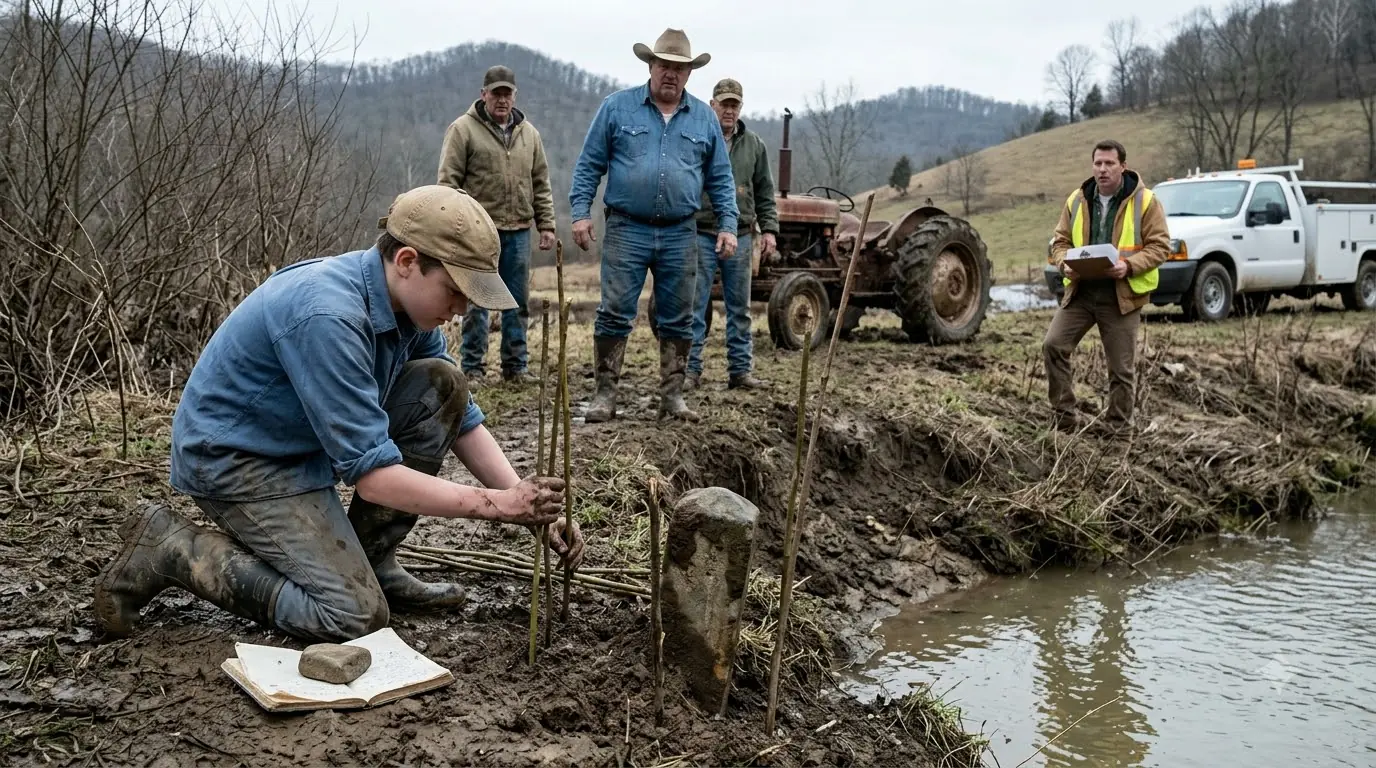
Everett read the last sentence again.
It was not written like the rest.
Most of his grandfather’s notebook was practical.
Dates.
Rainfall.
Calving records.
Fence repairs.
Seed prices.
Amounts paid for diesel.
Which field had been limed.
Which cow had a bad left hoof.
Which month the north spring usually started running clear again after winter.
But every few pages there were measurements that did not belong with farming notes.
Bearings.
Distances.
Trees that had vanished before Everett was born.
References to stones.
Iron.
A cedar stump.
A fence that apparently did not stand where a fence stood now.
His mother believed the old notebook was simply another collection of his grandfather’s habits.
Everett did not.
For almost three weeks, he had been waking before school and following the measurements along the creek.
He had started with one line.
Then another.
At first he thought his grandfather had been mapping drainage.
Then he discovered that every strange measurement seemed to point toward the same narrow stretch of muddy ground between Cole Farm and the neighboring Briggs cattle property.
That was why the willow branches mattered.
His grandfather had written about them repeatedly.
Not as trees.
As marks.
Living marks.
Everett pressed another cutting into the earth.
The creek rushed beside him, swollen from three days of spring rain. Brown water curled around exposed roots, carrying leaves and broken grass downstream.
His blue work shirt was already streaked with mud.
The shirt had belonged to his grandfather.
The sleeves were too long, so Everett rolled them above his forearms. He wore dark denim jeans, a faded brown cap, and rubber farm boots so oversized that his mother had joked he looked like a boy borrowing feet from a grown man.
He did not care.
They kept him dry.
Mostly.
He planted a third willow.
Then heard an engine.
Everett stopped.
A red pickup came down the gravel lane on the opposite side of the creek.
He recognized it immediately.
Harold Briggs.
Everett looked toward the notebook lying open on an overturned bucket.
Then toward the cuttings.
There were twelve already planted in a rough line.
He considered leaving.
Too late.
The pickup stopped.
The driver’s door opened.
Harold Briggs climbed out.
He was fifty-eight, broad through the belly and shoulders, with a gray mustache, a weather-darkened face, and the kind of voice that carried even when he did not intend it to.
This morning he intended it to.
“What in hell are you doing?”
Everett remained kneeling.
“Morning.”
“Don't morning me.”
Harold walked toward the creek.
His boots sank into the mud.
Two men followed from the truck.
Both worked on the Briggs farm.
Everett knew them by sight.
Neither looked cruel.
But both already seemed amused.
Harold reached the bank and stared at the planted sticks.
Then at Everett.
“What are those?”
“Willow.”
“I can see that.”
Everett did not answer.
Harold pointed.
“Why are you planting them here?”
“To hold the bank.”
Harold laughed once.
Behind him, one farmhand grinned.