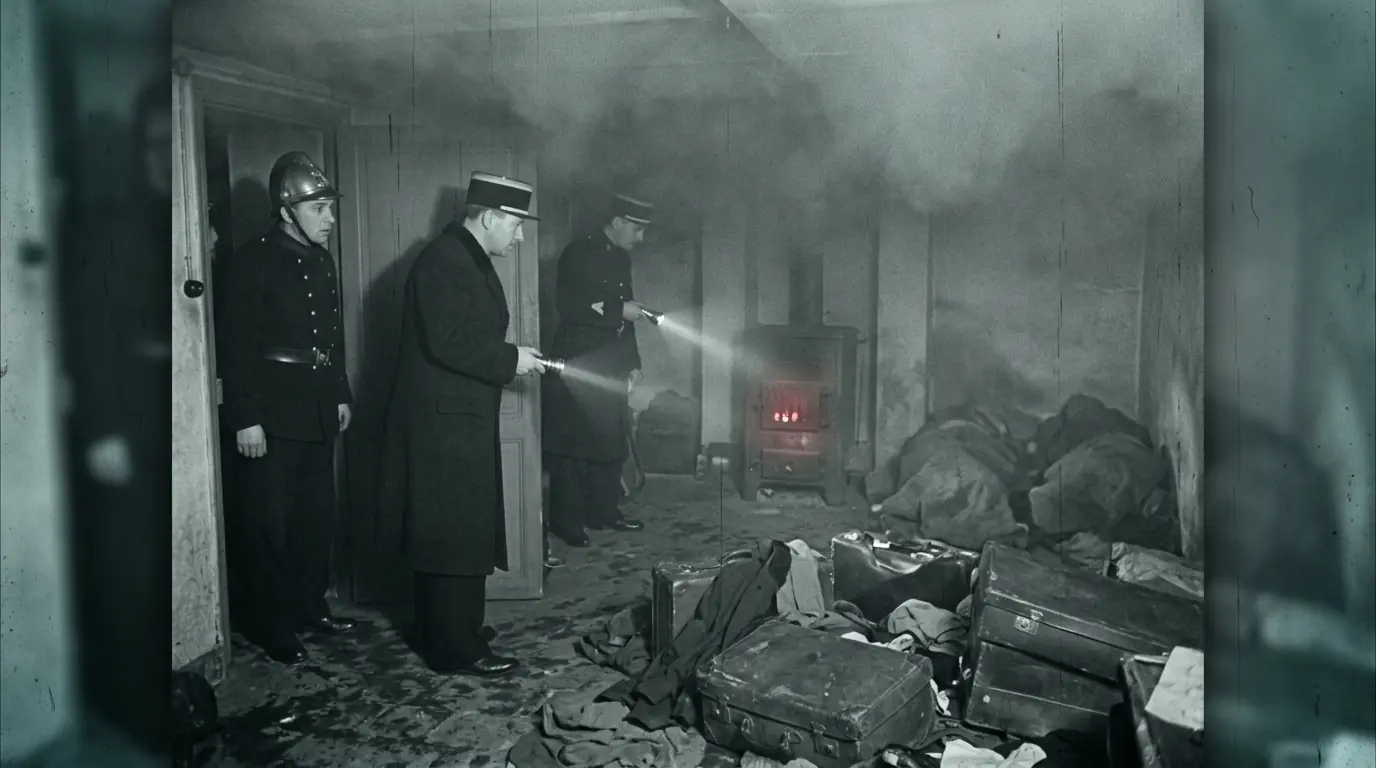
Paris, March 11, 1944.
For several days, the people living around 21 rue Le Sueur had been trying to ignore the smell.
Paris was not a clean city in wartime.
Coal smoke hung in the streets. Food was scarce. Buildings were badly heated. Deliveries were unreliable. German military vehicles moved through neighborhoods where ordinary French families were already exhausted by nearly four years of occupation.
Unpleasant smells were hardly unusual.
But this was different.
Something thick and sickening seemed to be drifting from the elegant private residence at number 21.
Then came the smoke.
Not the ordinary gray smoke of a household furnace.
Dense smoke.
Persistent smoke.
Enough that neighbors began complaining.
Something was being burned inside the house.
And whatever it was, the chimney was not carrying the evidence away fast enough.
By March 11, the situation could no longer be dismissed.
Firefighters were called.
Police followed.
The address belonged to a doctor.
His name was Marcel Petiot.
He was not standing at the door when authorities arrived.
That fact would matter later.
For the moment, all anyone knew was that a large Parisian house appeared to have a serious problem with its heating system or furnace.
The men entered expecting fire.
What they found turned the building into one of the most infamous crime scenes in French history.
Human remains.
Burned remains.
Fragments that had clearly not come from animals.
Suitcases.
Personal possessions.
Evidence that people had entered the property carrying the pieces of their lives with them and had never left.
French Ministry of Justice records later summarized the scene in stark terms: investigators discovered remains associated with 27 bodies, along with numerous suitcases containing the belongings of people who had disappeared. Authorities would conclude that Petiot had attracted men and women to the property by presenting himself as part of a false Resistance escape network, promising to help them flee occupied France before killing them and taking their property.
But on that morning in 1944, nobody yet understood the full architecture of the crime.
They had found the end of the story.
Now they had to work backward.
Who were the dead?
Why had they come to this house?
Why had so many carried luggage?
Why did the property appear to have been modified in ways no ordinary medical practice required?
And where was Dr. Marcel Petiot?
The investigation would eventually reach backward through missing-person reports, forged identities, clandestine escape networks, wartime black markets, frightened Jewish families, criminals hoping to leave France, informants, collaborators, German security services, and the chaotic world of the French Resistance.
By the time it was finished, police would discover something perhaps even more disturbing than the remains themselves.
Petiot had not simply murdered people during the war.
He had built a killing system that depended on the war.
Occupation created the fear.
Persecution created the victims.
Secrecy created the cover.
And Petiot turned all three into opportunity.
A City Where People Disappeared
To understand why the murders could continue, it is necessary to understand Paris under occupation.
In an ordinary city, a person disappearing suddenly can trigger questions.
Where did she go?
Who saw him last?
Why did he take his suitcase?
Why was the apartment abandoned?
Why did he not tell his family?
Occupied Paris had different answers.
A person might disappear because the Gestapo arrested him.
A Jewish family might leave overnight because someone warned them of an upcoming raid.
A Resistance member might change addresses without telling even close friends.
A black-market dealer might cross into another zone.
A collaborator who feared revenge might seek passage elsewhere.
A wanted criminal might acquire false documents.
A foreigner might attempt to reach Spain, Switzerland, Portugal or South America.
A man who vanished could be dead.
He could also be underground.
That ambiguity was extraordinarily useful to anyone who wanted to make people disappear.
The war created a world in which secrecy itself looked normal.
Many people trying to escape could not tell neighbors exactly where they were going.
They could not announce an illegal border-crossing route.
They could not leave detailed addresses behind.
Some deliberately severed contact to protect relatives.
Others traveled under false names.
And in the middle of that uncertainty, stories spread about men who could arrange passage out.
Fixers.
Smugglers.
Resistance intermediaries.
People who knew people.
Some were genuine.
Some were criminals.
Some were both.
Petiot would present himself as one of the useful ones.
A doctor.
A man with connections.
Someone who understood clandestine movement.
Someone who could supposedly move threatened people through a secret network and eventually toward safety abroad.
For a desperate person, the proposition could sound believable precisely because it was secretive.
If Petiot said the route could not be discussed, that made sense.
If he said travelers should avoid drawing attention, that made sense.
If he said they should carry their most valuable possessions because they might never return home, that also made sense.
The same details that should have looked suspicious in peacetime sounded logical during occupation.
That was the trap.
The Doctor
Marcel André Henri Félix Petiot was born in Auxerre in 1897.
Long before 21 rue Le Sueur made his name notorious, he had occupied positions that gave him a respectable public identity.
He became a physician.
He entered politics.
He served as mayor of Villeneuve-sur-Yonne and later as a local political figure.
Years afterward, the town would remember the uncomfortable fact that one of France's most infamous convicted killers had once occupied legitimate civic office.
The respectable titles matter because Petiot's crimes depended on credibility.
"Doctor" opened doors that "stranger" could not.
A physician is allowed to ask questions.
A physician can administer injections.
A physician can explain medical requirements.
A physician can tell a frightened traveler that a vaccination is necessary before crossing borders.
A physician's home can contain medical equipment without immediately causing suspicion.
And a physician can cloak strange behavior in technical language that ordinary people may hesitate to challenge.
That authority would become one of Petiot's most powerful tools.
But he also had another useful quality.
He was difficult to categorize.
People who encountered him often came away with conflicting impressions.
Intelligent.
Erratic.
Charming.
Arrogant.
Convincing.
Unsettling.
Later observers tried to diagnose him retrospectively, but those labels can obscure something simpler.
Petiot was good at becoming whatever the situation required.
To a patient, a doctor.
To someone fleeing, a rescuer.
To people in underground networks, a man with contacts.
To authorities after liberation, a patriot.
To a jury, if he could manage it, a Resistance hero falsely accused because he had killed enemies of France.
His greatest skill may not have been medicine.
It may have been narrative.
He constantly created stories that placed himself in the most useful role available.
And occupied France offered more roles than most eras ever could.
The Escape Network
At some point during the occupation, rumors circulated about an escape organization sometimes referred to in later accounts as a route capable of moving people toward South America.
The details offered to victims varied.
What mattered was the promise.
France was dangerous.
Petiot could get you out.
The network was secret.
The journey required money.
You needed to be ready.
You needed to bring valuables.
You might need medical preparation before the trip.
According to testimony heard during the later trial, intermediaries referred people to Petiot. A 1946 report from Le Monde described witness testimony that Petiot had claimed he could help people leave the country and instructed prospective travelers to carry jewelry and relatively little clothing.
That detail is important.
Take your jewelry.
Take what matters.
Do not bring an entire household.
If a person believes he is fleeing permanently, this sounds practical.
A ring can be converted to money.
Gold travels.