They Had Made the Back of the Closed Store Their Entire World
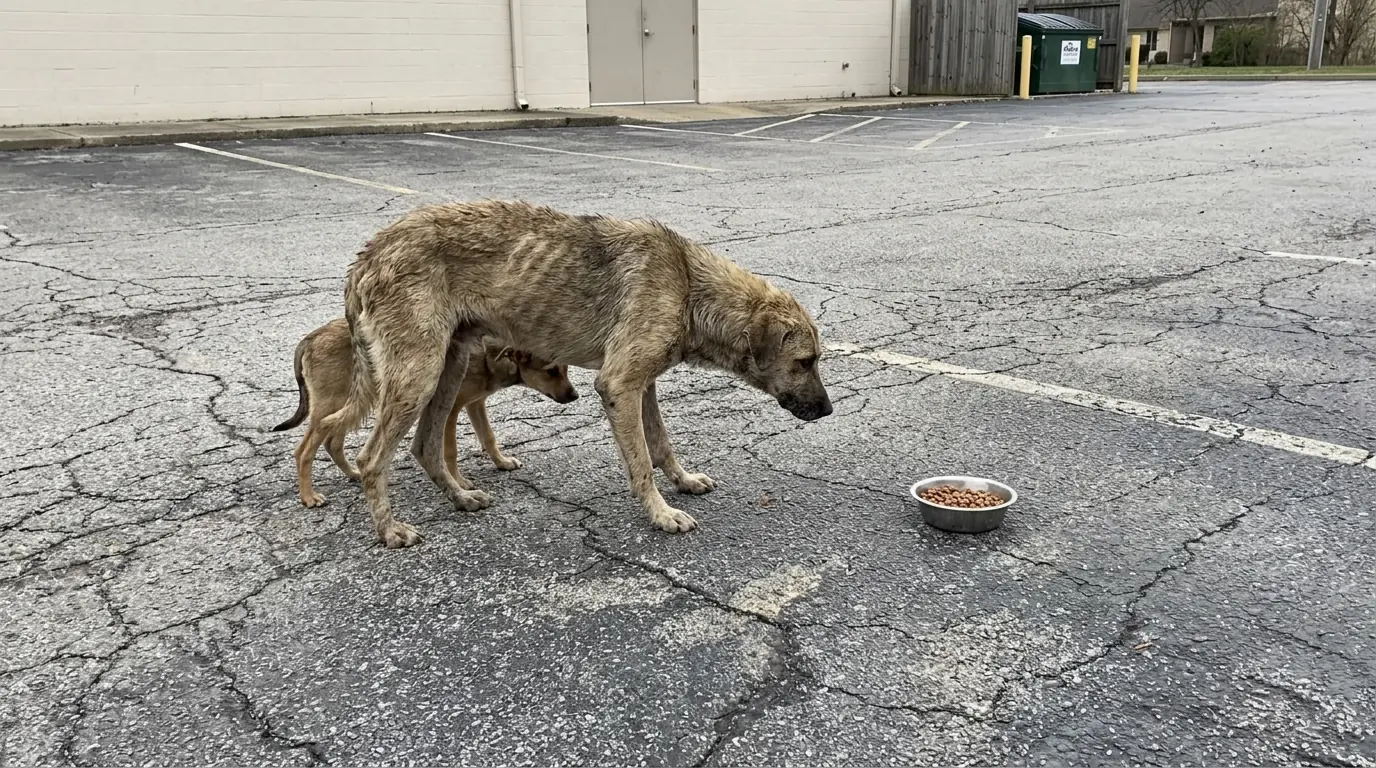
Mason and Rosie were found behind a closed retail store at the far edge of an almost empty parking lot.
The business had been shut for several days.
A delivery driver first noticed the dogs near the loading area and mentioned them to a nearby business owner. At first, people assumed someone might be returning for them. The dogs stayed in roughly the same area, disappearing behind the building at times and reappearing near the cracked pavement and loading dock.
By the time animal rescue volunteers were contacted, both dogs had been seen there repeatedly.
The larger dog, Mason, was noticeably thin even from a distance.
Rosie, the smaller dog, stayed close to him.
Witnesses believed the pair may have been left there, but there was no reliable way to confirm exactly how they came to be behind the closed store or how long they had been alone.
We could document where they were found.
We could document their physical condition.
We could document the way they stayed together.
Anything beyond that required caution.
During the first observation period, Mason usually positioned himself closer to the open part of the parking lot while Rosie curled behind the curve of his body or remained tight against the building.
The arrangement was striking enough that multiple witnesses described the same thing.
Mason outside.
Rosie tucked behind him.
Food Was the First Real Test of Whether They Would Let Anyone Close
Rescuers did not immediately walk straight toward the dogs.
The area was open, with several routes the dogs could use to flee into traffic or neighboring properties if frightened.
A low-stress approach mattered more than speed.
One rescuer stayed farther back while another placed food on the pavement and retreated.
Rosie watched from behind Mason.
Mason stared at the bowls.
He was clearly interested.
His nose lifted.
He licked his lips once.
But he did not go forward.
Several minutes passed.
The rescuers stayed quiet.
Rosie finally moved.
She crept from behind Mason, took a few tentative steps, stopped, and looked around.
Mason remained where he was.
Rosie reached the food first.
Only after she lowered her head and began eating did Mason step toward the second bowl.
That sequence happened more than once during the effort to gain their trust.
Mason appeared hungry.
But when both bowls were placed down, he often watched Rosie until she approached before he started eating.
We could not know why.
We did not describe it as a deliberate sacrifice.
We simply documented the pattern.
The larger, thinner dog consistently waited long enough for the smaller dog to reach food first.
Securing Rosie First Changed Mason's Behavior
Because Rosie was smaller and somewhat more willing to approach food, rescuers focused first on making her comfortable with their presence.
They tossed small treats without reaching toward her.
They avoided staring directly at either dog.
Rosie gradually moved closer.
Mason watched almost everything she did.
When Rosie accepted food nearer to one rescuer, Mason stepped forward.
When she backed away, he did too.
Eventually, a slip lead was placed on Rosie without chasing her.
Mason tensed immediately.
The team stopped moving.
Nobody pulled Rosie away.
She remained near him while one rescuer quietly held the lead.
Mason approached.
He sniffed Rosie's shoulder.
Then he looked toward the second rescuer.
More food was placed on the ground.
This time he ate.
A second slip lead was secured several minutes later.
The entire capture took patience, but there was no need for force.
The pair walked to the transport vehicle together.
Mason Was Weaker Than He Looked From Across the Lot
At intake, the difference between Mason and Rosie became clearer.
Mason was a large mixed-breed dog, likely middle-aged, with substantial loss of body fat and muscle.
His ribs and spine were prominent.
The muscles over his hips had thinned significantly.
He could stand and walk independently, but he tired quickly.
His gait was not acutely lame.
Instead, he moved like a dog with very little reserve.
Rosie was also underweight, though less severely.
She was a smaller adult mixed breed and remained physically brighter than Mason during intake.
She explored the examination room in short bursts, then returned to him.
Neither dog showed immediate signs of a traumatic injury.
That was reassuring.
It did not mean they were healthy.
Mason's Veterinary Workup Started With the Basics
Because of his body condition, Mason received bloodwork, urinalysis, and fecal testing.
The veterinary team wanted to know whether his severe thinness could be explained by an underlying disease, intestinal parasites, chronic organ dysfunction, or another medical problem requiring treatment beyond nutrition.
His heart and lungs were auscultated carefully.
His abdomen was palpated.
His mouth was examined.
Hydration was assessed.
His skin and coat were checked for infection, wounds, and parasite-related irritation.
His bloodwork showed changes consistent with poor nutritional status and mild dehydration but did not reveal an immediate organ crisis.
His fecal testing did not identify a parasite burden severe enough to account for all of his weight loss.
That distinction mattered.
Being thin does not automatically mean a dog has worms.
In Mason's case, the veterinary team's leading concern was prolonged inadequate caloric intake combined with muscle loss.
That could be treated.
But it had to be treated carefully.
Rosie's Examination Was Less Dramatic, but Still Important
Rosie received her own full examination.
It would have been easy to focus entirely on Mason because he looked worse.
We did not.
Rosie had mild dehydration and was underweight.
Her bloodwork was more stable than Mason's.
Her joints were comfortable.
Her abdomen was soft.
Her teeth showed some wear and mild dental disease but nothing that required urgent intervention.
She was alert and interested in food.
Behaviorally, however, she was more hesitant with unfamiliar people.
During examination, Rosie tolerated handling but frequently tried to orient back toward Mason.
Whenever possible, staff kept him within sight or scent range.
That made the process easier.
The First Shelter Meal Looked Familiar
Mason and Rosie were housed in a quiet medical recovery area because Mason needed nutritional monitoring.
They were given separate feeding stations.
That was important.
Mason needed measured calories.
Rosie needed her own portion.
Neither dog should have to compete.
At the first meal, staff placed the bowls several feet apart.
Rosie stayed close to the back of the kennel.
Mason stood near the front.
His bowl was closer.
He could have reached it immediately.
Instead, he looked toward Rosie.
A caregiver stepped back.
Rosie approached her food cautiously.
Mason remained standing.
She sniffed the bowl.
Then she began eating.
Mason lowered his head to his own meal.
The parking-lot pattern had followed them inside.
We Did Not Encourage the Waiting
It was tempting to find meaning in the behavior.
But there was no medical or behavioral reason to make Mason continue waiting.
He needed food.
His body did not have energy to waste.
So staff adjusted the setup.
Both bowls were placed where Rosie could reach hers without crossing a wide open section of the kennel.
Mason's remained nearby.
The dogs could see each other.
The caregiver then stepped farther away.
That helped.
Rosie approached sooner.
Mason did too.
Within several days, meals became faster and calmer.
But Mason still often glanced toward Rosie before eating.
Controlled Feeding Was Essential for Mason
When a severely thin dog is finally safe, the emotional instinct is to feed him as much as possible.
That is not always medically responsible.
Mason's daily calories were increased gradually according to his veterinary team's plan.
His meals were divided.
His weight was checked on a regular schedule.
Staff monitored stool quality, vomiting, hydration, energy, and appetite.
He ate eagerly.
That was a positive sign, but appetite alone did not mean he was ready for unlimited food.
His digestive system needed time to adapt.
His muscles needed time to rebuild.
His body condition would improve over weeks, not days.
Rosie was fed a somewhat more straightforward recovery diet because her nutritional depletion was less severe.
Both dogs received preventive care appropriate to their condition and history once they were medically stable enough.
The Sleeping Arrangement Was Almost Identical to the Parking Lot
The kennel had two beds.
Mason's was a large padded mat.
Rosie's was smaller and placed several feet away.
By the first morning, Rosie had moved.
She was curled directly behind Mason's abdomen.
Mason lay closer to the kennel entrance.
The same general formation witnesses had described behind the store appeared again.
Mason outside.
Rosie tucked in.
Sometimes she used her own bed.
Sometimes she did not.
When staff repositioned the beds after cleaning, the dogs often rearranged themselves by evening.
Eventually, caregivers moved the beds closer together.
There was no need to make them choose between comfort and proximity.
Mason Slept More Than Rosie
During the first week, Mason spent much of the day resting.
That was expected.
A malnourished dog can become more active before his body has actually rebuilt enough reserve for sustained exercise.
We did not mistake brighter behavior for full recovery.
Bathroom breaks were short.
Walks were limited to what he could comfortably manage.
He had no need for strenuous activity.
Rosie had more energy and sometimes became restless.
She was given brief individual enrichment while Mason rested.
At first, she hesitated to leave the recovery area without him.
A caregiver used treats and slow encouragement.
Rosie eventually walked into the hallway.
The first session lasted only a few minutes.
When she returned, Mason raised his head.
Rosie went straight to him.
Then she settled.
We Needed to Know Whether They Could Function Apart
Their bond was obvious.
Dependence was less clear.
For foster and adoption planning, we needed to understand whether short separations caused significant distress.
Mason was taken for a veterinary recheck without Rosie.
She stood at the kennel door for several minutes.
She listened.
Then she lay down.
When Mason returned, she greeted him and resumed resting.
Mason responded similarly when Rosie left for individual handling.
He watched her go.
He did not panic.
That was important.
They preferred one another.
They did not appear incapable of functioning separately for short periods.
Mason's First Weight Gain Was Small
His first meaningful weight check showed an increase.
It was not dramatic.
That was exactly what the team wanted.
Weight gain that occurs too fast is not automatically better.
Mason was tolerating his food.
His stool remained acceptable.
His hydration improved.
His energy was beginning to return.
His coat still looked rough.
His muscles were still visibly depleted.
Those changes would take longer.
Rosie improved faster on the outside.
Her body filled out gradually.
She became more interested in people.
She started approaching familiar caregivers instead of immediately retreating behind Mason.
Food Became the Best Measure of Their Growing Security
The biggest change was not how much they ate.
It was how they approached meals.
At first, Rosie waited for the room to become very quiet.
Mason waited for Rosie.
Eventually, Rosie began standing when she heard food carts.
Then she started walking toward her bowl before the caregiver had fully stepped away.
Mason watched.
One morning, Rosie reached the feeding area immediately.
Mason lowered his head at almost the same time.
There was no long pause.
A few days later, he began eating before she had taken her first bite.
Staff documented it because it was the first clear break in the original pattern.
Nobody celebrated loudly.
The dogs did not need excitement around meals.
But the change mattered.
Mason was learning that Rosie could eat without his waiting.
And perhaps more importantly, he was learning that his own meal was not going anywhere.
A Minor Setback Reminded Us How Weak He Still Was
As Mason's appetite and alertness improved, his enthusiasm began outpacing his physical recovery.
During one outdoor break, he became excited by Rosie's movement and trotted several steps after her.
That evening, staff noticed he was more tired than usual.
He was not acutely lame.
There was no sign of a new injury.
But he moved more slowly.
His veterinarian reassessed him.
The conclusion was simple.
He had overdone it.
His exercise was reduced again for several days.
That was not failure.
It was information.
Mason still needed controlled recovery.
The Parking Lot Became Less Important to Them Than the Routine
During the first days, both dogs reacted strongly to certain outdoor sounds.
Delivery trucks.
Rolling carts.
Metal doors.
Mason sometimes stopped walking and listened.
Rosie occasionally moved closer to him.
We did not claim that those sounds reminded them of the closed store.
There was no way to know.
But the reactions decreased as routine took over.
Morning feeding.
Bathroom break.
Rest.
Midday meal.
Short enrichment.
Evening feeding.
Lights down.
Predictability replaced uncertainty.
That is often one of the most powerful forms of behavioral recovery.
Foster Care Was the Next Test
Once Mason's weight trend was stable and both dogs were medically cleared to leave the shelter environment, they moved together into foster care.
The foster home was selected carefully.
There were separate feeding areas.
The family understood Mason's measured nutrition plan.
They knew not to dramatically increase his food simply because he looked hungry.
They also understood that Rosie might need time before interacting comfortably with new people.
The first evening was quiet.
Mason explored the main room.
Rosie followed.
Two beds had been placed side by side but not touching.
By morning, Rosie had wedged herself against Mason anyway.
The pattern had traveled again.
Mason Began Discovering That He Could Rest Without Watching Everything
In foster care, Mason initially chose sleeping locations with a view of the main room.
He raised his head whenever someone moved through the house.
Rosie often rested behind or beside him.
After several days, that vigilance began to soften.
Mason started sleeping through ordinary household movement.
He stretched onto his side.
Once, his foster caregiver found him asleep with his back toward the room.
That may sound insignificant.
For a dog who had repeatedly positioned himself on the exposed side of Rosie, it was an interesting change.
Again, we did not assign a story to it.
We simply noticed that he appeared more comfortable leaving part of the environment unmonitored.
Rosie Started Exploring Without Mason
The foster home's fenced yard became Rosie's favorite place.
At first, she stayed within a few feet of Mason.
Then she began wandering farther.
She sniffed along the fence.
Investigated leaves.
Followed her foster caregiver.
Mason watched from the patio during some of these sessions because his activity was still being controlled.
Rosie did not rush back every few seconds.
She could move away from him and return by choice.
That was a healthy development.
Bonded dogs do not need to occupy the same square foot of space every minute.
Mason's Bloodwork Was Rechecked
Because of the severity of his original body condition, follow-up laboratory work was appropriate.
The veterinary team wanted to make sure nutritional rehabilitation was progressing without revealing a previously hidden problem as his hydration and intake normalized.
His repeat results were reassuring.
There were no major new concerns.
His weight gain continued.
His muscle mass was still behind.
That would take more time.
His exercise plan was slowly advanced.
Short walks became slightly longer.
He was encouraged to move at a comfortable pace.
No running.
No repetitive jumping.
No strenuous play.
His Body Changed Before His Food Behavior Fully Did
Several weeks into foster care, Mason no longer looked skeletal.
His ribs were less prominent.
His hips were filling out.
His posture was stronger.
He could walk farther without fatigue.
But he still watched meals closely.
He knew the sound of the food container.
He arrived early.
He occasionally checked Rosie's feeding area after finishing.
The foster family maintained boundaries.
Mason was redirected calmly.
Rosie was allowed to eat without pressure.
Over time, he checked less.
Then one day, he finished his own bowl and walked into the living room.
He did not look for Rosie's.
The behavior was so ordinary that the foster caregiver almost missed it.
Ordinary was exactly what we wanted.
Rosie Became the Braver Dog Around Visitors
At intake, Rosie had been the more hesitant of the two.
Mason often stood closer to unfamiliar people.
In foster care, that gradually reversed.
Rosie began approaching visitors who ignored her at first and allowed her to make the decision.
She sniffed shoes.
Accepted treats.
Eventually, she leaned against one familiar guest.
Mason remained friendly but calmer.
He no longer seemed to need to position himself between Rosie and every unfamiliar person.
The change was not dramatic.
It was incremental.
That made it more believable.
Their Relationship Began Looking Less Like Survival
The dogs still slept close.
They still looked for each other after separate appointments.
Mason still sometimes waited when Rosie hesitated at a doorway.
But the rigid patterns were softening.
Rosie did not always curl behind him.
Sometimes she chose the couch-side rug.
Sometimes Mason slept in another room.
Meals became independent.
Outdoor time became more exploratory.
Their bond remained.
The survival behaviors around it became less necessary.
We Started Planning for Adoption Together
Given their history and consistent preference for one another, we decided to seek a home for Mason and Rosie as a pair.
We were careful in how we described them.
They were not presented as dogs who would collapse emotionally if separated for thirty seconds.
They could tolerate individual veterinary care.
They could rest apart.
They could engage with people independently.
But their repeated choice to remain together was clear.
They had been found together.
Recovered together.
Adjusted together.
There was no obvious welfare benefit to separating them permanently.
Their Future Family Needed to Understand Mason's History Without Feeding His Fear
Potential adopters were advised that Mason's previous malnutrition did not mean he should receive unlimited food forever.
By adoption time, his nutritional needs had changed.
He was moving toward maintenance.
Continuing to overfeed him out of sympathy could create a completely different health problem.
His body condition needed to remain appropriate.
Rosie also needed routine care and healthy weight management.
The family would need separate feeding stations at least initially, not because the dogs were aggressive, but because the arrangement had worked well and prevented unnecessary pressure.
The best permanent home would keep the stable routines that had helped them recover.
The Family That Chose Them Did Not Expect a Perfect Story
The approved family met Mason and Rosie several times.
They saw Mason's improved body condition.
They saw Rosie approach more slowly.
They watched the two dogs settle beside each other after the initial excitement passed.
They reviewed the medical records.
They understood that the exact history behind the parking lot could not be confirmed.
There was no invented villain.
No dramatic explanation.
There were simply two dogs who had been found behind a closed store and now needed somewhere permanent to go.
The family was comfortable with that truth.
The First Meal in Their New Home Brought the Story Back to the Beginning
The dogs entered the home together.
Their familiar beds went with them.
So did the feeding routine.
The family set the bowls down in separate areas of the kitchen.
Mason arrived first.
Rosie remained several feet away, taking in the new room.
For a moment, Mason stood beside his bowl.
The family recognized the old pattern immediately.
They did not call Rosie.
They did not push Mason toward the food.
They simply stepped away.
Rosie approached.
She reached her bowl.
Mason looked toward her.
Then he began eating.
It was not quite the same as the parking lot.
The pause was shorter.
Rosie was more confident.
Nobody was standing outside trying to earn their trust.
They were inside a home.
A Few Weeks Later, There Was No Pause at All
The family sent us an update.
Breakfast had been placed down.
Rosie was still walking in from the hallway.
Mason reached his bowl first.
He started eating.
Rosie arrived a few seconds later and began her own meal.
No waiting.
No checking.
No hesitation.
Later that morning, they slept in separate parts of the same room.
Rosie on a bed near the window.
Mason stretched on the rug.
That is what recovery eventually looked like for them.
Not separation.
Not forgetting one another.
Security.
Mason Still Chooses the Outside Position Sometimes
The old sleeping arrangement has not disappeared completely.
On many nights, Mason still lies closer to the bedroom doorway.
Rosie often curls beside him or slightly behind.
But it is no longer fixed.
Sometimes Rosie takes the outside spot.
Sometimes Mason sleeps farther away.
Sometimes both dogs choose separate beds.
The difference is that they now have choices.
Behind the store, their options were limited.
The parking lot was exposed.
The building was closed.
Food was uncertain.
Their world had narrowed to one another and whatever shelter the back wall could provide.
Now their world is larger.
What We Know About Mason and Rosie Is Enough
We still cannot say exactly how they ended up in that parking lot.
We cannot say how long they had been there.
We cannot prove what Mason believed when he waited for Rosie to approach the food first.
We cannot know whether his sleeping position was protective, habitual, or simply where he felt safest.
Responsible rescue storytelling means accepting those limits.
What we can say is this:
Mason was severely underweight when he arrived.
Rosie was smaller and more cautious.
They stayed together.
Mason repeatedly positioned himself on the more exposed side.
And when food first appeared, the dog who needed calories most often waited until Rosie moved toward the bowl.
Those facts were powerful enough without invention.
These Days, Neither Dog Watches the Bowl Before Eating
Mason has reached a healthy body condition.
His food is no longer part of a rehabilitation schedule.
It is breakfast.
It is dinner.
It arrives every day.
Rosie no longer needs to wait behind him when unfamiliar people enter the room.
She has learned the sounds of the house.
She knows where the door leads.
She knows which people belong there.
They still look for each other.
They still sleep close more often than not.
They still walk side by side through the yard.
But the urgency around those behaviors has faded.
That may be the most meaningful change of all.
When rescuers first placed food behind the closed store, Mason stood over a body that badly needed nourishment and watched until Rosie moved forward first.
Now, when his bowl reaches the kitchen floor, he eats.
Rosie eats too.
And neither one has to wonder whether another meal is coming.