This Orphaned Raccoon Is So Young — For Now, Every Day at Rehab Is About Getting Him to Grow
At first glance, he barely looks like the animal he will eventually become.
The baby raccoon is small enough to fit comfortably inside two hands. Sparse gray fur has begun appearing across his head and in a thin line along his back, but his belly remains almost bare. His ears are still tiny, his tail has none of the thick, ringed appearance associated with an older raccoon, and the dark facial “mask” that will eventually make him instantly recognizable is only beginning to develop.
Right now, his face is mostly pale.
His paws are disproportionately small.
And when he sleeps, he curls himself into a tight ball against the fleece as though he is still searching for the warmth of a body that should be beside him.
He is an orphan.
And at this age, that changes everything.
The little raccoon arrived at our wildlife rehabilitation center after being discovered alone near the base of a large tree on the edge of a residential property.
The homeowner hadn't initially realized what they were looking at.
There had been raccoon activity around the property before, particularly at night, but this animal was far smaller than expected. From a distance, the nearly bare abdomen and undeveloped coat made him look more like an unusually large newborn rodent than the familiar gray animal people picture when they hear the word raccoon.
He wasn't wandering around.
He was lying close to the tree, occasionally moving his front paws and making faint sounds.
The homeowner kept pets away and watched the area while seeking advice rather than immediately assuming the baby had been abandoned. With healthy young wildlife, the presence of a baby alone doesn't always mean that its mother is permanently gone. Depending on the circumstances, professional guidance may sometimes allow an opportunity for reunification.
But this baby was extremely young and vulnerable.
As the situation was assessed, no adult returned to retrieve him, and the youngster eventually required intervention.
When he reached us, his lack of fur made one of the first concerns immediately obvious.
He could not regulate his temperature the way an older, fully furred raccoon could.
His belly was almost naked. The thin coat developing across his back provided little insulation, and his body had already become cooler than we wanted.
Feeding wasn't the first thing he needed.
Warmth was.
He was settled into a carefully controlled environment and allowed to warm gradually while we evaluated his hydration, body condition, responsiveness, and overall developmental stage.
Only after he was appropriately stabilized could nutritional support become the next part of the plan.
For a baby this young, feeding isn't simply a matter of putting milk into a bottle and letting him drink as much as he wants.
The formula, amount, frequency, positioning, and the baby's ability to swallow safely all matter. Young mammals can aspirate liquid if feeding is performed improperly, which is one reason attempting to raise orphaned wildlife without appropriate training can go wrong very quickly.
This little raccoon needed consistent care around the clock.
At first, his world was remarkably small.
Warm bedding.
A protected nest area.
Food.
Sleep.
Then food again.
During those early days, he spent most of his time curled against soft fleece.
When hungry, however, he became surprisingly determined.
His head would begin moving.
His nose searched.
His tiny front paws pushed against the bedding.
Then came the vocalizations.
For such a small animal, he had no difficulty communicating that something was missing.
By the second night, the evening caregiver had started referring to him as Pip.
The name fit so naturally that nobody bothered replacing it.
Pip's progress was measured in grams rather than dramatic milestones.
His weight was monitored carefully because a growing orphan should not merely survive from feeding to feeding. We needed to see evidence that his body was actually developing.
Some mornings, the change seemed almost nonexistent.
Then we'd compare him with his intake photograph.
There was a little more gray along his shoulders.
A little more strength in his paws.
A slightly rounder body.
The differences were tiny.
Together, they meant he was growing.
His coat became one of the easiest ways to watch that development happen.
The scattered fur over his head thickened first.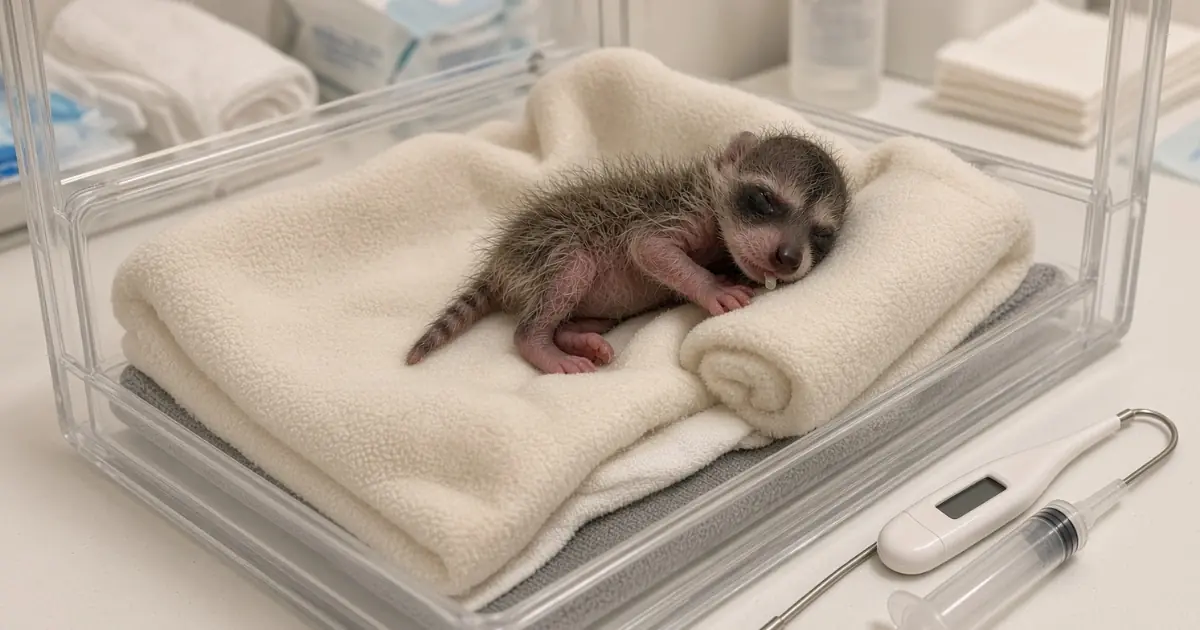
Then the narrow line along his back began spreading down his sides.
His belly remained sparsely covered much longer, giving him a strange two-tone appearance whenever he rolled over during a check.
And slowly, something began happening around his eyes.
The mask was coming in.
At first it was barely more than faint darker pigmentation.
Then the contrast increased.
Day by day, Pip's face began looking less like an anonymous newborn mammal and more like a miniature raccoon.
The tail changed too.
Fine fur appeared.
The coat thickened.
Eventually, the first suggestion of the characteristic rings became easier to distinguish.
But the most important changes weren't cosmetic.
Pip began moving.
Early on, his movements had consisted mainly of pushing and crawling through the bedding.
Then his legs became strong enough to support him.
His first attempts at walking were unsteady.
He would raise himself, take a few awkward steps, and tip sideways.
Sometimes he seemed genuinely surprised that his body hadn't gone where he intended.
Within days, those same legs were carrying him across the enclosure.
Soon, simply keeping him inside his nest became impossible.
That was when rehabilitation entered a different stage.
Pip no longer needed only warmth and nutrition.
He needed opportunities to develop.
His enclosure changed gradually as his coordination improved. Safe objects and structures allowed him to explore with his paws, strengthen his limbs, and begin interacting with the environment rather than simply sleeping through most of the day.
His front paws became increasingly busy.
Raccoons are extraordinarily tactile animals, and Pip seemed determined to discover that for himself.
He touched everything.
Bedding.
Edges.
Containers.
Food.
His own feet.
Sometimes he would sit for several seconds manipulating an object between his paws as though it represented the most complicated puzzle he had ever encountered.
That curiosity was exactly what we wanted to see.