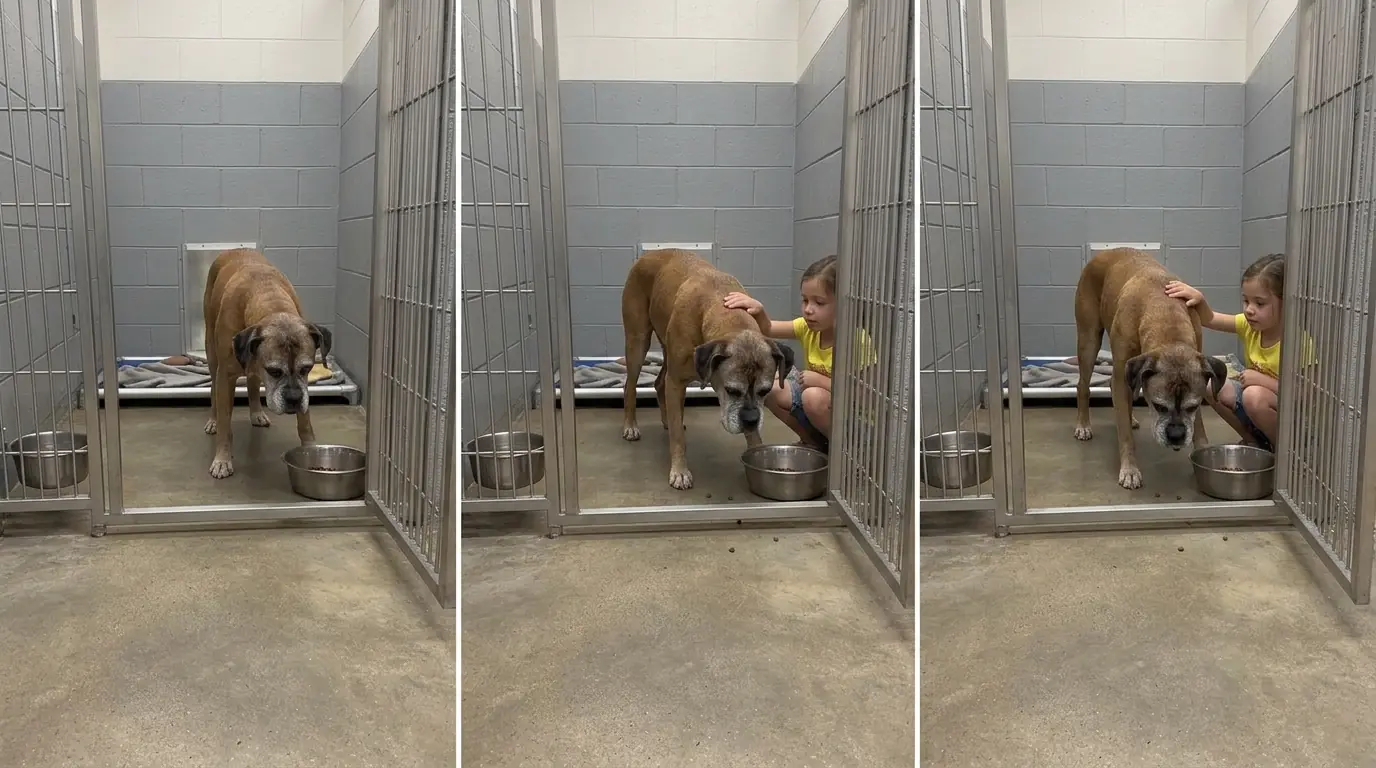
At First, Her Kennel Looked Like She Had Barely Eaten
After breakfast, there were pieces of food everywhere.
A few sat beside the bowl.
Several were scattered across the mat.
Others had rolled farther away, stopping near the edge of the senior Boxer's bed.
Looking through the kennel door, it would have been easy to assume she had rejected her meal.
Then staff watched her eat.
She lowered her broad muzzle into the bowl and carefully picked up several pieces.
Her jaw moved.
One piece stayed in her mouth.
Another slipped from the side.
Then another.
They hit the floor with tiny taps.
The Boxer stopped chewing.
She lowered her nose.
Sniffed around the bowl.
Found one of the pieces she had dropped.
Tried again.
It slipped out.
She followed it with her nose and picked it up a second time.
There was no frantic gulping.
No walking away.
She simply kept working through the meal one piece at a time.
By the time she finished, she had traveled in a small circle around her own bowl, searching for food her mouth could no longer reliably hold.
Her Mouth Had Been Hurting Long Before the Dental Procedure
The Boxer had arrived with significant chronic dental disease.
Her breath was strong.
Her gums were inflamed.
Heavy dental buildup was visible.
Several teeth were damaged or unstable.
Some areas of her mouth were clearly uncomfortable during examination.
For senior dogs, dental disease can become much more than stained teeth.
Inflammation can extend below the gumline.
Teeth can become loose.
Roots can become diseased.
Chewing can hurt.
Dogs often continue eating despite substantial oral discomfort, so appetite alone does not tell caregivers whether a mouth is healthy.
The Boxer's willingness to approach food did not mean her teeth were fine.
A proper dental assessment was needed.
The Full Extent Could Not Be Judged Just by Looking at Her Awake
An awake oral examination provided useful information, but it could not reveal everything happening beneath the gums.
Once she was medically evaluated and considered an appropriate candidate for anesthesia, the veterinary team performed a comprehensive dental procedure.
Each tooth could then be examined properly.
Dental radiographs were used where indicated to assess structures that could not be evaluated from the visible crown alone.
The findings confirmed that multiple teeth could not reasonably be saved.
Those teeth were extracted.
The goal was not to leave her with as many teeth as possible at any cost.
The goal was to leave her with a healthier, more comfortable mouth.
Losing Diseased Teeth Was Treatment, Not the Problem
People sometimes see a dog after multiple extractions and feel that something terrible has been done to her.
In reality, severely diseased teeth can be a source of chronic pain.
Removing them can significantly improve comfort once the extraction sites heal.
But recovery still takes time.
The Boxer's mouth had undergone a substantial procedure.
Her gums were healing.
Her remaining teeth were arranged differently than before.
And the mechanics she had used to pick up and hold food were suddenly changing.
The dental disease had not developed overnight.
Her mouth would not adapt overnight either.
Her First Meals Were Carefully Managed
Immediately after dental work, staff followed the veterinarian's feeding instructions.
Her food was softened as appropriate.
Hard chewing was avoided during the early healing period.
Pain medication was given according to her treatment plan.
Staff monitored for bleeding, swelling, reluctance to eat, excessive drooling, pawing at the mouth, or other signs that warranted reassessment.
She remained interested in food.
That was encouraging.
But once she began transitioning toward a more typical diet, another problem became obvious.
She could pick food up.
Keeping it in her mouth was harder.
The Shape of a Boxer's Face Already Makes Eating Look Different
Boxers have a short, broad muzzle compared with many other breeds.
Their lips and jaw structure affect how they gather food.
Individual dogs develop their own eating techniques.
For this senior Boxer, years of dental disease had added another layer.
She had likely been compensating for uncomfortable and unstable teeth before surgery.
After the extractions, some of those old strategies no longer worked the same way.
She would gather several pieces of kibble.
Begin chewing.
Then one or two would escape through the side of her mouth.
They landed around the bowl.
She noticed almost every one.
She Rarely Let a Dropped Piece Stay There
This became the part staff remembered.
The Boxer did not simply move on to another mouthful.
She stopped.
Her nose went down.
She searched.
Sometimes the kibble had rolled only an inch.
Sometimes it had disappeared beneath the rim of the bowl.
Occasionally a piece traveled farther across the mat.
She followed the scent until she found it.
Then she tried to pick it up again.
If it fell a second time, she often repeated the process.
Watching her eat became an exercise in patience.
Not for staff.
For her.
Her Appetite Was Better Than the Mess Suggested
That distinction was medically important.
If caregivers judged only by the scattered kibble, they might conclude that she was leaving a substantial portion of every meal.
So her intake was monitored more carefully.
How much was offered?
How much actually remained afterward?
How much had been dropped but eventually eaten?
Was her body weight stable?
Was she showing interest when meals arrived?
Was chewing becoming easier or harder?
Those observations helped separate a mechanical eating problem from true loss of appetite.
The Boxer wanted the food.
Her mouth was making her work for it.
Staff Changed the Bowl
A standard deep bowl was not ideal.
The Boxer's muzzle had to enter at an angle, and food could collect along edges that were difficult for her to reach.
Staff experimented with a wider, shallower feeding surface.
That gave her more room to approach the food.
It also made dropped pieces easier to locate.
The improvement was noticeable.
Not perfect.
Food still fell.
But she spent less time pushing her nose against the sides of a deep bowl.
The Floor Around Her Meal Became Part of the Feeding Setup
Because she searched for every dropped piece, cleanliness mattered.
Staff did not want her collecting old food from cracks or contaminated areas.
A clean feeding mat was placed beneath and around the dish.
It provided traction for her feet and a defined surface where dropped pieces could be found.
The mat also prevented kibble from rolling as far across the kennel.
Now when a piece escaped, it usually stayed close.
The Boxer still searched for it.
She just did not have to travel as far.
Softening the Food Changed the Problem
During recovery, softer food was easier on healing tissues.
But texture mattered.
Food that was too loose could be difficult for her broad muzzle to gather cleanly.
Staff worked within veterinary recommendations to find a consistency she could manage.
Moistening kibble could make pieces softer while still allowing her to pick them up.
Depending on her stage of healing, canned food could also be appropriate.
There was no single magic texture.
The team watched the dog.
She Had to Learn Where the Food Went in Her Mouth
After losing multiple teeth, the Boxer's tongue and remaining teeth had to perform more of the work.
She sometimes moved food around for several seconds before swallowing.
Her lips did not always contain small pieces efficiently.
The tongue occasionally pushed a piece outward instead of inward.
That could look alarming.
But as long as she was chewing safely, swallowing normally, maintaining intake, and showing no signs of aspiration or significant distress, staff could allow her time.
Rushing her would not help.
Meals Became Longer
Before the procedure, she had approached food eagerly despite her dental disease.
Afterward, she remained eager.
But eating took longer.
A younger dog might finish the same portion in minutes.
The Boxer worked through hers slowly.
Pick up.
Chew.
Drop.
Sniff.
Retrieve.
Chew again.
Swallow.
Back to the bowl.
Caregivers made sure she had enough uninterrupted time.
Her dish was not removed simply because the standard feeding period had passed.
Staff Watched for Pain, Not Just Difficulty
Mechanical awkwardness and pain are not the same thing.
The Boxer could struggle to hold kibble without being in severe pain.
But if she suddenly stopped eating, cried while chewing, developed new swelling, repeatedly pawed at her face, showed significant bleeding, or became unwilling to let anyone near her muzzle, that would require veterinary attention.
Her recovery was monitored with that distinction in mind.
Gradually, the signs suggested improving comfort.
She approached the bowl readily.
She did not recoil after taking food.
She continued trying when pieces fell.
Her Face Began Looking More Relaxed
One of the quieter changes appeared when she was not eating.
Before treatment, she sometimes held tension around her mouth.
After the extraction sites began healing, caregivers noticed more relaxed resting expressions.
She slept with her jaw loose.
She accepted gentle handling around the head more comfortably.
Those changes were difficult to quantify, but they matched the medical improvement in her mouth.
The dental procedure had not made eating immediately elegant.
It had removed diseased teeth that had been causing problems.
Those were different outcomes.
The Team Rechecked Her Mouth
Follow-up mattered.
Extraction sites needed to heal properly.
The veterinary team looked for inflammation, infection, delayed healing, retained material, or other complications.
Her progress was appropriate.
That meant staff could gradually focus less on postoperative protection and more on what her long-term eating routine should look like.
Some dogs function surprisingly well with very few teeth.
The Boxer was beginning to prove that she could adapt too.
She just needed time.
She Started Dropping Fewer Pieces
The change happened gradually enough that nobody could identify a specific meal when things became easier.
At first, nearly every mouthful seemed to produce something on the floor.
Later, several bites might pass without a piece falling.
Her tongue became more efficient.
She adjusted the angle of her muzzle.
She seemed to take smaller amounts at once.
Whether those changes were conscious choices could not be known.
What staff could see was that the mess around the bowl was shrinking.
She Still Went After Every Piece She Lost
That part remained remarkably consistent.
A piece fell.
Her nose followed.
She searched.
Sometimes her aging eyes did not seem to locate it immediately, but her nose usually did.
She moved slowly around the mat.
Sniff.
Sniff.
Found it.
Pick it up.
Try again.
The behavior became especially noticeable because she never appeared frustrated enough to abandon the effort.
Her Senior Body Had Other Needs Too
The dental problem was not the only consideration in her care.
As an older Boxer mix, she received an age-appropriate medical assessment.
Her joints were mildly stiff.
She took longer to rise after deep sleep.
Her body condition needed monitoring during dental recovery because weight loss in a senior dog could not simply be dismissed as “getting older.”
Her food intake mattered for more than healing her mouth.
It supported the rest of her body.
That made finding a feeding method she could manage especially important.
Nobody Wanted Her to Lose Weight Because Eating Was Too Much Work
A dog can be hungry and still fail to consume enough calories if the physical process of eating is difficult.
Staff tracked her weight.
Her portions were measured.
Food texture and caloric density could be adjusted if necessary.
The goal was not to make her eat a particular type of kibble to prove she was recovered.
The goal was adequate, comfortable nutrition.
If softer food remained easier long term, that was acceptable.
Her Water Intake Was Watched Too
Oral discomfort can sometimes change drinking behavior.
The Boxer had easy access to fresh water in a bowl that accommodated her broad muzzle.
Staff watched for normal swallowing and any coughing or unusual difficulty.
She drank appropriately.
That was another reassuring sign.
She Became Excited About Meals Again
One morning, a caregiver entered carrying breakfast.
The Boxer's tail started moving.
She stood before the bowl reached the floor.
Her body was old enough that standing took a moment.
Her enthusiasm arrived first.
Once the dish was placed, she lowered her muzzle immediately.
Several pieces stayed in.
One fell.
Her nose followed it.
The caregiver watched her retrieve it and continue eating.
The mess no longer looked sad in quite the same way.
It looked like adaptation.
Foster Care Offered a Better Test Than a Kennel
Once her mouth had healed sufficiently and her medical needs were stable, the Boxer moved into foster care.
The rescue sent her preferred feeding setup with her.
Wide shallow dish.
Clean mat.
Appropriate food texture.
Measured portions.
The foster caregiver was warned that meals might look messy.
That warning proved accurate.
At her first dinner, three pieces rolled out almost immediately.
The Boxer searched for all three.
The Foster Caregiver Learned Not to Help Too Quickly
The instinct was to pick up every dropped piece and place it back in the bowl.
Sometimes that was useful.
But the Boxer was also capable of retrieving much of the food herself.
Giving her a little time preserved independence.
So the foster caregiver watched.
If a piece rolled somewhere inaccessible, it was returned.
If it remained on the mat, the Boxer was allowed to find it.
Most of the time, she did.
She Developed a New Technique
Over the following weeks, the Boxer began taking smaller mouthfuls.
Instead of pushing deeply into the food, she gathered pieces closer to the front of the dish.
She chewed more deliberately.
Her tongue did more visible work.
Fewer pieces escaped.
Again, nobody could know how intentionally she had redesigned her eating technique.
But her efficiency improved.
Some Foods Were Simply Easier
Her foster caregiver and veterinary team identified textures that required less effort.
The Boxer did not need a diet chosen for appearance.
She needed nutritionally appropriate food she could eat comfortably.
Meals could be modified according to her dental status and other medical needs.
The result was simple.
She spent more time eating and less time chasing food around the floor.
She Still Made a Mess
Even after healing, nobody would describe her as a tidy eater.
A few pieces still escaped almost every meal.
Her broad muzzle pushed food around.
Her tongue occasionally sent a piece in the wrong direction.
There would be kibble on the mat.
That was now expected.
The difference was how much.
The Empty Space in Her Mouth Was Not a Disability She Needed to Be Ashamed Of
Dogs do not care whether their smile looks complete.
The Boxer had lost teeth because keeping those diseased teeth would have harmed her comfort.
Her mouth looked different afterward.
Her eating looked different.
Neither made her less capable of enjoying food.
She adapted to what remained.
Dental Care Would Still Matter
Multiple extractions did not mean future oral care could be forgotten.
The remaining teeth needed monitoring.
Her gums needed routine evaluation.
Home dental care would depend on what she tolerated and what her veterinarian recommended.
Any new reluctance to eat, facial swelling, unusual drooling, or oral odor would deserve attention.
She had already lived with significant dental disease once.
The rescue wanted to prevent another painful problem from going unnoticed.
Her Weight Stabilized
As eating became easier, the concern about inadequate intake decreased.
Her weight remained stable.
Her energy was appropriate for a senior dog.
Her coat looked better with consistent nutrition and care.
She still moved slowly after naps.
She still preferred a comfortable bed after meals.
But she was no longer spending quite as much effort simply getting breakfast into her mouth.
Staff Received Videos of Her Eating
The foster caregiver occasionally sent updates.
In one clip, the Boxer stood over her shallow dish.
She picked up several softened pieces.
Chewed.
One fell.
Her nose immediately went down.
She found it.
A second attempt succeeded.
Then she returned to the bowl.
It was an ordinary thirty seconds.
For the shelter staff who remembered her first meals after surgery, it showed almost everything they needed to see.
She Was Becoming Ready for a Permanent Home
Her adoption profile needed to be clear without making her sound more fragile than she was.
She was a senior dog.
She had a history of significant dental disease and multiple extractions.
Her remaining teeth required ongoing care.
She might always do better with certain food textures.
She might always make a mess around the bowl.
None of those things prevented her from having a comfortable daily life.
Her future family would simply need to understand how she ate.
The Scattered Food Still Tells the Story
Even now, someone seeing the floor after one of her meals might misunderstand.
There may be several pieces beside the dish.
One behind it.
Another near her front paw.
It can look as though she has decided she does not want them.
Then the Boxer lowers her head.
Her nose moves slowly across the mat.
She finds the closest piece.
Picks it up.
Sometimes it stays in her mouth.
Sometimes it falls again.
If it falls, she follows it.
She tries again.
That is the part staff wish people could see before judging the mess left around her bowl.
She is not carelessly throwing food aside.
She is not necessarily losing interest in eating.
She is an older dog learning how to do something she has done her entire life with a mouth that now works differently.
The diseased teeth are gone.
The painful dental problems have been treated.
Her gums have healed.
But adaptation has taken longer than the procedure itself.
And she has approached that adaptation the same way she approaches every piece that slips from her mouth.
She does not leave it where it falls.
She lowers her nose.
Searches until she finds it.
Picks it up.
And patiently tries one more time.