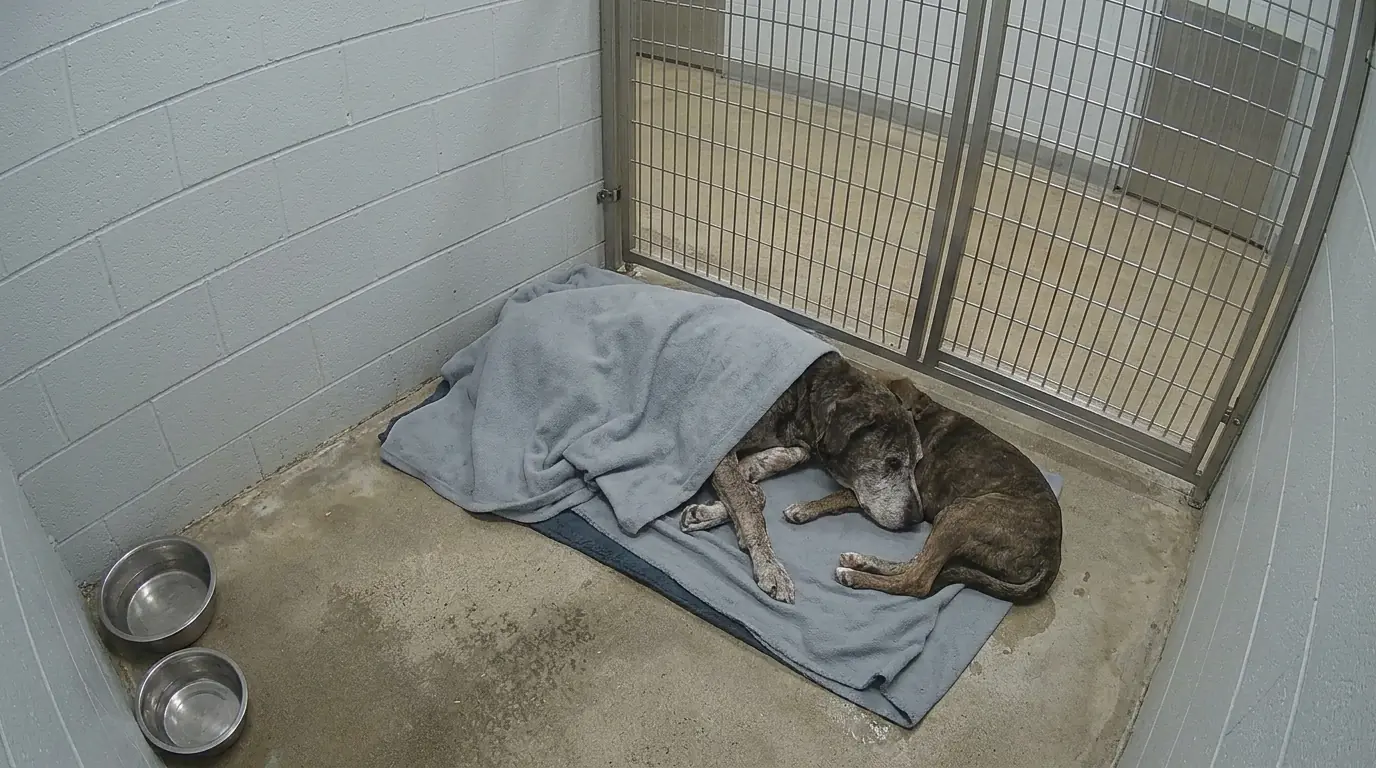
The Bed Was Close Enough to See, but Still Too Far to Reach
Every evening, the Saint Bernard mix followed the same small route.
Water bowl.
Turn.
Bed.
The distance between them was only a few steps.
For a healthy dog, it would have taken seconds.
For her, it could take everything she had.
She would stand beside the water bowl after drinking, her broad body visibly trembling from the effort of remaining upright.
Then she would shift one front paw forward.
A rear leg followed.
Pause.
Another step.
Her head stayed low.
Her breathing became heavier.
By the time she reached the middle of the kennel, the shaking in her hind legs had usually increased enough that staff began watching closely.
Sometimes she made it farther.
Sometimes she did not.
On the hardest nights, her front legs would bend first.
Then her chest lowered toward the floor.
Her hindquarters followed more slowly.
She would lie down directly on the concrete between the water and her orthopedic bed.
At first, staff assumed she was only stopping to rest.
Then several minutes would pass.
Her head would sink onto her paws.
Her eyes would close.
And the senior Saint Bernard would fall asleep only a few feet from the soft bed she had been trying to reach.
Her Weakness Was Visible Before She Took a Single Step
The Saint Bernard arrived in poor physical condition.
She was severely deconditioned.
Her ribs were easier to feel than they should have been beneath the heavy coat.
The muscles over her thighs had wasted substantially.
Her hips looked narrow compared with the massive frame of her chest and shoulders.
When she stood still, the weakness behind was obvious.
The hind legs trembled.
Her stance widened slightly as she tried to stabilize herself.
She could walk.
But not for long.
The rescue had information indicating she had spent an extended period in conditions where her care had been inadequate.
That history was taken seriously.
At the same time, the team was careful not to invent details it could not verify.
They could document her body condition.
Her muscle loss.
Her weakness.
Her coat.
Her mobility.
They could not reconstruct every day that had led to the condition they were seeing now.
Staff Did Not Assume All the Weakness Came From Being Thin
A senior giant-breed dog who can barely cross a kennel needs more than a nutritional explanation.
The veterinary team evaluated her carefully.
Her joints were examined.
Her spine was palpated.
Neurologic responses were checked.
Her heart and lungs were assessed.
Bloodwork and urinalysis helped look for anemia, kidney disease, liver abnormalities, electrolyte problems, infection, and other conditions that might contribute to profound weakness.
Her gait was observed on a nonslip surface.
She showed no evidence of a fresh fracture.
There was no single acute orthopedic injury explaining the full picture.
Instead, the findings supported severe generalized deconditioning and muscle wasting, with chronic age-related joint disease adding another layer of difficulty.
For a dog her size, those two problems together were significant.
Her Body Had Become Front-Heavy
Saint Bernards are already large dogs.
When rear muscle disappears, that size becomes harder to manage.
Her shoulders still carried substantial strength.
Her hindquarters did not.
That imbalance showed in every transition.
When standing up, she pulled through her front legs first.
When walking, her shoulders advanced before her rear paws followed.
When she became tired, her hips sagged lower.
Her front half could keep going longer than the back half could support.
Staff worried about what all that compensation could eventually do to her forelimbs.
Her elbows, wrists, shoulders, and front paw pads were monitored carefully.
She needed the stronger part of her body preserved.
The Concrete Floor Was Making Her Work Even Harder
The standard kennel floor gave her almost no margin for error.
If one rear paw slipped even slightly, she could lose enough stability to need to lie down.
So traction became an immediate priority.
Nonslip runners were placed along the route between the bed, water, and kennel door.
That helped.
But it did not solve the endurance problem.
Even with traction, her muscles still fatigued after only a few steps.
The flooring could prevent slipping.
It could not replace muscle that was no longer there.
The Water Bowl Was Moved Closer
The first obvious change was to shorten the route.
Her water was moved nearer to the bed.
Not directly beside the bedding, because staff wanted to keep spilled water from soaking the surface she slept on.
But close enough that she would not have to cross most of the kennel every time she needed a drink.
The change reduced the number of times she ended up sleeping on the concrete.
It did not eliminate them.
Some nights, even the shortened distance was too much.
Staff Started Putting Padding Where She Usually Stopped
Her resting point became predictable.
There was one section of kennel floor where her strength most often ran out.
So staff stopped pretending that only the bed mattered.
They added a second padded mat.
Then another.
The goal was to create a path where, if she needed to lower herself early, she would not have to sleep directly on hard concrete.
For a thin senior giant-breed dog, pressure points mattered.
Hips.
Elbows.
Hocks.
Shoulders.
Her body had too little natural padding left.
She Still Chose the Same Route
Even with extra padding, the Saint Bernard usually tried for the orthopedic bed.
That detail stood out.
She was not simply lying wherever she happened to be.
After drinking, she oriented toward the same bed.
Her head turned.
Her front feet aligned.
Then she started moving.
The orthopedic bed had become the place she seemed to prefer.
Staff could not know why.
It was softer.
Warmer.
More supportive.
It was also where she had learned to expect rest.
Whatever the reason, she kept trying to reach it.
Her First Few Steps Looked Better Than Her Last Ones
Fatigue changed her gait quickly.
The first step after drinking might look relatively stable.
The second still controlled.
By the third, her rear legs often began trembling more.
Her hips shifted side to side.
Her stride shortened.
Sometimes one paw landed slightly outward.
Those were the signs staff learned to watch for.
The goal was not to wait until she collapsed.
Once the quality of her movement deteriorated, the safest choice was often to help her lower herself before the body decided for her.
A Support Harness Became Part of Her Routine
A large rear-support harness gave caregivers a safer way to assist.
It was not used to carry her entire body.
The Saint Bernard still needed to use her own legs.
But the harness allowed someone to reduce some of the load on her hindquarters while keeping the pelvis more stable.
At first, the assistance was substantial.
She could stand longer when supported.
She could take a few more steps.
Sometimes that was enough to get from the water bowl to the bed.
Sometimes it was not.
Her First Successful Trip Back to Bed Looked Almost Uneventful
She finished drinking.
A caregiver positioned the support harness.
The Saint Bernard turned.
One step.
Then another.
Her hind legs trembled.
The caregiver lifted only enough to keep the hips from sagging.
She moved forward.
When the bed finally touched her front paws, she stopped.
Then she lowered herself.
Chest first.
Rear end second.
She exhaled heavily.
Several minutes later, she was asleep.
That was all.
A distance of a few feet.
A successful evening.
Nutrition Was Part of Rehabilitation, but It Could Not Be Rushed
Because she was underweight and profoundly deconditioned, her feeding plan was controlled.
She received a nutritionally complete diet appropriate for her condition and medical needs.
Meals were measured.
Her gastrointestinal tolerance was monitored.
Weight was checked regularly.
The veterinary team also tracked muscle condition rather than looking only at the number on the scale.
A dog can gain weight without regaining useful strength.
For her, functional recovery required both nutrition and movement.
She Ate Lying Down at First
Standing through a meal wasted energy she needed elsewhere.
So staff did not insist on it.
Her food could be positioned where she could eat comfortably while lying or in a supported posture.
That allowed her to conserve energy.
There was no benefit in making every daily task harder in the name of independence.
Independence meant participating where she could.
Not performing unnecessary physical challenges.
Her Joint Disease Needed Long-Term Management
The Saint Bernard's age-related joint changes were not expected to disappear.
Large breeds carry substantial mechanical load even when healthy.
With severe muscle loss, the joints were getting less support than they needed.
Her veterinary plan included appropriate pain management, weight management, controlled activity, and supportive surfaces.
No one described the arthritis as something rehabilitation would cure.
The goal was to manage it well enough that muscle rebuilding remained possible.
Rehabilitation Started With Standing
Not walking.
Not distance.
Standing.
The first sessions focused on helping her remain upright on good traction for short periods.
A few seconds at first.
Then a little longer.
Staff watched the hind legs.
If trembling increased sharply, the session ended.
She also practiced gentle weight shifts.
The movements were small.
But they asked the muscles to engage.
That was the point.
She Had to Learn to Lower Herself More Safely Too
Because she fatigued quickly, lying down often happened abruptly.
That created risk.
A large senior dog dropping onto the floor can bruise tissue or worsen joint discomfort.
So staff supported the descent when needed.
The harness slowed the hips.
Her front legs were allowed to fold in a controlled way.
The bed or mat did the rest.
The movement did not need to be elegant.
It needed to be safe.
Sleep Became Part of the Medical Plan
She slept a great deal.
That was expected.
Her body was depleted.
Her muscles were rebuilding.
Her joints hurt.
Even short periods of standing could be exhausting.
But staff still distinguished normal fatigue from deterioration.
Was she easy to wake?
Was her breathing normal?
Was her appetite intact?
Was she drinking?
Could she rise with assistance?
Was her temperature stable?
Those questions mattered.
A tired dog needs rest.
A declining dog needs reassessment.
The Concrete Sleeping Episodes Became a Daily Measure
The number of times she failed to reach her bed started telling staff something useful.
At first, it happened almost every evening.
Then only some evenings.
Then more often after busy days.
The route never became a formal medical test.
But it offered a simple picture of endurance.
If she could drink, turn, and reach the bed afterward, she had a little more reserve than before.
She Still Fell Asleep Midway on Hard Days
Progress did not erase the hardest nights.
There were evenings when she made two steps.
Stopped.
Tried one more.
Then lowered herself.
Even with padding beneath her, the distance to the orthopedic bed looked painfully small.
Sometimes she rested for ten minutes and finished the trip later.
Sometimes she fell asleep before trying again.
Staff stopped waking her just to make the bed look like the correct destination.
If she was comfortable and safely positioned, rest came first.
Her Body Began Filling Out Slowly
Weeks passed.
The sharpest parts of her frame softened.
Her coat improved.
Her shoulders looked less hollow.
The hindquarters changed more slowly.
That was expected.
Muscle takes time.
Especially in an older giant-breed dog with chronic joint disease.
The scale moved upward.
But caregivers were more interested in what happened when she stood.
The Trembling Took Longer to Start
That became one of the first clear changes.
Early in care, her hind legs could tremble almost immediately after standing.
Later, she could remain upright for longer before the shaking began.
Not dramatically longer.
But enough to matter.
That additional time could become another step.
Another turn.
Another chance to reach the bed.
One Night, She Stopped Halfway and Did Not Lie Down
She drank.
Turned.
Walked several steps.
Then stopped in the familiar middle area.
Staff expected her chest to start lowering.
Instead, she simply stood.
Her hind legs trembled lightly.
The caregiver waited nearby with the harness.
After several seconds, the Saint Bernard took another step.
Then another.
She reached the bed.
That pause was different.
Earlier, stopping had usually meant the trip was over.
Now it could simply mean resting while standing.
Her Personality Started Showing Through the Weakness
At intake, nearly every behavior was filtered through exhaustion.
As she became stronger, staff began seeing more of her.
She liked slow chest scratches.
She watched food preparation closely.
She preferred lying where she could see the kennel door.
Outside, she wanted to sniff longer than her rehabilitation plan allowed.
Her body had been the loudest thing about her.
Now other parts of her were becoming visible.
She Still Needed a Quiet Medical Environment
A standard kennel remained too demanding.
The floor traffic.
The transitions.
The noise.
The need to move around other animals.
She benefited from staying in a medical area where her routine could be controlled.
Her bed remained close to water.
Her traction path remained clear.
Her support harness stayed beside the kennel.
Everything was arranged around conserving energy for the movement that mattered.
Foster Care Offered a Better Next Step
Once her condition stabilized, the rescue found a foster home experienced with large senior dogs.
The home was primarily one level.
Rugs covered smooth flooring.
Multiple orthopedic beds were positioned strategically.
One near the living room.
One near the back door.
Another close to the water station.
The idea was simple.
She should never have to travel far just to rest.
The First Evening Repeated the Same Old Pattern
The Saint Bernard drank.
Then turned toward the nearest bed.
The distance was shorter than it had been in the shelter.
She took several steps.
Her legs began shaking.
She lowered herself onto a rug before reaching the bed.
Within minutes, her head was down.
She slept there.
The foster caregiver had been warned this could happen.
No one treated the first night as a setback.
A new environment is tiring even for a healthy dog.
For her, it was enough to make the old limit reappear.
The House Gave Her More Places to Succeed
The biggest improvement was not that she suddenly walked farther.
It was that every destination was closer.
Water to bed.
Bed to door.
Door to yard.
She no longer had to cross a long kennel just to meet basic needs.
That saved energy.
And the saved energy could go toward rehabilitation instead.
Her Support Harness Became Lighter Help
At first, the foster caregiver provided meaningful upward assistance.
Later, the handle remained nearly slack on stronger days.
The Saint Bernard did more of the work herself.
The harness stayed on because safety still mattered.
A single slip in a giant senior dog could undo progress quickly.
Independence did not require removing every support device.
She Started Walking Past One Bed to Reach Another
That surprised everyone.
One afternoon, she stood after drinking.
The closest bed was only a few steps away.
She reached it.
Paused.
Then kept going.
There was another bed farther across the room, near the foster caregiver.
She chose that one.
It was the first time anyone had watched her walk beyond a perfectly good resting place because she wanted to be somewhere else.
The distance was still modest.
The meaning was not.
She now had enough reserve to make choices beyond immediate survival.
There Were Still Bad Days
Cold mornings.
Longer veterinary appointments.
A busier afternoon.
Any of those could reduce endurance.
On difficult days, she might lie down sooner.
She might need more harness support.
She might sleep more.
The foster caregiver learned to adjust the plan rather than forcing consistency.
Chronic disease and deconditioning do not improve in a straight line.
Her Rehabilitation Never Became Aggressive
No long walks.
No stairs for exercise.
No repeated sit-to-stands until her legs shook uncontrollably.
The plan remained conservative.
Short standing sessions.
Controlled steps.
Good traction.
Plenty of rest.
Gradual increase only when the previous level had become comfortable.
Her size made fatigue and falls too consequential to gamble with.
Her Front End Needed Protection Too
As the hindquarters improved, caregivers continued monitoring the shoulders and elbows that had carried so much extra work.
Her nails were maintained.
Paw traction mattered.
Bedding protected pressure points.
A mobility problem affects the whole body, not just the weakest limbs.
The team treated her as one dog, not a pair of failing back legs.
She Began Sleeping Where She Intended To
This became the biggest change.
During the early weeks, sleep happened where endurance ended.
Midway across the kennel.
Beside the water bowl.
On the first padded surface she reached.
Later, she started deciding where to sleep before lying down.
She could get to the orthopedic bed.
Circle.
Lower herself.
Rest.
The bed stopped being an unreachable goal and became a normal part of the routine.
The Old Habit Did Not Disappear Completely
Even after months of progress, there were nights when she stopped short.
Especially when tired.
She might lower herself onto a rug two or three steps from the bed.
But now she usually rested briefly instead of falling into deep sleep there.
After several minutes, she sometimes stood again.
Finished the route.
Then settled where she had originally intended.
That was a major difference.
Her Future Home Would Need to Understand Her Limits
She remained a senior Saint Bernard with chronic joint disease and a history of severe muscle wasting.
Her recovery did not erase those facts.
A permanent home would need good traction.
Minimal stairs.
Appropriate body weight.
Supportive beds.
Regular veterinary care.
Pain management.
Controlled exercise.
A support harness available for harder days.
And realistic expectations.
She was stronger.
She was not suddenly young.
Staff Still Remember the Distance That Used to Defeat Her
It was almost nothing.
A few feet.
The length of a kennel aisle.
Water bowl on one side.
Orthopedic bed on the other.
Every evening, she tried.
Drink.
Turn.
Step.
Step.
Tremble.
Lower.
Sleep.
The soft bed remained visible from where she lay.
Sometimes her nose even pointed toward it while her body stayed on the concrete.
That image made her weakness easier to understand than any number on a medical chart.
She was not refusing the bed.
She simply did not have enough strength left to reach it.
Now the Bed Is Usually Where Her Day Ends
She still moves slowly.
Her hind legs are still thinner than they once should have been.
Her arthritis remains.
On some evenings, she pauses after drinking and gathers herself before moving.
The old tremor can still appear.
But most nights, she makes the trip.
One step.
Then another.
Past the place where she used to lie down.
Onto the orthopedic bed.
She turns slowly.
Lowers herself.
Then sleeps.
There are still rugs along the route in case she needs them.
The support harness is still nearby.
Nothing about her care assumes the problem is gone.
The difference is that sleep is no longer deciding where she stops.
More and more often, she reaches the place she was trying to get to in the first place.