Staff First Thought She Had Simply Stopped to Rest
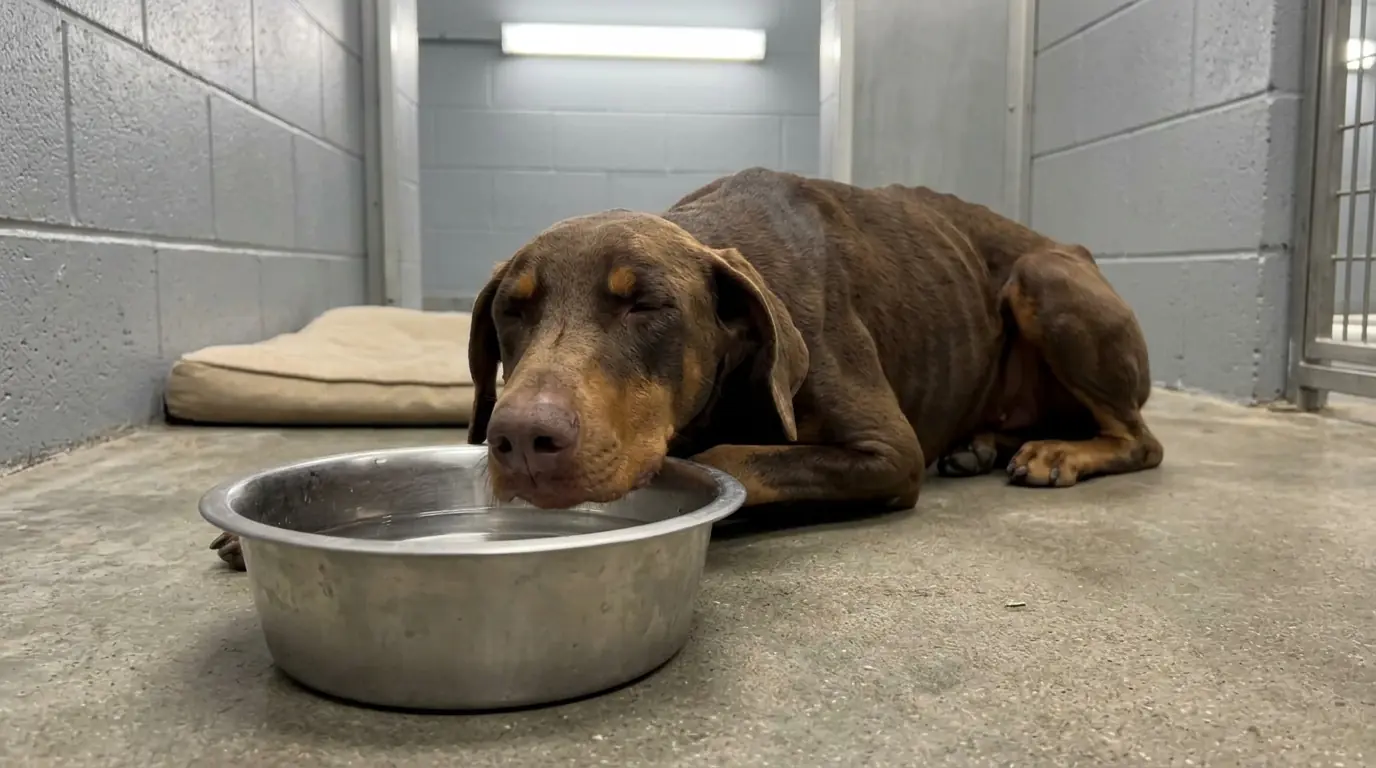
The stainless-steel water bowl sat only a few feet from her bed.
For most dogs, that distance would mean nothing.
For the underweight Doberman mix in the medical kennel, it could be the difference between making it back to the bedding and giving up halfway.
The first time staff found her asleep beside the bowl, they assumed she had stopped there briefly.
Her body was folded awkwardly on the kennel floor.
Her chest rested against the concrete.
Her front legs were tucked close.
Her muzzle lay across the rounded rim of the stainless-steel dish.
The water beneath her nose was still.
She was breathing normally.
She was asleep.
A caregiver touched the floor lightly before approaching so she would not startle.
The Doberman opened her eyes.
For several seconds, she did not lift her head.
Then she slowly raised it from the bowl, looked toward the person, and allowed it to sink back down.
The bed was visible behind her.
She had simply not made it there.
Later that day, staff saw how the pattern happened.
She stood to drink.
She remained at the bowl longer than expected.
Then her hind legs began trembling.
Instead of turning toward her bed, she lowered her chest to the floor beside the dish.
Her rear legs folded next.
She shifted her nose over the metal edge.
Within minutes, her eyes closed.
It happened again the following day.
And again after that.
That was when the team stopped seeing the water bowl as just another object in the kennel.
It had become the place where her strength sometimes ran out.
Her Body Condition Was Immediately Concerning
The Doberman mix had arrived severely underweight.
Her ribs were visible without touching her.
Her spine stood out beneath the coat.
The points of her hips were prominent.
The normally athletic outline of a Doberman had almost disappeared.
Most concerning was the loss of muscle.
Her thighs were narrow.
Her shoulders had little padding.
Even the muscles along her back looked reduced.
A dog can be thin and still reasonably strong.
She was not.
When she stood, her limbs trembled.
She could walk independently for short distances, but every transition required effort.
Getting up from the bed took time.
Standing long enough for an examination tired her.
A trip across the kennel to drink could become the most demanding thing she did in that hour.
Staff could document her condition.
They could not reconstruct exactly how she reached it.
There was no responsible way to say how long she had been underfed or whether inadequate food was the only cause.
Severe weight loss can come from many problems.
The rescue needed medical answers before assuming the history.
Being Extremely Thin Does Not Automatically Explain Why a Dog Is Thin
The veterinary team began with a complete examination.
Her temperature was checked.
Her heart and lungs were listened to.
Her abdomen was palpated.
Her mouth and teeth were examined.
Her skin and coat were evaluated.
The team assessed hydration, muscle condition, joint comfort, neurologic function, and the way she moved.
They also watched her carefully when she stood.
She was weak but coordinated.
She did not consistently drag her paws.
She was not showing obvious focal paralysis.
There was no single painful limb explaining why she could stand for only short periods.
Her weakness appeared more generalized.
That made laboratory testing especially important.
Bloodwork was performed to evaluate her red and white blood cells, kidney and liver values, blood sugar, protein levels, and electrolytes.
A urinalysis provided additional information about hydration and organ function.
A fecal test was used to look for intestinal parasites.
Other testing would depend on what those first results showed.
The rescue did not give her every possible diagnosis just because she looked sick.
They followed the evidence.
The First Results Pointed Toward Severe Depletion
Her bloodwork showed abnormalities consistent with significant nutritional depletion and dehydration, but there was no sign of an immediate catastrophic organ failure.
Her blood sugar was monitored carefully because dogs with very poor body reserves can become unstable.
Her protein status was also important.
The veterinary team wanted to know whether she was simply not receiving enough nutrition or whether her body might be losing nutrients through the intestinal tract, kidneys, or another disease process.
The initial findings did not establish one dramatic underlying illness.
That was useful.
It meant controlled nutritional rehabilitation could begin while the team continued monitoring her response and investigating anything that did not improve as expected.
She was not going to be “fixed” by one enormous meal.
In fact, that could have created more problems.
Feeding Her Required Restraint From the Humans, Not the Dog
When people see a severely underweight dog, the natural impulse is to feed as much as possible.
The veterinary team did the opposite.
Her meals were carefully measured.
They were divided into smaller portions.
Her gastrointestinal response was monitored.
Calories were increased gradually according to her condition and veterinary plan.
Staff watched for vomiting, diarrhea, abdominal discomfort, bloating, appetite changes, or worsening weakness.
Her electrolytes and other laboratory values could be rechecked if her condition indicated it.
Nutritional rehabilitation is not a contest to put weight on as quickly as possible.
A depleted body needs time to process increased intake.
The goal was steady improvement without overwhelming systems that had been operating with too little reserve.
She Still Wanted Water on Her Own
One encouraging feature was that the Doberman drank voluntarily.
She did not need to be coaxed to the water bowl.
When awake, she would look toward it.
Then came the hard part.
Standing.
She first rolled onto her chest.
Her front feet came forward.
Her shoulders rose.
The rear half followed more slowly.
Once upright, she remained still for a moment before walking.
Her steps were short.
The stainless-steel bowl was only a small distance away, but she often paused after reaching it.
Then she drank.
She did not gulp without stopping.
She took several laps.
Paused.
Drank again.
Staff tracked her intake.
Hydration was part of her medical plan, and supplemental fluids were provided when appropriate.
But allowing her to perform basic actions independently, when safe, also mattered.
She needed to use the strength she still had.
The Return Trip Was Harder Than the Trip to the Bowl
Drinking gave her a reason to get up.
Once she had finished, that motivation disappeared.
She would remain standing over the bowl.
Her head came up.
Her rear legs trembled.
Sometimes she looked toward the bed.
Then she lowered herself before taking a single step back.
That was how staff began seeing the same scene repeatedly.
The Doberman lying beside the water.
Her muzzle resting on the steel rim.
Her eyes closing.
At first, caregivers gently encouraged her back toward the bed whenever she woke.
Then they recognized that making her stand again simply to put her somewhere more comfortable could exhaust her further.
So they changed the kennel instead.
The Water Bowl Was Moved Closer
The first adaptation was obvious.
Bring the resources to the dog.
The water bowl was positioned closer to her bed while still leaving enough room that spilled water would not soak the bedding.
A nonslip mat was placed beneath and around it.
That helped her paws maintain traction while drinking.
Staff also experimented with bowl height.
Too low required more neck and shoulder effort.
Too high could make drinking awkward or unstable.
The final position allowed her to reach comfortably without leaning excessively.
The distance back to bed became shorter.
Still, there were days when even that was too far.
On those days, she slept beside the bowl.
Her Kennel Had to Be Designed Around Weakness
Ordinary kennel organization did not work for her.
Everything needed to be reachable.
Her bed could not be excessively soft because she needed a firm surface to push against when standing.
At the same time, her thin body had almost no natural cushioning over bony areas.
Pressure sores were a real concern.
The team chose supportive bedding that distributed pressure without swallowing her body.
Extra padding protected her hips, elbows, and chest.
Nonslip material covered the areas where she had to stand and turn.
Food and water remained close.
The kennel was kept warm enough that she did not waste unnecessary energy trying to maintain body temperature.
A severely underweight dog has fewer reserves.
Even simple comfort decisions matter.
Sleep Became Part of Her Treatment
She slept often.
That could look alarming.
But staff distinguished between expected fatigue and signs of deterioration.
Was she easy to rouse?
Was her breathing normal?
Could she lift her head?
Would she eat?
Would she drink?
Could she stand with assistance or independently?
Was her temperature stable?
Were her gums an appropriate color?
Those questions helped separate a depleted dog resting from a dog entering a medical crisis.
Her sleep was heavy but generally responsive.
When someone entered quietly, one ear often moved first.
Her eyes opened.
Sometimes she lifted her head.
Sometimes she did not.
The water bowl remained one of the places where staff most often found her asleep.
She Was Not Forced to Perform Recovery
There was no daily attempt to make her walk farther for a video.
No one repeatedly stood her up to prove improvement.
For the first phase of care, ordinary necessities provided enough activity.
Stand for a meal.
Walk a few feet to eliminate.
Shift positions.
Drink.
Return to bed if she could.
Those were exercises.
When muscle mass is severely reduced, even holding the body upright requires meaningful work.
Rehabilitation had to begin at the level her body could tolerate, not the level people hoped to see.
The Medical Team Watched Her Weight Carefully
Her weight was recorded consistently.
Daily fluctuations could reflect hydration, food in the gastrointestinal tract, or elimination, so staff did not celebrate every small increase.
They looked for a trend.
Over time, the direction began changing.
The loss stopped.
Then the numbers began creeping upward.
Her body did not look dramatically different after a few days.
Her ribs remained obvious.
Her hips remained sharp.
But her energy after meals improved slightly.
She began holding her head up longer.
Those were early changes.
The First Sign of Strength Was Not Walking Farther
One morning, the Doberman stood to drink.
She finished.
Her hind legs trembled.
Staff expected her to lower herself beside the bowl.
Instead, she turned.
One step.
Pause.
Another.
She reached the front edge of her bed.
Then she lowered herself onto it.
The distance was tiny.
It was also the first time in several days a caregiver had watched her make the complete trip without stopping to sleep beside the bowl.
That did not mean the habit was gone.
At the next evening drink, she lay down beside the dish again.
Recovery rarely moves in a straight line.
The team recorded both.
Some Days the Bowl Still Became Her Pillow
On difficult days, the old pattern returned immediately.
She stood.
Drank.
Lowered herself.
Muzzle on metal.
Sleep.
Sometimes her head rested so heavily on the rim that staff placed a folded towel beside it for additional support without blocking her access to water.
They never positioned fabric where it could fall into the bowl or create a safety issue.
The goal was not to stop the behavior by force.
It was to make the place where she ended up as safe and comfortable as possible until her strength improved.
Appetite Became More Reliable
Initially, she ate but tired during meals.
Staff used a bowl position that allowed her to eat without standing for prolonged periods.
Depending on the day, she could eat in a supported posture.
Her portions remained controlled.
As her digestive system adapted, meals were gradually adjusted.
Her stool provided important information.
Persistent diarrhea would have made nutritional recovery much harder.
Fortunately, her gastrointestinal tolerance became increasingly stable.
With every meal she successfully digested, her body gained material it could use for repair.
Muscle Took Longer Than Body Weight
The scale began improving before her hindquarters looked strong.
That was expected.
Putting calories into a dog does not instantly rebuild functional muscle.
Muscle requires nutrition plus safe activity over time.
At first, the team focused on standing tolerance.
Could she remain upright for ten seconds after drinking?
Then longer.
Could she shift weight without collapsing?
Could she take a few controlled steps on traction?
These small tasks became the beginning of physical rehabilitation.
Staff Looked for Pain Too
Weakness was not automatically assumed to be purely nutritional.
The Doberman's joints and spine were evaluated.
Severe underconditioning can make ordinary movement uncomfortable, and an older or previously injured dog may also have chronic joint disease.
She had some generalized stiffness, but no single orthopedic problem explained the severity of her weakness.
Pain management was used when indicated, but the team avoided unnecessary sedation or medications that might further reduce her already limited alertness.
Her care plan stayed focused on the actual findings.
The Water Bowl Kept Showing Staff Exactly Where She Was
The unusual sleeping position became a simple measure of her daily endurance.
On a weak day, she lay down immediately after drinking.
On a better day, she remained standing.
On an even better one, she turned toward the bed.
Staff never used the bowl behavior as a formal medical test.
But it offered an honest visual record of what her body could handle.
The kennel was small.
The distance was short.
If she could complete that return trip, she had a little more reserve than before.
She Began Sitting Instead of Collapsing
Another small milestone came when she finished drinking and lowered into a sit rather than going all the way to the floor.
Her rear legs folded carefully.
She remained upright.
Her head hovered above the bowl.
For almost a minute, she sat.
Then she stood again.
The effort was obvious.
But she made it back to bed.
The sequence would have looked ordinary in a healthy dog.
In her case, it represented several coordinated actions she previously could not sustain.
Her Personality Started Appearing as Her Energy Returned
During the earliest days, weakness obscured almost everything else.
She was a body trying to conserve energy.
As her physical condition improved, staff began seeing more behavior.
She noticed familiar caregivers.
Her eyes followed food preparation.
She sniffed more during bathroom breaks.
One morning, she walked past the water bowl and investigated a towel hanging near the kennel door.
That was new.
Curiosity requires energy.
A dog using almost every available calorie simply to maintain basic functions has little reserve for exploring.
Her interest in the environment became another useful sign.
She Still Was Not Ready for Normal Shelter Life
Even with progress, a standard adoption kennel would have been inappropriate.
She needed medical monitoring.
She needed controlled feeding.
She needed a low-stress environment.
And she needed staff who understood that a small decline in strength could be meaningful.
The medical kennel remained her world until she was stable enough for the next phase.
Eventually, the rescue began considering foster care.
The Foster Home Was Chosen Around Her Physical Needs
Her foster home had few stairs.
Rugs covered smooth flooring.
Multiple beds allowed her to rest without traveling far.
Food and water stations could be positioned strategically.
The caregiver understood that she was not ready for normal exercise.
The first goal was continuing nutritional recovery in a quieter setting.
Before the move, staff made sure the foster caregiver knew her most recognizable behavior.
If she drank and then lay beside the bowl, do not assume she had suddenly become lazy.
Watch the whole dog.
Check whether she could rise.
Check her breathing.
Check appetite.
Give her time.
And contact the medical team if her weakness worsened.
She Did the Same Thing on Her First Night in Foster
The new environment did not erase the pattern.
She found the water station.
She drank.
Then she stood motionless for several seconds.
The foster caregiver remained nearby without crowding her.
The Doberman lowered herself.
Her chin came down.
There was a soft mat beside the water bowl specifically because everyone had expected this possibility.
Her muzzle rested against the stainless-steel rim.
She fell asleep.
The scene looked almost identical to the medical kennel.
But the foster caregiver knew what to do.
Nothing.
She let her rest.
The Quiet Home Reduced Unnecessary Energy Use
In foster care, the Doberman did not have to respond to barking kennels, staff shifts, cleaning routines, and constant hallway movement.
Her environment became simpler.
That did not cure weakness.
It did reduce some of the demands placed on her.
She slept.
Ate.
Went outside for short bathroom breaks.
Drank.
Rested again.
The routine was repetitive.
That was exactly what recovery required.
Her Standing Time Gradually Increased
After several weeks, the foster caregiver could see the difference.
The Doberman no longer rushed to lie down after every drink.
Sometimes she stood beside the bowl and looked around.
She might take several steps into the room.
Then return to bed.
During bathroom breaks, she could remain standing long enough to sniff a small patch of grass before going back inside.
The walks were not extended simply because she looked stronger.
Strength and endurance develop at different rates.
The rescue kept her activity conservative.
There Were Setbacks
One morning, she appeared noticeably more tired.
She reached the bowl.
Drank.
Lay down immediately.
Later, she needed help standing.
That prompted a veterinary reassessment rather than an assumption that “bad days happen.”
Her temperature, hydration, laboratory values, appetite, and overall condition were reviewed.
No acute new crisis was identified.
The previous day had simply involved more activity than usual, and she appeared physically fatigued.
The plan was adjusted.
More rest.
Shorter activity.
Closer observation.
By the following day, she was closer to her recent baseline.
Setbacks were useful information.
Her Body Slowly Began Looking Like It Could Support Her Again
The outline of her ribs softened.
Her spine became less stark.
Muscle over her shoulders improved.
Her thighs remained narrow but no longer looked quite as hollow.
When standing, her knees trembled less.
Her weight gain remained gradual.
The rescue did not chase a particular number without considering body condition and muscle condition.
A healthy Doberman is naturally lean.
The goal was not to make her heavy.
It was to rebuild enough tissue that ordinary life no longer exhausted her.
She Began Choosing Where to Sleep
During the weakest phase, sleep happened where strength ended.
Beside the bowl.
Near the kennel door.
Halfway onto the bed.
Anywhere she could lower herself.
As she improved, sleep became a choice again.
She walked to her bed before lying down.
She sometimes changed positions.
She stretched onto her side.
She got up to drink and returned afterward.
Those details mattered more than a dramatic weight comparison.
The Bowl Stopped Being Her Most Common Resting Place
There was no single day when the behavior vanished.
It became less frequent.
First, she made it back to bed once a day.
Then most of the time.
Eventually, the foster caregiver realized several days had passed without finding her asleep beside the water.
The bowl remained in the same place.
She still drank from it.
What had changed was what happened afterward.
She could turn around.
She could walk away.
Rehabilitation Expanded Carefully
With veterinary approval, controlled strengthening increased.
She practiced standing on good traction.
Short walking intervals became slightly longer.
The foster caregiver encouraged slow, deliberate movement rather than speed.
There was no running.
No jumping.
No repeated stairs.
No long outings designed to “build endurance” quickly.
Her body had spent a long time without enough reserve.
Rebuilding had to respect that history even if the exact cause remained unknown.
Staff Never Needed a Dramatic Explanation for Her Condition
As she improved, people continued asking what had happened to her.
The rescue could answer only what it knew.
She had arrived severely underweight and profoundly weak.
Testing had not revealed one dramatic disease that explained everything.
Her response to structured nutrition, hydration, rest, and gradual rehabilitation supported severe chronic depletion and deconditioning as major contributors.
What happened before intake remained incomplete.
The team did not fill that space with invented cruelty.
Her condition was enough.
Preparing Her for Adoption Required Patience
Eventually, she became medically stable enough to consider adoption.
That did not mean her recovery was finished.
A future home would need to continue appropriate nutrition.
Her weight would need monitoring.
Exercise should increase gradually.
Routine veterinary care remained important.
Any renewed unexplained weight loss, weakness, vomiting, diarrhea, collapse, or loss of appetite would require prompt reassessment.
She was stronger.
She was not invulnerable.
The Most Important Change Could Be Seen in Three Feet of Floor
Her foster caregiver sometimes thought about how small the original challenge had been.
The water bowl had never been across a yard.
It had not been down a staircase.
It had not been at the end of a long walk.
It had been only a few feet from the bed.
And during her weakest days, that was too far.
She would drink.
Her legs would begin shaking.
Her body would lower.
Her muzzle would come down onto the steel rim.
Then she would sleep exactly where her strength disappeared.
She Still Rests After Drinking Sometimes
Even after substantial recovery, the Doberman remains a dog who tires more easily than a fully conditioned adult.
On busy days, she may drink and stand quietly for a moment afterward.
Sometimes she sits.
She may rest before deciding what to do next.
That is not ignored.
Her history means fatigue deserves attention.
But she no longer routinely collapses beside the bowl.
The Water Bowl Is Just a Water Bowl Again
The caregivers who knew her in the medical kennel still remember the sound of her muzzle touching stainless steel.
A faint tap.
Then silence.
They remember walking in and seeing a severely underweight Doberman folded beside the bowl, sleeping with her face resting on its edge because returning to the bed required more energy than she had left.
At that stage, recovery was not about walking a mile.
It was about crossing several feet.
Standing long enough to drink.
Turning around afterward.
Taking one step.
Then another.
Today, she still walks slowly compared with a healthy, conditioned Doberman.
Her body is still rebuilding.
Some muscle loss remains.
She still needs sensible exercise and medical follow-up.
But now she finishes drinking and lifts her head.
Her legs stay underneath her.
She turns away from the bowl.
She crosses the short stretch of floor.
Then she steps onto her bed, circles, and lies down because that is where she chose to sleep.
The stainless-steel dish is still beside her.
It simply no longer has to serve as her pillow.