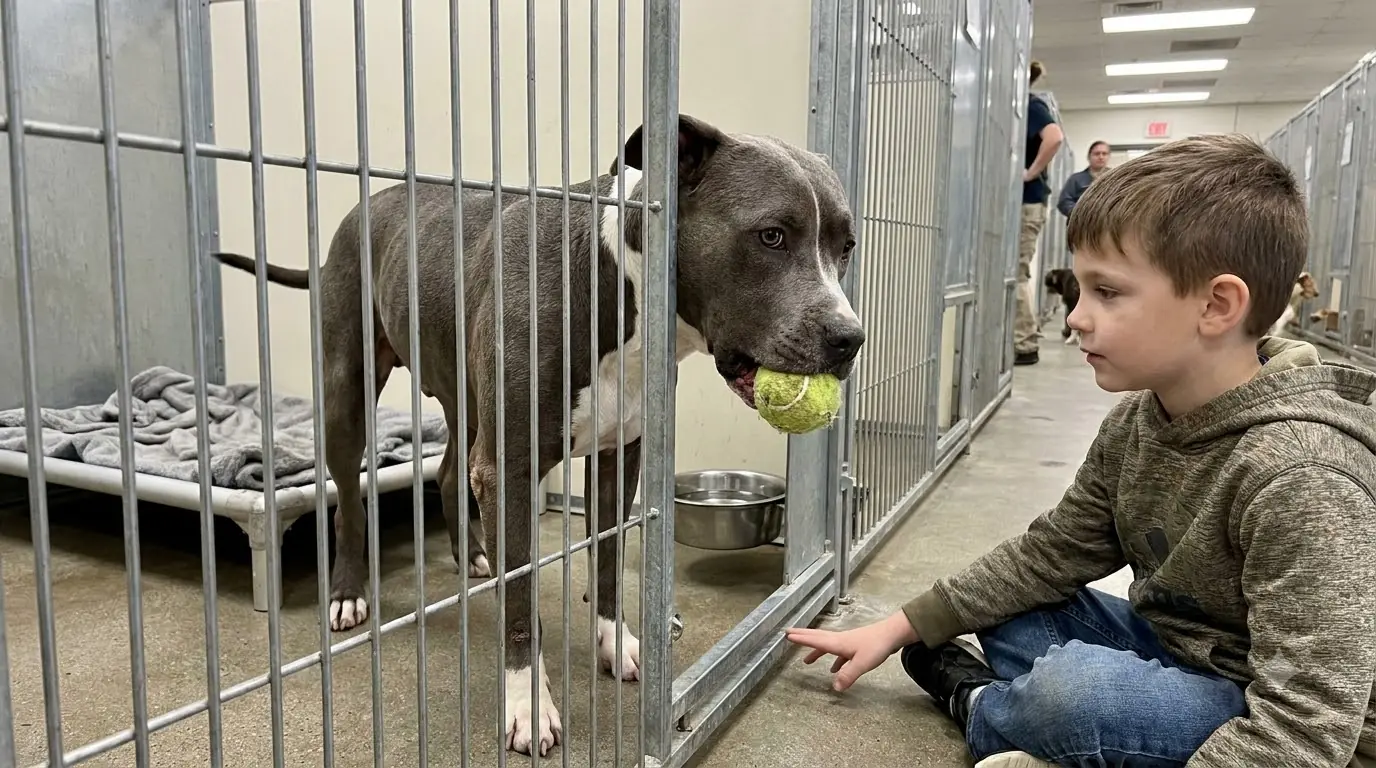
The tennis ball barely fit through the gap beneath the kennel gate.
The Pit Bull mix had already tried once.
He carried the old ball to the front of the kennel, lowered his head, and nudged it forward with his nose until it touched the metal.
On the other side, a little boy was sitting cross-legged on the shelter hallway floor.
The boy had stopped at this kennel several minutes earlier.
He had not called the dog.
He had not tapped on the bars.
He had simply sat down.
The Pit Bull watched him for a while.
Then he went to the back of the kennel, picked up the only tennis ball inside, and brought it forward.
The ball was worn enough that part of the felt had been rubbed nearly smooth.
He placed it against the narrow opening beneath the gate.
Then pushed.
The ball rolled into the hallway.
The little boy looked down.
He touched it with one hand and gently rolled it back underneath.
The Pit Bull immediately stepped backward.
For a second, staff thought he might wait for the boy to throw it farther.
He did not.
He turned around.
Trotted the few feet after the ball.
Picked it up.
And came straight back.
The same thing happened again.
Ball through the gap.
Boy rolls it back.
Dog retrieves it.
Dog returns.
Again.
Again.
Again.
The kennel row was crowded and loud.
Other dogs barked.
People moved past.
Metal latches opened and closed.
The Pit Bull barely looked away.
For weeks, visitors had passed his kennel without choosing him.
Now one child had stopped.
And the dog seemed determined to keep giving him a reason to stay.
He Had Been Left at the Shelter Weeks Earlier
The Pit Bull mix had not been found injured on a roadside.
There was no dramatic emergency intake.
He had been left at the shelter and had remained there while staff tried to find an appropriate adopter or rescue placement.
Days became weeks.
The facility stayed overcrowded.
New animals continued arriving.
His available time became increasingly limited.
That was the part of shelter life people outside the system do not always see.
A dog can be healthy enough to live in a home.
Social enough to engage.
Young enough to have years ahead.
And still become urgent because kennel space, staffing, placement options, and incoming animals do not expand indefinitely.
The Pit Bull mix had reached that uncomfortable point.
He was still there.
And there were fewer and fewer places for the shelter to move him.
The Ball Had Been in His Kennel Almost From the Beginning
Staff had given him several enrichment items over time.
Some lasted.
Some did not.
He showed moderate interest in durable toys and food puzzles.
But the tennis ball was different.
Whenever it appeared, he became more animated.
He carried it from the bed to the front.
Sometimes he rolled it beneath his own paws.
Occasionally he dropped it and chased it across the short kennel floor.
Because tennis balls can become unsafe when heavily damaged, staff inspected it regularly.
It was worn.
But still intact enough for supervised use.
More than anything, it gave the dog something to do inside a space where almost every day looked similar.
He Had Played With Staff Before
That was how they knew the boy was not witnessing a completely new behavior.
In the exercise area, the Pit Bull liked short games.
A staff member could roll the ball.
He would follow.
Pick it up.
Carry it back in the general direction of the person.
His retrieving was not polished.
Sometimes he stopped several feet away.
Sometimes he wanted to keep the ball.
Sometimes he dropped it too early.
He was not a trained retriever.
He was simply a dog who had learned that a ball could create interaction.
Inside the kennel, though, there was usually a barrier between him and whoever was passing.
That changed the game.
He Had Figured Out the Gap Beneath the Gate
Staff had seen him push toys toward it before.
Most were too large.
The tennis ball was just small enough.
If he angled his muzzle correctly and pushed with enough force, it slipped through.
Sometimes it became stuck briefly against the lower edge.
He would paw at it.
Nudge again.
Then it rolled out.
A person outside could return it.
The game continued.
The shelter did not claim that he had consciously invented a strategy for getting adopted.
That would be too much.
But he clearly understood the basic pattern.
Push ball out.
Human moves it.
Retrieve.
Return.
For a dog inside a kennel, that interaction gave him something ordinary.
A game with a person.
Most Visitors Did Not Stay Long Enough to Play
Some noticed the ball.
A few rolled it back once.
Then they continued down the row.
There were many dogs to see.
Sometimes visitors had appointments with a specific animal.
Sometimes they were only touring.
The Pit Bull would watch them leave.
Then pick up the ball himself.
Eventually, he carried it back to his bed.
That pattern had repeated often enough that staff knew what usually happened after one or two exchanges.
The person left.
The dog stayed.
The little boy did something different.
He kept rolling it back.
The Boy Did Not Throw It Hard
That helped.
Inside a kennel, a hard throw would have been unnecessary and potentially frustrating.
The space was small.
Instead, the child pushed the ball only a few feet.
The Pit Bull backed up.
Waited for it.
Then moved forward.
His body stayed loose.
He picked the ball up without frantic scrambling.
Returned.
The pace became almost rhythmic.
The boy smiled each time the ball appeared.
The Pit Bull kept bringing it back.
Staff Watched the Dog’s Whole Body
A tennis-ball game can create arousal.
That matters with any dog, especially a strong adult dog living in a stressful shelter environment.
Staff watched for stiffness.
Hard staring.
Frustration.
Possessive behavior.
Overexcitement.
None of those became prominent during the interaction.
The Pit Bull appeared engaged but manageable.
When the boy paused, the dog paused.
When the ball remained in the hallway for several seconds, he waited behind the gate.
He did not slam his body into the bars.
He did not begin barking at the child.
That made it possible to let the interaction continue.
Nobody Let the Boy Reach Into the Kennel
That boundary remained important.
The dog seemed friendly.
That did not make reaching fingers through metal bars a good idea.
Barrier environments can change behavior.
A dog may accidentally catch a hand while going for a toy.
Even a gentle dog can become overexcited during play.
So the game stayed simple.
The ball crossed the gate.
Hands did not.
The child rolled from his side.
The Pit Bull retrieved from his.
Both remained safe.
His Shelter Evaluation Had Never Suggested He Was a “Bad Dog”
That phrase should not decide outcomes anyway.
Dogs are more complicated than good or bad.
The Pit Bull had strengths.
He engaged with people.
He enjoyed toys.
He could settle after activity.
He was food-motivated enough for reward-based training.
He also had needs.
He was a strong adult dog.
He could become energetic around play.
He needed appropriate leash handling.
His compatibility with other dogs could not be generalized from one or two encounters.
Any home with children would require adults willing to supervise interactions and teach respectful boundaries.
That was normal responsible placement information.
It was not a hidden reason he had remained in the shelter.
The Real Problem Was Time
The building was too full.
His length of stay had become too long.
The pool of adopters willing and able to take a Pit Bull-type dog was smaller than the number of dogs needing homes.
Housing restrictions complicated placement.
Insurance rules could complicate placement.
Other household animals could complicate placement.
Even people who liked him sometimes could not take him.
That accumulation of ordinary barriers had brought him close to the end of the shelter's available options.
The dog did not know any of it.
He knew the tennis ball had come back.
So he brought it forward again.
The Boy’s Family Had Not Arrived Planning to Adopt Him
That was important.
They were visiting the shelter.
The child had become interested in the Pit Bull because of the dog’s behavior at the kennel.
The family had not walked in saying, “We are here for him.”
Staff did not turn the encounter into a guaranteed adoption story.
A child connecting with a shelter dog is emotionally meaningful.
Adults still have to decide whether the actual household can provide appropriate care.
Housing.
Schedule.
Finances.
Veterinary costs.
Other animals.
Experience.
Long-term commitment.
All of those matter.
The Pit Bull Did Not Know the Difference Between a Visitor and an Adopter
Every person who stopped was simply a person.
That was why staff avoided describing the game as the dog “begging the boy to take him home.”
There was no way to know that.
His behavior was easier to defend honestly.
He wanted to interact.
The ball created an interaction.
The boy kept participating.
So the dog kept returning.
After Several Minutes, the Dog Lay Down
The boy stopped rolling the ball for a moment.
The Pit Bull remained at the gate.
Ball in mouth.
Then he lowered his front legs.
His chest touched the floor.
He released the ball between his paws.
The boy stayed seated.
That was useful.
The dog had been able to transition from play into rest without becoming frantic when the activity stopped.
Staff noticed these things.
They mattered more for placement than an emotional interpretation of the ball.
Then the Boy Rolled It Again
The Pit Bull's ears lifted.
He stood.
Picked it up.
Returned.
The game restarted immediately.
That was the moment one staff member realized how long the child had already been there.
Most people had spent less than two minutes at the kennel.
The boy was approaching fifteen.
One Person Staying Changed the Dog
Not permanently.
Not magically.
But within the interaction.
The Pit Bull stopped tracking every other person who passed.
Earlier, he had looked toward footsteps.
Now the noises down the row produced only brief ear movements.
His attention kept returning to the child.
There was no need to scan for the next visitor.
One had stayed.
The Shelter Brought Him Into a Meet-and-Greet Room
Eventually, staff wanted to see how the interaction looked without bars.
This was handled carefully.
The boy stayed with his adult.
The dog was brought out by a trained handler first.
No immediate release into the room.
No child running toward him.
The Pit Bull entered on leash.
Sniffed.
Checked the walls.
Investigated the chairs.
The tennis ball was already on the floor.
He noticed it quickly.
He Picked Up the Ball Before Approaching the Boy
That was consistent with what staff had seen at the kennel.
He carried it.
Walked toward the child.
Stopped several feet away.
The handler watched body language.
Loose posture.
No hard fixation.
The boy was instructed to remain seated.
The Pit Bull moved closer.
Then dropped the ball.
Not directly in the child's lap.
On the floor nearby.
The Boy Rolled It
The dog followed.
Picked it up.
Returned.
This time, there was no narrow kennel gap forcing the exchange.
The Pit Bull could have gone anywhere in the room.
He still chose to bring the ball back toward the same person.
That strengthened one conclusion staff could make responsibly.
The dog was socially engaging through play.
But the Ball Was Not the Whole Meeting
After several repetitions, staff ended the game before arousal became too high.
The ball was placed aside.
The Pit Bull looked at it.
Then at the people.
He paced once.
Sniffed the child's shoe.
Moved toward the handler.
Accepted a treat.
Then lay down.
That was equally important.
A home cannot play fetch every minute.
The dog needed to be able to transition into ordinary presence.
He did.
The Boy Stayed on the Floor
The Pit Bull eventually rested several feet away.
The child's hands remained in his lap.
After a while, the dog moved closer on his own.
Sniffed.
Then sat.
No hugging.
No child climbing over him.
No staged photo.
The dog chose proximity.
The adults preserved space.
That was exactly how shelter staff wanted a child-dog introduction handled.
The Family Asked More Questions
Not “Can we take him right now?”
Better questions.
How long had he been there?
What did staff know about his home history?
How did he walk on leash?
What was his medical status?
Had he met other dogs?
How did he respond when toys were removed?
What kind of exercise would he need?
What did shelter staff recommend for a transition into a home?
Those questions suggested the adults were looking beyond the emotional moment.
Staff Answered Honestly
He had been in the shelter for weeks.
His available time was becoming critically short because of overcrowding.
He was not known to have a major medical condition requiring specialized care, but routine veterinary follow-up would still be part of adoption.
His toy behavior had been manageable in observed settings.
He would need decompression.
Structure.
Reward-based training.
Appropriate physical activity.
Adult supervision around children.
Any other household animals would need thoughtful evaluation.
Nothing was hidden.
The Ball Sat Between the Boy and the Dog
For several minutes, neither touched it.
That image was almost more useful than the earlier game.
The Pit Bull could be in the same room with his favorite object and not obsessively push it into interaction.
The child could be near the dog without constantly trying to stimulate him.
Both could be still.
That was what ordinary life would require.
The Family Could Not Decide in Five Minutes
Staff did not pressure them to pretend otherwise.
Urgency existed.
So did the seriousness of adoption.
A dog could live another decade.
A child might grow up with him.
Housing could change.
Schedules could change.
Veterinary needs would come.
The right decision needed adult commitment.
The family stepped out to talk.
The Pit Bull returned to the kennel.
He Brought the Ball Back to the Gate
Almost immediately.
That was difficult for staff.
The boy was no longer sitting outside.
The dog carried the ball forward anyway.
He stood behind the bars.
Looked down the hallway.
Waited.
Then placed the ball on the floor.
For a while, no one rolled it back.
Another Visitor Passed
The Pit Bull picked it up.
Approached.
The person smiled.
Kept walking.
He watched them leave.
Then returned to the front.
Ball still in his mouth.
The pattern continued.
The Boy Came Back
The change in the dog's posture was immediate.
His body moved forward.
He pushed the ball toward the gap.
It caught on the edge.
He nudged harder.
The ball rolled out.
The boy sat down.
And the game resumed exactly where it had stopped.
Staff Could Not Say He Recognized the Boy in a Human Sense
But he clearly differentiated familiar recent people from the general hallway to some degree.
Dogs can remember scent, appearance, movement, and recent interactions.
His response was consistent with recognition and anticipation of the previous game.
That was enough.
No need to say he had “chosen his person.”
The family had not made a decision yet.
The dog was simply happy to resume an interaction that had worked.
The Shelter Was Still Contacting Rescues
They could not stop because one family was considering him.
Until an adoption was approved or a rescue commitment was confirmed, the Pit Bull remained at risk.
Staff continued sending information.
Calling fosters.
Sharing his profile.
The ball interaction gave them useful video.
But they were careful with the wording.
This was a social, play-motivated dog.
Not a dog guaranteed to behave identically in every home.
Shelter Stress Had Already Changed Some of His Habits
In the first week, he had been more restless.
Later, he learned the routine.
Meals.
Cleaning.
Outings.
Visitors.
Night quiet.
He spent more time lying near the gate as his stay lengthened.
The tennis ball remained one of the reliable things that animated him.
That was another reason staff wanted placement before the kennel became his entire behavioral world.
Long shelter stays can narrow a dog's routine.
A home offers more context.
His Sleep Had Moved Closer to the Gate
Earlier, he often slept on the bed in the rear.
Later, he began choosing the front.
Especially during visitor hours.
Staff added a thin mat there.
The behavior was similar to many dogs who learn that the front of the kennel is where opportunities appear.
A walk.
Food.
A person.
The Pit Bull had added one more possibility.
A ball coming back.
The Boy Eventually Had to Leave for Lunch
Before going, he rolled the ball one final time.
The Pit Bull retrieved it.
Returned.
Pushed it through.
The boy did not roll it back.
Instead, staff picked it up and handed it safely to a caregiver.
The child stood.
The dog watched.
The boy moved away.
The Pit Bull remained at the gate.
For a few seconds, he looked down the hallway.
Then lay down.
No barking.
No frantic scratching.
Just a dog waiting after the game ended.
He Slept With the Ball Beside His Paw
Staff returned it once the area was safe and supervised.
The Pit Bull placed one front paw over part of it.
His eyes closed.
That was how the family found him when they returned later.
Not standing.
Not performing.
Sleeping.
The boy crouched quietly.
The dog's eyes opened.
Then the ball moved.
The Adults Had Made a Decision
They wanted to move forward with adoption screening.
That was not the same as taking the dog immediately.
The shelter began the normal process, expedited only where responsibly possible because his available time was limited.
Housing confirmation.
Household discussion.
Care expectations.
Medical review.
Any necessary introduction planning.
Staff still had to protect the dog from a rushed emotional placement.
The Family’s Housing Allowed Him
That was a major barrier cleared.
Pit Bull-type dogs frequently encounter rental or insurance restrictions.
In this case, the adults were able to confirm the dog would be permitted.
That mattered more than the emotional story.
A dog cannot remain safely in a home where housing rules force another surrender.
There Were No Other Dogs in the Household
That simplified part of placement.
It did not eliminate the need for neighborhood management and future dog introductions.
But there was no resident animal whose safety had to be assessed before the adoption could proceed.
The household could focus on helping the Pit Bull decompress.
The Child Was Given Rules
These were not optional.
Do not take the ball from the dog's mouth.
Do not climb onto him.
Do not disturb him when sleeping.
Do not hug his neck.
Do not corner him.
Adults handle feeding.
Adults handle leash walks.
If the dog walks away, let him.
Play is supervised until everyone understands one another better.
The boy listened.
The shelter wanted the relationship to remain as gentle as it had started.
The Ball Game Needed Rules Too
Fetch can create excitement.
The dog enjoyed it.
That did not mean endless repetition was healthy.
Short sessions.
Breaks.
No grabbing contests.
Use safe intact balls large enough to avoid swallowing risk.
Retire damaged toys.
Teach exchanges with rewards rather than forcibly removing valued objects.
These simple practices would make the game sustainable.
The Old Tennis Ball Was Nearly Worn Out
That created a decision.
Its sentimental value to humans was suddenly enormous.
The dog's safety mattered more.
Staff inspected the seam.
The felt was deteriorating.
He could continue using it under supervision for the moment, but it would need replacement soon.
The family was told.
No one should keep a dangerous toy in circulation simply because it was part of a rescue story.
The Boy Chose a New Ball
Not as a grand gift.
Just another tennis ball approved by the adults and staff.
The old one remained nearby.
The Pit Bull sniffed the new one.
Then looked toward the old one.
For the first few minutes, he chose the familiar ball.
That was unsurprising.
Later, staff rolled the new one.
He chased it too.
Good.
The game could survive the object.
Adoption Approval Came Before the Shelter’s Time Ran Out
Only then did the tone around his kennel change.
There was an actual plan.
Not a comment.
Not an inquiry.
Not “maybe.”
An approved household prepared to take responsibility.
The shelter could stop treating every passing hour as a placement emergency.
The Pit Bull did not know that.
He still brought the ball to the gate when the boy appeared.
His Exit Was Deliberately Undramatic
No crowd.
No staff lining the hallway.
No child holding the leash alone.
An adult handled the dog.
The Pit Bull came out of the kennel.
His body was energetic.
He sniffed the hallway.
Then noticed the boy.
The child was holding the new tennis ball.
Staff asked him not to wave it excitedly.
He kept it low.
The dog approached.
The Boy Rolled the Ball Down the Hallway
Just a few feet.
The Pit Bull followed.
Picked it up.
Turned around.
And returned.
There were no kennel bars this time.
He placed the ball on the floor near the boy.
The child rolled it again.
One final short repetition.
Then the adults ended the game and headed toward the exit.
That mattered.
Leaving the shelter should not become an overstimulating fetch marathon.
The Dog Did Not Walk Out Carrying the Ball Like a Movie Prop
He dropped it.
Sniffed a doorway.
Looked toward a staff member.
Accepted a treat.
The adult adopter took responsibility for the leash.
The boy walked beside them.
The ball went into a bag.
Ordinary logistics.
That is what a real transition looks like.
The First Ride Home Was Quiet
The Pit Bull was secured appropriately.
No child holding the dog loose in the back seat.
No face out the window.
No chaotic celebration.
The boy sat nearby but gave him space.
The dog sniffed.
Turned.
Lay down.
For a while, the ball stayed in the bag.
The household would have plenty of time to play later.
That was the point.
Time.
The First Days Were About Decompression
The family was told not to invite everyone over immediately.
A shelter dog may seem social and still need quiet adjustment.
New smells.
New sleep location.
New feeding routine.
New noises.
New expectations.
The Pit Bull explored gradually.
He found the water.
The bed.
The yard.
The child was asked not to follow him everywhere.
The adults managed the transition.
The Tennis Ball Stayed Important
On the second day, the boy sat on the living-room floor.
The Pit Bull noticed.
He found the new ball.
Picked it up.
Walked over.
Dropped it nearby.
The boy rolled it.
The dog retrieved it.
Returned.
Same game.
Different environment.
There Was No Gap Under a Gate Anymore
That changed how the interaction looked.
The Pit Bull did not have to push the ball through metal.
He could walk directly to the boy.
Sometimes he dropped the ball at his feet.
Sometimes several feet away.
Sometimes he carried it past him entirely.
That variation was normal.
The shelter ritual had become household play.
The Boy Learned Not to Make Every Return a Throw
Sometimes the dog brought the ball back.
The child left it.
The Pit Bull waited.
Then lay down.
This was good.
The interaction did not have to continue forever.
The dog learned that a person could remain even when the game stopped.
That may have been one of the biggest differences from the kennel.
At the Shelter, the Game Kept Someone at the Door
That is what made the behavior so emotionally striking.
Whether or not the Pit Bull understood it that way, the practical effect was clear.
As long as the ball kept moving, the boy stayed.
Ball out.
Ball in.
Dog back.
Boy still there.
For a long-stay shelter dog accustomed to people stopping briefly and leaving, the interaction lasted unusually long.
At Home, the Boy Stays After the Ball Stops
The Pit Bull can put it down.
Walk away.
Drink.
Sleep.
Wake up.
The same person is still part of the environment.
The dog no longer needs a repeated game to maintain proximity.
That is a major environmental change.
His Behavior Around Food Was Ordinary
The family monitored him carefully at first.
Meals were handled by adults.
The child did not disturb him.
The Pit Bull ate.
Finished.
Walked away.
No major food guarding behavior emerged in the early home observations.
That information was useful, though the family continued appropriate management.
A few successful meals do not justify careless handling.
His Sleep Deepened
In the kennel, hallway movement frequently woke him.
At home, predictable household sounds became easier to ignore.
He began sleeping on his side.
Legs extended.
Sometimes the tennis ball nowhere nearby.
That mattered.
A dog does not have to keep the object that connected him to people within reach every second when people themselves are reliably present.
The Old Ball Was Retired
Eventually, the seam became too compromised.
The family did not wait for pieces to break off.
They let him use it briefly under supervision one final time.
Then stored it away.
The Pit Bull accepted other balls.
The behavior continued.
That proved what staff had suspected.
The relationship with the boy was not dependent on one specific worn object.
He Started Bringing Other Things Too
A durable rubber ball.
A stuffed toy.
Once, a sock that was immediately exchanged for something appropriate.
The household laughed, then managed it correctly.
The basic social pattern had broadened.
Carry object.
Approach person.
Invite interaction.
That was simply part of who he was.
The Boy Was Not Made Responsible for the Dog
This was important.
Their connection was lovely.
The adults remained responsible.
Walks.
Feeding.
Training.
Veterinary care.
Safety decisions.
Exercise.
The child could play and participate within appropriate boundaries.
A rescue dog's future cannot rest on a child's emotional promise.
It rests on adult care.
Training Started With Simple Exchanges
The dog already liked returning with toys.
That gave the family something useful to build on.
Reward-based cues.
Drop.
Take.
Wait.
Short fetch sessions.
No dominance games.
No prying objects from the mouth.
The Pit Bull learned quickly when food or another toy made the exchange worthwhile.
The game became safer and clearer.
He Still Sometimes Waits With the Ball in His Mouth
The boy rolls it.
The dog retrieves.
Then stands nearby holding it.
He may not drop immediately.
The family no longer interprets that as stubbornness.
They wait.
Offer a cue.
Reward.
Or simply end the game.
A good relationship can include boundaries without conflict.
The Shelter Received the First Update a Week Later
A photograph showed the boy sitting on the living-room floor.
The Pit Bull was several feet away.
The ball rested halfway between them.
Neither was touching it.
That image mattered more than another fetch video.
They could simply share space.
Staff Remembered the Kennel Immediately
The narrow gap.
The worn tennis ball.
The child pushing it back.
The dog disappearing into the kennel for only a few seconds before returning with it again.
Every repetition had ended at the same place.
The boy.
The Dog Had Spent Weeks Watching People Move On
That is the context that made the game powerful.
He was not necessarily grieving every individual stranger.
But the rhythm of shelter visitation is brief.
A person appears.
Stops.
Evaluates.
Moves.
Another appears.
A dog can experience dozens of incomplete interactions.
Then one day, someone stayed long enough for a game to develop.
He Kept Returning Because the Game Continued
That is the most responsible interpretation.
The ball came back.
So he retrieved it.
The boy stayed.
So the social interaction stayed available.
No need to say the dog was desperately begging for adoption.
The observable behavior already carried enough emotional weight.
His Available Shelter Time Had Almost Run Out
That remained real.
Had the family not worked out, staff would have continued seeking rescue placement urgently.
The dog was living inside an overcrowded system.
The outcome was never guaranteed.
That is why the timing of the interaction mattered to the humans watching it.
He Never Knew He Was Close to Running Out of Time
There was no countdown in his mind that anyone could prove.
He knew a boy was sitting outside.
He knew the tennis ball could fit under the gate.
He knew that when he pushed it out, it often came back.
So he repeated a successful behavior.
The meaning came from the circumstances around him.
Adoption Did Not Erase Shelter Habits Overnight
For the first couple of weeks, he still reacted strongly when people approached the front of the house.
Door sounds.
Footsteps.
Visitors.
He often grabbed a toy.
Sometimes he hurried toward the entrance.
The family managed greetings calmly.
No crowding.
No door dashing.
Dog behind a secure barrier or on leash as needed.
Visitor enters.
Dog settles.
Then controlled introduction.
Predictability helped.
He Began Learning That Visitors Could Stay Too
Some people came in and sat down.
The Pit Bull brought a ball.
Played briefly.
Then lay nearby.
This was the broader lesson his home was offering.
People do not always vanish after thirty seconds.
A game does not have to be continually renewed to keep someone present.
The Child Became Better at Reading Him
Tail position.
Body tension.
When play was becoming too intense.
When the dog was tired.
When he wanted the ball versus when he wanted space.
Those are better relationship skills than simply knowing the dog “loves him.”
Compassion becomes safer when paired with observation.
The Pit Bull Developed More Ways to Seek Attention
He did not always need a toy.
Sometimes he approached and sat.
Sometimes he leaned briefly against a leg.
Sometimes he lay near the boy while the child played quietly.
The tennis ball remained a favorite.
It was no longer the only bridge.
That Was the Recovery Staff Had Hoped For
Not medical recovery.
He had not arrived with a major physical injury.
This was recovery from a narrow shelter routine.
His world expanded.
People became predictable.
Rooms replaced kennels.
Play became optional instead of one of the few ways to prolong an interaction.
His Future Still Requires Work
Adoption is not the final line of responsibility.
He needs training.
Exercise.
Routine veterinary care.
Supervision around children.
Appropriate toy safety.
Household structure.
Management when visitors enter.
A commitment that lasts beyond the emotional rescue moment.
The family knows that.
The Boy Still Sits on the Floor to Play
That has become their familiar position.
The Pit Bull appears with a ball.
The boy rolls it.
Dog retrieves.
Back again.
Some sessions last several minutes.
Some only twice.
Then the dog moves away.
The boy lets him.
That ability to let the game end matters.
One Evening, the Pit Bull Brought the Ball Back and the Boy Did Nothing
The dog placed it near his knee.
Backed up.
Waited.
The boy was reading something.
He looked at the dog but did not immediately pick up the ball.
The Pit Bull waited several seconds.
Then walked forward.
Picked it up himself.
Staff would have recognized the movement immediately.
Same as the kennel.
But instead of carrying it through a metal gap, he walked past the boy.
Climbed onto his bed.
Dropped the ball beside himself.
And lay down.
The Boy Stayed in the Room
That is the part that changes the entire scene.
No need for another retrieve.
No need to push the toy out again.
No need to keep restarting a game because the person might otherwise walk toward another kennel.
The interaction can end.
The relationship remains.
Staff Still Have the First Video
The Pit Bull behind metal bars.
Boy outside.
Worn ball rolling through the gap.
Little hand pushing it back.
Dog turning.
Retrieving.
Returning.
The clip repeats almost perfectly because the behavior repeated almost perfectly.
That is why it caught people's attention.
But the Best Update Would Look Boring
A dog asleep.
A boy nearby.
A tennis ball somewhere on the floor.
Nobody trying to get anyone to stay.
That is what a stable home often looks like.
He Still Brings the Ball Back
Of course he does.
That was never the problem.
Now he has space to run after it.
A person who knows his rules.
Safe replacement toys.
A home where the ball does not need to squeeze beneath a kennel gate.
Sometimes He Brings It to the Boy
Sometimes to an adult.
Sometimes he keeps it for himself.
That variety is healthy.
His social world is larger now.
The child who first caught his attention at the shelter has not become his only source of security or interaction.
He has a household.
The Shelter Ball Is Gone From Daily Play
Retired before it became dangerous.
Its surface is almost smooth.
The seam is damaged.
It sits out of reach.
A small physical reminder of the kennel without requiring the dog to keep using an unsafe toy.
The Pit Bull does not seem bothered by the replacement.
The game is what survived.
Recently, the Boy Rolled a New Ball Across the Living Room
The Pit Bull chased it.
Picked it up.
Returned.
Dropped it.
The boy rolled it again.
Same sequence.
Then, after the third return, he put the ball down beside his leg instead of sending it away.
The dog stood there.
Looked at the ball.
Looked at the boy.
Then lay down.
His shoulder rested against the child's shin.
The tennis ball stayed between his front paws.
No One Was Going Anywhere
That was the difference.
At the shelter, the Pit Bull kept carrying his only ball back to the boy who had chosen to stop at his kennel.
Push it through.
Wait.
Retrieve.
Come back before the boy disappeared.
Again.
Again.
Again.
Now he can return the ball once.
Or ten times.
Or not at all.
When the game ends, the child is still there.
And the dog who once had to send his only tennis ball beneath a kennel gate to keep one person in front of him no longer needs a game to make someone stay.