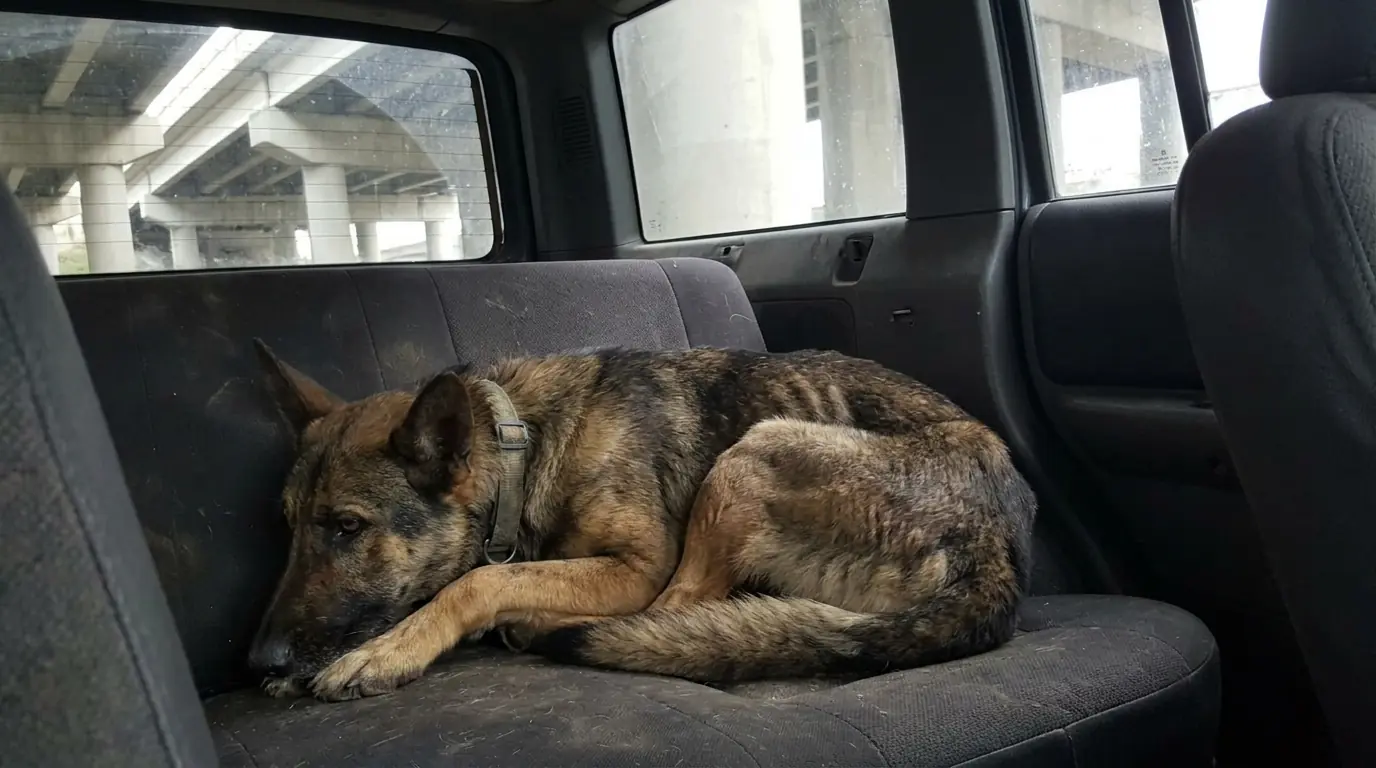
He Fell Asleep Before the Rescue Vehicle Even Moved
The German Shepherd mix had been inside the rescue vehicle for only a few minutes.
The engine was still idling beneath the highway overpass.
A rescuer was securing equipment.
Another was documenting the place where they had found him.
The dog had been given the entire back seat, covered with clean blankets.
He did not stretch out across it.
Instead, he moved toward the narrowest corner he could find.
He pressed his body against the seat and door, turned once with obvious stiffness, and folded himself into a tight curl.
Then he lowered his head onto his front paws.
His eyes closed.
The vehicle had not even pulled away.
Traffic continued thundering overhead.
The unfamiliar people were still nearby.
He was in a place he had never seen before.
And within minutes of being removed from the dirt hollow where witnesses said he had been sleeping beneath the same highway ramp, the thin Shepherd was asleep.
People Had Been Seeing Him Beneath the Overpass for Days
The first reports were inconsistent.
A driver had noticed a large dog near the concrete support columns early one morning.
Someone else saw what appeared to be the same dog late at night.
A nearby worker reported seeing him disappear behind one of the pillars whenever people approached.
Eventually, enough sightings pointed to the same location.
A rescue volunteer went to investigate.
The highway overpass was loud even when traffic was light.
Vehicles passed overhead continuously.
The ground beneath it was a mixture of packed dirt, gravel, discarded debris, and patches of weeds.
Near one concrete support, rescuers found a shallow depression in the dirt.
It was roughly the size of a curled large dog.
Loose soil had been pushed outward around the edges.
There was flattened fur caught against some of the debris nearby.
And several feet away, partly hidden behind the column, was the Shepherd.
He was thin.
His coat was dusty.
And around his neck was a collar that appeared far too tight.
The Dirt Hollow Was Barely a Bed
The depression beside the pillar was not deep.
It did not protect him from much.
But the concrete support blocked wind from one direction, and the overpass provided some protection from rain.
For a dog living outdoors, those small differences can determine where he returns to sleep.
Witnesses had repeatedly seen him in that same area.
Rescuers could not prove exactly how many nights he had spent there.
They could not know whether someone had once been caring for him nearby.
They could not know how far he traveled during the hours when nobody saw him.
But the worn hollow in the dirt suggested repeated use.
The Shepherd had apparently found one small place beneath the highway where his body fit.
And he kept returning to it.
His Collar Immediately Concerned the Rescue Team
The collar around his neck was not merely snug.
It was tight enough that staff could barely assess the skin beneath it while he was awake and frightened.
His coat had compressed beneath the material.
The skin around the edges looked irritated.
The rescue team did not know when the collar had been placed on him or whether he had grown or lost condition while wearing it.
They also could not use the collar as proof of any specific history.
It did tell them something important.
It needed to come off.
But first, they had to get close enough to safely handle him.
He Wanted Distance More Than Food
The Shepherd was hungry.
His body condition made that obvious, and he responded to the smell of food.
But hunger did not immediately overcome caution.
A rescuer tossed several pieces toward him.
He watched.
When the person moved away, he approached.
He ate quickly.
Then he retreated toward the concrete pillar.
Another treat was placed closer.
He came forward again.
His body remained low.
His ears shifted constantly toward sounds.
The traffic overhead made communication difficult, so rescuers kept their movements slow and predictable.
Nobody walked directly into the hollow where he had been sleeping.
Cornering a frightened large dog in the one place he considered safe could have escalated the situation quickly.
Instead, they gave him time.
The Capture Had to Be Controlled
The location made a loose-dog chase especially dangerous.
Roadways surrounded the area.
There were ramps, traffic lanes, and places where a frightened dog could disappear from view.
Rescuers used barriers and positioning to reduce his escape options without crowding him.
Food helped bring him within reach.
A slip lead was eventually secured.
The Shepherd froze when he felt it.
His body became rigid.
He did not lunge.
He did not attempt to bite.
But he clearly did not understand what was happening.
The handler loosened pressure immediately.
They waited.
After several seconds, the dog took one step.
Then another.
His gait was slow but functional.
He followed the food and the handler away from the pillar.
He Looked Even Thinner Once He Was Standing
When the Shepherd emerged fully into better light, his condition became clearer.
His ribs were visible.
His waist was sharply defined.
Muscle over his hips and thighs was reduced.
The coat along his sides made him look slightly fuller from a distance than he actually was.
His paws were worn but intact.
There was no obvious fresh fracture.
He could bear weight on all four limbs.
He appeared physically exhausted more than acutely injured.
The collar remained the most immediate visible concern.
Staff wanted it removed as soon as he was somewhere controlled.
He Looked Back at the Hollow Before Leaving
The walk from the pillar to the rescue vehicle was not long.
The Shepherd still stopped twice.
The first time, he turned his head toward the overpass.
The second time, he rotated most of his body.
His nose lifted.
He looked toward the concrete support and the patch of disturbed dirt beside it.
Staff could not know whether he was specifically looking for his sleeping place.
They could only note the direction of his attention.
The handler did not drag him forward.
After a few seconds, the Shepherd turned again.
The back door of the rescue vehicle was open.
A blanket covered the seat.
He sniffed the edge.
Then he climbed in.
He Chose the Smallest Corner
There was enough space for him to lie almost fully extended.
He did not use it.
He moved toward the corner behind the front passenger seat.
He turned slowly.
His back pressed against one surface.
His hindquarters touched another.
Only when his body was enclosed on multiple sides did he lower himself.
His front paws extended a few inches.
His chin dropped onto them.
Then his eyelids began closing.
A rescuer remained nearby, expecting him to stay alert.
Instead, his breathing slowed.
His ears stopped reacting to every small movement.
He fell asleep.
The vehicle was still parked beneath the highway.
Exhaustion Could Look Like Trust, but Staff Did Not Confuse the Two
It would have been easy to describe the moment as the Shepherd realizing he was finally safe.
That interpretation was emotionally appealing.
It was also impossible to prove.
Exhausted animals sleep.
Stress can produce physical fatigue.
A dog that has spent long periods resting lightly in an exposed environment may take advantage of an enclosed space when one becomes available.
His choice to sleep did not mean he suddenly trusted every person around him.
In fact, when he woke later and someone moved too quickly near the door, his body tightened again.
Staff treated the sleep for what it was.
A tired dog had found a small protected corner and was able to rest.
That alone mattered.
The Collar Came Off at Intake
At the shelter clinic, the Shepherd received a full examination.
Removing the collar was one of the first priorities.
Because he remained uncertain about handling around his head and neck, staff proceeded slowly.
Once the collar was removed, the compressed fur beneath it lifted.
The skin was irritated and rubbed in several areas.
Fortunately, the collar had not become deeply embedded.
There were no severe circumferential wounds requiring reconstructive surgery.
The skin needed cleaning and monitoring.
More importantly, nothing tight needed to go back around his neck.
For walks, staff used properly fitted equipment selected to avoid unnecessary pressure on the irritated area.
Being Thin Required More Than Feeding Him a Huge Bowl
The Shepherd was significantly underweight.
That did not mean staff immediately offered unlimited food.
His recent nutritional history was unknown.
His body condition was scored.
Hydration was assessed.
Bloodwork and urinalysis provided a baseline.
A fecal test was performed to look for intestinal parasites.
His mouth was checked for dental problems that might interfere with eating.
The results did not reveal an immediate life-threatening metabolic crisis.
He was dehydrated and nutritionally depleted, but stable.
That allowed the team to begin a controlled feeding plan.
Meals were measured.
His tolerance was monitored.
Calories were adjusted gradually.
He Ate Like He Expected the Bowl to Disappear
His first meals went quickly.
The Shepherd lowered his head and swallowed with very little pause.
Staff used a slow-feeding setup to reduce gulping.
Nobody repeatedly removed the bowl to test whether he would guard it.
He was allowed to eat without unnecessary interference.
His stool was monitored closely as his diet stabilized.
For the first several days, food was one of the few things that reliably brought him toward people.
Even then, he preferred food placed down rather than offered directly from a hand.
Staff accepted that.
Affection was not a requirement for receiving care.
Sleeping Was Still His Most Striking Behavior
Inside the kennel, he repeated what rescuers had seen in the vehicle.
He ignored the center of the room.