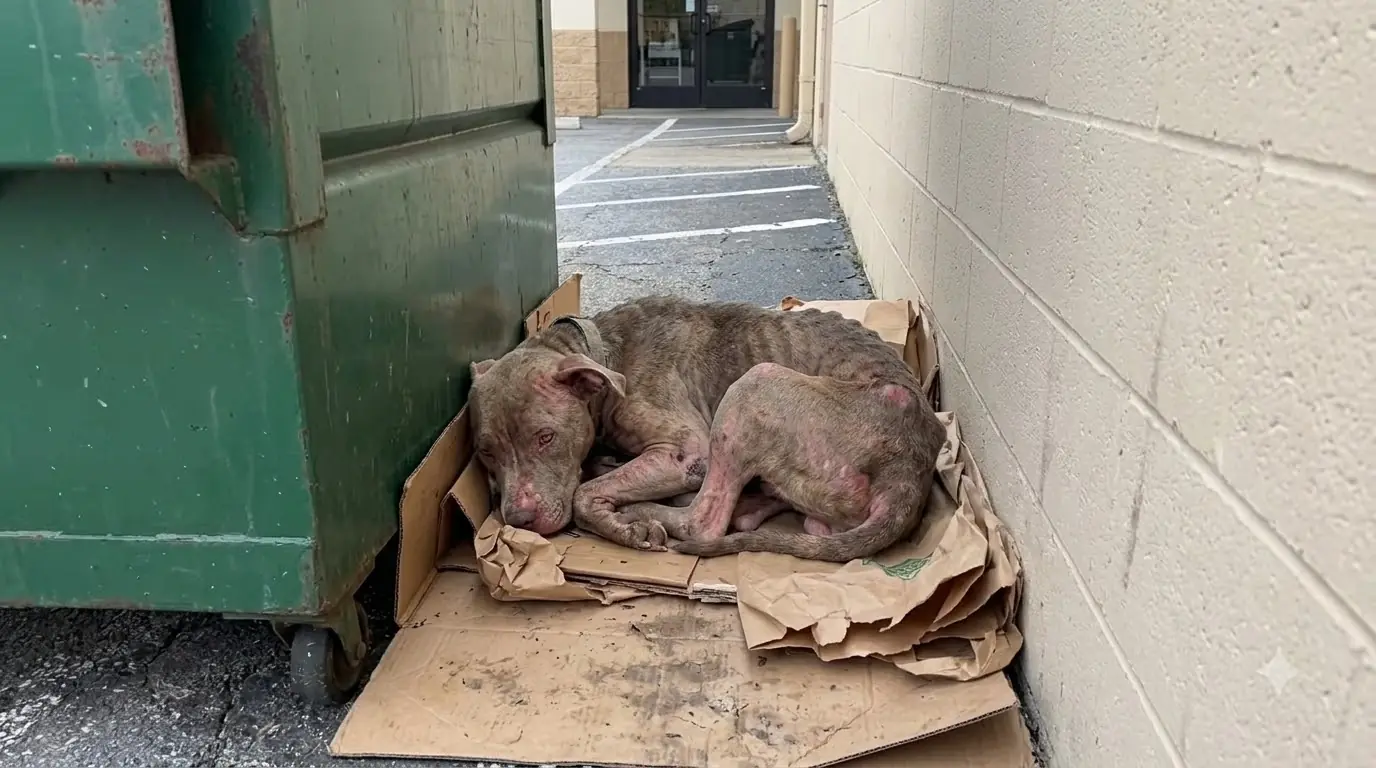
Rescuers First Noticed the Bed Before They Saw Her Clearly
Behind the closed storefront, between a dumpster and the back wall of the building, there was a strange little pile that seemed to change from day to day.
Flattened cardboard.
Brown paper bags.
Pieces of thin packaging.
A torn section of corrugated box.
At first glance, it looked like ordinary trash that had blown into the narrow space.
Then someone noticed the pieces were being gathered.
Not randomly.
Pulled together.
Layered.
Pressed into the same corner.
A maintenance worker who occasionally checked the property began seeing a thin brown-and-white Pit Bull mix there after dark.
She would disappear during busier hours, then return when the alley quieted.
More than once, he watched her carry a paper bag in her mouth.
Another night, she dragged part of a flattened carton several feet before disappearing behind the dumpster.
By morning, the material was tucked beneath her body.
That was when the pile stopped looking like litter.
She had made herself a bed.
She Slept Where the Wall and Dumpster Created the Smallest Space
The closed store backed onto a service lane used by neighboring businesses.
There was traffic during the day.
Delivery trucks.
Trash pickup.
Employees taking breaks.
People cutting through the alley.
The space behind the dumpster was narrow enough to shield most of the dog’s body from view.
One side was concrete wall.
The other was metal.
Above her, there was no real roof beyond the slight overhang of the building.
The cardboard did not make the area warm in any reliable way.
The paper bags were not waterproof.
But they lifted parts of her body off the bare pavement.
And she kept gathering more.
Witnesses could not say how long she had been there.
They could not confirm where she had come from.
They only knew that for several nights, when the alley became quiet, the same dog returned to the same improvised bed.
Her Condition Looked Worse Once She Stepped Into the Light
The Pit Bull mix was severely underweight.
Her ribs showed clearly.
Her waist narrowed sharply behind the ribcage.
The points of her hips were visible beneath the coat.
Her elbows were heavily callused, with thickened areas of skin where her body had repeatedly contacted hard surfaces.
Large patches of skin along her chest, sides, and legs were red and inflamed.
Some areas had lost enough hair that the irritated skin could be seen from several feet away.
And around her thin neck was an old collar.
It looked far too tight for the body she now had.
The material had compressed the fur beneath it.
The skin around the edges appeared irritated.
The collar alone could not tell rescuers how long she had worn it.
It did tell them that it needed to come off as soon as they could safely handle her.
She Would Not Leave the Trash Bed for a Person
Food got her attention.
People did not.
When rescuers first approached the alley, the Pit Bull mix moved deeper behind the dumpster.
Her body lowered.
Her mouth stayed closed.
She watched from the narrow gap.
No growling.
No lunging.
But no invitation to come closer either.
A rescuer placed food within smelling distance, then moved back.
The dog stretched her neck.
Stopped.
Waited.
Only after the humans retreated farther did she crawl forward.
She ate quickly.
Then returned to the cardboard.
The team did not reach for her.
Cornering a frightened dog between a wall and a dumpster could turn a manageable rescue into a dangerous one.
They gave her space.
The Bed Became Part of the Capture Plan
Rather than forcing her away from the only location she consistently returned to, rescuers used that predictability.
Food appeared near the same area.
Then slightly farther out.
Human movement remained slow.
The alley was kept as quiet as possible.
They worked during a lower-traffic period.
Each time the dog emerged, her route was nearly identical.
Out from the cardboard.
Sniff.
Eat.
Look toward the open alley.
Back toward the wall.
Over time, she tolerated a shorter distance between herself and the rescuer.
Eventually, safe handling equipment could be introduced.
The first time the lead touched her, she froze.
The rescuer stopped moving.
Several seconds passed.
Then the Pit Bull took one step.
That was enough to continue.
She Tried to Turn Back Toward the Dumpster
Once secured, she did not immediately walk toward the rescue vehicle.
She took a few steps into the open alley.
Stopped.
Looked behind her.
Then tried to pivot back toward the narrow gap.
The old paper bed was still there.
The cardboard had collapsed where her body had been lying.
Rescuers did not interpret that as proof she loved the place.
Familiarity can become powerful when an animal has very few predictable things.
The corner smelled like her.
She knew where it was.
The rescue vehicle did not.
So the handler waited.
No pulling.
No dragging.
Then the dog turned back toward the human and took another step.
Her Collar Was the First Thing the Medical Team Wanted Off
At intake, staff prioritized a low-stress physical assessment.
The Pit Bull mix was alert but exhausted.
Her body condition was concerning.
Her skin was inflamed.
Her elbows were thickened from chronic pressure.
And the collar around her neck was tight enough that staff did not want it remaining in place.
They approached carefully.
Because she was still tense about handling around her head and neck, appropriate sedation or calming support was used as needed rather than forcing the issue.
Once the collar was removed, compressed fur lifted away from the skin.
The area beneath was irritated.
Fortunately, there was no deeply embedded circumferential wound.
That was a relief medically.
It still did not make the collar harmless.
Her neck finally had room.
Being Thin Did Not Explain the Skin Disease
The skin required its own workup.
Poor nutrition can worsen coat quality and slow healing.
It does not automatically explain large inflamed patches.
The veterinary team examined the affected areas carefully.
Skin cytology was used where appropriate.
Parasite evaluation was considered.
The team looked for bacterial overgrowth, yeast, mites, flea-related irritation, and other contributors.
They also considered whether allergy or another chronic dermatologic problem might be involved.
The findings supported active inflammatory skin disease with secondary infection in some areas.
That meant treatment needed to be targeted.
Not just baths.
Not just better food.
Medication.
Skin care.
Parasite control as indicated.
And follow-up.
The Calluses Showed How Much Time Her Body Had Spent on Hard Ground
Her elbows were especially striking.
Thickened.
Hairless in places.
Rough enough that staff could feel how much pressure they had absorbed.
Calluses can develop in large dogs who repeatedly lie on hard surfaces.
They do not prove one exact sleeping history.
But in this dog, they matched what rescuers had just seen.
Concrete.
Cardboard.
Very little cushioning.
The team checked for cracking, infection, or deeper sores.
The callused tissue itself did not need dramatic treatment if intact.
What she needed most was a different surface.
Her Bloodwork Helped Define the Next Step
Because she was so underweight, baseline bloodwork and urinalysis were important.
The team looked for anemia, kidney disease, liver abnormalities, electrolyte problems, infection, and evidence of other systemic issues that might complicate nutritional recovery.
A fecal test was also appropriate.
Her mouth and teeth were examined.
No single catastrophic disease explained the full degree of wasting.
The overall picture supported prolonged undernutrition and poor physical condition, with skin disease adding another ongoing stressor.
That allowed the rescue to begin a controlled nutritional plan.
She Was Not Given Unlimited Food
The impulse to feed an underweight dog aggressively is understandable.
The veterinary team resisted it.
Her meals were measured.
Divided.
Adjusted gradually.
Her stool was monitored.
Her hydration was corrected carefully.
Staff watched for vomiting, diarrhea, abdominal discomfort, and other signs that her body was not tolerating the increase.
The goal was not to make her look different in three days.
The goal was safe recovery over weeks.
Her First Bed Confused Her
The medical kennel had clean bedding.
A supportive mattress.
Fresh fleece.
No damp cardboard.
No paper bags.
No dumpster.
At first, the Pit Bull mix stood beside the bed rather than getting on it.
She sniffed the edge.
Put one paw on.
Removed it.
Walked around.
Then lowered herself onto the floor beside it.
Staff did not force her onto the mattress.
A dog who has spent significant time on hard, unstable surfaces may not immediately understand thick soft bedding.
They left it available.
She Began Moving the Bedding
The first sign that she was interacting with the bed came later.
A caregiver entered and found the fleece bunched strangely.
The dog had pulled part of it away from the mattress.
Another day, a towel had been dragged into a corner.
Then the Pit Bull began gathering loose bedding near the wall.
The behavior looked familiar.
Not identical to the trash pile behind the store.
But close enough that staff noticed.
She seemed to prefer arranging the material herself before lying down.
Staff Did Not Stop Her
As long as she was not ingesting fabric or creating a safety problem, the behavior was allowed.
If she wanted to pull a fleece into a corner, she could.
If she wanted to wrinkle the bedding before lying on it, that was fine.
The rescue did not need the kennel to look neat.
They needed her to rest.
Her chosen corner was padded more heavily.
The bed was moved closer to the wall.
That way, she could use the boundary she preferred without lying on bare floor.
The First Time She Slept Fully on the Mattress Took Several Days
She approached it after eating.
Sniffed.
Placed both front paws on the edge.
Paused.
Then stepped up.
She turned slowly.
For a moment, staff expected her to get down again.
Instead, she lowered her chest.
Then her hips.
She curled.
Not in the center.
At the very edge.
One shoulder touched the wall.
Within minutes, she was asleep.
The bedding beneath her stayed dry.
Soft.
Clean.
That ordinary detail represented a complete change from the service alley.
Her Skin Was Itchier Before It Looked Better
Treatment did not make the inflammation disappear immediately.
Some areas remained red.
She scratched.
She licked.
Staff had to prevent self-trauma without making handling more stressful than necessary.
Depending on the location of lesions, topical treatment and systemic medication were used according to veterinary findings.
The skin was monitored for moisture, odor, discharge, new pustules, spreading redness, or other changes.
Progress came gradually.
Less redness.
Less scratching.
Then small areas of hair beginning to return.
Her Neck Took Time to Look Normal Again
Once the old collar was gone, the compressed area around her neck remained visible.
The fur did not instantly spring back.
The skin needed time.
Staff used properly fitted walking equipment that avoided unnecessary pressure on irritated tissue.
As her weight changed, fit was reassessed.
That mattered.
An animal gaining body condition can outgrow equipment surprisingly quickly.
Nothing around her neck would be allowed to become tight again simply because it had fit a week earlier.
She Was Afraid of Open Resting Spaces
Even as she began using the bed, she preferred boundaries.
Wall behind her.
Bed edge on one side.
Sometimes a covered portion of the kennel.
She rarely sprawled in the middle.
That preference made behavioral sense without requiring a dramatic story.
Behind the store, she had slept in the narrowest available gap.
Predictable edges may simply have felt easier.
So staff gave her those edges.
Her Calluses Began Softening
Weeks of good bedding changed the elbows.
Not instantly.
Thick calluses take time.
But the surrounding skin became less dry.
There were no new cracks.
She stopped shifting as often during sleep.
Staff continued checking pressure points because her low body condition left little natural padding.
Her body was healing from more than one thing at once.
Her Weight Gain Was Slow Enough to Be Honest
At first, people seeing her might have expected a dramatic transformation after a week of meals.
That did not happen.
Her ribs remained visible.
Her hips remained prominent.
The scale moved a little.
Then a little more.
Her hydration normalized before her body condition did.
Muscle rebuilding lagged behind weight gain.
That was normal.
The veterinary team adjusted portions based on trends, not emotion.
She Started Standing Longer
As nutrition improved and the skin became less painful, her endurance changed.
She could remain upright for longer grooming and handling sessions.
Her walks extended modestly.
She began sniffing instead of simply eliminating and returning to the kennel.
That was one of the earliest signs that energy was returning.
Curiosity requires reserve.
She was beginning to have some.
Staff Learned Her Favorite Kind of Bedding
She liked fleece.
But not perfectly flat fleece.
If a blanket was smoothed across the mattress, she often rearranged it.
Nose under edge.
Pull.
Paw.
Turn.
Then lie down.
It looked like a reduced version of the behavior witnesses had described behind the store.
Gather material.
Create a small surface.
Curl.
The difference was that she no longer needed trash to do it.
She Still Slept Tight Against the Wall
Even after becoming more comfortable, her preferred resting position stayed compact.
Head tucked.
Legs folded.
Back against a boundary.
She rarely exposed her abdomen during early sleep.
That changed slowly.
First one rear leg stretched out.
Later, her body loosened.
One afternoon, staff found her asleep on her side with both back legs extended across the mattress.
Nothing in the room had changed.
Her use of the room had.
Her Skin Treatment Required Patience
Dermatologic recovery can be frustrating because improvement may not be linear.
One patch clears faster.
Another remains inflamed.
Hair grows slowly.
A dog may look better before the underlying tendency is fully controlled.
The team scheduled rechecks.
Treatment was adjusted based on response.
If allergy or another chronic trigger remained likely, long-term management would need to account for it.
The rescue did not call her cured just because the redness faded.
She Began Approaching Familiar Caregivers
At intake, she tolerated people more than she sought them.
That changed in small increments.
She stopped retreating when a familiar caregiver entered.
Then she sniffed a hand.
Later, she stood close enough for gentle chest touch.
No reaching over her head.
No hugging.
No expectation that rescue should immediately turn into affection.
Trust grew through routine.
Food.
Cleaning.
Walks.
Medication.
Leaving again.
Predictability made humans less complicated.
Foster Care Became the Next Step
Once her medical needs were manageable outside the clinic environment, a quiet foster home was selected.
The home had nonslip floors.
A securely fenced yard.
No constant stream of visitors.
Several beds.
And, deliberately, plenty of washable blankets she could rearrange.
The foster caregiver was told something simple.
Do not make the bed for her over and over.
She may want to do that herself.
She Ignored the Nicest Bed First
The foster home had prepared a large orthopedic mattress in the living room.
The Pit Bull sniffed it.
Then walked past.
She found a thinner fleece near the wall.
Pulled it with her mouth.
Dragged it several feet.
Then curled on top.
The foster caregiver left her alone.
By the second night, she had moved the fleece onto the edge of the orthopedic mattress.
By the fourth, most of her body was on the bed.
The dog was combining the new with the familiar.
Household Trash Was Managed Carefully
Because of her history of pulling paper and cardboard into a sleeping area, the foster caregiver kept actual garbage inaccessible.
The behavior itself did not mean she was safe to rummage through bags.
Food packaging, sharp materials, string, and plastic could be dangerous.
Instead, she was given safe bedding she was allowed to manipulate.
That distinction mattered.
The rescue could respect the behavior without reproducing the unsafe environment.
Her First Paper Bag Was Surprisingly Emotional for the Foster Caregiver
One day, an empty clean grocery bag was accidentally left near the kitchen.
The Pit Bull approached it.
Sniffed.
Took the edge in her mouth.
The foster caregiver intervened gently and exchanged it for a fleece strip.
She carried the fleece to her bed.
Dropped it.
Curled.
The scene echoed the old alley without requiring her to go back to it.
That was enough.
Her Body Condition Finally Began Looking Different
After several weeks, the change became visible in photographs.
Ribs less sharp.
Hips less hollow.
More tissue over the shoulders.
Improved muscle through the thighs.
Her body still had an athletic Pit Bull outline.
The goal was not to make her heavy.
It was to restore a healthy body condition.
The old collar would not have fit her anymore.
That was exactly the point.
The Elbows Remained Callused
Some physical reminders did not disappear.
The thickened skin over her elbows improved but remained visible.
Calluses can persist.
They did not need to vanish for her quality of life to improve.
The important difference was that new damage had stopped.
She had soft surfaces now.
She did not have to sleep with bone pressed against pavement every night.
She Began Choosing the Center of the Bed Sometimes
That was one of the subtler behavioral changes.
Early on, everything happened at an edge.
Wall.
Corner.
Bed perimeter.
Later, the foster caregiver found her lying diagonally across the mattress.
No body part touching a wall.
The fleece she had rearranged sat underneath her.
She stayed there for nearly an hour.
The next nap was back in the corner.
That was fine.
Progress meant options.
She Still Builds Her Bed
The habit has not disappeared.
At night, she may pull one blanket across another.
Push fabric with her nose.
Turn.
Adjust again.
Only when it looks right to her does she lie down.
Nobody knows whether the behavior began behind that particular store or existed before.
The rescue does not need to know.
It is part of how she settles now.
The Store Remained Closed
There was no dramatic return to the property.
No reunion.
No hidden owner suddenly appearing in the alley.
The rescue handled the legal and lost-pet steps appropriate to the case.
The verified past remained simple.
She had been living behind a closed store.
She had gathered trash between a dumpster and a wall.
She had slept on it repeatedly.
The old collar was still tight around her neck when rescuers found her.
That was enough history.
Her Adoption Profile Needed to Tell the Truth Without Freezing Her in That Alley
Potential adopters needed to know about the skin disease.
Ongoing veterinary monitoring might be necessary.
Her body condition had improved, but healthy weight management remained important.
Her elbows would benefit from soft bedding.
A secure home was essential.
She remained somewhat cautious with new people.
And she loved arranging blankets.
The rescue did not want the opening image to become her permanent identity.
She was no longer only the dog behind the dumpster.
She Learned That Bedding Could Stay Dry
The first rainy night in foster care produced an unexpectedly ordinary moment.
Rain tapped against the windows.
The Pit Bull looked toward the sound.
Then went to her bed.
She pulled the fleece twice.
Turned.
Lay down.
The blanket remained dry.
The floor beneath it remained dry.
She did not need to search for cardboard.
She did not need to wedge herself behind metal for cover.
She simply slept.
Staff Still Remember the Shape of the Trash Pile
It had looked insignificant at first.
A few paper bags.
Wet cardboard.
Packaging pushed together behind a dumpster.
Then they saw the dog inside it.
A thin Pit Bull curled so tightly that the raised bones of her hips showed beneath the coat.
Red inflamed skin visible where fur had disappeared.
Callused elbows pressed into the flattened carton.
An old collar tight around a neck that had become too thin for it.
And beneath all of her, a bed she had built from whatever the alley gave her.
She Still Rearranges Everything Before Sleeping
That part has stayed.
Give her a perfectly made orthopedic bed with a fleece folded neatly across it and she may immediately undo the arrangement.
She takes an edge in her mouth.
Pulls.
Bunches it.
Turns.
Moves it again.
Then curls.
Sometimes the foster caregiver walks in later and finds the blanket twisted into a pile that makes no sense to anyone but the dog.
Nobody straightens it while she is sleeping.
She made it the way she wanted.
The Difference Is What She Has to Build With Now
She no longer waits behind a store that stays dark.
She no longer sleeps between a dumpster and a concrete wall.
Her elbows are not pressed into pavement.
The inflamed skin is healing.
Her body is stronger.
There is no collar tightening around her neck.
And when night comes, she still performs the same little routine.
Find something soft.
Pull it closer.
Arrange it.
Turn around.
Curl down.
Only now, what she gathers beneath her is clean fleece instead of trash.
The instinct to make herself a bed remains.
The materials finally match the kind of bed she should have had all along.