
Why the P-47 Thunderbolt Could Take Punishment Other Fighters Could Not
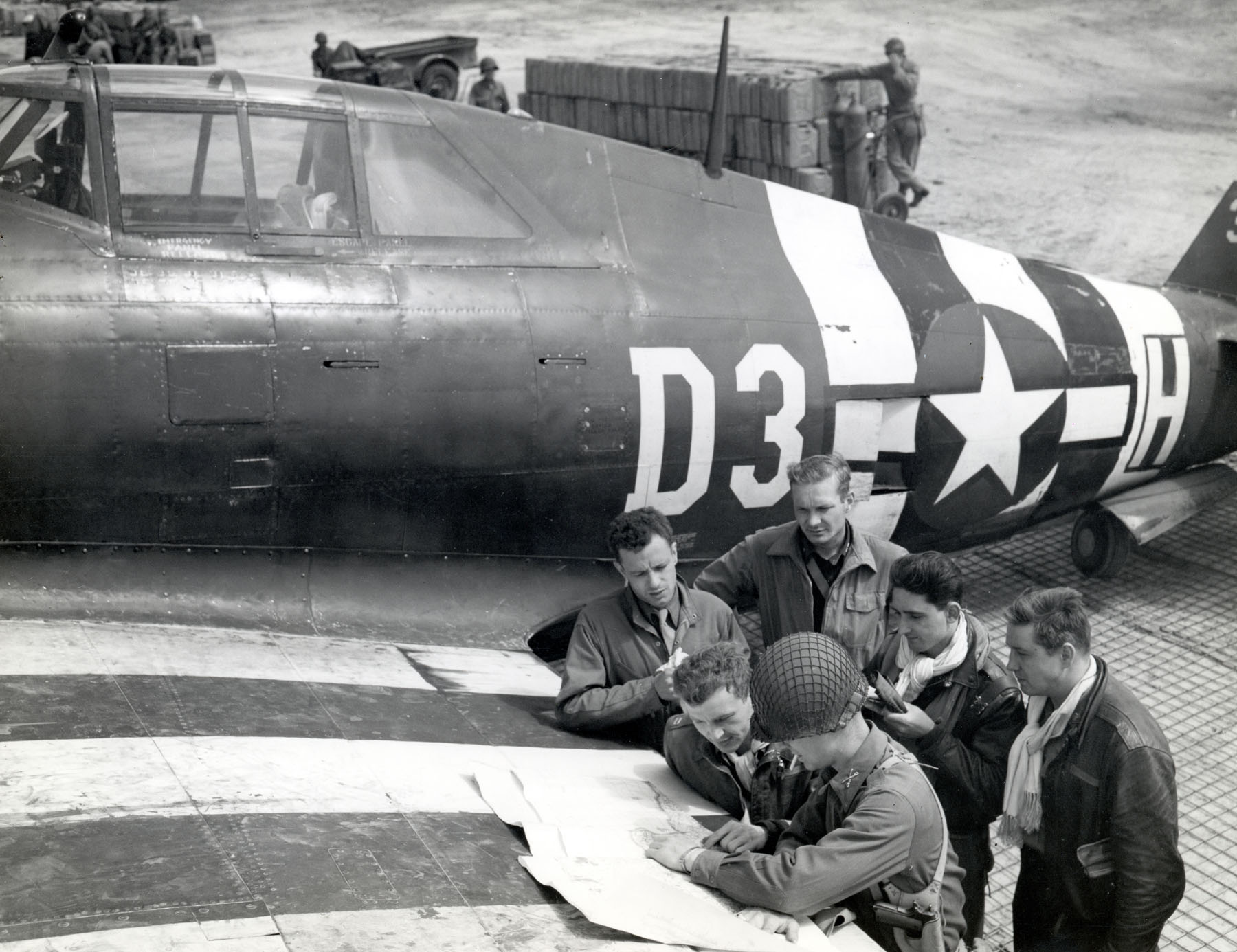
On June 6, 1944, Republic P-47 Thunderbolts crossed the English Channel as part of the enormous Allied air effort over Normandy. Many flew fighter-bomber missions carrying 500-pound bombs and eight .50-caliber machine guns. Rockets soon became another important part of the Thunderbolt's ground-attack arsenal, although documented D-Day missions commonly show bombs and machine-gun strafing rather than a universal bomb-and-rocket load. The distinction matters because the P-47 earned its reputation less from one spectacular weapon combination than from what happened after pilots descended toward roads, railways, gun positions, trucks, and armored vehicles where German flak could shoot back. (Ang AF)
The Thunderbolt was enormous for a single-engine fighter. A representative P-47D could weigh about 13,500 pounds loaded, while later configurations could reach roughly 17,500 pounds maximum weight. Its Pratt & Whitney R-2800 radial engine delivered about 2,000 horsepower in many wartime versions, with later P-47Ds using still more powerful variants, and the aircraft could exceed 400 mph. Eight Browning .50-caliber guns filled the wings. Bombs and, later, rockets turned it into a formidable fighter-bomber. Smithsonian records list 15,683 P-47s built during the war, not 15,608. (Bảo Tàng Quốc Gia)
Those numbers explain why the Thunderbolt could hit hard. They do not fully explain why pilots trusted such a large fighter close to the ground. The deeper answer was inside its blunt nose.
The prototype XP-47B had first flown on May 6, 1941, and production Thunderbolts did not enter combat over Western Europe until April 1943. In barely a year, the aircraft moved from a new escort fighter to a machine increasingly assigned to dive-bombing and low-level attack. Normandy did not create the P-47's toughness; it created the battlefield on which that toughness became one of its most valuable weapons. (Bảo Tàng Quốc Gia)
The engine that created the Jug
The P-47's heart was the Pratt & Whitney R-2800 Double Wasp, an 18-cylinder, two-row radial engine. Instead of using long cylinder banks inside a narrow cowling, the radial arranged cylinders around the crankshaft, giving the Thunderbolt its broad nose. Republic designer Alexander Kartveli then added an elaborate turbo-supercharger system, placing the turbo far back in the fuselage and connecting it to the engine through long ducts. The machinery helped make the aircraft large, but it also gave the Thunderbolt tremendous high-altitude performance. (Bảo tàng Hàng không Smithsonian)
When P-47s entered combat over Europe in 1943, pilots quickly learned that the heavy fighter could dive exceptionally fast. It first served largely as a high-altitude fighter and bomber escort. As the longer-ranged P-51 Mustang became available in greater numbers, many P-47 units shifted increasingly toward tactical missions where weight, firepower, and rugged construction became strengths rather than disadvantages. (Bảo tàng Hàng không Smithsonian)
That shift placed pilots in a much more dangerous environment. A bomber escort might spend much of its mission at high altitude. A fighter-bomber deliberately descended toward a locomotive, convoy, bridge, gun battery, or troop concentration. Near the ground, machine guns, 20 mm cannon, heavier antiaircraft weapons, and even small-arms fire could threaten an aircraft whose attack path became predictable for a few seconds.
The P-47 was never invulnerable, and many were lost. What pilots discovered was that the Thunderbolt often gave them another chance after a hit that might have ended the flight of a more vulnerable fighter.
Why the missing radiator mattered
The most important technical difference was simple: the R-2800 was air-cooled.
A liquid-cooled fighter engine depends on coolant circulating through the engine and a radiator exposed to airflow. That arrangement can produce a slim, efficient installation, but it also creates vulnerable components. A bullet or shell fragment does not have to destroy the engine directly. If it punctures a coolant line or radiator and enough fluid escapes, overheating can follow quickly. The engine may keep running for a short period, but the pilot is now operating against a clock.
The National Museum of the U.S. Air Force makes this exact comparison between the P-47 and the P-51. The Mustang was an exceptional long-range fighter, but its liquid-cooled engine depended on a cooling system vulnerable to enemy fire. The P-47's radial engine did not need that same external liquid-coolant circuit. Air flowing over cooling fins on the cylinders carried heat away directly. (Bảo Tàng Quốc Gia)
This did not mean bullets could not kill an R-2800. Oil lines could be severed, cylinders destroyed, fuel lines ruptured, or the propeller and ignition systems damaged. A cannon shell in the wrong place could still destroy the aircraft. The advantage was tolerance. A hit that caused catastrophic coolant loss in a liquid-cooled fighter did not necessarily create the same failure chain in a Thunderbolt.
Wartime maintenance accounts describe P-47s returning with heavily damaged cylinders, large holes in wings and fuselages, and oil covering the aircraft. Smithsonian reporting records mechanics remembering Thunderbolts that came home with cylinders blown away while the remaining engine continued to run. These stories became part of the aircraft's reputation because tactical units saw battered fighters return repeatedly. (Smithsonian Magazine)
The engine was only one protective layer
Republic had also built a remarkably substantial airframe around the R-2800. Armor protected important areas around the cockpit. The large engine sat ahead of the pilot. The turbo-supercharger installation and ducting filled much of the lower fuselage. Air Force and Smithsonian histories note that this ducting sometimes acted almost like a crushable buffer during belly landings, absorbing energy beneath the cockpit. (Bảo tàng Hàng không Smithsonian)