California, March 14, 1968.
It was late afternoon in Huntington Beach.
Today, the area around Newland Street and Yorktown Avenue is filled with houses, streets and suburban development.
But in 1968, much of that part of Huntington Beach still looked very different.
There were open fields.
Drainage ditches.
Oil fields.
Long stretches of dirt where children could wander after school without anyone paying much attention.
That afternoon, three young boys were playing near one of those fields.
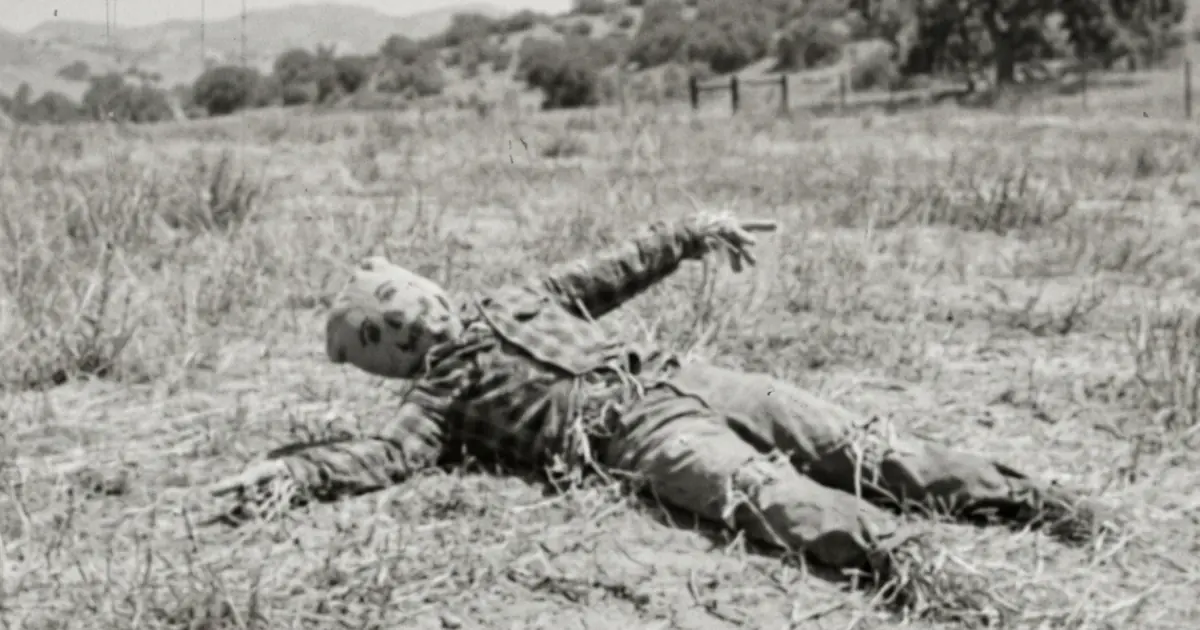
Then one of them noticed something lying motionless in the distance.
At first, it did not look human.
The shape was stretched out in the dirt.
Old clothing.
Arms and legs forming an unnatural silhouette.
From far away, the boys thought it might be a scarecrow that had fallen down.
There was no reason for them to immediately think otherwise.
So they moved closer.
A few steps.
Then a few more.
The closer they came, the less it looked like a scarecrow.
Finally, from only a short distance away, they understood what they were looking at.
A woman.
Motionless.
Face down.
The boys backed away.
Their afternoon game was over.
At approximately 4:05 p.m., Huntington Beach police were called to the field.
What those children had discovered would become the beginning of the oldest unidentified homicide case in Orange County.
And for the next 52 years, investigators would have two questions.
Who was the woman?
And who had left her there?
They would eventually answer both.
But almost everyone connected to the case in 1968 would have to wait a lifetime for it to happen.
The Woman in the Field
The victim was lying in a drainage area near the intersection of Newland and Yorktown.
Investigators determined that she was a young adult woman.
She appeared to be in her twenties.
She was roughly five feet four inches tall and weighed around 140 pounds.
She had dark, shoulder-length hair and brown eyes.
She was wearing a floral-print blouse.
Purple pants.
Flat loafers.
A dark three-quarter-length coat.
On one finger was a costume ring with a large light-blue stone set in a silver-colored band.
There was nothing in her clothing that immediately gave police her name.
No identification investigators could use to call a family.
No driver's license.
No simple answer.
And her injuries made one thing clear immediately.
This was not an accidental death.
She had been violently assaulted and sexually attacked before being killed.
Authorities believed she had been left in the field only hours before the boys found her.
For detectives, that created urgency.
Somewhere in Southern California, someone may have known her.
Someone may have seen her that morning.
Someone may have watched her enter a car.
Someone may have spoken to her in a restaurant, bar, apartment or parking lot.
And whoever killed her had probably been near that field not long before three children arrived.
Police began processing the scene.
They found tire impressions.
Footwear impressions.
And something small enough that it would have been very easy to overlook.
A smoked cigarette butt.
In 1968, that cigarette was just another physical clue.
No detective standing in that field could possibly have understood how important it would become.
DNA profiling did not exist.
Investigative genetic genealogy belonged to a future nobody had imagined.
The cigarette could be photographed.
Collected.
Stored.
Maybe examined for fingerprints or brand information.
But there was no scientific method capable of doing what investigators would eventually do with it.
So police preserved it.
And waited for technology to catch up.
That decision would matter more than half a century later.
Rain and a Vanishing Trail
Investigators faced another problem.
It had rained.
Any fragile evidence that might have existed in the field could already have been damaged.
Footprints blurred.
Surface material displaced.
Tracks softened.
A killer who had abandoned a body in an open field was usually taking a risk.
But weather had unintentionally helped erase parts of the trail.
Detectives nevertheless worked the scene carefully.
They searched the surrounding field.
They documented tire tracks.
They collected the victim's clothing.
They preserved biological evidence.
They kept the cigarette.
And they began the task that would prove even more difficult than identifying her killer.
They tried to identify her.
Because in 1968, the dead woman did not have a name.
She was simply Jane Doe.
The First Mystery Was Her Identity
Modern true-crime audiences often assume murder investigations begin with the victim.
Detectives learn who the person was.
Where she lived.
Who she dated.
Where she worked.
Who saw her last.
Who had reason to hurt her.
Then they build outward.
This case worked in reverse.
Police had a murder scene.
They had a body.
They had clothing.
They had physical evidence.
They had an approximate age.
But they did not have the most basic piece of information.
Her name.
Without it, investigators could not reconstruct her final day.
They could not reliably identify friends.
They could not interview relatives.
They could not examine her relationships.
They could not search her home.
They could not determine whether she had reported threats.
They could not even know what city she normally lived in.
A homicide investigation without a victim's identity is like starting a book in the middle with the first hundred pages torn out.
Police can see the ending.
They just do not know how anyone arrived there.
Her Clothes Became Clues
Investigators studied everything she had been wearing.
The floral blouse.
Purple pants.
Dark coat.
Loafers.
Blue-stone ring.
In a case with no identification, ordinary objects become unusually important.
Maybe someone sold the clothing.
Maybe someone recognized the ring.
Maybe the shoes were associated with a particular region.
Maybe the victim's dental work would point toward where she had lived.
Detectives circulated descriptions.
Composite drawings were created.
Photographs were shown.
They contacted other agencies.
They searched missing-person information available at the time.
Nothing produced a confirmed identity.
The woman remained unknown.
One detail would cause decades of confusion.
Her teeth.
Investigators consulted dental information in hopes that it might reveal where she came from.
At one point, authorities received an opinion suggesting the dental work may have been done outside the United States, possibly Mexico.
That pushed investigators toward theories that the woman might have come from somewhere else entirely.
Decades later, former investigators would describe this as a misleading direction.
The woman was not from Mexico.
She was from Maine.
Almost as far across the continental United States as it was possible to get from Huntington Beach.
An Unidentified Woman Waits
Police continued trying to identify her.
People called.
Some thought the victim might be a missing daughter.
A sister.
A friend.
Former Huntington Beach detective Monty McKennon later remembered that authorities delayed burial because potential identifications kept appearing.
Again and again, someone believed they knew her.
Again and again, the identification failed.