Three Orphaned Squirrels Arrived With No Mother to Care for Them — Now They’re Growing Up Together at Our Rehab Center
The three baby squirrels didn't arrive together.
The first came to us inside a small cardboard box lined with an old T-shirt. The second arrived two days later after being found beneath a damaged tree. The third had been discovered alone near the edge of a residential yard after a dog repeatedly showed interest in something hidden in the grass.
Three different places. Three different circumstances.
But all three had the same problem.
They were much too young to survive without their mothers.
The smallest was still almost entirely dependent on warmth and milk. Her eyes were closed, her ears remained close to her head, and her tail was little more than a thin line behind her body. The second was slightly older, with more fur and stronger movements, but he was dehydrated and unusually quiet when he arrived. The third was the largest of the group. His eyes had recently opened, but he was thin and had spent an unknown amount of time alone before being found.
None had an obvious catastrophic injury.
For babies this young, however, being orphaned can be an emergency by itself.
A squirrel mother provides far more than food. Her babies depend on the warmth of the nest, regular nursing, grooming, protection, and the presence of their littermates. Take those things away from an immature squirrel and the margin for error becomes very small.
Each baby was evaluated individually when they arrived.
The youngest needed warmth before anything else.
She felt cool when she reached us and barely moved beyond small stretching motions with her front paws. Rather than immediately attempting to feed her, we placed her into a controlled, warm environment and allowed her temperature and responsiveness to improve.
The second squirrel was more active but clearly depleted. He had enough strength to squirm during his examination, yet once returned to the bedding he curled up almost immediately.
The third was strong enough to try to hide.
That reaction made us smile.
A wild squirrel trying to get away from us is usually preferable to one that doesn't have the energy to care.
At first, all three were kept under the conditions appropriate for their individual health and developmental stages. They were weighed, their hydration and physical condition were monitored, and feeding plans were based on their age, size, and needs.
For the youngest two, much of life revolved around carefully controlled formula feedings.
The nursery became a repeating cycle.
Warm the babies appropriately.
Prepare what was needed.
Feed carefully.
Monitor.
Clean.
Record weights.
Let them sleep.
Then do it all over again.
There was nothing particularly dramatic about most of those days, but neonatal wildlife rehabilitation often works that way. Success may be measured in tiny changes that almost no one outside the rehabilitation room would notice.
A few grams gained.
A stronger feeding response.
A baby that had been quiet suddenly pushing forward for food.
A squirrel that had spent most of the previous day sleeping beginning to crawl around the nest.
As their conditions stabilized, another question became increasingly important.
Could these three babies grow up together?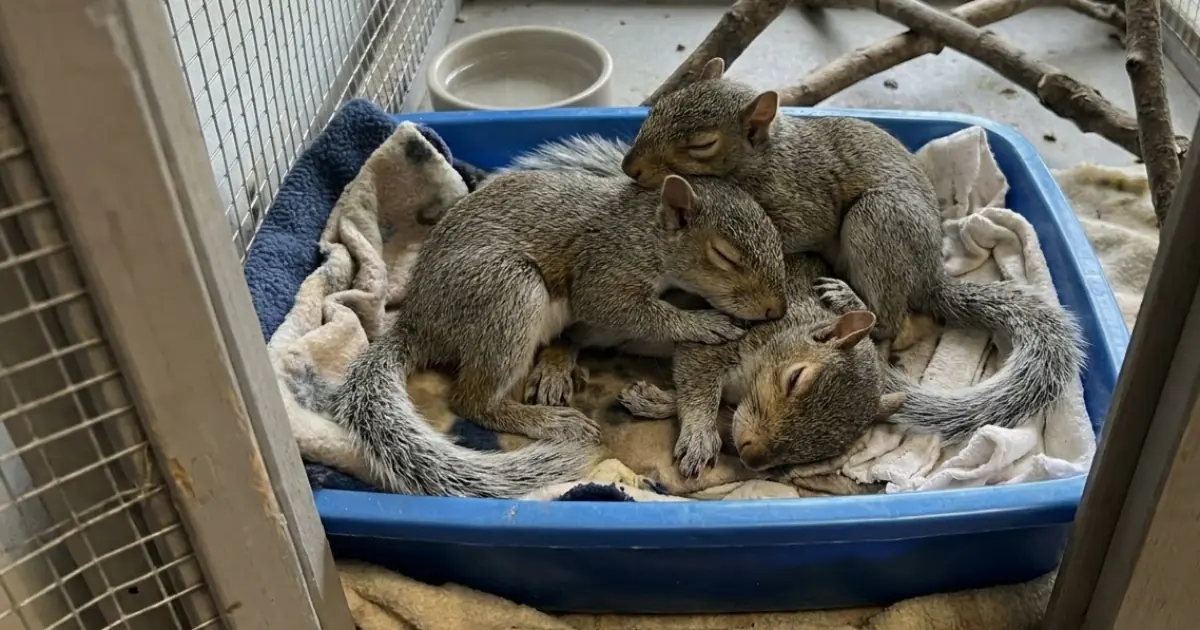
Young squirrels naturally develop in the company of other squirrels. When compatible orphaned youngsters of similar developmental stages can safely be placed together after appropriate health considerations, that companionship can help create a more natural rearing environment than raising each animal entirely alone.
So, when the time was right, we began carefully bringing them together.
Their first interactions weren't dramatic.
There was no instant movie-like reunion.
One baby sniffed the other.
Another crawled beneath the bedding.
The smallest seemed mostly interested in finding the warmest possible place to sleep.
Within a short time, however, we began finding them in a pile.
Three little bodies pressed together beneath the fleece.
The smallest was usually somewhere in the middle.
That became such a predictable arrangement that the staff started calling her Poppy. The slightly larger male, who seemed determined to climb over everyone whenever he woke up, became Scout. The third had a noticeably darker patch of fur along his back, and someone casually started referring to him as Ash.
None of the names came from an official naming ceremony.
They simply appeared during daily care, and before long, everyone was using them.
Poppy, Scout, and Ash had become our little squirrel trio.
Their personalities became easier to distinguish as they grew.
Poppy remained the smallest for some time. During feeding sessions, she was enthusiastic but slower than the others. She would grip the feeding syringe with both front paws and hold on long after the feeding was finished.
Scout seemed to wake up ready to move.
Even before his coordination was particularly good, he was constantly trying to crawl over the sides of the nesting material. If there was a fold in the fleece, Scout wanted to know what was behind it.
Ash was initially more reserved.
He often stayed buried while the other two moved around, but once his strength returned, he began matching Scout's curiosity.
Their physical transformation happened surprisingly quickly.
Poppy's eyes opened.
Scout's tail began becoming noticeably fuller.
Ash started sitting upright while manipulating objects with his front paws.
The three animals that had once needed carefully maintained warmth gradually began behaving like miniature versions of the squirrels we see outside every day.
Their enclosure had to change with them.
A neonatal setup designed to keep tiny babies secure would soon become frustrating—and potentially inappropriate—for growing squirrels whose bodies were telling them to climb.
So their environment became larger and more complex.
At first, the climbing opportunities were low and simple.
Scout immediately attempted more than his coordination could support.
He climbed partway up, lost his footing, dropped safely into the bedding below, and almost immediately tried again.
Ash watched him before making his own attempt.
Poppy took longer.
For several days, she seemed perfectly satisfied letting the two males investigate while she remained closer to the nest.
Then one morning we found her above both of them.
Once she figured it out, she apparently saw no reason to stay on the ground.
Their feeding routine was changing at the same time.
The formula that had been essential when they arrived could not remain the center of their diet indefinitely. As they reached appropriate developmental stages, suitable solid foods were gradually incorporated and natural feeding behaviors were encouraged.
They learned to hold food.
They chewed.
They investigated unfamiliar items.
They began searching through their environment instead of expecting everything to appear directly in front of them.
Sometimes they stole from one another even when identical food was available nearby.
Scout was particularly talented at this.
He could be holding something in his own paws and still become intensely interested in whatever Ash had.
Those interactions might look like ordinary sibling behavior, but from a rehabilitation perspective, seeing the three squirrels interacting with one another rather than directing all of their attention toward caregivers was important.
We didn't want to become their family.
We wanted other squirrels to fill that social space.
As the trio became healthier, we deliberately reduced unnecessary human interaction.
When they had been tiny and helpless, close handling was unavoidable. They required feeding, monitoring, cleaning, and supportive care.
But growing squirrels need something different.
They need distance.
The change happened gradually.
At first, all three associated our arrival with food.
Then they became less interested in us between routine care.
Eventually, they started retreating when someone entered.
Ash was the first to become noticeably wary.
He would climb away and watch from a protected position.
Scout soon followed, although curiosity sometimes caused him to peek back.
Poppy, once the baby that wrapped both paws around a syringe, also began choosing the company of the other squirrels over human attention.
That was one of the best developments we could have asked for.
Their bodies were changing just as quickly.
The thin tails became full.
Their legs became powerful.
Their claws allowed them to grip vertical surfaces with ease.
The awkward climbing attempts disappeared and were replaced by fast, confident movement.
Soon, simply trying to visually check all three animals could become surprisingly difficult.
One would disappear behind a branch.
Another would move overhead.
The third would suddenly be somewhere completely different from where we had last seen him.
They were becoming squirrels.
And that meant the next stage of rehabilitation had to become more demanding.
Keeping three healthy young squirrels alive inside a protected enclosure isn't the final goal.
They need to become capable of living without that protection.
Their environment increasingly encouraged climbing, jumping, balance, exploration, and foraging. Food presentation could be made less predictable so they had reasons to search rather than simply wait at a familiar location.
We watched how they landed after jumps.
We watched their grip.
We looked for symmetry in movement and any developmental problems that might have been hidden when they were younger.
We also continued monitoring body condition and growth.
All three had arrived from different circumstances, so they didn't progress at exactly the same rate.
Poppy remained slightly behind the others in size for a while.
That didn't automatically mean something was wrong.
What mattered was that she continued developing appropriately, gaining strength and keeping up behaviorally.
Eventually, keeping up stopped being a concern.
Poppy became remarkably quick.
Scout remained the most adventurous.
Ash remained the first to disappear whenever a person approached.
Together, they began looking less like three orphaned babies receiving rehabilitation and more like a small group of juvenile wild squirrels temporarily passing through our care.
That's an important distinction.
We may have names for them.
We may know which squirrel tends to sleep in which spot and which one usually reaches a new climbing structure first.
But Poppy, Scout, and Ash aren't pets.
Everything we're doing is intended to make our presence increasingly irrelevant to their lives.
At the time of this update, all three squirrels remain in rehabilitation and are continuing to develop toward eventual release. They are eating independently, active, climbing confidently, interacting normally with one another, and becoming appropriately cautious around people.
They still have milestones to meet.
Release isn't determined by age alone.
Before returning to the wild, each squirrel has to demonstrate appropriate physical condition, coordination, climbing ability, foraging behavior, and the capacity to function without human support. Suitable habitat, season, weather, and other release considerations also matter.
Most importantly, all three have to be ready as individuals.
They may have grown up together here, but rehabilitation doesn't guarantee that every animal reaches the same milestone on exactly the same day.
For now, we're happy to watch them become increasingly difficult patients.
It's hard to reconcile the squirrels we see today with the three babies who originally came through our doors.
Poppy once needed carefully controlled warmth simply because her tiny body couldn't manage without the protection she should have been receiving in a nest.
Scout arrived depleted and spent much of his first day curled beneath bedding.
Ash was alone in a yard, already old enough to recognize that something was wrong but far too young to solve the problem himself.
None of them had the mother they needed.
We couldn't truly replace her.
No rehabilitator can completely reproduce everything a wild mother teaches and provides.
What we could do was keep them warm when they couldn't keep themselves warm, provide appropriate nutrition when they couldn't feed themselves, monitor their development, give them opportunities to grow alongside their own species, and gradually remove ourselves from the picture.
Now, when we enter their space, three little squirrels no longer crawl toward us looking for help.
Usually, we see three tails disappearing in three different directions.
Someday, if everything continues as it should, even those brief glimpses will stop.
There will be no enclosure to check in the morning.
No weights to record.
No feeding schedule with Poppy, Scout, and Ash written beside it.
There will simply be three young squirrels somewhere outside, climbing trees, searching for food, choosing their own sleeping places, and making decisions without us.
For three babies who arrived separately because they couldn't survive alone, becoming completely independent is exactly where we hope their story is heading.