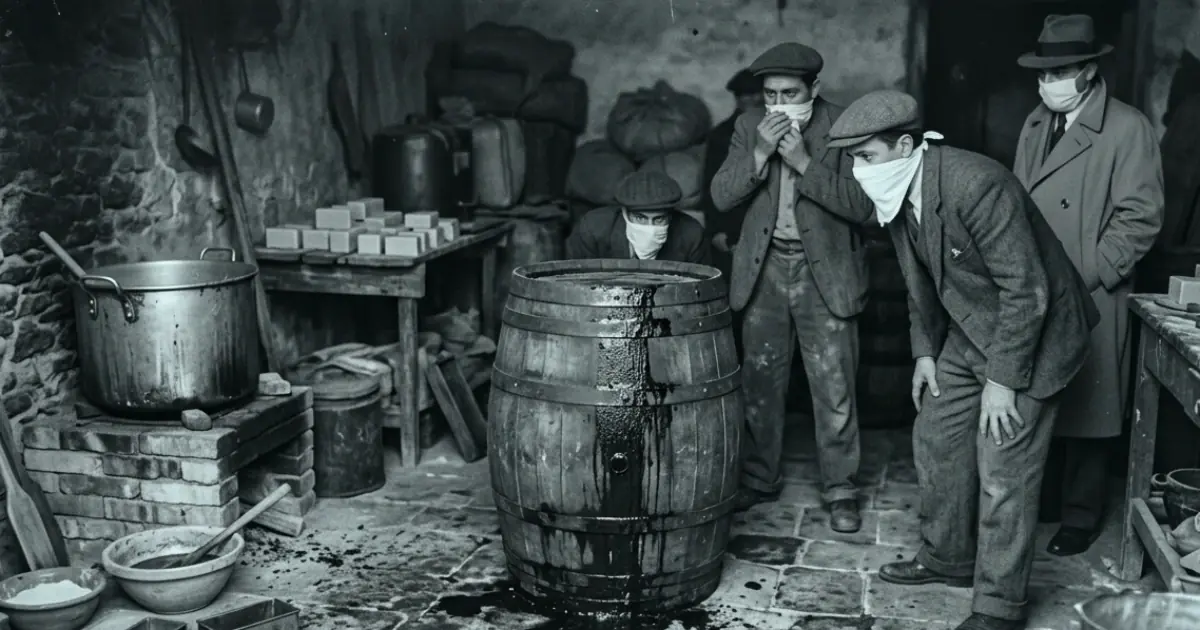
Italy, 1940.
Europe was at war.
Italy had entered the Second World War in June, and everywhere ordinary life was beginning to contract around shortages, military service, uncertainty and fear.
But in the small northern town of Correggio, the mystery did not begin with soldiers or bombs.
It began with women disappearing.
Not young women running away.
Not political fugitives.
Not people obviously connected to espionage or the war.
Three middle-aged women.
Each lived alone or had relatively few people closely watching her movements.
Each had savings.
Each wanted something badly enough to believe a woman named Leonarda Cianciulli could help her obtain it.
For one, it was marriage.
For another, a new job.
For the third, a chance to rebuild a life that seemed to have already reached its final chapter.
And each time, Leonarda offered exactly what the woman wanted.
Then she asked for secrecy.
Do not tell anyone yet.
Wait until everything is certain.
Write a few letters before you leave.
Make arrangements for your property.
Then come to my house.
One after another, the women entered Leonarda Cianciulli's home in Correggio.
One after another, they disappeared.
At first, nothing connected the disappearances strongly enough to cause panic.
Each woman seemed to have left voluntarily.
Letters appeared afterward.
Friends were told not to worry.
Possessions were sold.
Money changed hands.
There were plausible explanations for everything.
But the explanations had one weakness.
None of the women ever came back.
And eventually someone began asking why.
That question would uncover one of the strangest criminal cases in Italian history.
Because when police finally reconstructed what had happened inside Leonarda's home, they discovered that the disappearances had not ended with murder.
According to Cianciulli's own later account, she had destroyed the victims' remains using caustic soda in a large pot.
She claimed that part of the resulting material had been turned into soap.
Then she made an even more disturbing claim.
She said she had dried and processed blood from the victims and used it in cakes that were eaten inside her household and offered to visitors.
The murders themselves are established historical fact.
The disposal of the bodies through saponification was accepted by the court.
The more sensational claims about soap and cakes come largely from Cianciulli's own confession and later memoir, and not every detail can be independently verified today. That distinction matters. But the central case is horrifying enough without embellishment: three women entered the same house between 1939 and 1940, were killed, their bodies were destroyed, and their property was taken.
The investigation would ultimately have to solve three mysteries.
Where had the women gone?
Why had they all trusted the same person?
And why did that person seem to know exactly how to make each disappearance look voluntary?
The answer began years before the murders.
Leonarda Before Correggio
Leonarda Cianciulli was born in Montella, in southern Italy, in 1894.
By 1930 she had moved with her husband, Raffaele Pansardi, and their family to Correggio in the province of Reggio Emilia.
There she became known around town for buying and selling household goods and for another side of her personality that would later become inseparable from the mythology surrounding the case.
Fortune telling.
Superstition.
Magic.
Predictions.
Cianciulli was known as a woman who read fortunes and dealt comfortably in the world of omens and folk belief.
She was also known for an intense attachment to her children.
Later retellings would turn this into a simple story.
A superstitious mother believes her children are cursed.
She sacrifices women to protect them.
But that version is too neat.
At trial, prosecutors argued that money was a central motive.
The women Cianciulli targeted had savings.
She took control of their possessions.
She benefited financially after they disappeared.
Cianciulli, by contrast, described the murders as sacrifices intended to protect her children from death.
Both narratives became part of the case.
The court ultimately convicted her of three murders, destruction of the bodies and aggravated theft.
So any serious reconstruction must hold both elements at once.
Cianciulli may have genuinely believed in curses and sacrifices.
She also profited from the women she killed.
The two things are not mutually exclusive.
A Mother Obsessed With Death
Cianciulli's attachment to her children became central to her own explanation of the crimes.
Her life had included pregnancies and losses, and over time she reportedly developed an obsessive fear that her surviving children might also die.
One son in particular, Giuseppe, occupied an important place in her emotional world.
When Italy moved toward war and young men faced military service, her fear intensified.
According to the story she later gave investigators and psychiatrists, she believed blood sacrifices might somehow protect her children.
That explanation is impossible to verify as a sincere motive.
It may have reflected genuine delusion.
It may have been partly constructed after arrest.
It may have provided a supernatural justification for crimes that also produced obvious financial benefit.
At trial, this became one of the major disputes.
Was Leonarda Cianciulli a calculating murderer motivated by money?
Was she mentally ill and acting under a ritual delusion?
Or was she both?
The answer would matter enormously when sentencing came years later.
But in 1939, none of that was visible to the women who knew her in Correggio.
To them, Leonarda could appear useful.
Resourceful.
A woman with connections.
Someone who knew how to arrange things.
And she was very good at discovering what a lonely person wanted.
The First Woman
The first established victim was Ermelinda Faustina Setti.
Sources disagree about her exact age, but they agree on the essential circumstances.
She was alone.
She wanted companionship.
Leonarda told her she had found a suitable husband for her.
The supposed match lived elsewhere.
A new life was waiting.
All Setti needed to do was prepare.
That promise gave Cianciulli enormous power.
Once a person believes she is about to relocate permanently, many unusual actions become reasonable.
Selling possessions.
Moving savings.
Writing farewell letters.
Giving someone authority to handle financial matters.
Keeping the details secret until arrangements are complete.
According to the case record, Cianciulli persuaded Setti to prepare evidence that would later help explain her own disappearance.
Letters.
Instructions.
Signs that she had willingly left Correggio.
It was an extraordinarily important part of the method.
Leonarda did not merely remove the victim.
She created a story before the victim disappeared.
That story would continue operating afterward.
On December 18, 1939, Setti entered Cianciulli's home.
She never emerged into ordinary life again.
According to the reconstruction accepted by investigators and later by the court, Cianciulli killed her there, dismembered the body and destroyed it using caustic soda in a large cooking vessel.
There was no public discovery.
No body dumped where someone might find it.
No obvious murder scene exposed to neighbors.
Instead, Setti simply seemed to have gone away.
And because Leonarda had helped manufacture that explanation in advance, suspicion remained weak.
The first disappearance appeared to have succeeded.
A Crime Without a Missing-Person Alarm
This is one of the most important parts of the Cianciulli case.
The murders were not hidden only by disposal.
They were hidden by paperwork.
A person disappears suddenly and relatives become suspicious.
But what if the person has already announced a move?
What if she has written letters explaining that move?
What if friends have been told she has found a husband?
What if she has sold things because she is starting over?
Then disappearance becomes evidence of the cover story.
It looks like departure.
Leonarda seems to have understood that instinctively.
And she would use the same principle again.
The Second Woman
The second victim was Francesca Soavi.
Unlike Setti, Soavi was not being promised a husband.
Leonarda changed the bait.
This time the opportunity was employment.
She told Soavi that a good position was available at a girls' school.
A respectable job.
A reason to relocate.
A future.
Again, secrecy became part of the arrangement.
Do not announce too much until everything is secure.
Write to people.
Explain the move.
Prepare your affairs.
The pattern was almost identical even though the promised reward changed.
That is a key sign of an adaptable offender.
Cianciulli was not tied to one script.
She was tied to one structure.
Identify a desire.
Offer a solution.
Create secrecy.
Arrange property.