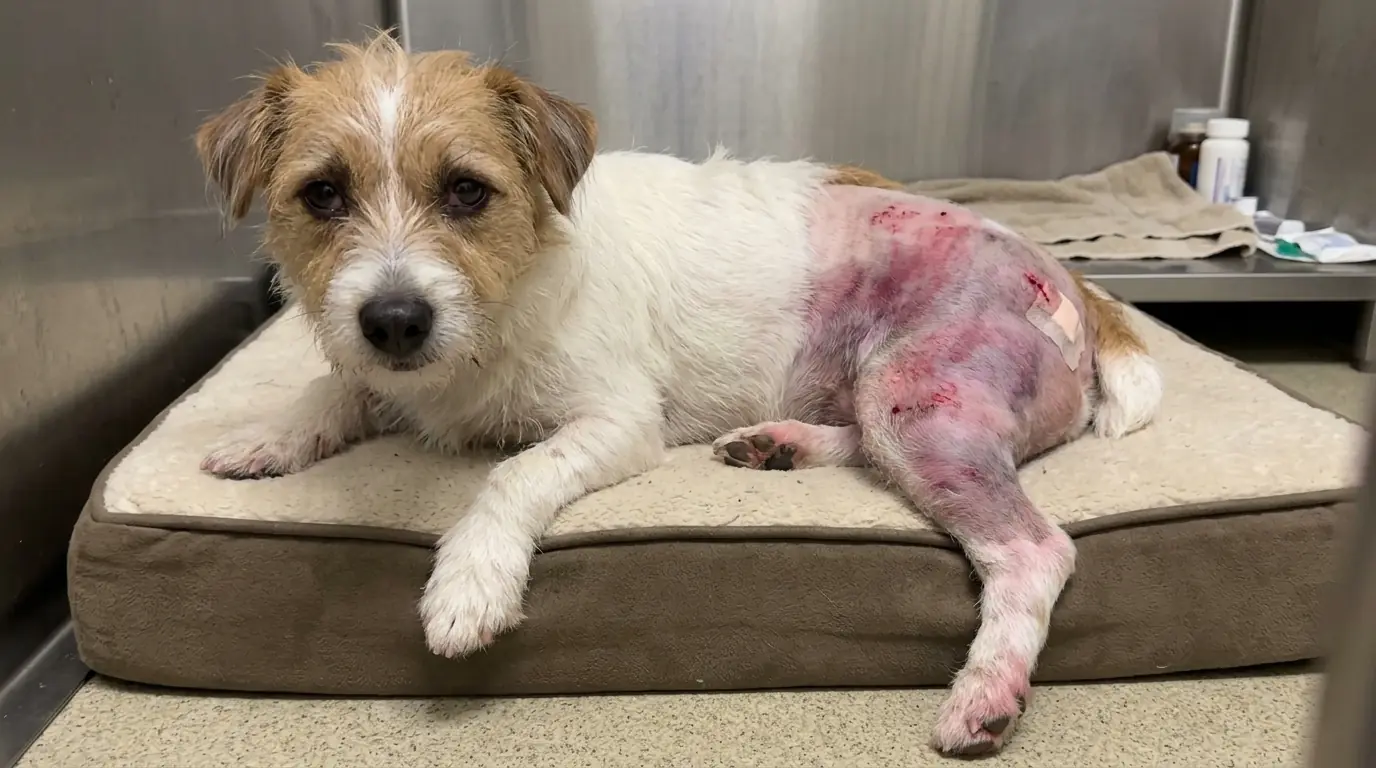
Toby's front paws are still on the bed.
The rest of him isn't.
The six-year-old Jack Russell Terrier had only been trying to change position on the thick orthopedic mattress in his medical kennel. He shifted his shoulders, moved one front paw, and began turning his body.
Then his weak hind leg slipped over the edge.
His pelvis followed.
Slowly, Toby's back half slid down until his hindquarters reached the floor while his chest remained pressed against the mattress.
For a few seconds, he stayed like that.
Two front paws gripping the bedding.
Chest on the mattress.
Back legs below.
Then those front legs started working.
Toby pulled.
The mattress compressed beneath his paws, but his injured hindquarters barely followed.
He was trying to get back onto a bed that was only inches above him.
And suddenly, those few inches were too much.
He Can Rest on the Bed—Getting Repositioned Is the Problem
Toby is recovering in a medical shelter after a vehicle accident left him with a fractured pelvis and an injured hind leg.
Those injuries have changed even the smallest parts of his day.
Walking is obviously difficult.
Getting up requires care.
But one of Toby's most persistent problems appears when he is already lying somewhere comfortable.
He tries to turn.
That is all.
A healthy dog can circle, scoot, roll onto another hip, stretch, curl up, and reposition repeatedly before settling.
For Toby, changing position requires his recovering hindquarters to participate.
And one leg does not reliably support him.
When that leg reaches the edge of the orthopedic bed, it can slip.
Once it does, Toby's pelvis begins following it.
It Doesn't Look Like a Fall at First
There is rarely one dramatic drop.
Instead, Toby slides.
The weak hind leg goes first.
His rear end shifts toward the edge.
His front paws spread slightly as he tries to stabilize himself.
For another moment, his chest remains on the mattress.
Then gravity keeps pulling the heavier, unsupported part of his body downward.
His hindquarters reach the floor.
That slow movement can almost make the problem look less serious than it is.
But Toby is recovering from a fractured pelvis.
Repeatedly slipping from a bed and then struggling to pull himself back up is not something he should have to practice.
The fact that he can attempt it does not make it useful rehabilitation.
The question is not whether Toby can eventually climb back onto the mattress.
The question is what that effort costs his recovering body.
His Front Legs Make Him Look More Capable Than He Is
Toby still has considerable use of his front legs.
That becomes obvious whenever he slips.
His paws grip.
His elbows bend.
His shoulders pull.
Sometimes his chest moves farther onto the mattress.
For a moment, it can look as though the rest of him is about to follow.
But the front half of Toby's body is not the part that was most severely affected by the accident.
His pelvis and hind leg are.
Strong front limbs can move his chest without solving the problem behind it.
That distinction matters.