Tucker showed almost no response when the veterinary team lifted him from the stretcher.
The medium-sized tan dog lay completely still, his head resting sideways on a folded towel. The left side of his muzzle had swollen until the features of his face were difficult to recognize.
The swelling continued beneath his jaw and down his neck.
One eye had disappeared behind enlarged tissue. His other eye remained partly open, but it did not follow the people moving around the treatment table.
Only his shallow breathing showed that he was still alive.
Two small punctures were visible near the front of his muzzle.
They were separated by less than an inch and surrounded by a darkening patch of skin. Although no one had witnessed the incident, the marks and rapidly expanding swelling raised an immediate suspicion.
Tucker may have been bitten by a venomous snake.
He had been found less than an hour earlier beside a suburban walking trail.
A cyclist noticed him lying partly in the grass near a drainage ditch. At first, Tucker appeared to be sleeping, but he did not move when the bicycle stopped nearby.
The cyclist called to him.
Tucker’s front paw shifted once against the dirt. His head remained down.
When the cyclist approached, she saw that the dog’s muzzle looked unusually large. A small amount of fluid had collected around his lips, and the skin under his jaw appeared to be expanding.
She did not see a snake.
The trail bordered an undeveloped area with tall grass, rocks and brush. Residents had reported copperheads in the neighborhood before, particularly during warm weather.
The cyclist contacted animal control and kept other trail users away from Tucker.
She did not attempt to make him walk.
By the time the responding officer arrived, Tucker’s breathing had become louder. He tried to raise his head when the officer placed a blanket near him, but his neck muscles could not hold it.
The swelling was visibly progressing.
Tucker was lifted onto a stretcher and transported directly to the nearest veterinary emergency hospital.
No collar was found.
A microchip scan would have to wait until he was stable.
At the ER, the team’s first concern was Tucker’s airway.
Swelling around the muzzle alone can look dramatic without blocking airflow. Swelling that spreads beneath the jaw and into the neck can become far more dangerous.
Tucker’s tongue was enlarged, and saliva gathered at the corner of his mouth because swallowing had become difficult.
Oxygen was provided immediately.
A technician placed an IV catheter in one front leg while the veterinarian listened to Tucker’s lungs and evaluated his throat.
His breathing was strained, but air was still moving.
Equipment was prepared in case a breathing tube became necessary.
Tucker’s heart rate was rapid, yet his blood pressure was falling. His gums appeared pale rather than healthy pink, and his body temperature had begun dropping.
Those findings suggested more than a painful local reaction.
His circulation was becoming unstable.
Blood was drawn for urgent testing.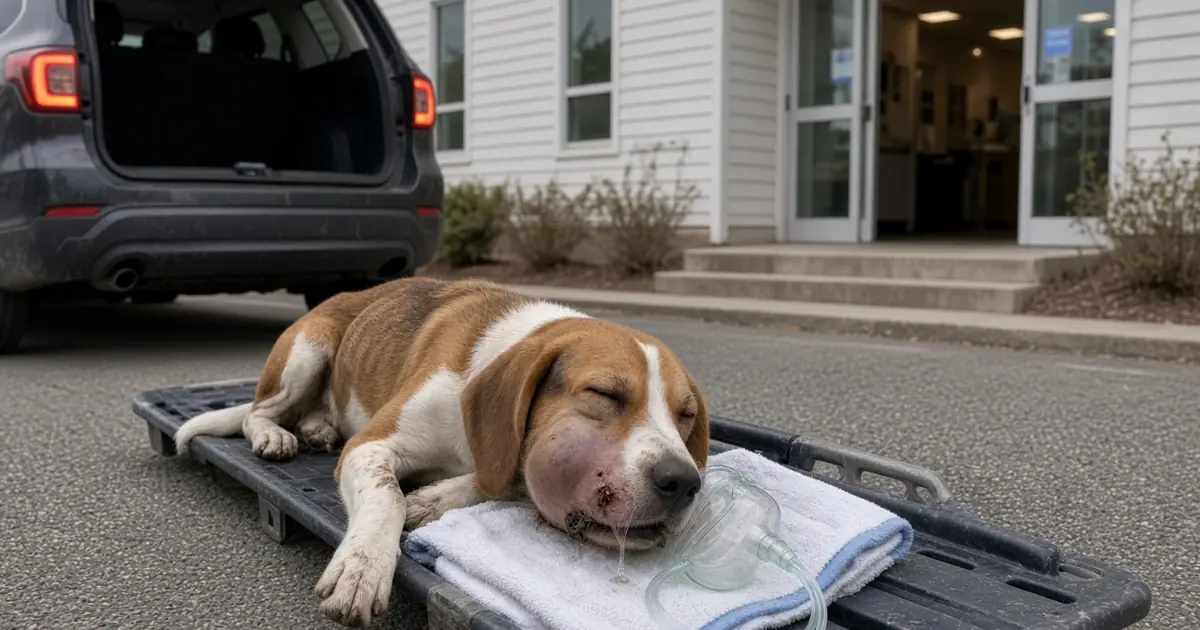
The results showed abnormalities in Tucker’s clotting ability. His platelet count was already declining, and damaged red blood cells appeared in the sample.
Depending on the snake species, venom can disrupt clotting, damage tissue, affect blood cells and place severe strain on the organs. The effects may continue progressing even after the snake is gone.
The punctures on Tucker’s muzzle were small.
The injury developing inside his body was not.
The team could not confirm the exact snake species from the marks alone. No snake had been photographed or safely identified at the trail.
However, waiting for absolute proof could cost Tucker the opportunity for effective treatment.
His clinical signs were consistent with venom exposure, and they were worsening rapidly.
Antivenom was prepared.
Before it could be administered, the medical team discussed the possibility of a serious allergic reaction. Tucker’s condition was already unstable, so his heart rate, blood pressure and breathing needed continuous monitoring throughout the infusion.
The first dose began slowly through his IV.
Tucker remained motionless beneath the oxygen support.
A line was drawn along the edge of the swelling on his neck so staff could track whether it continued moving. Within a short time, the enlarged tissue extended beyond the mark.
His right eye began narrowing as the swelling crossed his face.
The antivenom infusion continued.
Fluids supported his circulation, while pain medication was chosen carefully to avoid worsening the clotting problems or depressing his breathing.
The puncture sites were cleaned gently.
No attempt was made to cut them open, suction them or apply a tourniquet. Those measures would not remove the venom and could cause additional injury.
The team instead focused on supporting Tucker while the antivenom bound to venom still circulating in his bloodstream.
For nearly an hour, his condition remained unchanged.
Then Tucker’s blood pressure stopped falling.
The swelling did not immediately disappear. Antivenom cannot reverse tissue damage that has already occurred, and the body still needs time to clear inflammation and fluid.
But the expansion along Tucker’s neck began slowing.
That was the first cautiously encouraging sign.
His breathing remained the greatest concern.
The swelling beneath his jaw made positioning difficult. Staff kept his neck extended naturally and avoided pressure against the enlarged tissue.
When Tucker attempted to swallow, a faint distressed sound came from his throat.
The team prepared to intubate.
Before proceeding, they reassessed airflow and oxygen levels. Despite the external appearance, Tucker was still moving enough air to maintain oxygen with support.
Intubation also carried risks because the swollen tissue and abnormal clotting could make the procedure traumatic.
They continued monitoring him minute by minute.
Tucker received the rest of the antivenom without an allergic reaction.
Repeat blood testing followed.
His platelet count remained low, but the rapid decline had begun to slow. His clotting time was still abnormal, and his urine had darkened, raising concern that damaged blood cells and muscle tissue were placing stress on his kidneys.
The danger had not passed.
Tucker was transferred to intensive care.
His head and neck were supported on soft padding, and the swollen side of his face remained elevated where possible. Oxygen tubing stayed near his nose because a conventional mask pressed against the injury.
He could not eat or drink safely.
Fluids continued through the IV while staff monitored his urine production, kidney values and heart rhythm.
During his first several hours, Tucker barely reacted to touch.
When the enclosure door opened, his uninjured ear moved faintly. His eyes remained closed.
The team repeated neurological checks to make sure the reduced response came from shock, exhaustion and medication rather than a separate brain injury.
There was no evidence that Tucker had been struck by a vehicle or suffered head trauma.
All findings continued pointing toward severe envenomation.
Animal control returned to the trail after closing the immediate area to pedestrians.
They searched the grass around the place where Tucker had been lying. No snake was found, which was not unusual. A snake involved in a defensive bite would likely have moved away quickly.
The puncture marks suggested Tucker had approached nose-first.
He may have been sniffing through brush or investigating movement beneath the leaves when he was bitten directly on the muzzle.
A bite to the face can produce especially alarming swelling because the tissue around the lips, eyes and throat expands easily.
No one knew how much time passed before the cyclist found him.
The severity of his symptoms suggested that the venom had been circulating long enough to affect his entire body.
Back at the hospital, Tucker’s swelling reached its peak late that afternoon.
Both eyes had closed.
His muzzle appeared several times its normal size, and the loose skin along his neck hung heavily against the bedding. Small bruised areas developed around the punctures and along his gums.
Tucker remained able to breathe with oxygen support.
The team avoided placing anything unnecessary into his mouth.
Shortly after sunset, his blood pressure dropped again.
Another blood sample showed that his clotting values had worsened despite the initial improvement. The veterinarian determined that active venom effects might still be present.
A second antivenom dose was given.
The infusion began more cautiously than the first because repeated exposure can increase the chance of an allergic response. Emergency medication remained ready beside the enclosure.
Tucker tolerated the treatment.
Near midnight, his breathing became quieter.
At first, the change caused alarm. Staff checked him immediately, worried that his effort had weakened.
His oxygen level remained stable.
The noise had decreased because swelling near the upper airway had begun to ease.
Tucker opened his right eye a narrow amount.
He could not lift his head, but the eye moved toward the technician examining him.
It was his strongest response since arrival.
By morning, the line drawn around his neck was visible again because the swelling had begun receding inside it.
His blood pressure was holding with less support, and repeat tests showed that the clotting abnormalities were slowly improving.
Kidney values remained within an acceptable range.
Tucker was still critically ill, but the venom no longer appeared to be progressing unchecked.
A microchip scan was performed once he was stable enough to be repositioned.
The chip led to a family living in the neighborhood beside the trail.
They had reported Tucker missing earlier that morning after discovering an open section beneath their backyard gate. They had searched the surrounding streets without realizing he had entered the trail system.
The hospital contacted them.
His family confirmed that Tucker often investigated animals in the yard and had previously barked at snakes from a distance. They had never seen him encounter a venomous one.
They provided his veterinary history, which showed no chronic disease that would complicate treatment.
The family was allowed to see him briefly through the intensive-care enclosure.
Tucker could not rise.
When he heard a familiar voice, his visible eye opened. One front paw shifted across the blanket before his body relaxed again.
His condition did not allow a longer visit.
During his second day, Tucker attempted to swallow more normally. A small amount of water was offered under close supervision.
He licked once and turned away.
The swelling inside his mouth still made swallowing uncomfortable, so the team continued IV support rather than forcing him to drink.
Several hours later, he accepted a small amount of liquid food.
His tongue moved slowly around his swollen lips, and some of the food spilled onto the towel. He swallowed the rest without coughing.
That allowed carefully measured feedings to begin.
The puncture area required continued attention.
Snake venom can damage tissue around the bite, and the full effect may not become visible immediately. The skin on Tucker’s muzzle was inspected repeatedly for loss of circulation or infection.
A small area near one puncture became darker and less responsive.
The veterinarian did not remove it immediately. The boundary between damaged and healthy tissue needed time to become clear.
Treating too aggressively could sacrifice tissue capable of healing.
Tucker’s blood was checked throughout the day.
His platelet count stopped falling and then began increasing. The clotting time moved toward normal, reducing the risk of spontaneous bleeding.
The dark color of his urine also improved as fluids supported his kidneys.
By the third morning, Tucker could open both eyes, although the left remained narrowed by swelling.
He lifted his head several inches from the bedding.
The movement lasted only a few seconds. His neck trembled, and he lowered his chin again.
Later, he raised it when food entered the room.
His appetite returned before his strength.
A shallow bowl of softened food was positioned directly beneath his mouth. Tucker ate slowly while lying on his chest.
He paused after every few bites to rest and breathe.
Standing came later.
When staff used a padded sling to help him rise, Tucker extended his front legs but could not hold his hindquarters upright. Shock and prolonged immobility had left him weak.
The team supported most of his weight.
He remained standing for less than ten seconds before being returned to the bedding.
The swelling continued decreasing over the following days.
As Tucker’s features became recognizable again, the small punctures on his muzzle appeared almost insignificant compared with the reaction they had caused.
One eye reopened completely.
The other remained partly closed until inflammation around the cheek subsided.
The tissue near the bite site developed a shallow wound where damaged skin separated. It was cleaned and protected with medication while healing from the edges.
No extensive surgery was required.
Tucker’s kidney and liver values remained stable, one of the strongest indicators that treatment had begun before irreversible organ damage occurred.
He left oxygen support on the fourth day.
At first, he tolerated only brief periods breathing room air. Each session was extended as his oxygen levels remained normal.
When the tubing was removed entirely, Tucker rested for several hours.
Then he lifted his head and watched the doorway.
His first independent steps came inside the recovery room.
Tucker pushed himself upright, paused and took one unsteady step toward his water bowl. His legs trembled, but he remained standing long enough to drink several times.
Afterward, he returned to his bed with assistance.
Tucker remained hospitalized until his clotting tests, appetite and breathing were consistently stable.
His family secured the damaged section of fencing before he was released into monitored home recovery. Walks were restricted, and the yard was inspected carefully for brush piles or areas where snakes could shelter.
Follow-up examinations continued.
The swelling disappeared gradually rather than all at once. For several days, Tucker’s muzzle remained uneven, and loose skin hung beneath his jaw.
The wound near the punctures closed without a major infection.
His vision appeared unaffected.
The exact snake species was never confirmed.
The location, puncture pattern and clinical effects made a venomous bite the most likely explanation, but responsible medical documentation could not name a species without identification.
What the team could confirm was the severity of Tucker’s reaction.
The venom had disrupted his blood’s ability to clot, damaged blood cells, destabilized his circulation and produced swelling close enough to his airway to threaten his breathing.
The punctures themselves had looked small.
Within hours, nearly every part of his condition had become critical.
Tucker now responds normally when his family calls his name. He eats, drinks and walks without assistance, though his activity remains limited while his body finishes recovering.
He still carries a small healing mark on the side of his muzzle.
It is easy to overlook.
That mark is the only visible remnant of an injury that once closed both his eyes, enlarged his neck and left him motionless beside the trail.
When Tucker reached the ER, he could barely react to the hands treating him.
Now, whenever the back door opens, he lifts his head immediately—but he is no longer allowed to investigate the brush alone.