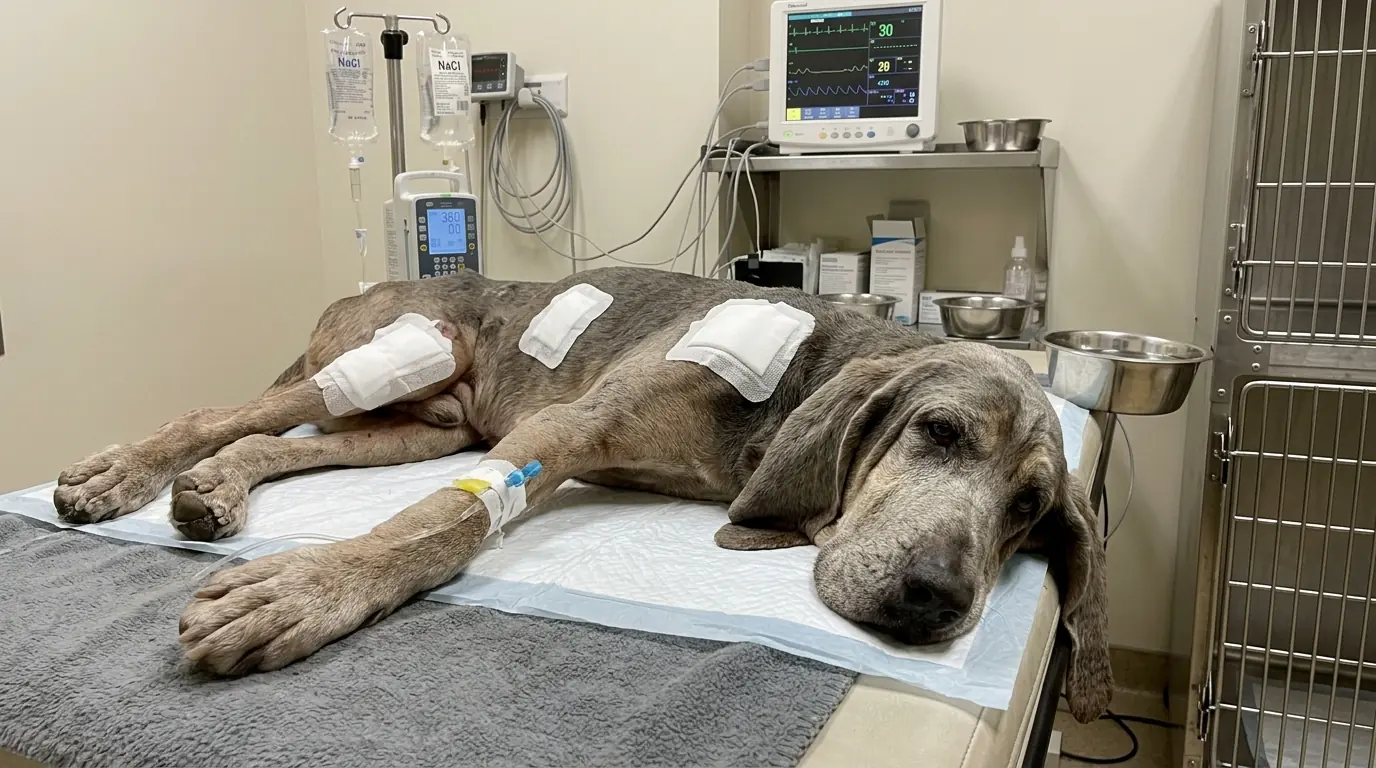
Walter did not try to stand when he arrived.
The ten-year-old Bloodhound had already spent whatever energy he had left simply surviving long enough to be found beside a rural road.
By the time he reached veterinary recovery, his body looked depleted.
His ribs and hip bones were easy to see beneath his loose skin. Several areas along his body had been shaved so the medical team could examine and treat sores caused by prolonged pressure. Bandages covered some of the most damaged spots.
An IV line was secured to one front leg.
Walter lay on his side on a thick pad, his long ears spread across the bedding.
Even when his eyes were open, he barely moved.
Then, every so often, he would try.
Walter would gather what little strength he had and lift his head a few inches from the mattress.
For several seconds, he held it there.
His eyes moved slowly toward the room.
Then the effort became too much.
His muzzle lowered.
His chin settled between his front paws.
And Walter became still again.
For the veterinary team, that tiny movement said almost everything about how weak he had become.
Walter Was Found With Almost Nothing Left to Give
The details of Walter's life before he was found were unknown.
He had been discovered beside a rural road, exhausted and unable to move normally.
There was no reliable medical history.
No one could say how long he had been without consistent food or water.
No one knew how many days he had spent lying in one place.
And no one knew whether he had been trying to travel or had simply reached a point where his body could no longer continue.
What staff could see was concerning enough.
Walter was significantly underweight.
He was dehydrated.
His muscles appeared wasted.
Several pressure sores had formed where his body had remained in contact with the ground or another hard surface for too long.
These were not problems that appeared in a few hours.
His condition suggested that his body had been declining for some time.
The Pressure Sores Told Their Own Story
Pressure sores, sometimes called pressure wounds, can develop when an animal remains in one position for extended periods.
Constant pressure reduces normal blood flow to the tissue trapped between the body and a hard surface.
Bony areas are especially vulnerable.
For a dog who is extremely thin, the natural padding provided by muscle and body fat is reduced.
That can make the risk even greater.
Walter's sores were visible reminders of just how little he may have been moving.
Several areas required clipping or shaving so they could be properly examined.
The missing fur made Walter look even more fragile.
But appearance was not the main concern.
The medical team needed to assess how deep the wounds were, whether they showed signs of infection, and how best to protect them while Walter remained largely unable to reposition himself.
His weakness created a difficult cycle.
The sores needed him to move.
His body barely had enough strength to do it.
Sitting Up Was Already Beyond Him
A healthy Bloodhound can lift a large, heavy head without a second thought.
Walter could not.
Even supporting his own neck seemed to require concentration.
He spent most of his time lying laterally on the pad.
When he became more alert, there were moments when he appeared to want to look around.
His eyes opened wider.
The muscles along his neck tightened.
Then his head rose.
Sometimes only an inch.
Sometimes a little higher.
But the effort rarely lasted long.
Within a few seconds, his head began to descend.
Walter did not collapse dramatically.
He simply ran out of strength.
His chin returned to the bedding.
Then he rested.
Severe Weakness Can Have More Than One Cause
Walter's exhaustion could not be explained by one visible problem alone.
Significant weight loss can leave a dog with reduced muscle mass and less physical reserve.
Dehydration can affect circulation, energy, and overall function.
Pain from pressure sores may further discourage movement.
Older dogs may also have underlying disease that is not immediately obvious from appearance alone.
That is why veterinary teams cannot safely look at a dog like Walter and assume that feeding him is the entire answer.
The visible condition is only the beginning.
Bloodwork, physical examination, hydration status, organ function, infection, pain, mobility, and other factors may all need to be considered.
Walter's thin frame showed that he needed nutritional support.
His weakness showed that the situation was more complicated than simply putting a full bowl in front of him.
The IV Was Only One Part of Stabilizing Him
The line placed in Walter's front leg allowed the veterinary team to provide fluids and other treatment as appropriate to his condition.
For a dehydrated dog, restoring fluid balance can be an important part of stabilization.