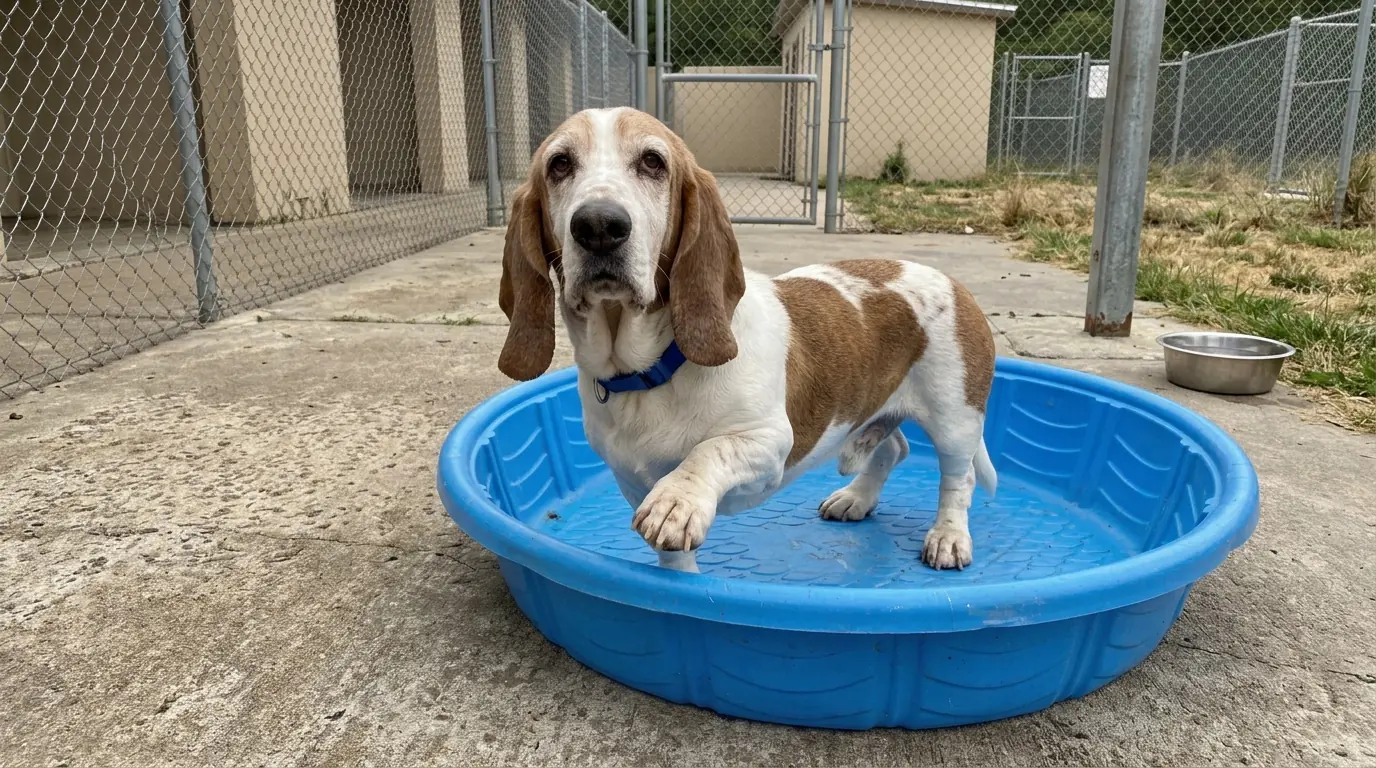
Walter does not fall into the pool.
He walks into it on purpose.
The 11-year-old Basset Hound is spending a quiet afternoon in the shelter’s outdoor exercise yard, where short periods of gentle movement give him a chance to stretch his aging legs.
There is no water in the small plastic kiddie pool.
Its sides are low.
A younger dog could step over them without thinking.
Walter approaches slowly.
His nose points toward the ground.
One short front leg crosses the plastic rim.
Then the other.
His hind legs follow with more effort.
A few seconds later, Walter is standing completely inside the empty pool.
Then he stops.
He does not sniff around.
He does not turn around and immediately step back out.
Walter simply stands there.
Minutes seem to pass inside his head before anything happens.
Eventually, he looks toward the yard.
He raises one front paw toward the rim.
The leg does not clear it.
Walter puts the paw down.
He tries again.
His arthritic body shifts awkwardly.
Then he stops trying.
Slowly, Walter folds himself onto the bottom of the empty pool.
He rests his chin across the plastic edge.
And waits.
The Strange Part Is That Walter Keeps Doing It
If it happened once, it might mean nothing.
Walter could have been curious.
He might have mistaken the pool for another resting surface.
Perhaps he simply wanted to investigate something unfamiliar.
But the behavior repeats.
Walter wanders through the yard.
Eventually, he reaches the kiddie pool.
He steps inside.
Then something seems to change.
The dog who figured out how to enter suddenly struggles to organize the movement needed to leave.
Walter Is Living With Two Problems That Can Overlap
Walter has age-related cognitive dysfunction as well as arthritis.
Either condition can make ordinary activities more difficult.
Together, they can create particularly confusing moments.
Canine cognitive dysfunction is an age-associated condition involving changes in brain function. Affected dogs can show altered sleep patterns, changes in social interaction, house-soiling, disorientation, anxiety, altered activity, or difficulty navigating familiar environments.
Arthritis creates a different obstacle.
It can make joints painful and stiff.