Warm cloths removed layers of dirt from his face and paws.
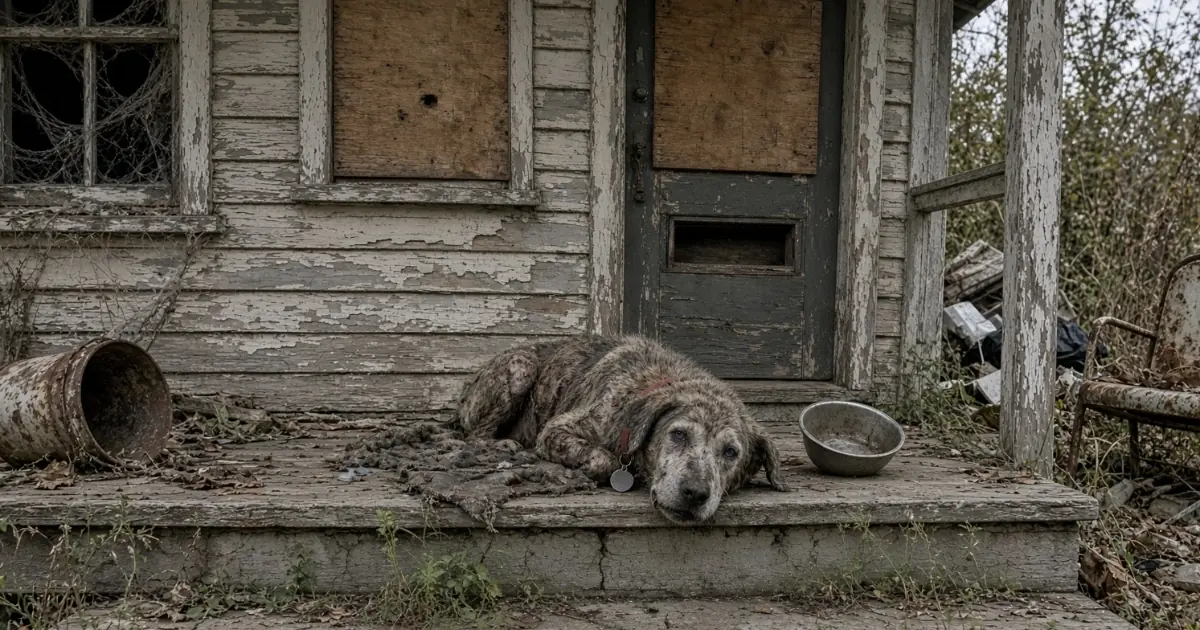
Beneath the damaged coat, they found additional sores over his hips and elbows. Some had formed because there was almost no protective tissue between his bones and the hard surfaces where he had been lying.
The shelter’s investigation eventually uncovered part of Walter’s history.
He had been registered as a young adult dog nearly nine years earlier. The original record contained only basic information and an outdated photograph.
In that picture, Walter’s coat was full and dark. His unusual rear leg was visible even then, but he stood upright beside a porch railing wearing the same blue collar.
It was impossible to know everything that had happened afterward.
Property records showed that several different people had occupied the vacant house over the years. Neighbors remembered seeing a dog in the yard but disagreed about who owned him or when he had last been inside.
No one could confirm whether Walter had recently lived in the house, been left nearby or returned there after being abandoned somewhere else.
Yet his behavior suggested that the property meant something to him.
He knew the porch.
He knew the front door.
And even when food and water were available elsewhere, he had chosen to remain against it.
By Walter’s third day at the shelter, he could hold his head up for longer periods. He finished each measured meal and began drinking without assistance.
Standing remained difficult.
A rehabilitation technician fitted him with a padded sling that supported his abdomen and hindquarters. During the first attempt, Walter’s front paws slid forward while his damaged rear leg folded awkwardly beneath him.
The technician stopped immediately and repositioned him.
On the second attempt, Walter remained upright for five seconds.
His legs trembled, but he did not collapse.
He took one short step toward the doorway.
Then another.
When he reached the threshold of the treatment room, he stopped. His ears lifted slightly, and he stared down the hallway.
No one was there.
Walter remained in that position until his strength failed and the technician carried him back to his bed.
Each day brought another small change.
His blood sugar stabilized. The anemia stopped worsening. The sores on his skin began drying, and the swelling around his paws decreased.
Walter also started accepting touch.
At first, he tolerated only brief contact along his shoulders. If a hand moved toward his collar area or damaged hind leg, his entire body became rigid.
Staff kept every interaction predictable. They spoke before touching him and avoided approaching from behind.
One technician began sitting beside his kennel during meals.
For several days, Walter waited until she moved away before eating. On the fifth morning, he took his first bite while she was still sitting there.
After finishing, he rested his chin on the edge of the bowl and watched her.
His tail tapped the bedding once.
The old collar remained in a sealed bag with Walter’s belongings.
Staff considered replacing it immediately, but Walter still reacted whenever he saw it. The object appeared to provide familiarity, even though it had also caused years of irritation around his neck.
Instead, they fitted him with a soft harness that avoided the damaged skin.
Walter resisted leaving the medical ward during his first outdoor walk.
He reached the exit, saw the open doorway and froze.
His front feet remained inside while his nose stretched toward the sunlight. The rehabilitation technician waited without pulling.
After nearly a minute, Walter stepped across the threshold.
Outside, he stood in the grass with the sling supporting his hindquarters. He raised his nose and smelled the air.
Then a car door closed in the parking lot.
Walter turned so quickly that one rear leg slipped from beneath him.
He stared at the vehicle until the driver walked away. Only then did he lower his head.
No verified owner came forward.
The shelter posted Walter’s photograph and contacted every person connected to the available records. Several callers believed they recognized him, but none could provide reliable details or proof of ownership.
The investigation into his abandonment remained open.
What could be documented was Walter’s condition at intake: severe emaciation, untreated infections, parasites, chronic orthopedic pain and a collar worn long enough to leave a permanent mark.
Walter had once belonged to someone.
But when he needed care most, he had been left beside a locked house with no safe way inside.
Two weeks after his rescue, Walter stood without the sling for the first time.
His posture remained unusual. His curved spine caused his shoulders to sit higher than his hips, and the old leg injury gave his rear gait a permanent sideways motion.
He would never walk like other dogs.
That did not prevent him from trying.
He crossed the medical room in seven slow steps before sitting down heavily. When the technician knelt beside him, Walter leaned his thin shoulder against her knee.
His appearance began changing as his body recovered.
Healthy skin emerged beneath the crusted patches, and soft new fur appeared along his sides. His ribs remained visible, but his weight increased gradually. With medication and controlled exercise, he could move more comfortably despite the arthritis and old injuries.
The shelter transferred Walter to an experienced foster home where he could continue healing away from the noise of the kennel.
His foster family prepared a quiet room with rugs, a low orthopedic bed and a ramp leading to the backyard.
Walter ignored the bed on his first night.
He chose a spot beside the front door.
Each time someone left the house, he remained there and watched the door close. He would not follow food into another room, and he refused to settle until he heard the lock turn again.
When the person returned, Walter did not run or jump.
He simply lifted his head and released a long breath.
Over the following weeks, the routine began to change him.
Every person who walked through the door eventually came back.
Meals arrived at the same times each day. Water never disappeared. No one removed his harness and left him outside alone.
Walter slowly began sleeping farther from the entrance.
First, he rested on a blanket two feet away. Several nights later, he chose the edge of the orthopedic bed. Eventually, his foster caregiver woke to find him sleeping in the center of it, his old rear leg stretched comfortably to one side.
Walter still watches doors.
He may always look up when one closes, and he sometimes waits in the hallway when someone leaves. Years of familiarity cannot be replaced in a few weeks, especially for a senior dog whose world may have revolved around one house and the people inside it.
But he no longer presses his body against the front door all night.
Walter is continuing treatment for arthritis, skin disease and anemia. He still needs to gain weight, and veterinarians are monitoring the long-term effects of malnutrition.
His physical differences will remain.
The curved spine, uneven legs and patchy coat may cause some people to look away before meeting him. But none of those things have stopped Walter from learning routines, seeking affection or following his foster caregiver from room to room.
He is not yet ready for adoption.
When that time comes, Walter will need a quiet home willing to care for a senior dog with limited mobility and a deep fear of being left behind.
The shelter may never learn exactly who abandoned him or why he waited at that particular house.
What they know is that Walter stayed beside the locked door even as hunger weakened him and illness took away his strength.
He did not understand that the house was empty.
He only understood that it had once been home—and that the person connected to his worn blue collar might still return through that door.
Walter waited until he could no longer stand.
Now, in his foster home, he is beginning to learn something different.
A closing door does not always mean goodbye.
Sometimes, the footsteps on the other side really do come back.