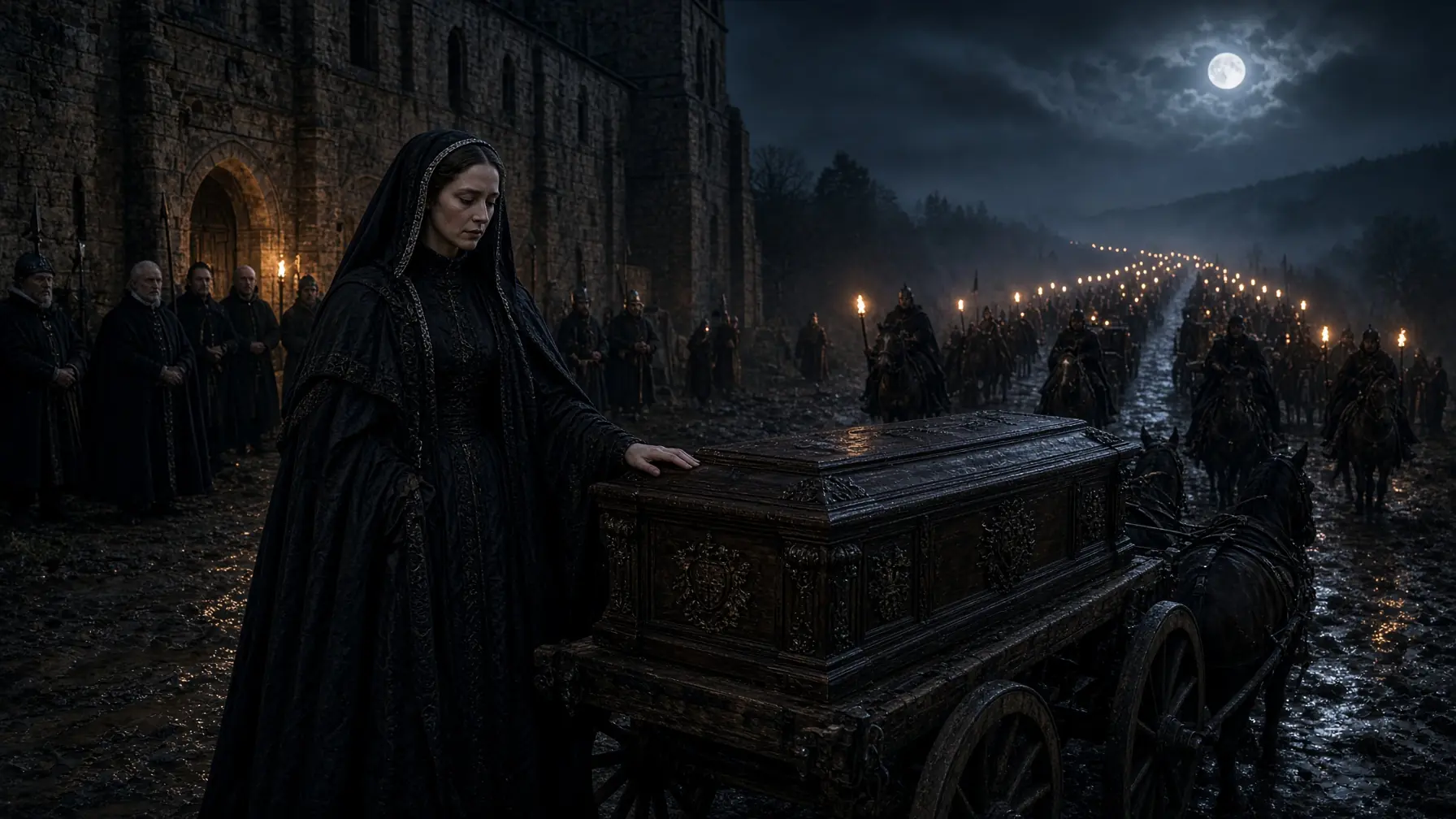
When Philip the Handsome died unexpectedly on September 25, 1506, his 27-year-old widow was not merely a grieving wife.
Joanna of Castile was a queen in her own right.
She had inherited the Crown of Castile after the death of her mother, Isabella I, in 1504. Philip had become king through his marriage to her, and the Castilian Cortes recognized Joanna as queen, Philip as her husband and their young son Charles as heir.
Yet Philip’s sudden death transformed Joanna’s life into one of the strangest—and most politically consequential—stories in European royal history.
She became inseparable in popular memory from her husband’s corpse.
Accounts described the widowed queen accompanying Philip’s coffin as his remains were taken toward their intended burial place in Granada. Over time, the story became increasingly sensational. Joanna was portrayed wandering through the countryside beside the coffin, consumed by jealousy and grief, unwilling to let other women approach her dead husband.
Later versions went further, claiming that she had Philip’s coffin repeatedly opened so that she could gaze upon, kiss, or embrace his remains.
The image was irresistible.
A queen dressed in mourning. A dead king in a coffin. A nighttime procession across Castile. A widow supposedly unable to accept that her husband was gone.
Centuries later, Spanish painters would turn precisely this image into some of the most haunting representations of Joanna. Francisco Pradilla’s famous nineteenth-century Doña Juana la Loca depicts her beside Philip’s coffin in a bleak winter landscape, reinforcing the romantic image of a queen psychologically destroyed by love and loss. The Prado itself notes the tradition that Joanna personally guarded Philip’s remains during the journey toward Granada.
But there is a problem with the story most people remember.
The most dramatic versions of Joanna’s behavior cannot simply be treated as neutral evidence of her mental condition.
Her reputation for madness developed in a world where declaring Joanna incapable of governing could produce enormous political benefits for the men closest to her.
Her husband had an interest in limiting her authority.
Her father had an interest in governing Castile in her place.
And eventually her own son would rule while his mother—the legal queen—remained confined.
The real mystery surrounding “Joanna the Mad,” therefore, is larger than what she did beside Philip’s coffin.
It is whether the woman imprisoned for 46 years was incapable of ruling—or whether genuine psychological distress became entangled with a political struggle in which almost everyone around her had something to gain from her incapacity.
Before She Was “Joanna the Mad”
Joanna was born in Toledo in 1479, the daughter of Ferdinand of Aragon and Isabella of Castile, the monarchs whose marriage helped create the dynastic foundations of early modern Spain.
She was not originally expected to inherit Castile.
There were other heirs ahead of her.
But a remarkable sequence of deaths changed everything.
Her brother John died in 1497. Her older sister Isabella died the following year. Isabella’s young son Miguel da Paz, who might have united the crowns of Portugal, Castile and Aragon, died in 1500.
Suddenly Joanna moved toward the center of the succession.
By then she was already married.
In 1496 she had married Philip of Habsburg, later known as Philip the Handsome. Their marriage was part of the intricate dynastic diplomacy connecting Europe’s great ruling houses.
The union also produced the next generation of Habsburg power.
Among their children was Charles, born in 1500, who would eventually become Charles I of Spain and Holy Roman Emperor Charles V.
But Joanna and Philip’s marriage acquired a notoriously difficult reputation.
Sources describe intense marital conflict, including Joanna’s jealousy over Philip’s relationships with other women. Her emotional behavior became part of the evidence later used to construct the image of a mentally unstable princess.
Determining what modern diagnosis—if any—could accurately describe Joanna is far more difficult.
She lived five centuries ago. The surviving evidence is incomplete, politically charged and filtered through observers who did not understand mental health in modern clinical terms.
More importantly, questions about her condition were never purely medical.
They were questions about power.