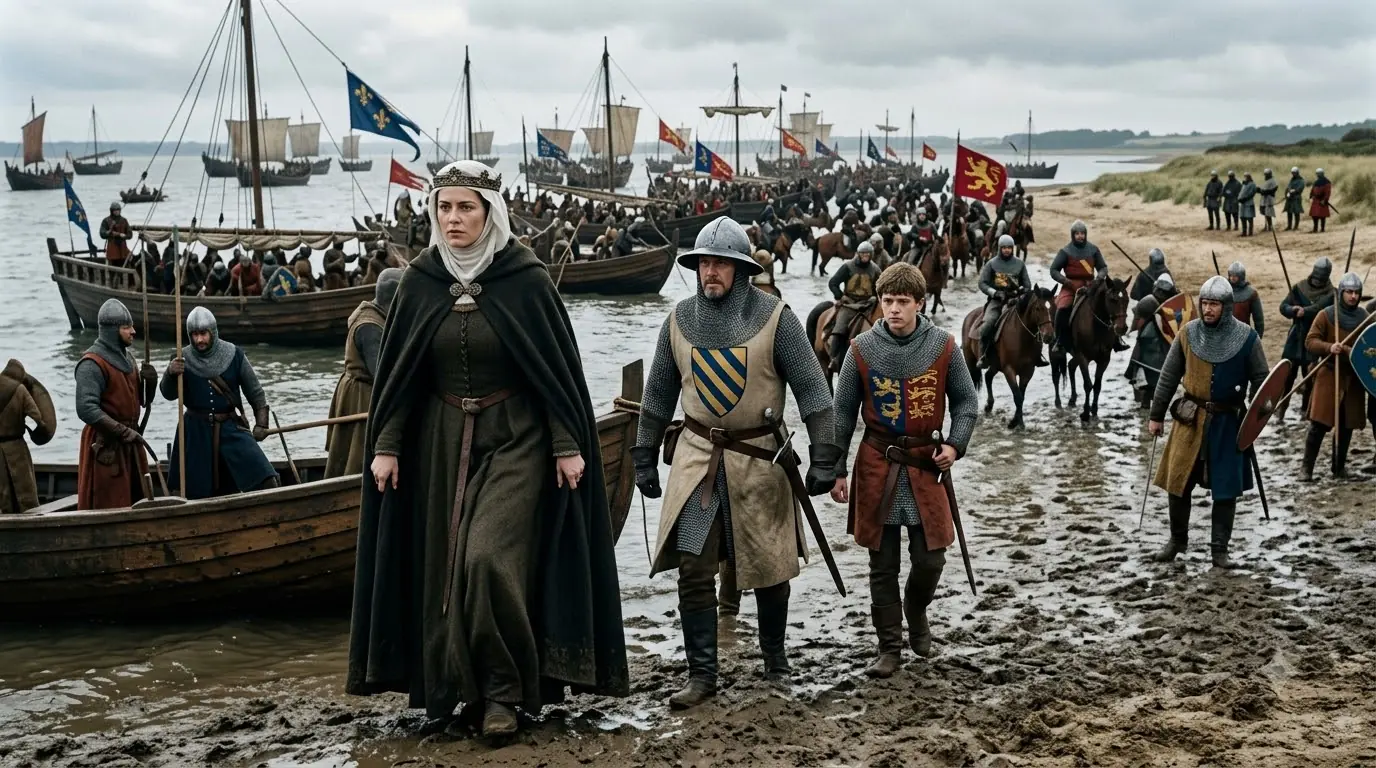
In September 1326, ships approached the English coast carrying a force that posed an extraordinary threat to King Edward II.
At the center of the invasion was not a foreign king seeking Edward’s crown. Nor was it simply another rebellious English baron.
It was Edward’s own wife.
Queen Isabella of France had returned to England prepared to destroy the political regime of the man she had married nearly two decades earlier. Beside her stood Roger Mortimer, one of Edward’s most dangerous enemies and a man who, by this point, was widely believed to be Isabella’s lover.
The invasion succeeded with remarkable speed. Support for Edward’s government crumbled. Edward fled west with his powerful favorite Hugh Despenser the Younger, but both men were eventually captured. Despenser was brutally executed. Edward was forced to surrender the throne, and his teenage son became King Edward III.
Then came an even darker chapter.
The former king was moved to Berkeley Castle, where he died in September 1327. The traditional account held that Edward had been murdered, although the circumstances of his death—and even some elements of the conventional narrative surrounding it—have remained subjects of historical debate.
The transformation was astonishing.
Isabella had entered England as Edward II’s young French bride in 1308. Eighteen years later, she returned at the head of an invasion that destroyed his government.
What had happened inside their marriage?
And what could have driven a medieval queen to take the extraordinary risk of turning against an anointed king who was also the father of her children?
A crucial part of the answer lies with another man.
His name was Hugh Despenser the Younger.
The Favorite Who Came Between a King and Queen
Edward II had long generated resentment through his relationships with royal favorites.
Early in his reign, the most notorious was Piers Gaveston. Edward recalled Gaveston almost immediately after becoming king and elevated him to Earl of Cornwall. His extraordinary access to the king infuriated powerful nobles, some of whom regarded Gaveston as exercising influence far beyond what his rank should have allowed.
The relationship became one of the defining political conflicts of Edward’s early reign.
Eventually, Gaveston’s enemies captured and killed him in 1312.
But Gaveston’s death did not solve Edward’s problem with favoritism.
Another figure eventually became even more politically dangerous: Hugh Despenser the Younger.
Despenser became royal chamberlain in 1318 and accumulated extraordinary influence with Edward. Contemporary and later sources have fueled speculation about the precise nature of Edward’s relationships with both Gaveston and Despenser, including whether they were sexual. That question cannot be established with certainty from the surviving evidence.
Politically, however, the important point is much clearer.
Despenser became exceptionally powerful.
English Heritage notes that chroniclers portrayed him almost as a “second king.” His appetite for lands, privileges and influence alienated members of the aristocracy, and his rise intensified the political instability already surrounding Edward’s monarchy.
The consequences were not confined to rival barons.
They reached the queen herself.
Isabella had been born into one of Europe’s most formidable royal families. The daughter of Philip IV of France and Joan of Navarre, she married Edward in January 1308 while still very young. English Heritage places her age at about 12 at the time of the marriage; Edward was roughly 11 years older.
The marriage fulfilled a diplomatic purpose, helping bind together two kingdoms whose interests repeatedly collided.
Isabella also fulfilled one of the central dynastic expectations placed upon a medieval queen: she produced an heir.
Her eldest son Edward was born at Windsor on November 13, 1312. He would eventually become Edward III.