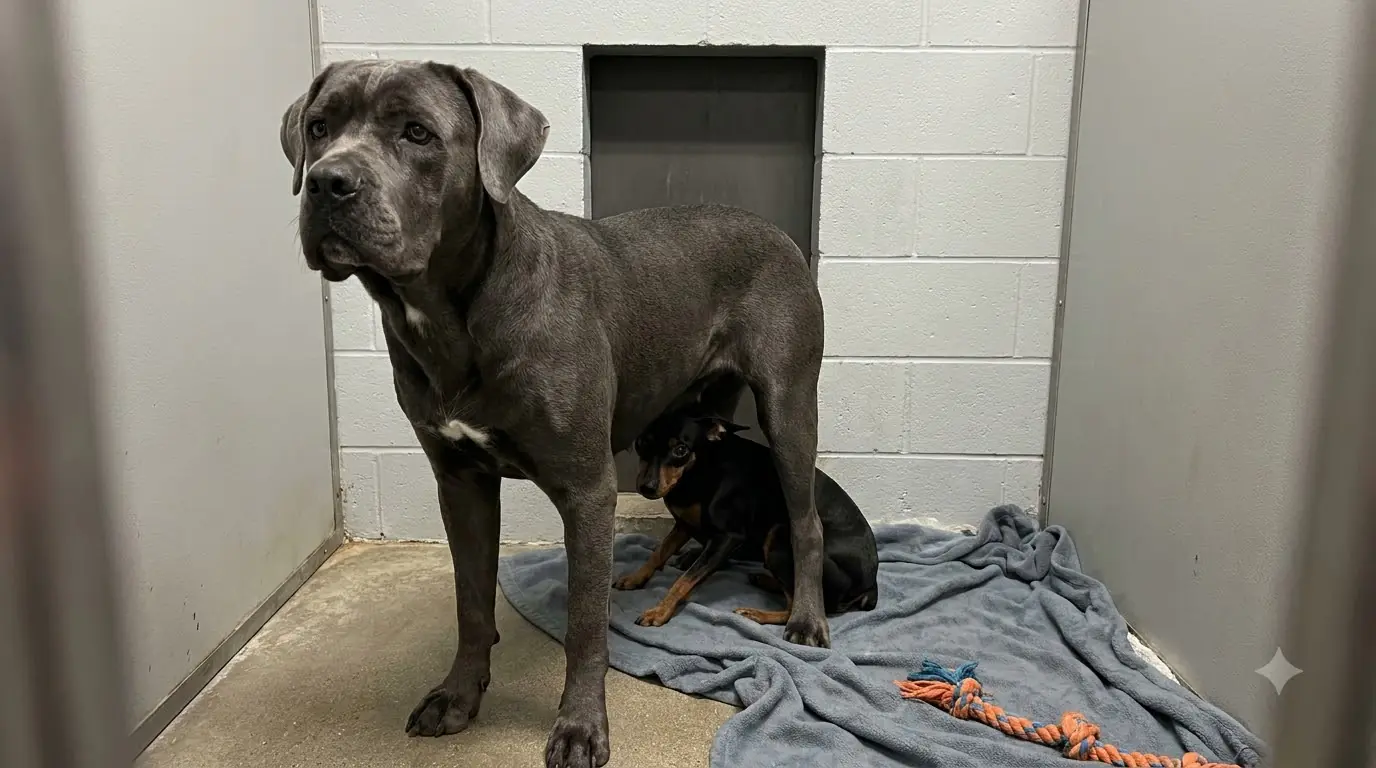
The first loud sound came from three kennels down.
A metal door slammed shut.
Several dogs barked at once.
The Miniature Pinscher reacted before anyone could reach him.
His body dropped lower.
His front legs bent.
His ears flattened.
Then the shaking started.
It moved through his entire frame.
Not a small tremble.
A rapid, visible vibration through his shoulders and hindquarters as he backed toward the corner of the kennel.
The Cane Corso had been standing near the center.
She turned immediately.
Not toward the noise.
Toward him.
She took two slow steps.
Then positioned herself between the smaller dog and the barred kennel door.
Her body blocked most of his view of the hallway.
The Miniature Pinscher moved forward.
Not toward the gate.
Toward her.
He slipped behind her front legs.
Pressed his chest against the inside of one foreleg.
Then lowered himself until nearly his entire body was hidden beneath the shadow of her chest.
The Cane Corso remained standing.
Broad shoulders facing the kennel door.
The smaller dog stayed behind her.
Within a minute, the trembling began to slow.
Staff noticed the sequence.
They saw it again later that afternoon.
And again the next morning.
Whenever the kennel row got loud, the Cane Corso moved first.
The Miniature Pinscher followed.
They Had Arrived Together After Their Owner Died
The pair entered the shelter under circumstances staff could verify clearly.
Their owner had died.
There was no dramatic abandonment story to invent.
No claim that someone had intentionally discarded them.
The household had changed suddenly because the person caring for both dogs was gone.
Relatives and available contacts were unable to provide a permanent placement.
So both dogs entered shelter care together.
They arrived on the same day.
In the same transport.
With the same limited history.
But they did not respond to the shelter in the same way.
The Cane Corso Watched
The Miniature Pinscher shook.
That difference was obvious from intake.
The Cane Corso was alert but comparatively composed.
She scanned the room.
Watched handlers.
Sniffed the floor.
Paused before walking through doorways.
Her body was not loose enough to call relaxed, but she could process the environment without shutting down.
The smaller dog struggled much more.
Metal sounds were especially difficult.
Kennel latches.
Doors.
Food pans.
Equipment striking bars.
Each sharp noise could cause him to freeze or retreat.
Sometimes the trembling began immediately.
Other times he ran toward the farthest corner first.
Staff Did Not Call Them Bonded Right Away
They had arrived together.
That was not enough.
Dogs from the same household can coexist without depending heavily on each other.
Others may have close relationships.
Staff needed behavior.
So they watched.
Did they choose proximity?
Did one become distressed when the other left?
Did they sleep together when separate beds were available?
Did they eat independently?
Did they compete for space?
Did one block the other from resources?
The pattern that emerged was specific.
The Miniature Pinscher repeatedly sought the Cane Corso during startling events.
The Cane Corso repeatedly allowed it.
And often positioned herself physically between him and whatever had triggered the reaction.
The First Night Made the Pattern Clearer
The kennel row quieted after evening care.
Both dogs had separate beds.
Separate bowls.
Enough room to lie apart.
The Cane Corso chose a mat near the front.
The Miniature Pinscher initially chose the rear corner.
When the building settled, he came forward.
He curled behind her shoulder.
Not on top of her.
Not underneath her.
Just close.
They slept that way for part of the night.
Then a door slammed somewhere in the building.
The little dog woke instantly.
The Cane Corso lifted her head.
The Miniature Pinscher pressed closer.
She shifted her body so her side faced him.
He tucked into the space behind her.
That was the first overnight example staff documented.
The Smaller Dog’s Fear Was Not Treated Like Disobedience
No one dragged him out of the corner.
No one forced him toward the bars.
No one punished the shaking.
Fearful behavior is not stubbornness.
The shelter used low-stress handling.
Quiet approach.
Sideways body posture.
Treats tossed rather than pushed into his face.
Time.
A place to retreat.
If he chose to remain behind the Cane Corso, staff allowed it as long as both dogs were safe.
The goal was to reduce fear.
Not prove that he could tolerate more.
The Cane Corso Was Not Asked to Become His Therapy Dog
That distinction mattered.
Her calming effect was useful.
It was not her job to carry the entire emotional burden of the smaller dog's shelter experience.
She had her own needs.
Her own medical examination.
Her own stress.
Her own need for walks, enrichment, rest, and individual handling.
Staff wanted to preserve the relationship without turning one dog into a permanent caretaker.
That meant both dogs needed some independence.
Separate Medical Exams Came First
The Cane Corso was examined on her own.
Weight.
Heart and lungs.
Joints.
Skin.
Teeth.
Ears.
General senior or adult health depending on age.
The Miniature Pinscher received his own assessment too.
Because trembling can come from fear, cold, pain, metabolic illness, neurologic disease, or other causes, staff did not automatically assume every shake was purely behavioral.
His physical examination did not reveal a clear medical cause that explained the pattern.
The trembling occurred most reliably around loud environmental triggers and decreased when the environment calmed or when he settled near the Cane Corso.
That supported a fear response.
The Shelter Became a Trigger Map
Metal doors.
High-pitched barking.
Carts.
Sudden footsteps.
The Miniature Pinscher reacted most strongly to abrupt noise.
Lower continuous sounds were easier.
A person talking quietly nearby.
Ventilation.
Soft radio in the staff area.
Those did not produce the same response.
This gave the team something practical to work with.
Reduce the sharp noises where possible.
Warn before opening doors.
Avoid slamming latches.
Create a quieter resting area.
The Cane Corso Learned the Pattern Too
At least behaviorally, it looked that way.
A door slammed.
Her head came up.
Sometimes she looked toward the Miniature Pinscher before he had fully retreated.
Then she moved.
Not always.
But often enough that staff noticed consistency.
She would step toward the kennel front and stand there.
The smaller dog came behind her.
That position became their repeated response.
Her Size Made the Contrast Strong
A Cane Corso has a large, powerful frame.
Broad chest.
Heavy shoulders.
Substantial height over a Miniature Pinscher.
The little dog could nearly disappear behind her legs.
That visual contrast made the behavior easy to notice.
But staff did not want the emotion to come only from size difference.
They watched the actual sequence.
Noise.
Small dog retreats.
Large dog repositions.
Small dog presses in behind.
Trembling slows.
That was the behavior.
She Did Not Growl at the Hallway
That was important.
Her positioning was not accompanied by repeated lunging or aggressive display toward people.
She did not throw herself at the gate.
She did not bark every time she stepped in front.
Often she simply stood.
Body between the smaller dog and the bars.
That helped staff interpret the behavior as proximity and blocking rather than clear protective aggression.
Still, a large guardian breed in a stressful environment required careful handling.
No romanticizing.
No assumptions.
The Miniature Pinscher Began Using Her as a Visual Barrier
That became clear when staff changed the kennel setup.
A covered retreat box was added.
Soft bedding inside.
A place where the little dog could hide from visual and acoustic stimulation.
He used it sometimes.
But during certain loud episodes, he still left the box and moved behind the Cane Corso instead.
That told staff her presence was doing something the box alone did not.
The box reduced exposure.
The Cane Corso added familiar social proximity.
Staff Did Not Remove That Support
There was no reason to.
If her presence reduced distress safely, keeping them together during the early shelter period made sense.
But staff also began short individual sessions.
Not forced separations.
Brief, structured experiences.
Could the Miniature Pinscher remain in the kennel while the Cane Corso went for a short walk?
Could he eat?
Could he settle?
Could she walk without constantly pulling back toward him?
Those observations would help determine how dependent they truly were.
The First Separation Was Difficult for Him
The Cane Corso left with a handler.
The Miniature Pinscher watched the door.
For several seconds, he stood frozen.
Then the shaking started.
He retreated into the covered bed.
Staff did not flood him with attention.
They sat nearby.
Tossed a high-value treat.
Waited.
He did not eat immediately.
After several minutes, he sniffed.
Eventually took the treat.
When the Cane Corso returned, he emerged quickly.
That response supported the idea that her presence was significant.
The Cane Corso Handled Separation Better
On her individual walk, she looked back toward the kennel initially.
Then engaged with the handler.
Sniffed outside.
Accepted treats.
Moved through the environment.
That was useful.
She was socially connected to the smaller dog.
She was not unable to function without him.
That meant staff could protect her independence while continuing to support his confidence.
The Second Separation Was Slightly Easier
Same structure.
Short duration.
Miniature Pinscher remained in his covered bed at first.
This time, he accepted food sooner.
A quiet caregiver sat several feet away.
He watched.
No one pulled him out.
By the time the Cane Corso returned, he was resting rather than standing and shaking.
Small improvement.
Staff Wanted More Than “He Calms Down When She’s There”
The long-term goal had to include coping skills that did not depend completely on one dog.
A foster home.
A veterinary visit.
Transport.
Temporary separation.
Any of those could happen.
The Miniature Pinscher needed other reliable supports.
Covered spaces.
Predictable people.
Visual cues.