Which Dream Bedroom Would You Choose Tonight?
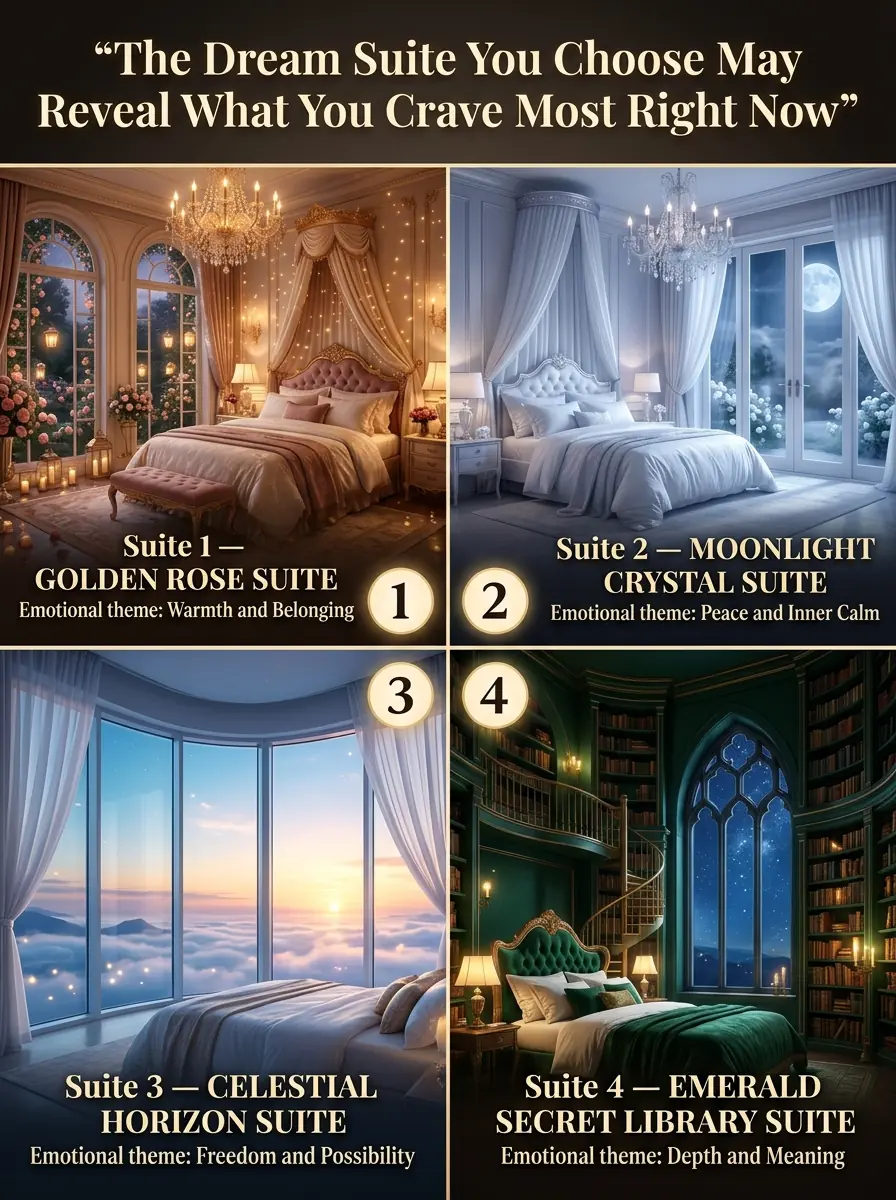
Imagine for a moment that there is nothing you have to do.
No appointment waiting tomorrow morning.
No phone call you need to return.
No one asking where you are.
No list sitting on the kitchen counter.
You simply have a quiet evening ahead of you, and you can choose one of four beautiful rooms to spend it in.
Which one feels right?
For many people, the answer comes surprisingly quickly.
And while a choice like this cannot define your personality or explain everything about you, the kinds of spaces we are drawn to can reflect something meaningful about what feels comforting, restorative, or emotionally important to us right now.
That becomes especially interesting later in life.
When you are younger, you often choose spaces based on excitement, trends, convenience, or what you imagine other people will admire.
Over time, that tends to change.
You begin caring more about how a place makes you feel.
Does it calm you?
Does it remind you of home?
Does it make you breathe a little deeper?
Does it make you imagine a different kind of life?
Does it give your mind somewhere pleasant to wander?
Sometimes the room we want most is not really about furniture at all.
It is about what we want to feel inside it.
If one of these four bedrooms immediately pulled you in, read the result that matches your choice.
BEDROOM 1: FAMILIARITY
If you chose Bedroom 1, the comfort you may be craving most right now is familiarity.
This room probably did not attract you because it looked unusual.
It attracted you because something about it felt known.
The warm light.
The wooden furniture.
The soft bedding.
The familiar details.
The feeling that someone has actually lived there.
It may have reminded you of a home you once knew, a room from another time in your life, or simply the kind of place where you could imagine closing the door and immediately feeling settled.
That feeling can become surprisingly important as we get older.
After enough years, many people discover that comfort is not always about having something new.
Sometimes it is exactly the opposite.
Comfort can be knowing where everything is.
It can be sitting in the same chair every evening.
It can be drinking coffee from the mug you always reach for.
It can be making a recipe you have cooked for decades without needing to measure anything.
It can be sleeping under a quilt that reminds you of someone.
If Bedroom 1 was your choice, you may be someone who understands the emotional value of familiar things.
That does not mean you are afraid of change.
It may simply mean that you no longer feel the need to replace things just because they are old.
You know the difference between outdated and meaningful.
You may also place a lot of value on continuity.
Family traditions.
Holiday routines.
Recipes.
Objects with stories.
Places that carry memories.
People who have known you long enough that you do not need to explain your entire history.
There is comfort in being known.
And there is comfort in knowing where you belong.
People drawn to this kind of room often have a strong emotional relationship with home.
Home may not necessarily mean one specific house.
It may be a feeling.
The sound of dishes in the kitchen.
A lamp glowing in the evening.
A familiar television program in the background.
Someone walking through the hallway.
The smell of dinner.
A dog asleep nearby.
A photograph that has been sitting in the same place for twenty years.
Those ordinary details can become more valuable with time.
When we are young, we often assume that ordinary things will always be there.
Later, we realize how much of life changes.
Children grow up.
Parents are gone.
Friends move away.
Houses are sold.
Neighborhoods change.
The family table may not be as crowded as it used to be.
That is when familiar comforts can take on deeper meaning.
They become little anchors.
They remind us who we are and where we have been.
If you chose this bedroom, you may be craving more of that grounded feeling right now.
Maybe life has changed recently.
Maybe the world outside feels faster than you want it to.
Maybe you are simply at a point where you appreciate things that feel genuine more than things designed to impress.
There is nothing wrong with that.
In fact, there is wisdom in knowing what makes you feel safe and settled.
The challenge is making sure familiarity remains comforting rather than limiting.
Sometimes we keep routines simply because they are routines.
We keep objects because they have always been there.
We avoid new experiences because the familiar feels safer.
But the healthiest kind of familiarity gives you a strong home base without closing the door on what is still ahead.
You can love your traditions and still make new memories.
You can treasure the past without trying to live inside it.
You can keep the things that matter while letting go of the things that no longer serve you.
If Bedroom 1 felt right, your heart may simply be saying:
Give me warmth.
Give me something real.
Give me a place where I do not have to perform.
Give me a little more of what feels like home.
And perhaps that is one of the most honest kinds of comfort there is.
BEDROOM 2: PEACE
If you chose Bedroom 2, the comfort you may be craving most right now is peace.
You probably noticed the quietness of this room before anything else.
The pale colors.
The soft bedding.
The moonlight.
The uncluttered space.
The feeling that nothing inside it was asking anything from you.
That may be exactly why you chose it.
For many people, peace becomes much more valuable later in life.
There was probably a time when being busy felt normal.
Maybe you worked long hours.
Maybe you raised children.
Maybe you managed a household, cared for parents, kept appointments, solved problems, paid bills, answered phones, handled emergencies, and carried responsibilities most people never saw.
For years, your mind may have always been somewhere else.
What needs to happen next?
Who needs me?
What did I forget?
What problem still needs solving?
And then eventually something changes.
You begin wanting moments where absolutely nothing needs solving.
If Bedroom 2 was your choice, you may be at that point.
Peace may look different for you now.
It may be waking up before the rest of the world.
It may be turning off the television.
It may be sitting near a window with coffee.
It may be telling someone, “Not today.”
It may be deciding that an argument is not worth your evening.
It may be leaving the phone in another room.
It may simply be knowing that no one is upset with you and nothing urgent is waiting.
Those moments can feel incredibly valuable.
People sometimes mistake peace for boredom.
But after enough life experience, the two feel very different.
Boredom leaves you restless.
Peace leaves you settled.
Peace is not having nothing in your life.
It is having less of what constantly disturbs it.
If you chose this room, you may have become especially sensitive to emotional noise.
You probably notice when someone brings unnecessary tension into a room.
You may feel exhausted by constant complaining, arguments, gossip, pressure, or people who make everything more complicated than it needs to be.
That does not make you antisocial.
It may simply mean you have learned the cost of emotional chaos.
You may also be less willing to sacrifice your peace simply to keep everyone else comfortable.
That is something many people learn slowly.
For years, we say yes because we do not want to disappoint anyone.
We explain decisions that really do not require an explanation.
We allow people to interrupt our time because we feel guilty protecting it.
We carry worries that belong to other adults.
Eventually, some people reach a point where they say:
I cannot keep doing this to myself.
That is often when life becomes lighter.
If Bedroom 2 was your choice, perhaps what you want most right now is not a dramatic change.
You may simply want fewer things pulling on you.
A cleaner schedule.
A quieter home.
Simpler relationships.
More time to think.
Better sleep.
Less conflict.
Those may sound like small things.
They are not.
They shape how your entire day feels.
There is one caution, though.
People who discover the value of peace sometimes begin protecting it so strongly that they also keep life at a distance.
A peaceful evening is wonderful.
A peaceful month without seeing anyone you care about may feel different.
Quiet can heal.
Too much isolation can slowly become loneliness.
The goal is not to remove yourself from life.
It is to create enough calm that you can actually enjoy it.
If Bedroom 2 called to you, perhaps what you need is permission to stop treating peace as something you earn only after everything else is finished.
Everything will never be finished.
There will always be another task.
Another concern.
Another opinion.
Another thing someone thinks you should be doing.
At some point, peace has to become something you choose.
And maybe your choice of this room is a small reminder of that.
BEDROOM 3: FREEDOM
If you chose Bedroom 3, the comfort you may be craving most right now is freedom.
You probably noticed the view immediately.
The wide windows.
The horizon.
The open air.
The feeling that the room was connected to something larger beyond its walls.
Unlike the first two rooms, this one may not have felt like a place to hide away.
It may have felt like a place from which something could begin.
That distinction matters.
People often assume that comfort means staying still.
But for some people, comfort comes from knowing they still have choices.
If Bedroom 3 was your choice, that may describe you.
You may want to know that life still contains possibility.
That there are places you have not seen.
Meals you have not tried.
Roads you have not driven.
People you have not met.
Mornings you have not experienced yet.
That feeling can become especially powerful after years of responsibility.
Think about how much of adult life is shaped by obligation.
You work because you have to.
You live near a certain place because the job is there.
You plan vacations around school calendars.
You spend money carefully because other people depend on you.
You arrange your time around schedules you did not create.
For many people, those years can last decades.
Then one day, life opens a little.
And a question appears:
What do I actually want?
That question can feel surprisingly unfamiliar.
If Bedroom 3 drew you in, you may be entering a stage where you want to answer it more honestly.
Freedom does not necessarily mean selling everything and traveling the world.
It can be much smaller than that.
Freedom can be waking up and deciding what you want to do with the morning.
It can be taking the long way home.
It can be booking a trip without needing to coordinate five schedules.
It can be joining a class because the subject interests you.
It can be spending an afternoon outside rather than cleaning something that can wait.
It can be saying no to an invitation and not inventing an excuse.
It can be changing your mind.
The common thread is choice.
People who choose this kind of room often care deeply about preserving that feeling.
You may dislike being micromanaged.
You may become frustrated when others assume they know what is best for you simply because of your age.
You may resist the idea that reaching a certain birthday means your world should automatically become smaller.
And perhaps it should not.
There is no rule saying curiosity belongs only to the young.
In fact, freedom can become more meaningful later because you understand its value.
You know time is not endless.
That can make experiences feel more precious rather than less worthwhile.
You may also find yourself becoming less interested in other people's expectations.
Earlier in life, it is easy to wonder:
What will people think?
Later, a different question often becomes more important:
Will I be glad I did it?
That shift can be incredibly freeing.
Of course, freedom has a challenge too.
Sometimes we imagine that changing the scenery will automatically change how we feel.
It does not always work that way.
A beautiful view cannot solve every worry.
A trip cannot replace meaningful relationships.
And independence does not mean refusing help when help would make life better.
Real freedom is not running away from everything.
It is having enough agency to decide what deserves a place in your life.
If Bedroom 3 was your choice, perhaps you are craving that sense of agency right now.
More room.
More light.
More options.
More reasons to look forward instead of only backward.
There is something hopeful about that.
It means part of you is still asking:
What else might be possible?
That is a wonderful question at any age.
BEDROOM 4: DEPTH
If you chose Bedroom 4, the comfort you may be craving most right now is depth.
This room probably felt different from the others.
It may have seemed richer.
Quieter in another way.
Perhaps the books caught your attention.
Perhaps it was the warm lamps, darker colors, or the feeling that you could spend hours there without needing entertainment from anyone else.
It looked like a place built not just for sleeping, but for thinking.
If this was your choice, you may be craving more meaningful experiences rather than simply more experiences.
There is an important difference.
As people get older, some become less interested in quantity.
They do not need ten acquaintances when two real friends will do.
They do not need a hundred television channels if one good book can hold their attention.
They do not need every weekend filled if one meaningful conversation makes the week memorable.
If Bedroom 4 spoke to you, you may understand this instinctively.
You probably value substance.
You may enjoy conversation that moves beyond small talk.
You may appreciate history, books, music, faith, art, family stories, or subjects that give you something to think about long after the moment ends.
You may also spend more time reflecting on your own life.
What mattered?
What did I learn?
What would I do differently?
What turned out to matter far less than I once thought?
What do I still want to understand?
Those questions are not signs that you are living in the past.
They can be signs that you are integrating it.
That is something human beings naturally do.
We take decades of experiences and slowly turn them into perspective.
And perspective can be one of the greatest gifts of age.
If you chose this room, you may also place increasing value on your inner life.
Perhaps you no longer need constant activity.
You may enjoy reading alone.
Listening to music.
Looking through old photographs.
Writing.
Working on a hobby.
Sitting in a church.
Thinking.
Remembering.
These activities can look quiet from the outside.
Inside, a lot may be happening.
There is also something else that often comes with depth: discernment.
You may have become more selective about what deserves your attention.
A dramatic argument may once have consumed an entire evening.
Now you may see it for what it is and move on.
A person who tries to impress everyone may no longer impress you very much.
You may care more about sincerity, consistency, and character than appearances.
That kind of perspective is earned.
The challenge is that reflective people can sometimes become too inward.
It is possible to spend so much time thinking about life that you forget to keep living it.
Meaning is valuable.
But meaning is not only found in reflection.
Sometimes it arrives unexpectedly through a new friendship, a trip, a silly conversation, a grandchild's question, or an ordinary afternoon you were not trying to make profound.
Depth does not require seriousness all the time.
Some of the deepest parts of life are surprisingly simple.
If Bedroom 4 was your choice, perhaps what you want most right now is a life with more substance in it.
Less noise.
Less superficiality.
More beauty.
More thought.
More conversations that matter.
More time with the things that feed your mind or spirit.
That kind of comfort is different from merely resting.
It is the comfort of feeling connected to something meaningful.
WHAT YOUR BEDROOM CHOICE MAY REALLY REFLECT
The four rooms were very different.
Yet each represents a kind of comfort most people need at one time or another.
Familiarity.
Peace.
Freedom.
Depth.
The interesting question is not whether one is better than another.
It is why one felt right to you today.
If you chose Bedroom 1, you may be longing for warmth, familiarity, and the comforting feeling of home.
If you chose Bedroom 2, your mind may be asking for more quiet, rest, and protection from unnecessary noise.
If you chose Bedroom 3, you may want more openness, choice, and reminders that there are still new things ahead.
If you chose Bedroom 4, you may be craving more meaning, reflection, beauty, and substance.
You may even find that your answer would have been different ten years ago.
That is part of what makes these choices interesting.
We change.
What we need changes.
What once excited us may no longer matter very much.
Things we once overlooked may become precious.
A quiet morning.
A comfortable house.
Good health.
A familiar voice.
Freedom over your own schedule.
A book you cannot put down.
Dinner with someone you love.
An evening with nowhere else to be.
Later in life, comfort often becomes less about luxury and more about alignment.
Does this life feel like mine?
Does this place allow me to breathe?
Do these people bring me peace?
Am I spending my time in ways that still feel meaningful?
Those questions can tell you much more than the price of anything in the room.
And perhaps that is the real meaning behind your choice.
The room you selected may not be the room you literally want to sleep in.
It may represent a feeling you want more of when you wake up.
And once you recognize that feeling, you can begin finding small ways to bring more of it into your actual life.
If you chose familiarity, perhaps call someone who makes you feel at home.
If you chose peace, protect one quiet hour this week.
If you chose freedom, do one thing simply because you want to.
If you chose depth, spend time with something that feeds your mind instead of merely filling time.
It does not have to be dramatic.
Often, the best changes are not.
They simply make life feel a little more like your own.
And now there is another choice that may reveal something entirely different:
If you could walk outside this bedroom and discover one secret garden waiting for you, which one would you enter first?