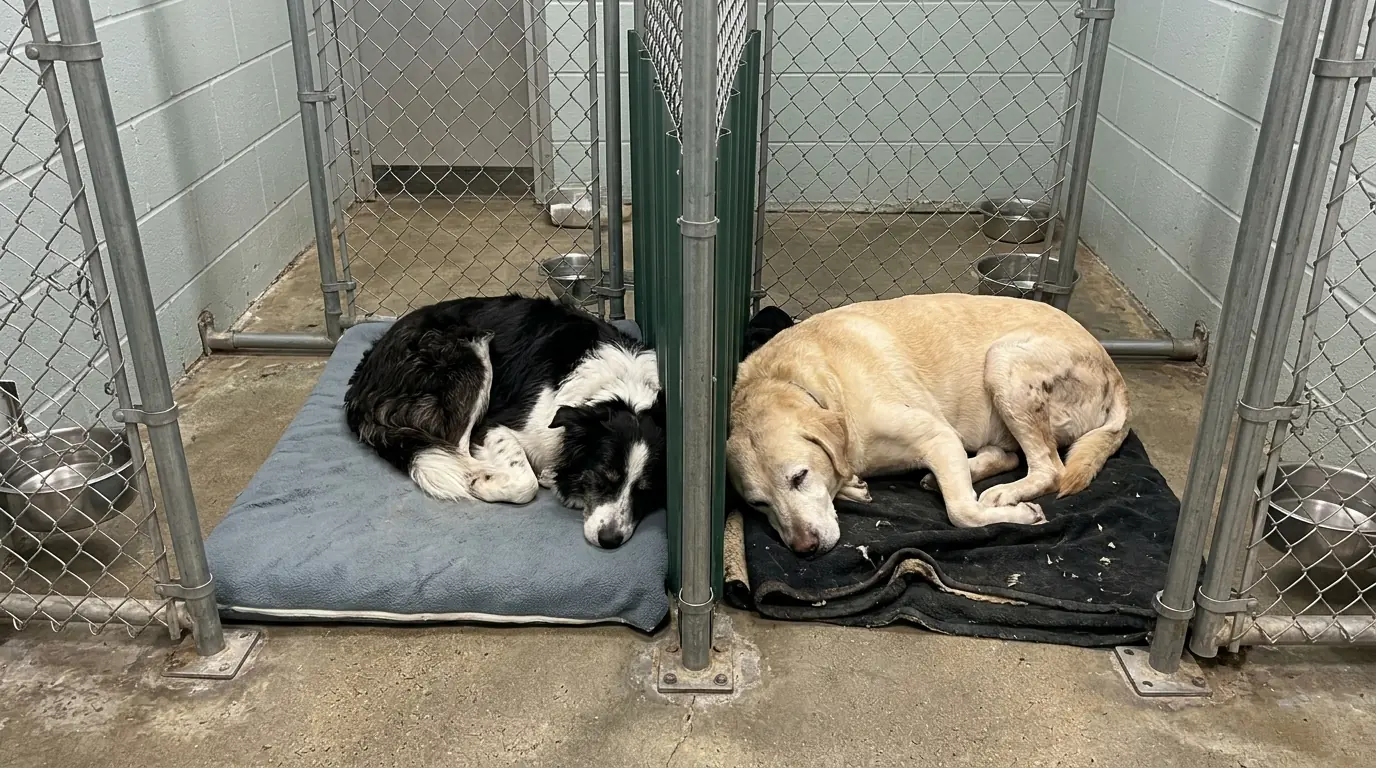
Every evening, Maggie begins moving her bed.
The six-year-old Border Collie mix lowers her head, presses her nose against the edge of the thin kennel mattress, and pushes.
It moves only a few inches.
She stops, changes position, and pushes again.
Little by little, Maggie works the bed across her recovery run until it reaches one particular wall—the divider separating her kennel from the one next door.
Then she lies down.
But she doesn’t settle in the middle of the mattress. Maggie presses her back against the wall and curls up along its edge, almost as if she has chosen the least comfortable part of the bed on purpose.
On the other side of that wall is Duke.
Duke is an 11-year-old Labrador Retriever with significant weakness in his hind legs. And when shelter staff began paying closer attention to Maggie’s strange nightly routine, they noticed something that made the location of her bed much harder to dismiss as coincidence.
Duke often slept against that very same wall.
They Arrived Together, but Needed Different Care
Maggie and Duke had been brought into the shelter together.
Although they were accustomed to being around one another, their physical needs were very different.
Maggie was younger and considerably more mobile. Duke, however, was a senior dog whose hind-end weakness immediately required closer attention.
At 11 years old, mobility problems can have many possible causes in a Labrador Retriever, including arthritis, muscle loss, orthopedic disease, or neurological problems. Shelter staff could see the practical consequence even before every underlying question had been answered: Duke had difficulty supporting himself for long periods.
Getting up took effort.
Turning around inside the kennel required more careful footing than it would for a younger dog. If he stood for too long, his back legs could become unsteady.
That meant Duke needed a recovery space where staff could monitor his movement, keep his floor as safe as possible, and make sure essentials such as water and bedding were within easy reach.
Maggie did not require the same degree of mobility support.
But separating the two dogs completely introduced another consideration.
They had arrived together, and staff could observe that they remained highly aware of one another.
So whenever the shelter setup allowed it, Maggie and Duke were housed in neighboring recovery runs.
They could not simply share one kennel without staff considering Duke’s physical limitations. An accidental bump, an excited movement, or competition around a doorway could make things more difficult for a dog already struggling to stay steady.
Side-by-side runs offered a compromise.
They were physically separated.
But they were still close.