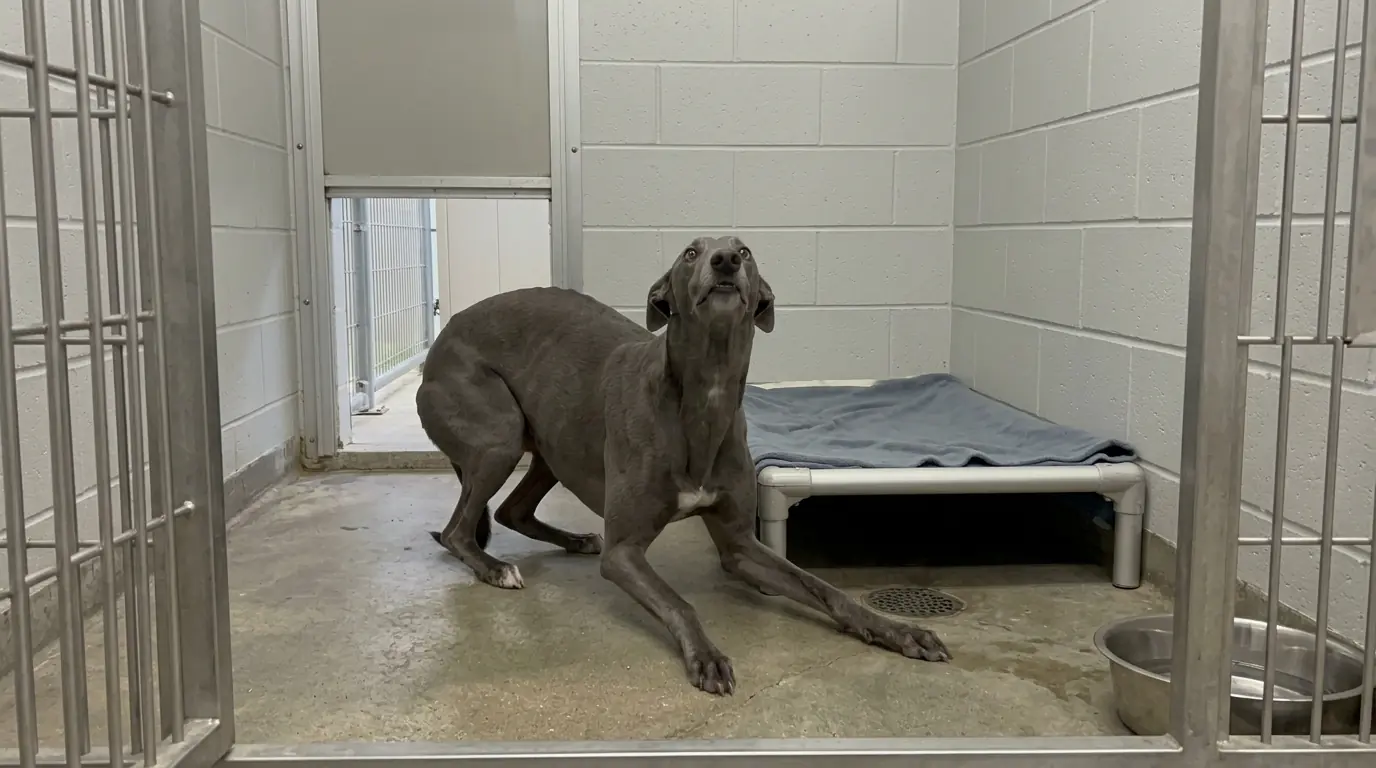
Outside, Willow looks like a different dog.
The five-year-old Greyhound walks slowly around the outdoor run.
She sniffs along the fence.
She stretches her long legs across the concrete.
When she becomes tired, she lies down without hesitation.
Her muscles loosen.
Her head settles between her front paws.
Nothing about her posture suggests that she is preparing to escape.
Then the door to the indoor kennel opens.
Willow walks inside.
There is a roof above her now.
Within seconds, her body changes.
Her back drops.
Her legs bend.
She looks toward the ceiling.
Then Willow begins moving around the perimeter of the kennel with her shoulder close to the wall.
One circle becomes another.
Her pace increases.
She looks up again.
Finally, Willow drops even lower and squeezes herself beneath the raised cot.
She stays there until the outdoor door opens again.
Only then does she crawl back out.
The Difference Between Indoors and Outdoors Is Immediate
Willow does not need several minutes inside before becoming uncomfortable.
The change can begin almost as soon as she crosses the threshold.
Outside, her head is carried normally.
Inside, it lowers.
Outside, she crosses open space.
Inside, she follows the walls.
Outside, she lies wherever she chooses.
Inside, she searches for cover beneath a bed.
That contrast gives caregivers an unusually clear behavioral pattern to investigate.
There Is No Obvious Injury Explaining It
Willow has been examined for physical problems that might make movement inside the kennel difficult.
Nothing obvious has explained the dramatic difference.
She can walk.
She can run.
She can lie down.
She can turn normally.
And she demonstrates those abilities readily outdoors.
That does not mean medical causes should be permanently dismissed.
But it shifts attention toward something about the indoor environment itself.
Willow Always Looks Up
That may be the most important detail.
She enters.
Her body lowers.
Then her eyes move toward the ceiling.
Sometimes she stops completely while looking upward.
Only afterward does the circling begin.
Whatever is bothering Willow may not simply be the kennel floor, the doorway, or being enclosed by walls.
Something overhead appears to matter.
A Ceiling Contains More Than a Flat Surface
From a dog's perspective, an indoor ceiling can come with many environmental differences.
Lights may hum.
Ventilation equipment may vibrate.
Shadows move differently.
Sound echoes.
Pipes can click.
Air vents can turn on unexpectedly.
Objects outside the kennel may produce noises that seem to come from overhead.
Even subtle differences that humans barely notice can be significant to an individual dog.
Willow cannot explain which one matters.
So caregivers have to observe.